

An AI-ready data infrastructure roadmap is a phased plan for assessing existing data systems, designing scalable data architecture, connecting fragmented data sources, and establishing governance controls. Enterprises should prioritize high-value business use cases, improve data quality and accessibility, and build reliable infrastructure before expanding AI applications across business operations.
Despite growing AI adoption, many enterprises still struggle to translate experimentation into measurable business results. One underlying challenge is whether existing data systems can provide the reliable, accessible, and timely information required by production AI applications.
For business and technology leaders, the real problem is rarely model capability, it is how to sequence infrastructure investments without disrupting daily operations. Replacing legacy ERP, CRM, and database systems all at once can lead to lengthy implementation cycles and high costs. Meanwhile, building separate data connections for individual AI pilots creates duplicated work, inconsistent data management, and additional security risks.
Key takeaways
- Start with three to five high-impact business use cases and build reusable data pipelines around them instead of attempting an immediate, company-wide platform overhaul.
- A centralized lakehouse simplifies compliance and maintenance for unified teams, while a federated or hybrid model fits multi-unit enterprises that need faster local execution.
- Granular access controls, data lineage, and real-time quality checks must be operational before connecting proprietary records to generative AI or autonomous workflows.
- According to Kyanon Digital practitioners, enterprises avoid wasted cloud and storage spend when data engineering investments are gated by specific business decisions rather than speculative capacity upgrades.
- Engage a partner such as Kyanon Digital when your roadmap requires connecting legacy core systems, cloud modernization, and production AI engineering under one phased delivery framework.
Further reading:
- Hire Data Engineers for scalable, AI-ready data platforms
- AI in Business: What It Is, Why It Matters, and How to Use It
- AI-Driven Retail Analytics: From Data to Decisions
What are the essential components of an AI-ready data infrastructure?
Data architecture defines how enterprise data is structured, connected, and governed, while data infrastructure provides the underlying systems and technologies that make this architecture operational. An AI-ready data infrastructure builds on this foundation by supporting scalable storage, continuous data integration, secure access, and reliable data delivery for machine learning and generative AI workloads.
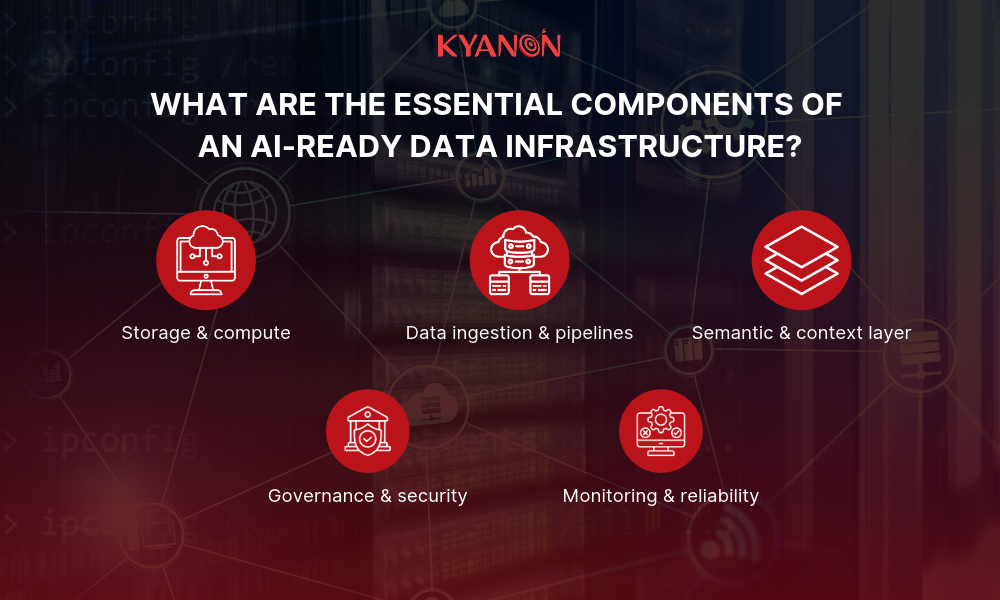
Before approving infrastructure budgets, business and technology leaders should evaluate five core components against the operational demands of their target AI workloads:
|
Infrastructure layer |
Traditional data infrastructure | AI-ready data infrastructure | When to prioritize |
| Storage & compute | Relational databases and data warehouses for structured data and reporting. | Scalable storage and computing resources for diverse data and AI workloads. |
When existing systems struggle to handle growing data volumes or AI workloads. |
|
Data ingestion & pipelines |
Batch processing that updates data at scheduled intervals. | Batch and real-time pipelines that connect and update data across systems. | When AI applications require timely data from multiple sources. |
| Semantic & context layer | Basic data dictionaries and manually maintained metadata. | Shared data definitions, metadata catalogs, and AI search capabilities. |
When AI applications need to understand and retrieve information across business systems. |
|
Governance & security |
Basic access permissions and manually managed data policies. | Automated access controls, data protection, and data lineage tracking. | When handling sensitive business, customer, or financial data. |
| Monitoring & reliability | Basic system monitoring and periodic data checks. | Continuous monitoring of data quality, pipeline performance, and AI outputs. |
Before deploying AI applications into critical business workflows. |
A centralized architecture can simplify governance and reduce duplicated infrastructure when enterprise data is managed by a shared central team. However, organizations with multiple business units and independent data teams may benefit from a hybrid or federated model, provided they maintain common data standards and access policies.
Data leaders must move away from static repository management toward a continuous, use-case-driven practice that aligns, qualifies, and governs business context across the entire AI lifecycle. Without a shared semantic and context layer, every new AI application forces engineering teams to manually re-map what fields mean across disconnected systems.

How should enterprises embed security, governance, and data quality?
Security, governance, and data quality must be built directly into automated data pipelines rather than handled through manual reviews after data is collected. When an AI copilot or automated agent queries unverified or overly broad datasets, inaccurate figures or restricted records propagate immediately into business decisions and customer interactions.
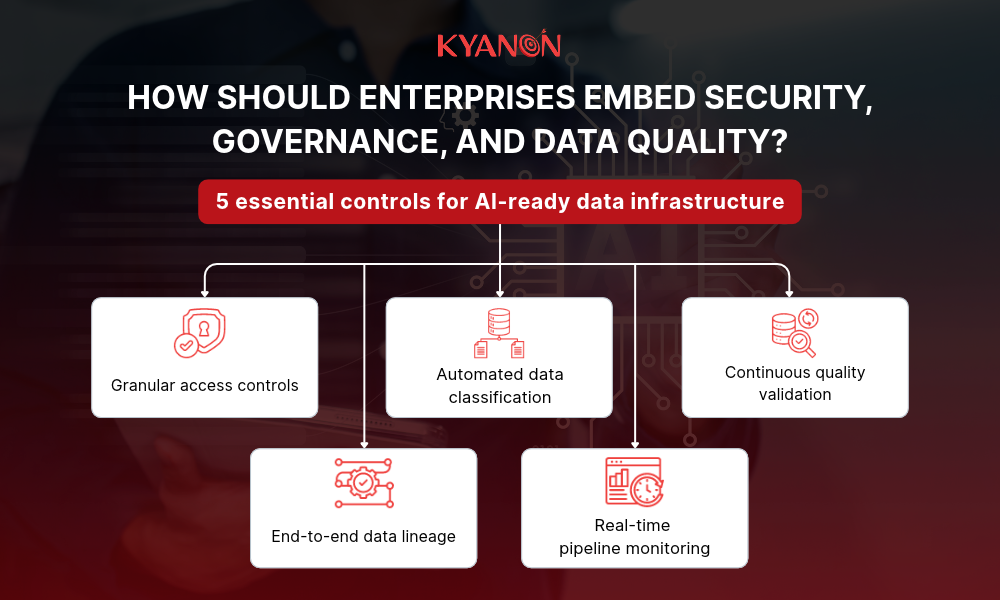
To prevent operational errors and compliance breaches, enterprises should operationalize five technical controls before scaling AI across departments:
- Granular access controls: Enforce role-based (RBAC) and attribute-based access controls (ABAC) so retrieval pipelines verify a user’s exact permissions at query time, ensuring an AI assistant never surfaces confidential HR or financial records to unauthorized staff.
- Automated data classification and retention: Tag sensitive records, such as personally identifiable information (PII) and commercial contracts, at ingestion to apply encryption, data masking, and retention policies across storage systems and AI applications.
- Continuous quality validation: Embed automated schema checks, completeness thresholds, and anomaly alerts into data pipelines to identify and isolate incomplete or inconsistent records before they affect AI outputs.
- End-to-end data lineage: Track where data comes from and how it has been processed so teams can verify AI-generated information.
- Real-time pipeline and output observability: Monitor data freshness, unexpected changes, and system response times so teams detect silent degradation before operational performance drops.
In enterprise modernization projects, improving data accessibility and consistency is often more important than simply expanding storage capacity. Enterprises need clear data ownership, standardized integration processes, and automated quality controls to ensure AI applications can access reliable information.
When legacy databases suffer from undocumented schemas, duplicate customer identities, or inconsistent permissions, resolving those integration bottlenecks must come before model deployment. For organizations working through fragmented core systems, working with a partner that provides enterprise data strategy, architecture, and augmentation services helps establish automated quality gates and unified pipelines before scaling AI investments.
How can enterprises build an AI-ready data infrastructure roadmap?
Enterprises can build an AI-ready data infrastructure roadmap through four phases over an indicative 12-to-18-month period. Each phase addresses a specific priority, from understanding existing data limitations to deploying reliable infrastructure that supports production AI applications.
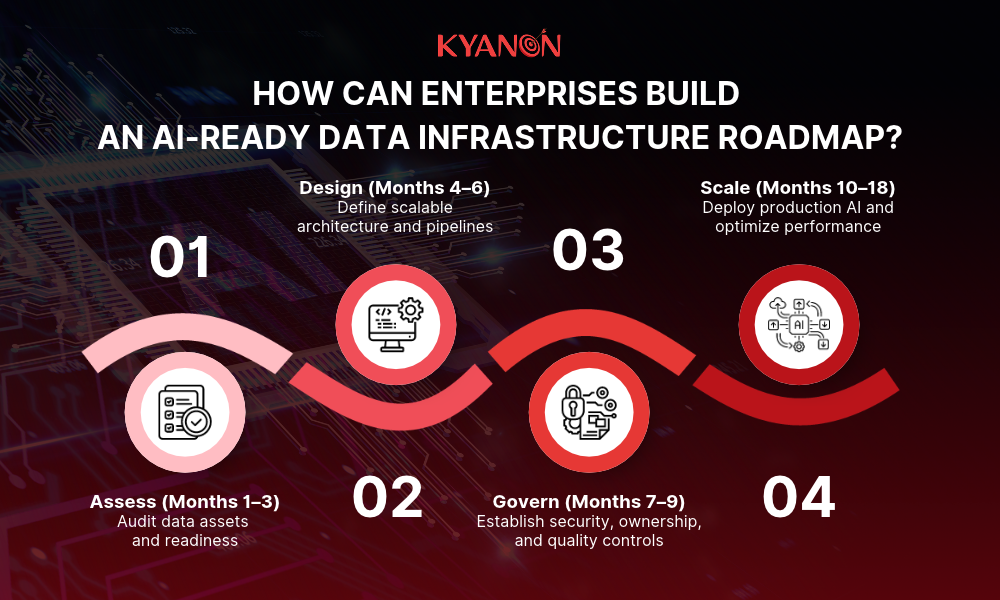
Phase 1: Assess data readiness (Months 1–3)
Phase 1 establishes a clear baseline of current data assets, system bottlenecks, and regulatory requirements before committing capital to new cloud platforms or AI licenses.
- Core activities: Audit structured databases, unstructured document repositories, and underutilized dark data across business units; map integration dependencies across ERP, CRM, and operational tools; review regulatory obligations (such as PDPA, GDPR, HIPAA, or sector-specific financial rules); and score candidate AI use cases by business value versus data availability.
- Key deliverables: Enterprise data asset inventory, regulatory and security gap assessment, and a prioritized AI use-case readiness scorecard.
- Success metrics: Percentage of critical data domains catalogued, baseline data quality pass rate, average lead time to grant engineering teams compliant data access, and readiness scores for top candidate workflows.
Phase 2: Design the target architecture (Months 4–6)
Phase 2 translates priority use-case requirements into a scalable technical blueprint that balances cloud elasticity, integration speed, and predictable running costs.
- Core activities: Select the target architectural topology (centralized lakehouse versus federated hybrid); define storage and compute tiers; design hybrid batch and streaming ingestion pipelines; and establish shared metadata standards, semantic models, and vector indexing rules.
- Key deliverables: Target reference architecture, cloud and hybrid capacity plan, enterprise integration standards, and FinOps cost-per-workload projections.
- Success metrics: Share of priority source systems covered by standardized ingestion pipelines, target data latency benchmarks, cross-system interoperability compliance, and projected unit cost per model query or training run.
Phase 3: Implement governance and quality controls (Months 7–9)
Phase 3 operationalizes trust, access security, and clear ownership across the newly connected pipelines so engineering teams can safely move toward production.
- Core activities: Deploy automated data quality checks and observability alerts; configure RBAC and ABAC policies across storage and retrieval layers; activate automated lineage tracking; and assign clear data ownership across business units, with a central team responsible for shared standards and individual teams managing their respective data.
- Key deliverables: Automated data quality and observability framework, enforced access and encryption controls, end-to-end lineage documentation, and a data governance operating charter.
- Success metrics: Automated data quality pass rate, governance policy compliance rate across active pipelines, mean time to detect and resolve data incidents, and percentage of critical datasets with verified lineage.
Phase 4: Scale implementation and optimize performance (Months 10–18)
Phase 4 focuses on launching production AI workloads into daily business operations, standardizing reusable engineering templates, and managing unit economics based on live usage data.
- Core activities: Deploy initial production AI applications (such as unified customer intelligence, RAG-based operational copilots, or predictive supply chain models); create reusable data integration and AI deployment processes so future applications can be implemented faster and more consistently; and review inference unit costs and user adoption quarterly.
- Key deliverables: Production AI workflows embedded in core business processes, reusable infrastructure-as-code templates, and quarterly value-realization reviews.
- Success metrics: Time-to-production for subsequent AI use cases, inference cost per completed transaction, compute utilization efficiency, active business user adoption, and measured operational ROI against baseline KPIs.
These timelines represent a standard enterprise baseline and often overlap depending on existing cloud maturity, legacy system complexity, regulatory scrutiny, and internal engineering capacity. Organizations with modern cloud warehouses may compress Phases 1 and 2, whereas heavily regulated enterprises running fragmented on-premises systems should allocate extra time to integration and governance before scaling Phase 4.
How can enterprises choose the right data infrastructure implementation partner?
Choosing an implementation partner requires evaluating the ability to manage the full implementation process across data integration, cloud infrastructure, and production AI—not just software licensing or isolated model tuning. A qualified partner should connect architectural planning directly to measurable operational workflows.
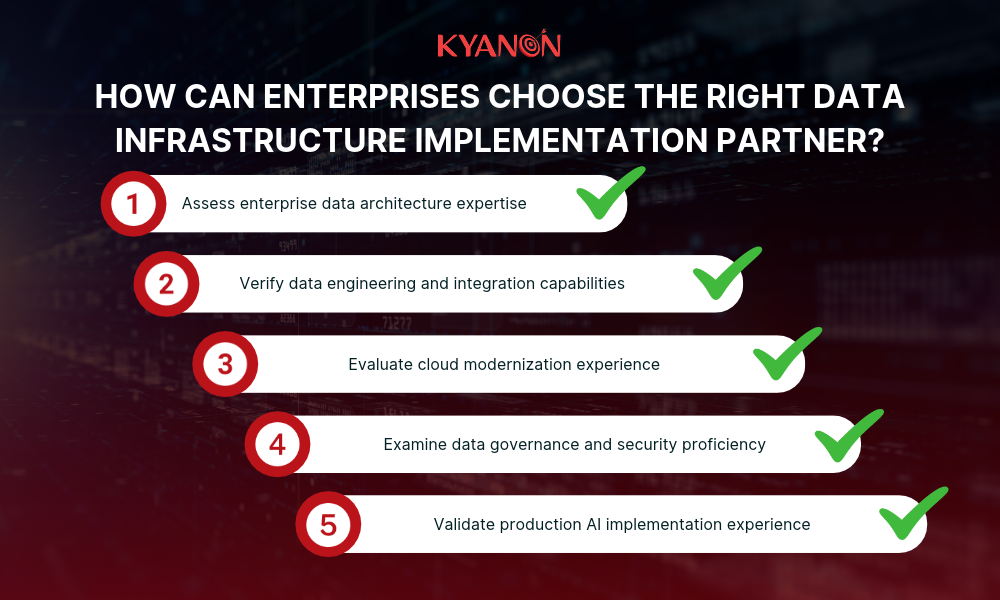
Business and technology leaders should assess prospective partners against five practical criteria:
- Enterprise data architecture expertise: Proven ability to design different data architecture models that integrate cleanly with existing ERP, CRM, and core transaction systems without disrupting daily operations.
- Data engineering and integration capabilities: Demonstrated track record building reliable data pipelines that support scheduled and real-time data processing.
- Cloud and infrastructure modernization: Practical experience migrating and optimizing workloads across cloud, on-premises, and hybrid environments while enforcing strict FinOps cost controls.
- Data governance and security proficiency: Deep command of automated data lineage, granular access controls, privacy compliance, and auditability standards within your industry.
- Production AI implementation experience: Ability to translate governed data foundations into live AI applications, ensuring pipeline design supports fast data access, reliable AI outputs, and manageable operating costs.
Beyond these technical capabilities, enterprises should also evaluate how a partner approaches implementation scope and risk management. Avoid committing to vendors that recommend replacing core enterprise platforms before assessing existing data quality, system dependencies, and integration requirements. A qualified partner should structure bounded, milestone-driven phases that validate technical feasibility early.
How does Kyanon Digital support enterprise data infrastructure modernization?
Kyanon Digital supports enterprise data modernization through data strategy, enterprise data warehousing, system integration, and governance. These capabilities help businesses consolidate fragmented data sources, standardize information management, and establish reliable data foundations for analytics and AI applications.
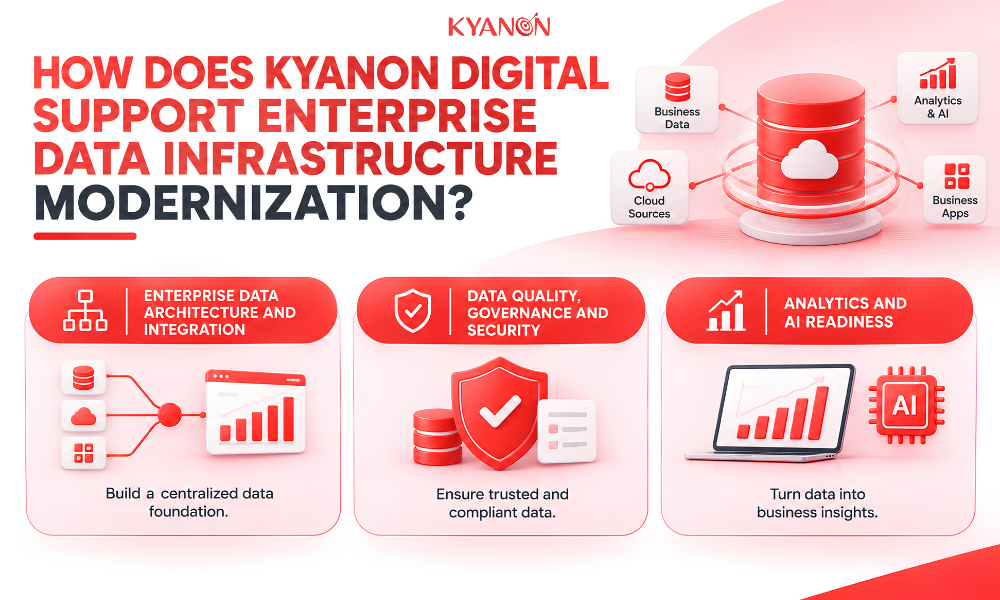
Support spans three integrated capability areas:
- Enterprise data architecture and integration: Designing centralized data architectures, developing enterprise data warehouses, and building data pipelines to connect siloed datasets and streamline data access across business functions.
- Data quality, governance, and security: Establishing data governance frameworks, improving data quality and consistency, and implementing security controls to support reliable, compliant, and responsible data usage.
- Analytics and AI readiness: Implementing real-time dashboards, reporting systems, and augmented analytics while preparing clean, structured, and accessible data for AI, machine learning, and predictive analytics.
Ready to turn fragmented enterprise data into actionable business insights? Explore Kyanon Digital’s Insights & Analytics consulting services to identify data gaps, strengthen analytics capabilities, and build a foundation for more informed business decisions.
These capabilities can also be applied incrementally, starting with focused projects that address specific operational challenges while preparing data for future AI adoption. The following case study illustrates how Kyanon Digital took this approach through an AI-ready Deal Room MVP.
Case study: Building an AI-ready Deal Room MVP for Australian cross-border trade
Building an AI-ready Deal Room MVP for Australian cross-border trade
For enterprises building an AI-ready data infrastructure roadmap, the first step does not always require a large-scale transformation. A focused MVP can help validate business needs, connect fragmented workflows, and establish structured data foundations before expanding AI capabilities. Kyanon Digital demonstrated this approach through a Deal Room MVP for an Australian cross-border trade and logistics enterprise.
Challenges
- Trade discussions and documents scattered across WhatsApp, KakaoTalk, email, and offline channels.
- Manual tracking of trade activities and limited operational visibility.
- Need for a scalable platform to support future AI capabilities.
Solution from Kyanon Digital
- Built chat-first Deal Rooms with secure invitation links for easy partner onboarding.
- Used Next.js 14, React, TypeScript, Vercel, and Supabase to deliver a scalable cloud-based platform.
- Centralized deal conversations, documents, and participant activity with role-based access controls.
- Structured operational data to support future AI development.
Results and business impact
- ~40% faster MVP delivery than planned.
- 90% external partner adoption within the first 30 days.
- 65% lower communication overhead.
- 30% lower infrastructure TCO compared with traditional on-premise hosting.
- Established a structured data foundation for future AI-powered trade intelligence.
The project shows how enterprises can take a phased approach to AI readiness: validate a focused use case, centralize operational data, and build a scalable foundation before investing in more advanced AI capabilities.
Explore how Kyanon Digital built an AI-ready Deal Room MVP to see how a focused digital solution can simplify complex trade operations, accelerate partner collaboration, and lay the groundwork for future AI capabilities.
Conclusion
An effective AI-ready data infrastructure roadmap starts with understanding existing data limitations, selecting an architecture that fits business requirements, and establishing reliable integration and governance processes. Rather than replacing entire legacy systems, enterprises should modernize infrastructure in phases, prioritizing the data capabilities needed for their most valuable business use cases.
Before approving major infrastructure expansion, confirm that your highest-priority AI use case has an accountable business owner, verified source-system lineage, and a clear operational baseline. Scale compute and model workloads only when pilot deployments demonstrate reliable data quality, predictable inference unit costs, and measurable workflow adoption.
Planning your enterprise data modernization initiative? Discuss your AI-ready data roadmap with Kyanon Digital to assess your current data architecture, identify critical integration dependencies, and define a practical, phased implementation plan.
References
The State of AI: Global Survey 2026 — McKinsey & Company, 2026.
Foundations of AI-Ready Data — Gartner, 2026.
Building an AI-Ready Deal Room MVP for Australian Cross-Border Trade — Kyanon Digital, 2026.




 Create project brief with AI