


Phygital retail combines digital tools, such as QR codes, virtual try-ons, and smart kiosks, with physical shopping to create a more engaging and convenient in-store experience. These phygital retail examples show how technology can improve product discovery and customer interactions. In contrast, omnichannel commerce connects inventory, orders, and customer data across websites, apps, and physical stores to create consistent shopping journeys.
Consider a customer scanning a shelf QR code to check a jacket’s availability, only to find outdated stock information because the last item has already been sold or reserved online. This shows how a phygital shopping experience can fall short when product and inventory information is not consistent across channels. A study by IBM and the National Retail Federation (NRF) found that 54% of surveyed brand executives struggle to keep product and policy information consistent across channels.
Understanding the difference between these approaches helps retailers identify where technology investment can create the most value. The following sections compare their roles, explore practical applications, and explain how both can work together to improve the shopping experience.
Key takeaways
- Phygital retail combines digital tools, such as QR codes, virtual try-ons, and interactive kiosks, with physical stores to improve in-store shopping experiences.
- Omnichannel commerce connects inventory, orders, and customer data across physical stores, websites, and mobile apps to create consistent shopping journeys.
- Phygital retail and omnichannel commerce serve different but complementary roles, improving in-store engagement and cross-channel operations respectively.
- Retailers should prioritize omnichannel improvements when inventory and order inconsistencies affect operations, then introduce phygital tools to address specific in-store friction points.
- Kyanon Digital supports connected retail experiences through CX design, data-driven insights, AI-powered automation, and scalable eCommerce solutions.
Further reading:
- Top 10 Omnichannel E-commerce Developers in Singapore
- Best Retail Order Management Systems for Omnichannel Brands
- How Omnichannel Loyalty Programs Drive Retention in Retail
What is phygital retail and how does it work?
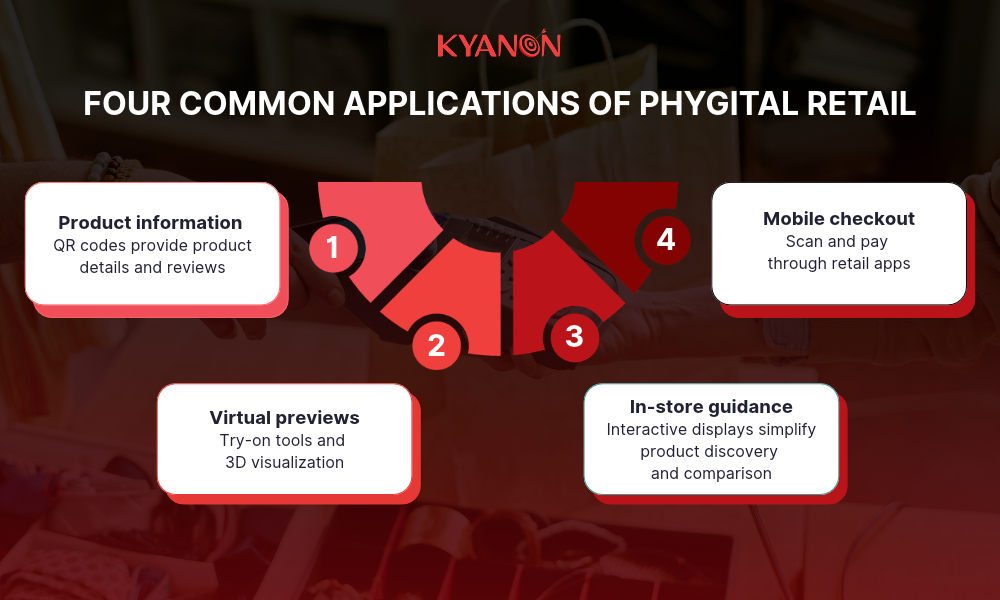
Phygital retail combines physical shopping with digital tools to make in-store experiences more convenient and engaging. It helps shoppers browse products, compare options, access information, and complete purchases without leaving the store.
In practice, phygital experiences connect store touchpoints, such as shelf QR codes, mobile apps, and digital displays, with product information, inventory, and loyalty programs. This allows shoppers to access digital services while browsing or purchasing products in physical stores.
Retailers typically use phygital in retail to solve four everyday store challenges:
- Self-service product information: Shoppers scan shelf QR codes to view product details, customer reviews, available sizes, and demonstration videos without waiting for store assistance.
- Virtual product previews: Cosmetics and eyewear retailers offer virtual try-on tools, while furniture brands let shoppers preview how products may look in their homes before purchasing.
- Digital in-store guidance: Interactive kiosks and digital displays help shoppers locate products, compare options, and explore relevant recommendations.
- Mobile self-checkout: Shoppers scan products and pay through a retailer’s mobile app, reducing the need to wait at checkout counters.
However, a phygital retail experience depends on accurate product, pricing, and inventory information. If a kiosk recommends an unavailable product or a digital shelf tag displays an outdated promotion, shoppers may lose confidence in the store. This is why connecting in-store digital tools with reliable business information is essential.

What are the differences between phygital retail and omnichannel commerce?
Phygital retail improves the in-store shopping experience through digital tools, while omnichannel commerce connects sales channels and business systems to keep product, inventory, order, and customer information consistent.
Although both approaches create a more connected shopping experience, they serve different roles in retail operations. Omnichannel commerce connects the channels behind each purchase, allowing customers to buy online, collect orders in-store, or return online purchases at a physical location. Phygital retail focuses on the in-store experience, using digital tools to help shoppers discover products, access information, and complete purchases more conveniently.
Comparison between phygital retail and omnichannel commerce
|
Comparison criteria |
Phygital retail | Omnichannel commerce |
| Primary focus | Improving the in-store shopping experience with digital tools |
Connecting physical and digital sales channels |
|
Main objective |
Making product discovery and checkout more convenient | Providing a consistent shopping experience across channels |
| Where customers use it | Inside physical stores, including aisles, fitting rooms, and checkout areas |
Across physical stores, websites, mobile apps, and marketplaces |
|
Common tools |
QR codes, virtual try-ons, interactive kiosks, and mobile checkout | Order management, inventory management, customer databases, and connected commerce platforms |
| Information flow | Links store tools with product, pricing, and loyalty information |
Keeps product, inventory, order, and customer information consistent across channels |
|
Business value |
Better store engagement, product discovery, and checkout convenience | More reliable order fulfillment and consistent customer experiences |
| Success measures | QR scans, store conversion rates, loyalty sign-ups, and checkout time |
Cross-channel sales, order accuracy, and repeat purchase rates |
From a Kyanon Digital practitioner perspective, digital tools alone cannot create a seamless shopping experience. QR codes, mobile checkout, and interactive kiosks all depend on accurate product, pricing, and inventory information. Without reliable connections to business systems, retailers risk introducing new store tools that create additional work instead of improving customer experiences.
Should enterprise retailers invest in phygital retail or omnichannel commerce?
Enterprise retailers should prioritize omnichannel improvements when inconsistent inventory, order, or customer information affects sales and daily operations. Phygital tools become a stronger investment when these core processes are reliable but in-store shopping still has clear friction points.
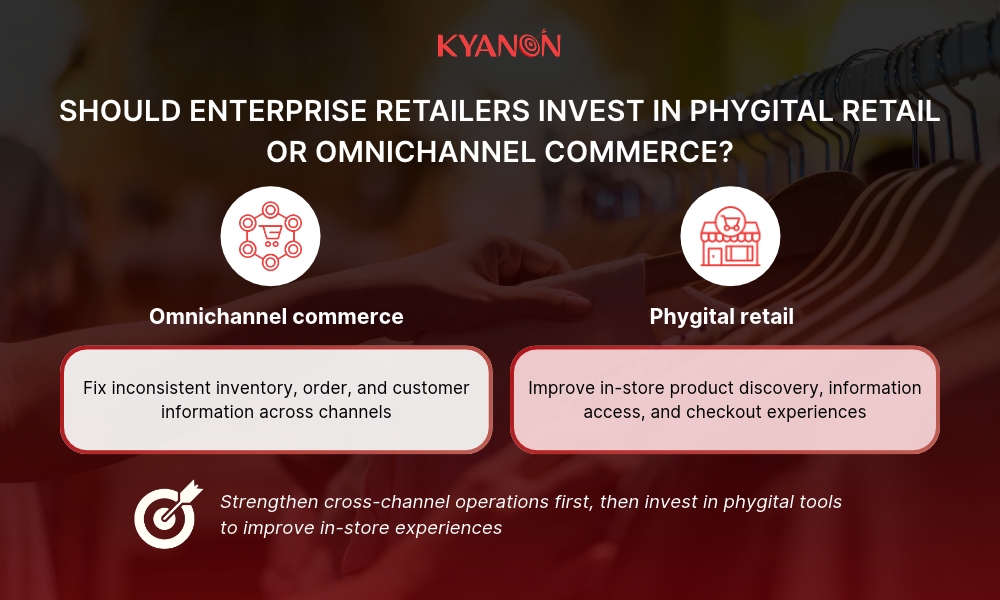
The right investment depends on where customers experience friction and where the business is losing sales. If customers cancel store-pickup orders because products shown as available online are already sold out, retailers should first improve inventory and order management across channels. However, if stock information is accurate but shoppers struggle to find products, access information, or complete purchases in-store, phygital tools can address these issues more directly.
Enterprise investment priority guide
|
What you see in daily operations |
Likely business issue | Best first move | When to consider the other approach |
| Customers cancel store-pickup orders because products are unavailable | Online and in-store inventory information is inconsistent | Connect inventory and order management across channels |
Inventory information is accurate, but shoppers struggle to find products in-store |
|
Stores attract many visitors but experience long checkout queues |
Checkout takes too long or shoppers cannot easily access product information | Introduce mobile checkout or QR-based product guides | Store staff cannot access online stock information when assisting customers |
| Store visitors make purchases but rarely join the loyalty program | In-store purchases are not easily connected to digital loyalty accounts | Introduce QR-based receipt submission or a mobile loyalty experience |
Customer information is not shared consistently between online and physical stores |
|
Shopping malls struggle to run joint loyalty promotions across retailers |
Purchase information and promotional rules are difficult to coordinate across stores | Link in-store purchases to centralized loyalty campaigns |
Retailers already share consistent purchase and customer information |
Kyanon Digital’s retail project experience highlights the value of choosing practical implementation approaches. For retailers operating across multiple locations, replacing existing checkout systems can increase costs and disrupt daily operations. Mobile apps and QR-based experiences offer an alternative, allowing businesses to test customer engagement and campaign performance without immediately changing store systems.
When existing business systems make it difficult to connect store experiences with online channels, retailers may need support in improving their commerce platforms and data flows. Explore Kyanon Digital’s digital commerce services to assess system readiness and plan the next steps.
How Kyanon Digital helps retailers build connected commerce experiences
Kyanon Digital helps retailers connect physical and digital shopping experiences through CX design, data-driven insights, and AI-powered automation. These capabilities support more consistent customer journeys, better access to commerce information, and more efficient retail operations.
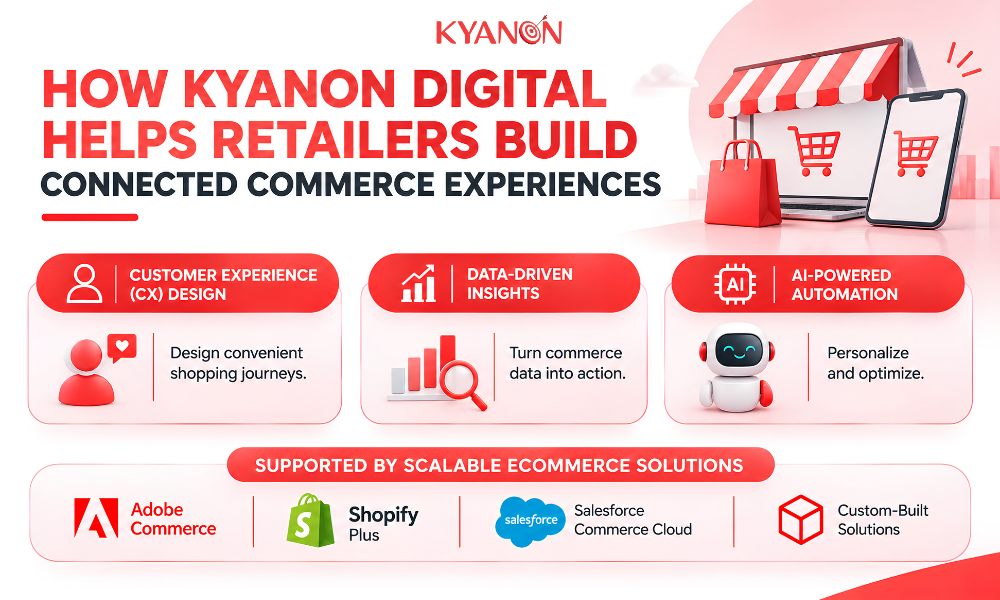
Kyanon Digital supports retailers through three core capabilities:
- Customer experience (CX) design: Design convenient shopping journeys across physical stores and digital channels, using customer insights and conversion optimization to improve engagement.
- Data-driven insights: Connect commerce data through analytics and customer segmentation to help retailers understand customer behavior and make better business decisions.
- AI-powered automation: Apply AI to product recommendations, customer service, pricing, and inventory management to improve personalization and operational efficiency.
These capabilities are supported by scalable eCommerce solutions across platforms such as Adobe Commerce, Shopify Plus, Salesforce Commerce Cloud, and custom-built systems.
Explore Kyanon Digital’s omnichannel eCommerce solutions in Singapore to learn more.
Case study: How Kyanon Digital connects physical and digital shopping experiences for a large-scale shopping mall in Thailand

Kyanon Digital helped a large-scale shopping mall in Thailand connect in-store purchases with digital loyalty experiences through a QR-enabled mini-app within its existing super app. The solution allowed shoppers to earn rewards across participating stores without requiring changes to each store’s checkout system.
Challenges
- Disconnected shopping experiences: Turning physical store visits into ongoing digital engagement.
- Different checkout systems: Connecting purchases across multiple retailers without changing their existing systems.
- Complex promotions: Managing spending tiers, payment conditions, and bank-funded rewards.
- Reward management risks: Preventing invalid receipt claims and controlling reward availability.
Solution from Kyanon Digital
- Connected physical and digital touchpoints: Integrated a QR-enabled mini-app with AI-powered OCR to capture and validate in-store receipts, linking physical purchases to digital loyalty experiences.
- Unified loyalty management: Connected Talon.One and Point Wallet to track spending across tenants, manage rewards, and support promotional campaigns.
- Integrated partner promotions: Configured campaign rules around payment methods, bank partners, card tiers, and spending thresholds.
- Consistent campaign management: Added receipt validation, anti-fraud checks, real-time reward quotas, and automated rollbacks.
Results and business impact
- Day-one digital engagement: Connected grand-opening shoppers with the mall’s digital loyalty program.
- No changes to store checkout systems: Enabled participation across retailers without modifying their existing systems.
- Higher average order value (AOV): Encouraged shoppers to spend across multiple stores through shared rewards and spending milestones.
- More connected shopping experiences: Linked physical purchases with digital rewards and promotional campaigns.
This project shows how phygital retail can support a broader omnichannel strategy. By linking in-store purchases with digital loyalty programs, retailers can extend customer engagement beyond individual store visits without replacing existing checkout systems. Starting with practical tools such as QR-based receipt submission also provides a more manageable way to connect physical and digital experiences.
Explore the full phygital experience for a large-scale shopping mall in Thailand case study to learn more about the solution and its implementation.
Conclusion
Phygital retail and omnichannel commerce address different but complementary parts of the shopping experience. Phygital tools make physical stores more engaging and convenient, while omnichannel commerce connects inventory, orders, and customer information across sales channels. Together, they help retailers create more consistent and connected customer journeys.
The right investment depends on business priorities. Retailers facing inventory and order inconsistencies should improve cross-channel operations first, while those looking to improve in-store engagement can introduce targeted phygital tools. The key is to ensure that digital experiences are supported by accurate business information and measurable outcomes.
Planning to connect physical stores with digital commerce platforms? Book a consultation with Kyanon Digital to assess system readiness and identify practical opportunities to improve phygital and omnichannel experiences.
References
Own the agentic commerce experience — IBM Institute for Business Value with National Retail Federation (NRF), 2026.
IBM-NRF Study: Brands and Retailers Navigate a New Reality as AI Shapes Consumer Decisions Before Shopping Begins — IBM Newsroom, 2026.
Singapore Digital Economy Report 2026 — Infocomm Media Development Authority (IMDA), 2026.
Phygital Experience for a Large-Scale Shopping Mall in Thailand — Kyanon Digital, 2026.










 Create project brief with AI