

AI chatbot use cases in healthcare can deliver strong operational ROI when they automate high-volume administrative tasks, such as appointment scheduling, pre-visit intake, and routine patient inquiries. Their value depends on successful resolution rates, integration costs, and ongoing maintenance.
Healthcare providers across Asia-Pacific face growing administrative workloads, but not every chatbot use case offers the same return. While clinical applications often require more extensive validation and oversight, basic FAQ chatbots may deliver limited value without integration into existing Electronic Medical Records (EMR) and appointment scheduling systems. Evaluating inquiry volume, automation feasibility, and system dependencies helps healthcare leaders identify opportunities with measurable business value.
Drawing on its experience delivering healthcare AI automation and integrating chatbot workflows with existing systems in Singapore, Kyanon Digital shares a practical approach to identifying high-ROI AI chatbot use cases, assessing implementation trade-offs, and selecting pilots based on operational KPIs, integration complexity, and data governance requirements.
Key takeaways
- Prioritize non-clinical workflows with clear rules and measurable outcomes to reduce implementation complexity and clinical risk.
- Assess whether existing platforms can support the selected workflow before committing to custom development, especially when legacy-system integration or complex routing is required.
- Establish an operational baseline (measuring volume, handling time, and cost per interaction) before estimating potential ROI.
- Evaluate candidate use cases using the P.A.I.N. framework to rank pain points, automation feasibility, financial impact, and data readiness before committing capital.
- Prioritize bounded, non-clinical pilots to test workflows against predefined operational baselines before scaling across other workflows.
- Kyanon Digital recommends validating AI chatbot use cases against operational baselines, integration feasibility, and total cost of ownership before scaling across healthcare workflows.
Which healthcare AI chatbot use cases offer the strongest business potential?
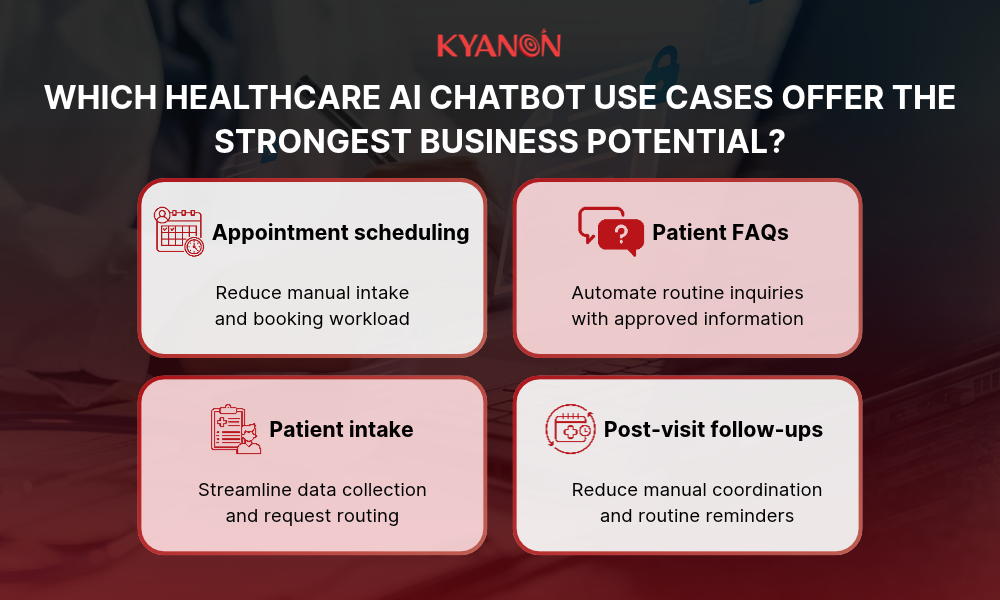
Healthcare providers in Singapore and across regional markets should compare chatbot use cases based on operational value, automation feasibility, integration complexity, and clinical risk. High-volume administrative workflows can be practical starting points when requests follow clear rules and outcomes can be measured. Actual returns depend on successful automation, implementation costs, and ongoing support requirements.
Appointment scheduling and patient access
- Business problem: Manual intake forms, repeated data entry, and misrouted administrative inquiries create delays and additional staff workload.
- Potential value: Less manual data entry, faster request processing, and more accurate administrative routing.
- Core capabilities: Collect required administrative information, categorize requests by service type, and transfer details to relevant systems or staff.
- KPIs: Intake completion rate, routing accuracy, processing time per request, and staff handling time.
- Business problem: Staff repeatedly answer questions about clinic hours, preparation instructions, services, location directions, accepted insurance, and administrative policies.
- Potential value: Immediate patient access to approved, consistent information without increasing call center headcount.
- Core capabilities: Source-grounded knowledge retrieval using Retrieval-Augmented Generation (RAG), direct source attribution, multilingual support, and human escalation.
- KPIs: Containment rate, response accuracy, escalation rate, and cost per resolved inquiry.
Patient intake and administrative routing
- Business problem: Manual collection of basic patient history, paper intake forms, and misrouted digital inquiries create operational delays and data entry errors.
- Potential value: Streamlined administrative intake, reduced manual data entry, and faster, accurate patient request routing.
- Core capabilities: Structured digital information collection, request classification, basic symptom-gathering for administrative routing, and enterprise system sync.
- KPIs: Intake completion rate, routing accuracy, processing time per record, and staff handling time.
Post-visit follow-ups and routine reminders
- Business problem: Staff capacity limits routine follow-up communication, care instruction reminders, and post-discharge coordination.
- Potential value: More consistent follow-up communication, fewer manual coordination tasks, and better visibility into unanswered patient requests.
- Core capabilities: Approved follow-up messaging, routine reminders, response collection, and escalation when a patient response requires clinical attention.
- KPIs: Follow-up completion rate, patient response rate, staff time per follow-up cycle, and escalation rate.
From Kyanon Digital’s perspective, the highest-volume use case is not always the best first investment. Routine FAQs may be easier to automate, while appointment management may offer broader operational benefits when booking demand is high and scheduling integrations are feasible. Healthcare leaders should compare expected benefits, implementation costs, and the proportion of inquiries that can be resolved without staff intervention before selecting a pilot.

How can healthcare leaders evaluate the ROI potential of an AI chatbot use case?
Calculating the business potential of an AI chatbot requires evaluating expected operational savings against the true total cost of ownership (TCO). A common mistake is assuming that every minute of saved administrative time converts directly into cash savings.
Measure the current operational baseline
Before deploying technology, quantify current operational metrics across candidate workflows:
- Inbound inquiry volume and seasonal spikes.
- Average handling time (AHT) per call or ticket.
- Staff labor cost per hour, including relevant employment costs.
- Current error rates and misrouting costs.
- Existing service-level performance (e.g., call abandonment rates, hold times).
- Realistically identify the portion of work that can be automated without human intervention.
Estimate the total cost of ownership
An accurate TCO model must account for the full software lifecycle, including:
- Discovery and custom development or platform configuration: Workflow mapping, safety boundaries, and custom software engineering.
- Integration with scheduling systems, CRM, EMR, or other relevant systems: Secure connections to existing healthcare and business systems.
- Data preparation, security controls, and compliance assessment: Enterprise data governance, encryption, and regulatory reviews.
- Cloud infrastructure and model usage: Cloud hosting, token usage costs, and database maintenance.
- Monitoring, maintenance, and ongoing optimization: Knowledge base updates, response monitoring, guardrail tuning, and continuous quality evaluation.
- Human review and escalation costs: Labor required for complex query handoffs and agent interventions.
Use the following KPIs to evaluate the operational impact of a chatbot pilot.
Operational impact KPIs
Operational focus area | Baseline KPI | Potential business impact |
| Front-desk support | Inquiry volume, handling time, cost per inquiry | Reduced repetitive workload and service costs |
Administrative operations | Processing time, staff hours, error rate | Less manual work and fewer errors |
| Patient access | Booking completion, abandoned requests, no-show rate | More completed bookings and fewer missed appointments |
Patient intake and routing | Intake completion, routing accuracy, processing time | Faster processing and fewer misrouted requests |
| Customer service | Response time, resolution rate, escalation rate | Faster responses and more efficient support |
Validate the business case through a controlled pilot
Select a bounded workflow and user group to compare operational results against the baseline. Track operational improvements alongside accuracy, escalation rates, and user experience, while defining the explicit conditions required before scaling across departments.
Reduced handling time does not automatically translate into cash savings. The business case should distinguish between costs avoided, staff capacity released for other work, and additional revenue generated. Measure costs and benefits over the same period, and track non-financial outcomes such as patient satisfaction and staff workload separately from direct financial returns.
What framework can you use to prioritize healthcare AI chatbot investments?
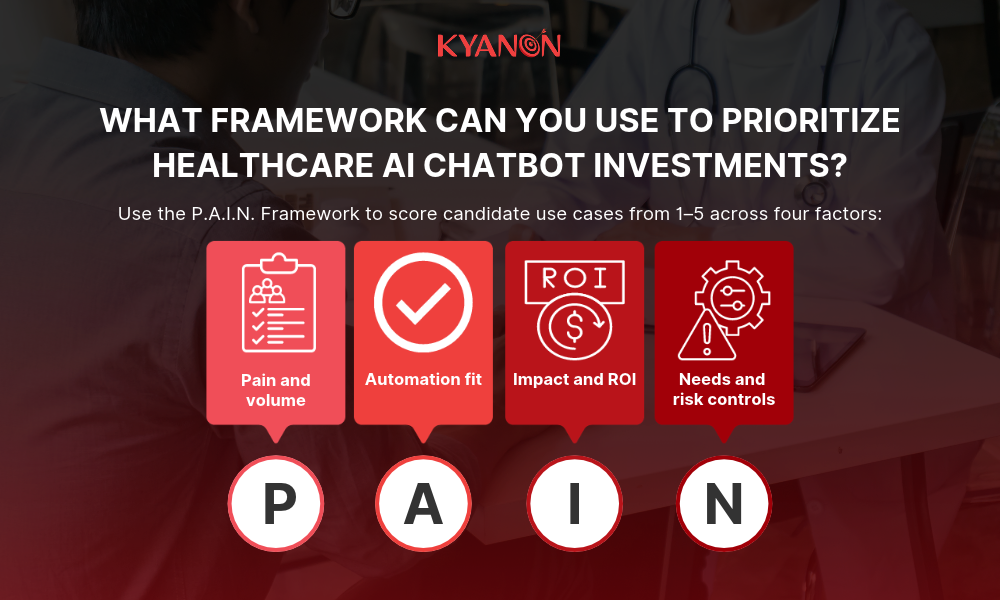
To evaluate candidate use cases objectively, healthcare organizations can apply the P.A.I.N. Framework (Pain, Automation Fit, Impact, Necessities) as a practical scoring model on a 1-to-5 scale across four factors:
P.A.I.N. framework evaluation factors
Factor | Evaluation questions |
| P: Pain and volume | How frequently does the problem occur, and how much staff time or operational cost does it consume? |
A: Automation fit | Is the workflow repetitive, predictable, and supported by reliable information or rules? |
| I: Impact and ROI | Which measurable business outcomes could improve, and how will they be verified? |
N: Needs and risk controls | What data, EHR integrations, safeguards, and human oversight are required? |
Scoring rule & prioritization logic:
- Score each factor from 1 (lowest) to 5 (highest).
- Add the four scores to compare candidate workflows, with totals ranging from 4 to 20.
- Use the score to shortlist candidates, then assess implementation cost, integration feasibility, data readiness, and operational risk before selecting a pilot.
A high score does not guarantee financial returns. A workflow with unreliable data or complex integrations may be less suitable than a narrower administrative task with clear rules and measurable outcomes. Validate shortlisted candidates through technical and operational assessment before committing to implementation.
What should healthcare providers look for in an AI chatbot development company?
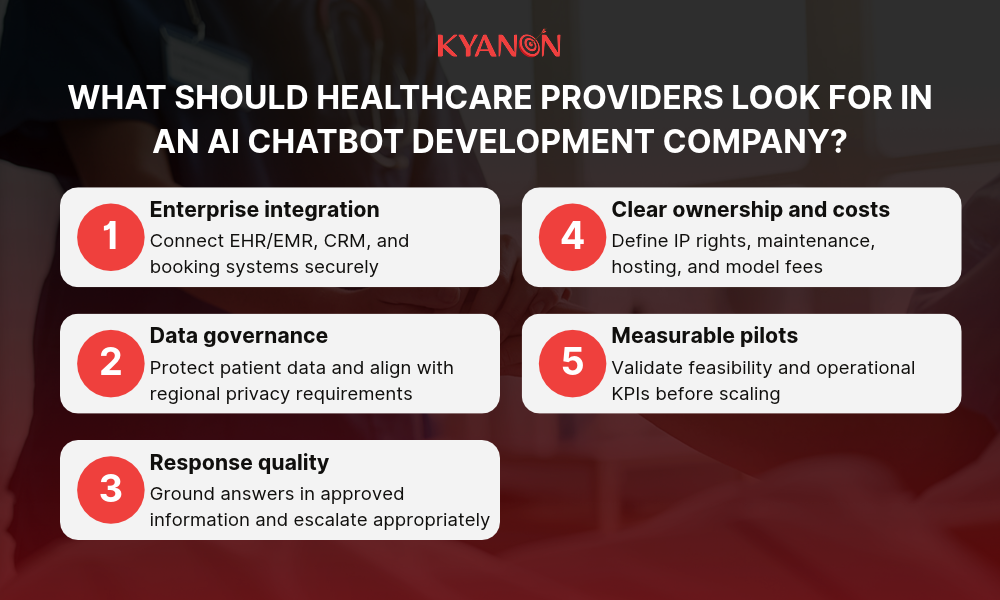
Deciding whether off-the-shelf software is adequate or if custom AI chatbot development is required depends on system complexity, governance, and workflow requirements. Standard platforms may suffice for simple FAQ handling, but custom engineering is essential when coordinating several systems or enforcing organization-specific security controls.
When selecting a partner for AI chatbot development, healthcare providers should evaluate five essential capabilities:
- Experience integrating AI with existing enterprise systems: Proven track record connecting custom components with legacy EHR/EMR, CRM, and booking systems via secure APIs.
- Clear data governance and security practices: Established protocols for managing sensitive patient data, maintaining role-based access control, and aligning with regional privacy standards (such as Singapore’s PDPA).
- Evaluation of response quality and escalation behavior: Test whether responses are grounded in approved information and whether requests outside the chatbot’s scope are escalated appropriately.
- Transparent ownership, maintenance, and total cost: Full clarity on IP ownership, cloud infrastructure hosting, ongoing maintenance, and model usage fees without vendor lock-in.
- A pilot-led approach with measurable acceptance criteria: A delivery framework that proves technical feasibility and operational KPIs in a bounded setting before enterprise expansion.
Custom development is worth considering when existing platforms cannot meet critical integration, workflow, governance, or scalability requirements. For routine FAQs, an existing platform may be sufficient.
How can Kyanon Digital help validate and implement high-ROI AI chatbot use cases?
Kyanon Digital supports healthcare organizations by evaluating workflow feasibility, designing secure conversational architectures, and validating business impact through bounded engineering engagements.
Start with workflow and feasibility assessment
- Identify high-volume, repetitive processes and define clear baseline KPIs.
- Assess organizational data readiness, system integration requirements, operational risks, and likely total cost of ownership.
- Prioritize a practical first use case using structured evaluation criteria to ensure early time-to-value.
Build around existing enterprise workflows
- Design the chatbot around approved knowledge sources and strictly defined workflow boundaries.
- Evaluate and engineer secure integrations with existing scheduling platforms, EMRs, CRM databases, and back-office tools.
- Define escalation rules, access controls, and monitoring requirements.
Validate outcomes before scaling
- Launch a controlled pilot with agreed-upon operational acceptance criteria.
- Compare pilot results against baseline metrics.
- Use pilot findings to determine whether to optimize the solution, expand across additional clinic locations, or reconsider the implementation approach.
How Kyanon Digital scaled healthcare customer service with an AI chatbot in Singapore
Controlled AI chatbot pilots deliver measurable operational efficiencies and cost savings.
In a Singapore healthcare AI chatbot project, Kyanon Digital helped a private healthcare provider automate routine inquiries, accelerate responses, and expand self-service through approved knowledge retrieval, workflow automation, and human escalation.
Challenges
- Growing volumes of routine inquiries about appointments, services, and administrative procedures.
- Fragmented service knowledge causing inconsistent responses.
- Manual inquiry routing increasing agent workload.
- Need for clear boundaries around clinical and sensitive inquiries.
Solutions
- Centralized approved service knowledge for consistent responses.
- Built an AI chatbot using retrieval-augmented generation (RAG) for non-clinical inquiries.
- Integrated APIs and workflow automation for request routing and escalation.
- Implemented AI guardrails and performance monitoring.
Results & business impact
- 38% reduction in routine manual inquiries.
- 32% faster response times.
- 28% of eligible inquiries resolved through self-service.
- 24% reduction in repetitive agent workload.
- Improved response consistency and service scalability.
This case illustrates how approved knowledge, workflow integration, and human escalation can support measurable improvements in healthcare customer service. Similar use cases should be evaluated against baseline workload, successful resolution rates, and implementation costs.
Explore the full case study to learn how Kyanon Digital helped a Singapore healthcare provider scale customer service with AI chatbot automation.
Conclusion
Maximizing ROI from healthcare AI chatbot investments requires prioritizing high-volume administrative workflows, establishing reliable operational baselines, and assessing implementation costs and risks. By validating a focused use case through a controlled pilot, healthcare providers can determine whether the expected benefits justify further investment before scaling.
Planning your next digital transformation initiative? Book a consultation with Kyanon Digital to discuss your operational roadmap with our enterprise AI consultants.
References
Scaling customer service with an AI chatbot for healthcare — Kyanon Digital, 2026.
Building the next generation AI-powered chatbots & generative AI — Kyanon Digital, 2026.
Which AI development companies serve Singapore healthcare? — Kyanon Digital, 2026.









 Create project brief with AI