

Mendix low-code development helps businesses build web and mobile applications faster using visual modeling and reusable components. It supports workflow automation, enterprise integration, and application modernization with less manual coding.
However, successful implementation still requires careful planning for scalability, security, integration, and maintenance. This guide explores Mendix’s benefits, limitations, and implementation approaches with support from Kyanon Digital.
Key takeaways
- Mendix low-code development accelerates application delivery through visual modeling, reusable components, and shared development environments for business users and professional developers.
- The Mendix low-code platform supports enterprise applications through system integrations, flexible deployment options, workflow automation, and application lifecycle management.
- Mendix AI Assistance (Maia) introduces agentic development capabilities, but teams still need engineering oversight, testing, security controls, and governance.
- Scalability, integration, customization, and maintenance depend on application architecture and implementation quality, not just the platform’s features.
- Kyanon Digital helps businesses assess Mendix requirements, integrate applications with existing systems, and implement low-code solutions aligned with business and technical objectives.
Further reading
- Kyanon Digital Is A Solution Partner With Mendix – A Low-code Platform
- How to Build Your Business with AI Assisted Software Development Services
- AI-Driven Software Development for Enterprises

What is Mendix low-code development?
Mendix is a low-code application development platform owned by Siemens. Siemens announced its acquisition of Mendix in August 2018 and completed the acquisition on October 1, 2018. The platform uses visual modeling and reusable components to help teams design, build, test, deploy, and maintain applications. Source: Siemens acquisition announcement.
Traditional software development often requires developers to write and maintain substantial amounts of code for application interfaces, business logic, and integrations. With Mendix, teams can model these components visually and use platform capabilities to accelerate common development tasks.
The platform supports different development roles through two main environments:
- Mendix Studio: A browser-based environment suited to collaborative application development, visual modeling, and participation from business-oriented users.
- Mendix Studio Pro: A development environment for professional developers who need more control over application logic, data models, integrations, security, testing, and custom code.
This shared approach helps business stakeholders contribute to requirements and application design while developers handle more complex technical decisions.
Low-code does not mean no code. Professional developers may still need to implement custom logic, resolve integration challenges, optimize performance, and maintain complex applications. The advantage is that teams can use visual development for supported tasks while applying traditional engineering where necessary.
How does the Mendix low-code platform work?
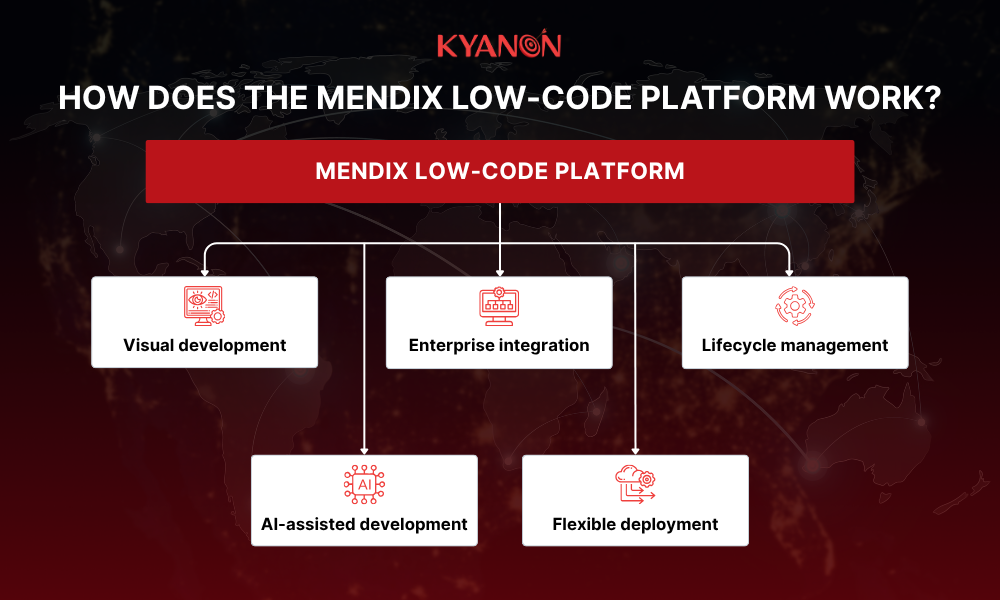
Mendix combines visual application modeling, reusable components, integration capabilities, deployment tools, and lifecycle management within a development platform.
Visual modeling and reusable components
Developers use visual tools to define application pages, data structures, business rules, and workflows. Reusable components and Marketplace modules can reduce the need to create common functionality from scratch.
This approach can help teams establish consistent application patterns and shorten development cycles, provided the components match the project’s requirements.
AI-assisted and agentic development
Mendix AI Assistance, known as Maia, extends the platform with AI capabilities that support application development. According to the Mendix documentation updated in October 2026, Maia supports work across the application lifecycle, including planning, modeling, building, quality improvement, and ongoing application evolution.
Depending on the capability being used, Maia can help developers understand existing application models, generate or change model documents, identify potential issues, and work through development tasks.
AI assistance does not remove the need for human review. Teams should validate generated changes against business requirements, application architecture, security policies, and testing standards before release.
Integration with enterprise systems
Enterprise applications rarely operate in isolation. Mendix supports integration approaches including REST, OData, SOAP web services, data exchange through formats such as JSON and XML, and other supported integration mechanisms. Mendix Connect helps teams discover, understand, connect, and govern data across applications.
These capabilities can support connections to ERP, CRM, databases, and third-party services. The exact approach depends on the interfaces exposed by existing systems, data quality, authentication requirements, and integration complexity.
Deployment and application lifecycle management
Mendix applications can be deployed to supported environments including Mendix Cloud, Kubernetes-based infrastructure, Cloud Foundry-based platforms, Azure, SAP Business Technology Platform, and configured on-premises environments.
The appropriate deployment model depends on infrastructure requirements, data residency, operational responsibilities, availability targets, and the capabilities supported by the selected environment.
Mendix also provides deployment and lifecycle tools for managing application environments and releases. Organizations should still define their own release approval, monitoring, backup, incident response, and maintenance procedures.
What are the benefits of Mendix low-code development?
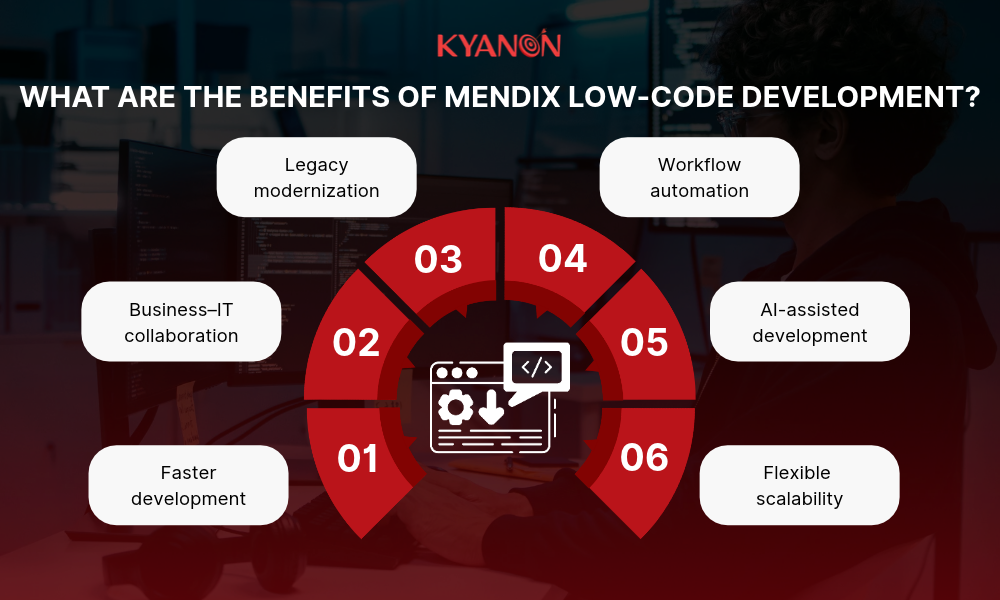
Mendix can help organizations accelerate application delivery and improve collaboration, particularly when requirements align with the platform’s capabilities.
- Faster application development: Visual modeling and reusable components reduce the need to build every application element from scratch, helping teams deliver internal applications, digitize workflows, and extend existing enterprise systems more efficiently.
- Better collaboration between business and IT: Business stakeholders can contribute to requirements and workflow design, while professional developers oversee architecture, security, and implementation quality.
- Flexible integration and modernization: Connect new applications with existing enterprise systems, extend legacy capabilities, and support phased modernization without necessarily replacing the entire system.
- Workflow automation: Digitize processes that rely on spreadsheets, email, paper forms, or disconnected applications to standardize approvals, information exchange, and task execution.
- AI-assisted development: Use AI capabilities to support application modeling, development tasks, and quality improvement, while retaining human oversight for testing, security validation, documentation, and production readiness.
- Scalable implementation based on business needs: Adapt the approach to application complexity, integration requirements, team experience, and customization needs. Validate expected benefits through a scoped proof of concept rather than assuming fixed performance improvements.
What are the main challenges of Mendix low-code development?
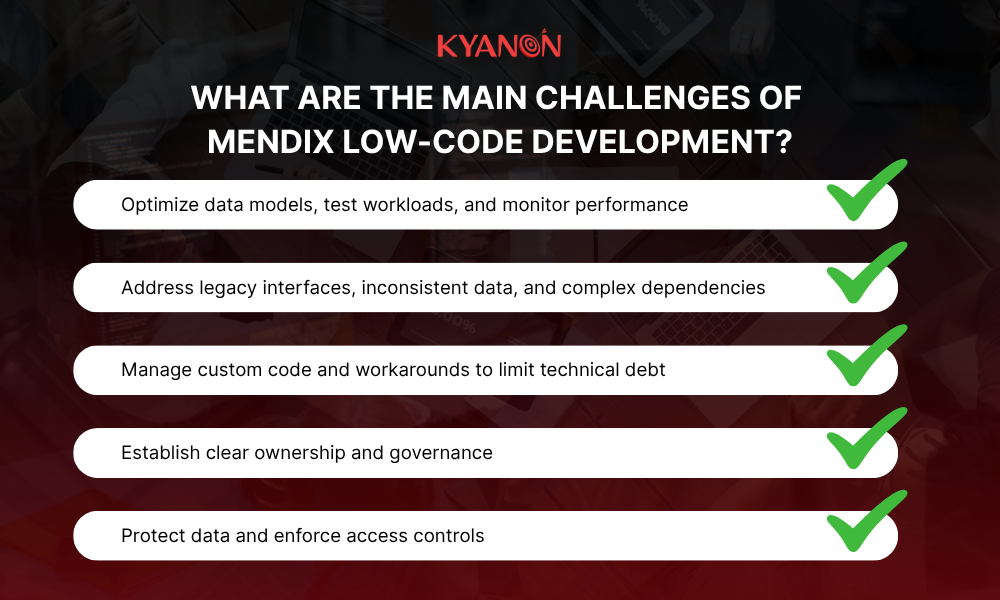
Mendix offers substantial development capabilities, but successful implementation requires organizations to address several technical and operational challenges.
- Scalability and performance: Growing user volumes and transaction loads require efficient data modeling, application design, load testing, and performance monitoring.
- Integration with legacy and enterprise systems: Undocumented interfaces and inconsistent data structures can complicate integration. Clear data ownership and suitable integration patterns help reduce risks.
- Customization and technical complexity: Specialized requirements may need custom code or additional services. Excessive workarounds can increase maintenance effort and technical debt.
- Maintenance and application governance: Without clear ownership, documentation, version control, and release procedures, applications can become difficult to maintain as business needs evolve.
- Security and access control: Teams must configure permissions, protect sensitive data, manage authentication, and validate application security before deployment.
How is Mendix evolving with AI in 2026?
Low-code development is increasingly incorporating AI assistance and agentic capabilities. Instead of relying only on visual modeling and reusable components, modern platforms are adding tools that help developers interpret requirements, generate application elements, identify issues, and perform development tasks.
Gartner’s 2026 research on AI-augmented low-code application platforms evaluates the market as vendors expand AI capabilities, agentic workflows, and governance. The shift makes platform selection more complex: organizations need to assess not only how quickly an application can be built, but also how AI-generated changes are controlled and maintained.
McKinsey’s 2026 analysis of AI-powered software development similarly emphasizes that meaningful gains depend on redesigning development workflows, not merely giving developers access to AI tools.
For Mendix teams, this creates three practical priorities:
- Use AI where it adds value: Evaluate assistance for requirements, modeling, repetitive development tasks, and quality improvement against the actual needs of the project.
- Maintain human accountability: Assign qualified engineers to review application logic, architecture, security, and AI-generated changes.
- Govern the full lifecycle: Include AI-assisted development in testing, release management, documentation, monitoring, and ongoing maintenance.
The objective is not to maximize the number of AI-generated components. It is to improve delivery speed and quality without weakening the controls required for enterprise software.
What are the enterprise use cases for Mendix?
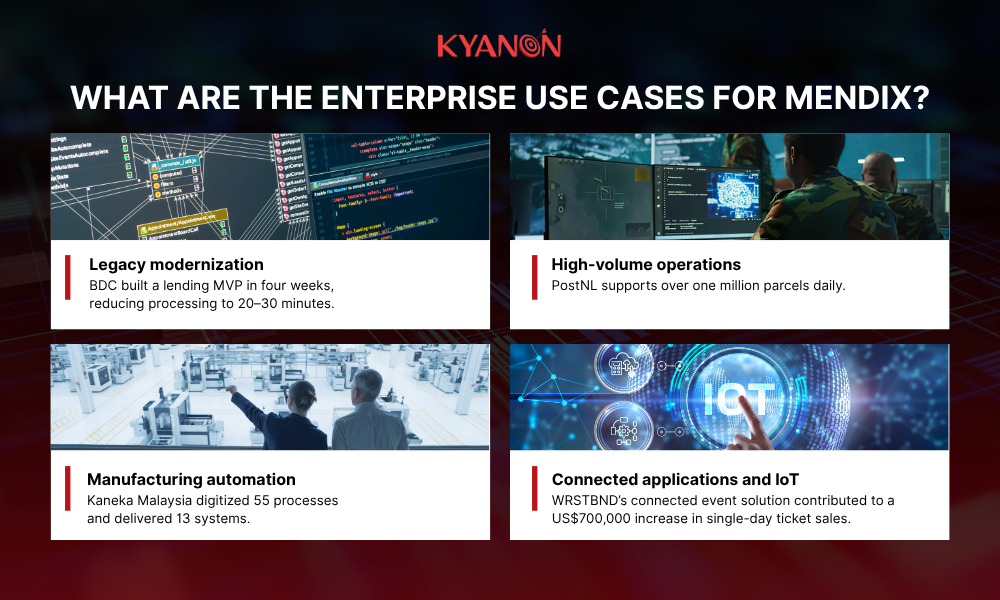
Mendix can support a range of enterprise scenarios, from digitizing internal processes to extending legacy systems and connecting operational data.
Legacy application modernization
Organizations can use Mendix to extend or gradually replace parts of legacy applications rather than undertake a full system replacement at once.
For example, the Business Development Bank of Canada (BDC) used Mendix to develop a core lending system MVP in four weeks. The solution consolidated documentation and approvals and reduced loan processing to approximately 20–30 minutes in the reported use case.
The broader lesson is that modernization can be approached incrementally, provided the new application is integrated carefully with existing systems and business processes.
High-volume operational applications
Organizations handling large transaction volumes may use Mendix to build applications around specific business functions and connect them to existing systems.
Mendix reports that PostNL used a microservices-based approach to modernize its order management system. The resulting system supports more than one million parcels per day, according to the Mendix use-case overview.
This illustrates the importance of architecture and operational design alongside the choice of development platform.
Manufacturing and process automation
Manufacturers can use low-code applications to digitize manual workflows, improve operational reporting, and connect information across systems.
Mendix describes how Kaneka Malaysia used low-code to rebuild 55 manual processes and deliver 13 new systems over 18 months, reporting time savings of 80% to 100% across various parts of its manufacturing processes.
Such results are specific to the reported implementation. Organizations should assess their own process complexity, baseline performance, and expected benefits before using published case studies to estimate ROI.
Connected applications and IoT
Mendix can also support applications that connect operational systems, devices, and user-facing workflows.
For example, Mendix reports that WRSTBND used applications integrated with IoT turnstiles and other event-management systems, contributing to an increase of US$700,000 in single-day ticket sales. See the Mendix low-code use cases for details.
These examples show that the value of low-code depends on the business problem being addressed, the surrounding technology environment, and the quality of implementation.
How can businesses choose the right Mendix implementation approach?
Selecting Mendix is only one part of an application initiative. Businesses also need to determine the appropriate architecture, delivery approach, and level of implementation support.
- Define the business problem: Identify operational bottlenecks, target users, and expected outcomes.
- Assess platform fit: Evaluate workflows, integrations, security, and scalability requirements.
- Validate with a proof of concept: Test key technical assumptions against measurable acceptance criteria.
- Establish architecture and governance: Define application ownership, security controls, testing, and release procedures.
- Plan for ongoing improvement: Prepare monitoring, documentation, user training, and support, then review post-launch results.
How can Kyanon Digital help with Mendix low-code development?
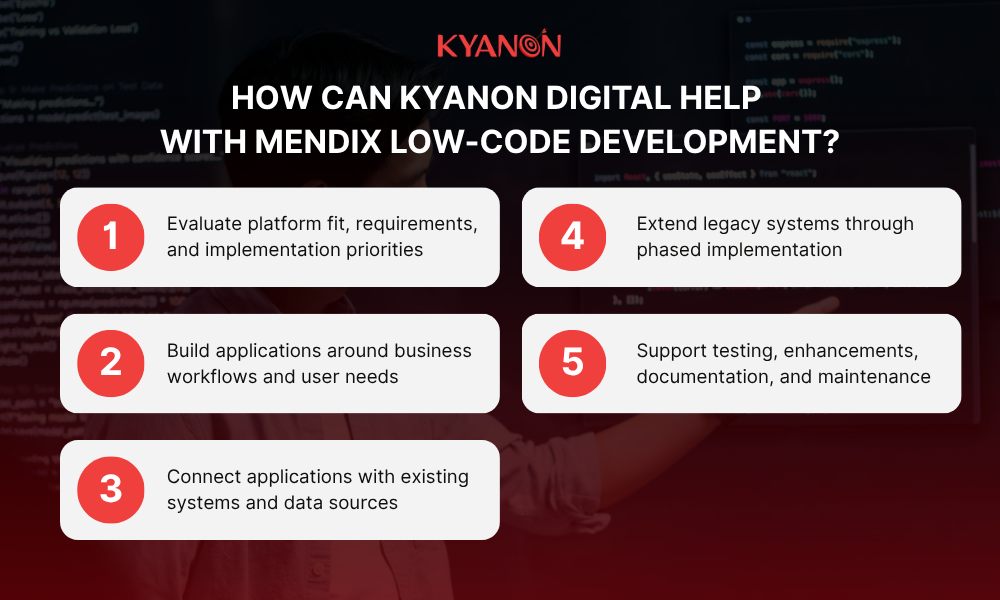
Kyanon Digital supports businesses adopting and optimizing Mendix through low-code development expertise and broader software engineering capabilities.
As a strategic Mendix partner in Vietnam and the Asia-Pacific region, Kyanon Digital can help organizations assess requirements, plan application development, and address implementation challenges involving integrations, customization, scalability, and maintenance.
Support can include:
- Solution assessment and planning: Evaluate business requirements, platform fit, application scope, and implementation priorities.
- Low-code application development: Build applications around defined workflows, user needs, and business objectives.
- Enterprise integration: Connect applications with existing systems and data sources using appropriate integration patterns.
- Application modernization: Extend or modernize existing systems through a phased approach where appropriate.
- Ongoing engineering support: Address application enhancements, quality assurance, documentation, and maintenance needs.
The appropriate engagement depends on the project’s technical requirements, existing systems, internal capabilities, and expected outcomes. Businesses should define these factors before selecting an implementation approach.
Explore Kyanon Digital’s services to discuss how low-code development can support specific application and digital transformation goals.
Case study: Kyanon Digital delivered integrated omnichannel fulfillment and transportation management
This project demonstrates how Mendix low-code development can support continuous business innovation while connecting fulfillment, transportation, and customer-facing operations across retail channels.
Kyanon Digital partnered with a leading multi-format retail corporation to modernize omnichannel operations through an integrated platform combining Mendix, intelligent automation, and enterprise system integration.
Client challenge
The retailer faced fragmented delivery operations, inefficient fulfillment processes, rising transportation costs, disconnected ERP, POS, eCommerce, and logistics systems, and limited real-time order visibility.
Kyanon Digital’s solution
Kyanon Digital implemented an integrated omnichannel platform featuring:
- Mendix low-code innovation: Enabled business teams to prototype processes, test operational ideas, and adapt workflows without lengthy development cycles.
- Smart fulfillment: Optimized order batching and pick-and-pack operations, supported by barcode scanning and mobile task management.
- Intelligent transportation management: Applied route optimization, dynamic load planning, vehicle tracking, and automated carrier selection.
- Enterprise integration: Connected ERP, POS, eCommerce, inventory systems, and third-party logistics providers through an API-first architecture.
- Real-time customer visibility: Enabled order tracking, proactive delivery notifications, and digital proof of delivery.
Results and impact
- Greater operational efficiency: Streamlined fulfillment and delivery workflows, reducing manual tasks and errors.
- Improved customer experience: Increased order visibility and proactive communication helped reduce service friction.
- Cost optimization: Route and load optimization supported more efficient transportation and resource utilization.
- Scalable innovation: A modular, cloud-native architecture enabled the retailer to adapt workflows and expand across channels, locations, and business models.
This case demonstrates how Mendix creates value beyond faster application development: combined with enterprise integration and modular architecture, low-code can help retailers adapt business processes while maintaining connected, scalable operations.
Read more: Transforming Retail Operations: Integrated Omnichannel Fulfillment & Transportation Management Solution.
Why choose Kyanon Digital for Mendix low-code development in Singapore?
Expertise Trusted by Fortune 500 Clients
With a presence in Singapore and extensive experience supporting regional and global businesses, Kyanon Digital helps Singapore enterprises build, modernize, and scale software solutions across their digital ecosystems. Our experience spans complex software engineering and digital transformation projects for enterprises, Fortune 500 companies, and organizations across APAC.
A World-Class IT Team
Our 500+ consultants and engineers bring expertise across software engineering, technical architecture, project management, QA, DevOps, cloud, data, and AI/ML. With delivery capabilities across Vietnam, Singapore, Thailand, Australia, and MalaysiaAPAC region, we combine local business understanding with scalable engineering resources to support Singapore-based clients.
Enterprise-grade quality & delivery
Our ISO 9001-certified quality management system supports consistent delivery, structured engineering processes, and continuous improvement. We apply Agile methodologies and quality assurance practices throughout the software development lifecycle, from planning and architecture to development, testing, deployment, and ongoing optimization.
Uncompromising Security
With ISO 27001-certified information security management, Kyanon Digital integrates security considerations throughout the software development lifecycle. This helps Singapore businesses manage data protection, access control, application security, and operational risks while developing and modernizing enterprise software.
Conclusion
The Mendix low-code platform helps businesses accelerate application development, modernize existing systems, and streamline workflows through visual modeling, integrations, and AI-assisted capabilities.
However, successful implementation requires more than rapid development. Platform fit, integration complexity, security, scalability, and ongoing governance all influence long-term results.
For businesses evaluating Mendix, the next step is to identify priority use cases, validate technical requirements, and establish an implementation approach aligned with business goals and existing systems.
If application delivery or legacy modernization is becoming a challenge, discuss Mendix low-code development with Kyanon Digital to explore an approach that supports business innovation and sustainable growth.
References
Low-Code Examples and Use Cases — Mendix, 2026.
The AI-Augmented Future of Low-Code Application Platforms — Gartner, 2026.
AI-Powered Software Development: How Technology Is Rewriting the Rules — McKinsey & Company, 2026.
What Is Low-Code? — IBM, 2026.
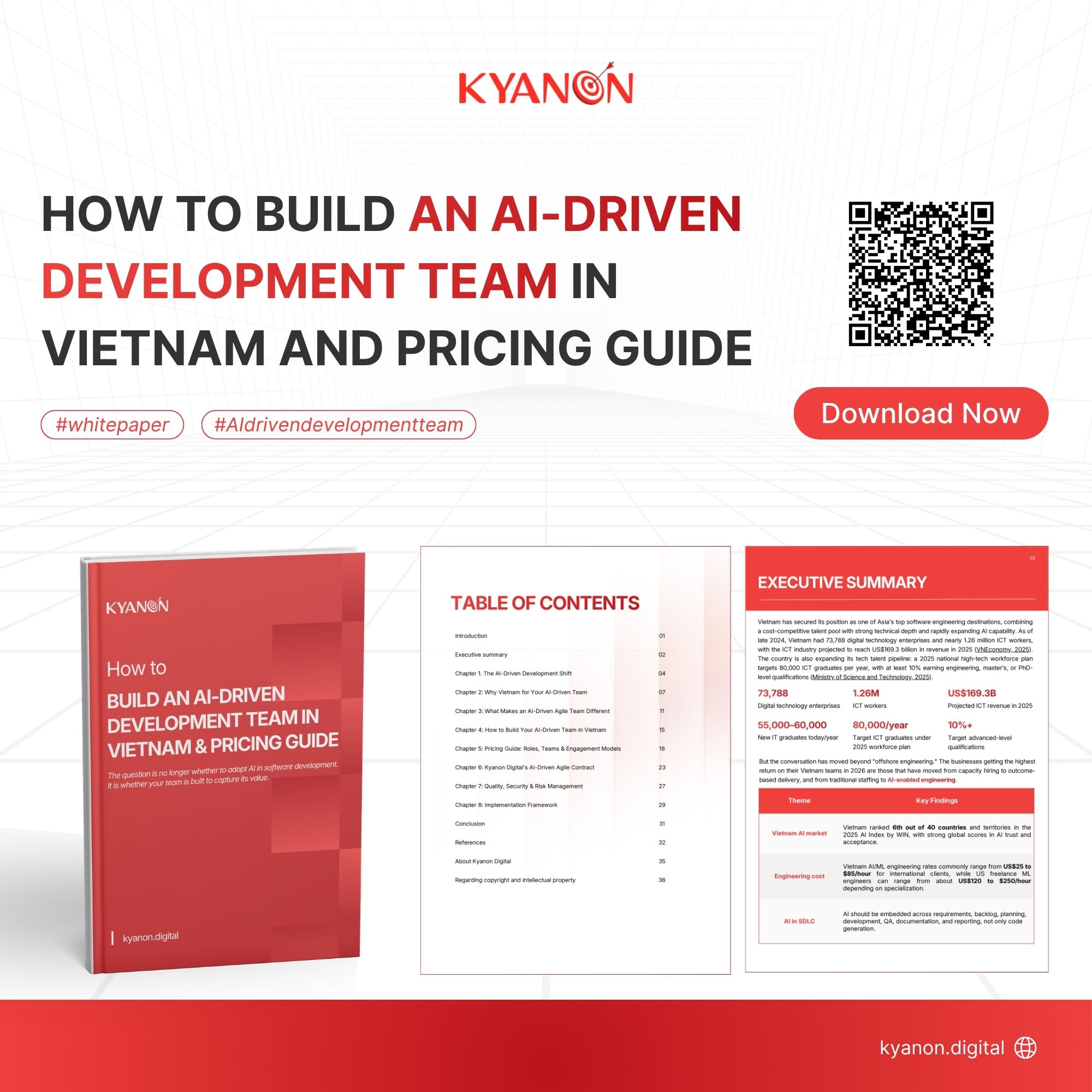








 Create project brief with AI