

Are you trying to combat rising customer acquisition costs by building deeper brand advocacy? A study published in the journal Marketing Science stated that non-tiered customer loyalty program increased customer value by almost 30% over a five-year horizon. While searching for the ideal white label loyalty platform, navigating through a crowded market of software vendors can be overwhelming.
Fortunately, by leveraging market-leading solutions like Open Loyalty and partnering with experienced digital transformation experts like Kyanon Digital, brands can deploy world-class rewards ecosystems without starting from scratch. Read on to explore the top platforms dominating the industry today and find the perfect match for your business.
Key takeaways
- Open Loyalty stands at the top as the premier API-first, headless loyalty engine designed for enterprise flexibility and scalability.
- Kyanon Digital is a certified partner with Open Loyalty, having successfully deployed customized rewards solutions for multiple global brands.
- Beyond software licensing, Kyanon Digital eliminates technical complexity by building custom frontend UI/UX and integrating complex backend data.
- Transitioning from rigid, transaction-only templates to flexible, event-based rewards is critical to driving true customer emotional loyalty.
Further reading:
- A Practical Guide To Retail Loyalty Programs
- How AI Is Redefining Customer Loyalty in SEA
- Customer Loyalty Programs Advantages For E-commerce Brands
Why the build vs buy decision is the wrong question to ask first
Industry software engineering benchmarks like Forrester stated that commonly estimate annual maintenance costs at 15–25% of the original development investment for custom software applications. Yet most brands still debate “build or buy” as if building were a safe, predictable choice. In reality, framing the conversation around this binary choice puts the tactical cart before the strategic horse. Loyalty programs are no longer a superficial marketing “nice-to-have” or a digital punch card. In an era of strict privacy regulations and soaring acquisition costs, they serve as core business infrastructure for customer retention and first-party data collection.
Because this infrastructure underpins your entire data ecosystem, the real question is not “which delivery method is better,” but rather: “Which path aligns with our current growth stage, time-to-market constraints, and internal engineering capabilities?”
At Kyanon Digital, we have guided leading brands across the Retail, FMCG, and F&B sectors through this exact architectural decision. We consistently find that standard evaluations fail because they ignore the critical hidden variables that dictate long-term success: vendor lock-in risk, API surface area, and the compounding trajectory of ongoing maintenance costs.
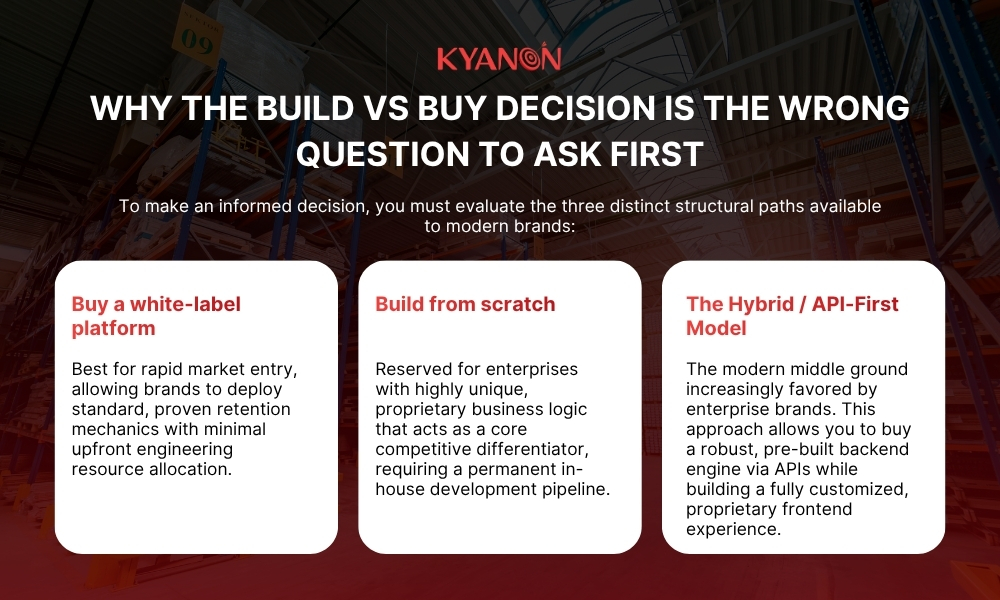
To make an informed decision, you must evaluate the three distinct structural paths available to modern brands:
- Buy a white-label platform: Best for rapid market entry, allowing brands to deploy standard, proven retention mechanics with minimal upfront engineering resource allocation.
- Build from scratch: Reserved for enterprises with highly unique, proprietary business logic that acts as a core competitive differentiator, requiring a permanent in-house development pipeline.
- The Hybrid / API-First Model: The modern middle ground increasingly favored by enterprise brands. This approach allows you to buy a robust, pre-built backend engine via APIs while building a fully customized, proprietary frontend experience.
Platforms like Open Loyalty exemplify this hybrid model at scale. By leveraging an API-first architecture, brands gain the speed and security of a proven transactional engine without sacrificing the creative control or data flexibility required to build a truly unique brand experience.

What is a white-label loyalty platform?
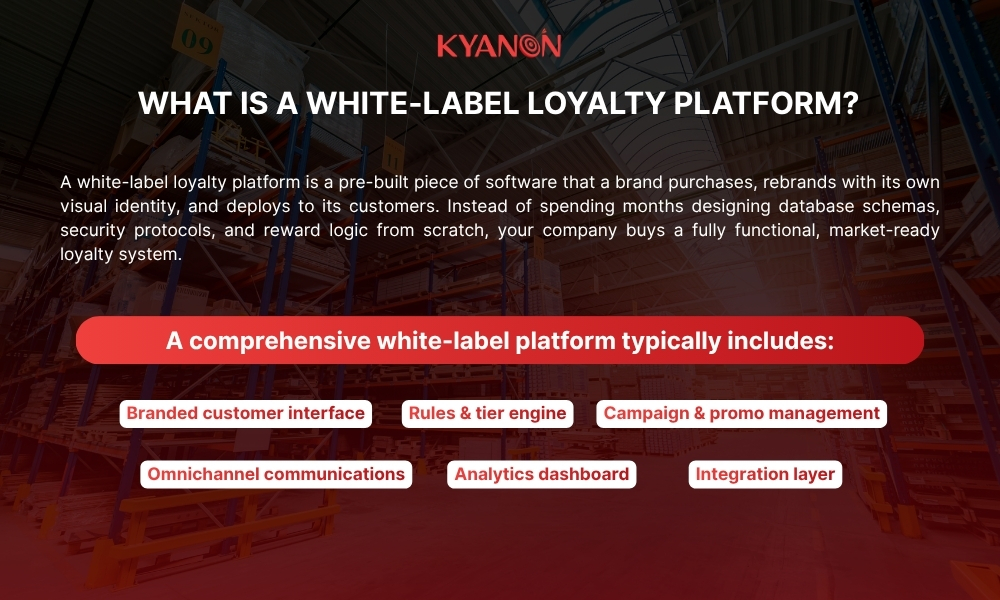
A white-label loyalty platform is a pre-built piece of software that a brand purchases, rebrands with its own visual identity, and deploys to its customers. Instead of spending months designing database schemas, security protocols, and reward logic from scratch, your company buys a fully functional, market-ready loyalty system. You skin it with your logos, fonts, and brand colors, making it look entirely custom-built to the outside world.
A comprehensive white-label platform typically includes:
- Branded customer interface: A mobile app or web portal where customers track points, view tiers, and redeem rewards.
- Rules & tier engine: A backend interface to set up rules like “spend $1, get 5 points” or define Bronze, Silver, and Gold VIP tiers.
- Campaign & promo management: Tools for marketing teams to launch double-points weekends, birthday bonuses, or targeted flash sales.
- Omnichannel communications: Integrated push notifications, SMS gateways, and email triggers to re-engage slipping segments.
- Analytics dashboard: Centralized reporting on customer lifetime value (LTV), active user rates, reward redemption costs, and ROI.
- Integration layer: Pre-built connectors or webhooks that plug directly into your Point of Sale (POS) terminals, CRM, and eCommerce checkouts.
The key distinction lies in the split of ownership: with a white-label solution, you own the entire brand experience and customer data, while the software vendor owns and maintains the core technology infrastructure. You focus on customer retention strategy; they handle the bugs, security patches, and server scaling.
What is a loyalty engine?
It is common to see the terms “white-label platform” and “loyalty engine” used interchangeably, but they are architecturally different. A loyalty engine is the API-first backend system that powers the heavy mathematical lifting, calculating points, processing event triggers, executing tier logic, and validating reward fulfillments. It does not come with a pre-made user interface.
Open Loyalty is a leading headless loyalty engine that powers global enterprises like Heineken, ALDO, limango, and EQUIVA. Unlike an “all-in-one” rigid white-label app that forces you into their pre-designed mobile templates, a headless loyalty engine acts as an invisible utility layer. You plug it into your existing custom apps, websites, or smart vending machines via APIs.
This terminology matters immensely during your vendor evaluation. Many vendors market themselves as flexible “white-label platforms” but are actually rigid, monolithic SaaS applications. If you buy a rigid platform, you will quickly hit a wall when trying to build custom user experiences or integrate legacy systems because their API access is limited. Knowing whether you need a turn-key white-label application or a flexible, headless loyalty engine is the first real step to picking the right tech stack.
Build vs Buy vs Hybrid: Key differences at a glance
The hybrid model is where the most sophisticated enterprise programs land in 2026. It completely solves the false binary of the classic build-vs-buy debate by decoupling the user experience from the core transactional logic. The next sections unpack each path in detail and explain why platforms like Open Loyalty are redefining what “buying” actually means.
Factor | Build from Scratch | White-Label Platform | Hybrid (Buy Engine + Build UX) |
| Time to launch | 6–18 months | Days to weeks | 4–12 weeks |
Upfront cost | Very high | Low–medium | Medium |
| Ongoing maintenance | Your team owns everything | Vendor handles core | Split: vendor owns engine, you own UX |
Customization | Unlimited | Within platform config | High — UX fully custom, engine proven |
| Data ownership | Full | Shared / vendor-hosted | Full (self-hosted engine available) |
Risk profile | High — delivery + tech debt | Low | Low–medium |
| Best for | Brands where loyalty IS the product | SMEs, hospitality, F&B, clinics | Enterprise retail, FMCG, omnichannel eCommerce |
Example platforms | — | Authic, Tada, Hubble | Open Loyalty (loyalty engine, MACH/API-first) |
Option 1 – Buy a white-label loyalty platform
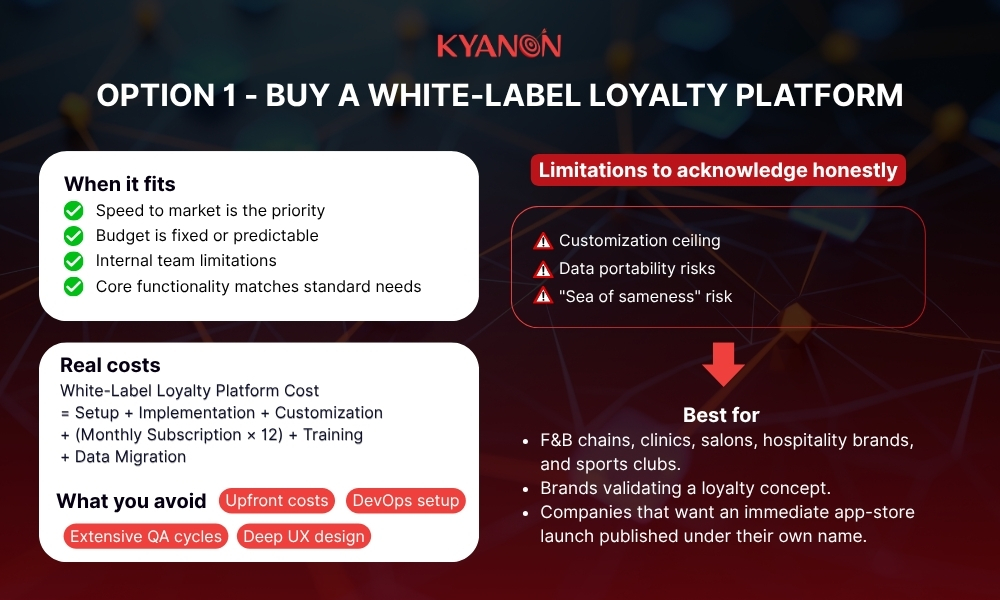
When it fits
- Speed to market is the priority: You need to launch in weeks, not months, to capture customer data immediately.
- Budget is fixed or predictable: Predictable monthly subscription/SaaS pricing beats heavy, unpredictable capital expenditure (capex).
- Internal team limitations: Your organization lacks dedicated loyalty product engineers or data scientists to build complex logic.
- Core functionality matches standard needs: Your strategy relies on proven mechanics like points, VIP tiers, referrals, campaigns, and standard analytics.
Real costs
- White-Label Loyalty Platform Cost = Setup + Implementation + Customization + (Monthly Subscription × 12) + Training + Data Migration
- Pricing commonly scales with monthly active users (MAU), transaction volume, and enabled modules.
- What you avoid: You bypass substantial upfront investment in product discovery, loyalty strategy design, UX/UI design, custom software development, QA testing, DevOps and infrastructure setup, security hardening, app store deployment, and ongoing platform maintenance. Compared with building a loyalty platform in-house, a white-label solution provides a pre-built loyalty engine, proven integrations, and managed platform support, significantly reducing time-to-market and implementation risk.
- The hidden trade-off: You save capital, but the vendor’s product roadmap entirely controls your future feature timeline.
Limitations to acknowledge honestly
- Customization ceiling: If your marketing team conceives a highly unique or non-standard reward logic, you will likely hit a rigid technical wall.
- Data portability risks: You must carefully audit contract terms to ensure clear data export policies and full ownership of your customer profiles.
- “Sea of sameness” risk: Because many brands use identical backend templates, programs built on standard platforms can look and feel incredibly similar to competitors, a common pitfall noted in Open Loyalty’s Loyalty Trends Report.
Best for
- F&B chains, clinics, salons, hospitality brands, and sports clubs looking for quick, reliable community engagement.
- Brands validating a loyalty concept before committing to a deeper, multi-million dollar technology investment.
- Companies that want an immediate app-store launch published under their own brand name with minimal technical overhead.
Option 2 – When should an enterprise build from scratch?
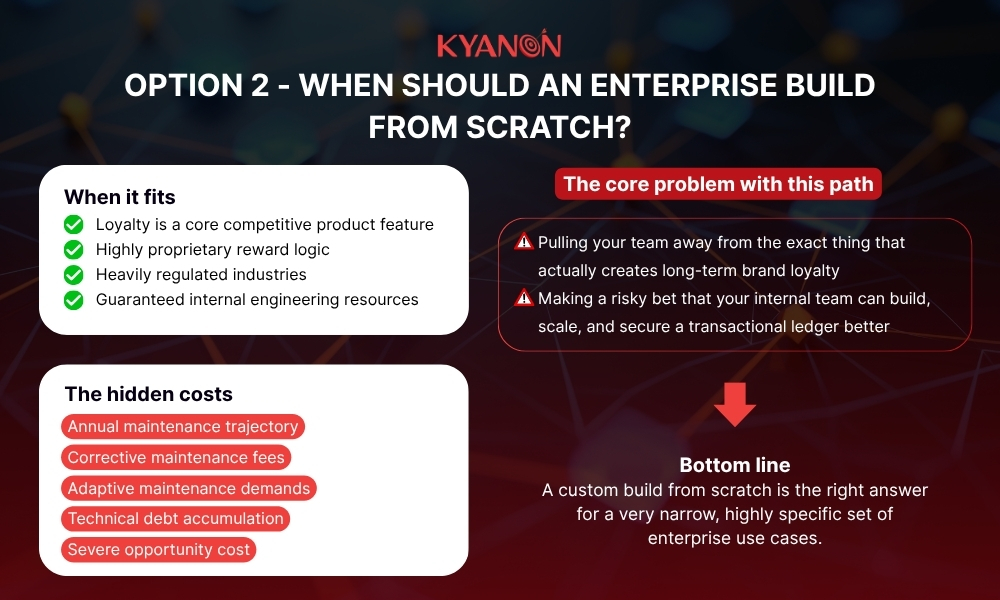
When it actually makes sense
- Loyalty is a core competitive product feature: The loyalty mechanics are not just a retention tool but are the actual value proposition you sell to your users.
- Highly proprietary reward logic: You have complex, unique business rules or trade secrets that no off-the-shelf vendor can support natively.
- Heavily regulated industries: You operate in healthcare, financial services, or specific jurisdictions requiring 100% data sovereignty and on-premise infrastructure.
- Guaranteed internal engineering resources: Your business can comfortably commit a dedicated product team and an ongoing development budget for the software’s lifetime.
- Annual maintenance trajectory: Software upkeep never ends. Annual maintenance runs roughly 15% to 25% of the original development cost just to keep the system operational.
- Corrective maintenance fees: Resolving a single bug cycle or regression issue in a large-scale, custom transactional system can easily exceed $5,000+ in developer hours.
- Adaptive maintenance demands: Your team must constantly update the platform for iOS/Android operating system upgrades, security compliance patches, and new POS firmware compatibility.
- Technical debt accumulation: Shortcuts made to hit your initial launch deadline quickly become expensive “interest payments,” reducing your future agility and platform stability.
- Severe opportunity cost: Every engineer assigned to build backend ledger plumbing is an engineer diverted from building customer-facing innovation and unique user experiences.
The core problem with this path
Building your own backend loyalty infrastructure pulls your team away from the exact thing that actually creates long-term brand loyalty: memorable customer experiences. When you choose to build from scratch, your company is making a risky bet that your internal team can build, scale, and secure a transactional ledger better than a specialized vendor whose entire business model depends on perfecting loyalty software. This bet is rarely true.
Bottom line
A custom build from scratch is the right answer for a very narrow, highly specific set of enterprise use cases. For the vast majority of brands, it represents a longer, riskier, and significantly more expensive path that delays the immediate retention results and first-party data capture the business actually needs. First-year total cost of ownership is about $500,000 – covering recruitment, project management, QA, cloud hosting, maintenance, and UX/UI design. Costs persist into subsequent years for hosting, maintenance, and ongoing feature development. (Open Loyalty)
Option 3 – The modern middle ground: Buy the engine, build the experience
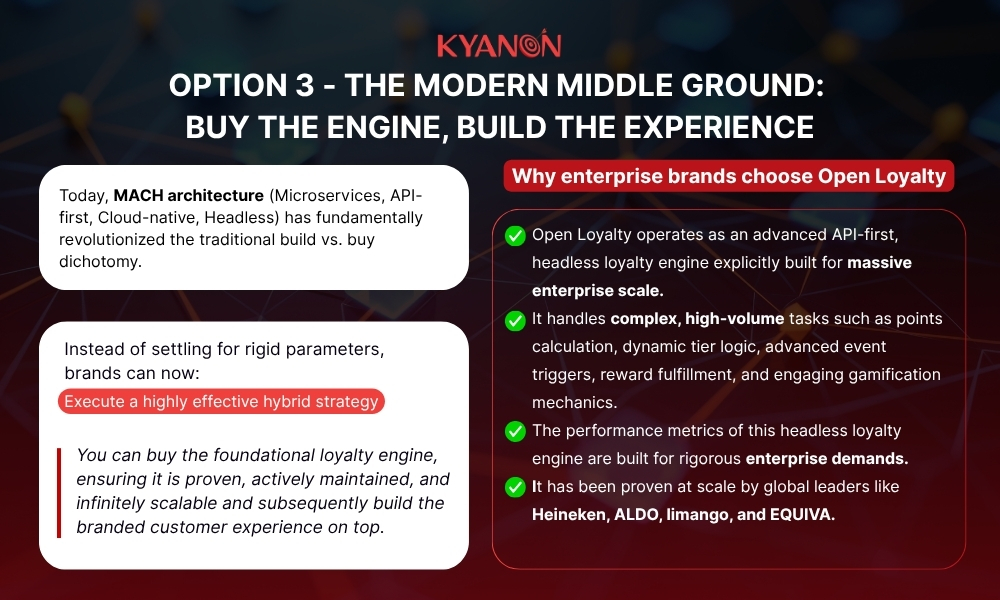
The traditional build vs. buy dichotomy was framed during the era of monolithic, all-in-one SaaS systems. In that restrictive paradigm, enterprise leaders were forced to choose: either own every single line of code with a massive internal build or rent a generic white label loyalty platform where you owned nothing. Today, MACH architecture (Microservices, API-first, Cloud-native, Headless) has fundamentally revolutionized this landscape.
Instead of settling for rigid parameters, brands can now execute a highly effective hybrid strategy. You can buy the foundational loyalty engine, ensuring it is proven, actively maintained, and infinitely scalable and subsequently build the branded customer experience on top. This grants you complete ownership over unique UIs, custom journeys, and original features that drive actual business value.
Why enterprise brands choose Open Loyalty as their loyalty engine
Open Loyalty operates as an advanced API-first, headless loyalty engine explicitly built for massive enterprise scale. Unlike a traditional all-in-one white label loyalty platform, it functions seamlessly as the core infrastructure layer. It handles complex, high-volume tasks such as points calculation, dynamic tier logic, advanced event triggers, reward fulfillment, and engaging gamification mechanics. By offloading these heavy-lifting backend processes, brands retain absolute freedom over designing the customer-facing experience.
The performance metrics of this headless loyalty engine are built for rigorous enterprise demands. It comfortably handles 500 million monthly API calls at a blazing 120ms response time, ensuring zero friction during peak retail events. Furthermore, it is fully ISO 27001 and GDPR compliant, effortlessly satisfying strict enterprise and regulated industry data protection requirements. Through its composable architecture, the engine integrates cleanly with an enterprise’s existing POS, CRM, eCommerce, and marketing stacks.
With flexible self-hosted or cloud deployment options guaranteeing full data ownership, it has been proven at scale by global leaders like Heineken, ALDO, limango, and EQUIVA. What you build on top is where your competitive advantage shines: a beautifully branded customer app, unique gamification mechanics, a custom campaign management UI, and seamless operational integrations. Ultimately, you secure the speed, reliability, and compliance of a battle-tested platform without falling into the “sea of sameness” typical of standard generic solutions.
Kyanon Digital × Open Loyalty: Turning platform capability into real business results
Kyanon Digital is an official implementation partner of Open Loyalty, with hands-on experience deploying loyalty solutions powered by the Open Loyalty engine for enterprise brands across Retail, FMCG, F&B, and eCommerce. We have successfully deployed these sophisticated ecosystems across competitive markets including Singapore, Malaysia, Australia, and the UK.
Where most technology vendors simply sell you a software license and leave, Kyanon Digital bridges the critical gap between the loyalty engine and the actual business outcome. We meticulously design the loyalty architecture, integrate it with your existing POS/CRM/eCommerce stack, build the beautifully branded customer experience, and continuously optimize the program post-launch.
For enterprise brands evaluating this hybrid MACH architecture, execution matters immensely because the platform is only as good as the implementation. An underconfigured Open Loyalty deployment delivers only a fraction of its potential value. Kyanon Digital’s extensive track record across multiple loyalty implementations guarantees faster time to value, fewer integration surprises, and a resilient program built entirely around your specific customer journeys—not a generic template.
Case study: Enhancing & Maintaining Banking Loyalty System with Kyanon Digital x Open Loyalty
Client Overview
Our client is a leading commercial bank in Vietnam, established in the early 1990s, recognized for its strong financial performance and long-term commitment to digital banking innovation.
The Challenge: Scaling a Mission-Critical System
The bank operated a point-based loyalty program designed to maximize customer retention. However, maintaining and scaling this mission-critical platform on rigid, on-premises infrastructure presented severe operational bottlenecks. Key challenges included:
- Infrastructure Complexity: The on-premise environment required heavy manual resource allocation for security updates and performance optimization.
- System Scalability: Processing millions of transactions seamlessly became increasingly difficult as customer adoption surged.
- High Availability & Security: As a financial institution, the system required strict adherence to regulatory compliance, rigorous data protection protocols, and 24/7 uptime without fail.
- Complex Integrations: The platform needed to synchronize flawlessly with core banking services to calculate and update rewards in real-time.
The Solution: End-to-End Enhancement & Maintenance To turn this operational burden into a scalable growth engine, Kyanon Digital took full responsibility for the end-to-end support and continuous enhancement of the loyalty system. Our strategic approach included:
- Overcoming On-Premises Limitations: We deployed advanced caching mechanisms, real-time monitoring tools, and automated deployment pipelines to optimize system response times and minimize downtime during updates.
- The Open Loyalty Advantage: Leveraging our status as an exclusive Open Loyalty partner in Asia, we utilized deep platform expertise, early access to new features, and direct support to implement industry best practices tailored to the bank.
- Continuous UX Optimization: Beyond standard maintenance, our engineers continuously enhanced the platform by optimizing the web and mobile UI/UX and introducing new, dynamic reward structures to drive user engagement.
The Business Impact: ROI & Operational Efficiency
By partnering with Kyanon Digital, the bank successfully transformed a legacy system into a future-proof customer retention tool. The tangible business outcomes include:
- Improved Scalability & Stability: The platform now easily handles peak transaction volumes for a growing user base with uninterrupted performance.
- Uncompromised Security: Upgraded safeguards ensure strict compliance with modern financial regulations.
- Elevated Customer Engagement: A friction-free user experience directly led to higher program participation and retention.
- Operational Efficiency: By offloading maintenance, the client dramatically reduced internal IT workloads, freeing their team to focus on strategic business growth.
Explore the full case study here: Enhancing & Maintaining Banking Loyalty System with Open Loyalty
How to choose the right path for your brand
Before committing capital or drafting a complex RFP, technology and marketing leaders must align on exactly what the loyalty program is meant to achieve and what resources are available to support it. At Kyanon Digital, we have seen firsthand that a successful digital deployment requires mapping your software choices directly to your business reality, ensuring the technology serves your ultimate goals of sustainable growth and an exceptional customer experience.
Use this strategic decision framework to rigorously evaluate your position before you begin briefing vendors:
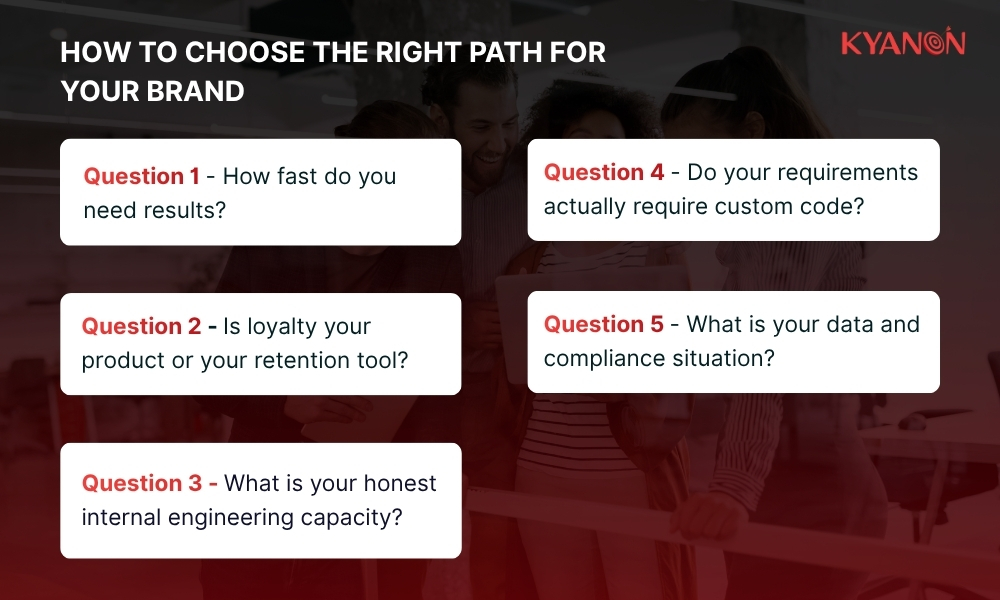
Question 1 – How fast do you need results?
Time-to-market is often a critical factor in digital initiatives. If your objective is to capture market share and launch within a matter of weeks, you should lean toward a standard white label platform or an agile hybrid approach implemented by Kyanon Digital. If your timeline affords several months or more, a fully custom build may be a viable route, provided the delay in ROI is strategically justified.
Question 2 – Is loyalty your product or your retention tool?
Define the primary role of the software in your business ecosystem. If loyalty is a mechanism to drive customer retention and increase lifetime value, you should buy a proven engine—your internal energy belongs on optimizing the customer experience, not building backend logic. Conversely, if the loyalty mechanism is your actual core product differentiator, a custom build may be warranted to protect your intellectual property.
Question 3 – What is your honest internal engineering capacity?
Building a loyalty platform is only 20% of the effort; maintaining it is the other 80%. If you do not possess a dedicated, in-house product team focused entirely on loyalty, do not build from scratch. However, if you have the specialized engineering talent and the guaranteed budget to support rigorous maintenance and upgrades for the next 3 to 5 years, a custom build becomes a defensible business decision.
Question 4 – Do your requirements actually require custom code?
Many enterprises believe their loyalty rules are unique, but standard platforms often easily accommodate them. If your program relies on standard mechanics—points calculation, tiered memberships, referral bonuses, campaign triggers, and API-based integrations—you should buy the engine. If your reward logic relies on genuinely unique, complex, and non-configurable algorithmic calculations that no off-the-shelf product can support, then you must build.
Question 5 – What is your data and compliance situation?
Data governance dictates infrastructure. If you operate in a highly regulated industry (such as healthcare or fintech) that mandates 100% data sovereignty and strict compliance, you need a custom build or a self-hosted headless engine (like Open Loyalty, which supports isolated enterprise environments). For brands with standard data privacy requirements (like typical retail GDPR/CCPA compliance), a standard white label SaaS or hybrid cloud solution is perfectly sufficient.
The executive decision matrix
To synthesize your evaluation, use the table below to align your brand’s current profile with the most effective technological pathway.
| If your brand profile is… | Your best path forward |
| An SME in F&B or hospitality needing a fast, cost-effective launch | White label platform |
| An enterprise brand in Retail/FMCG needing scale, high API volume, and custom UX | Hybrid — Open Loyalty engine + Kyanon Digital implementation |
| A brand where loyalty IS the core product (e.g., proprietary fintech rewards) | Custom build — or Open Loyalty self-hosted architecture |
| Unsure of market fit and wanting to validate customer behavior before committing | White label first, validate data, then migrate to a scalable hybrid model |
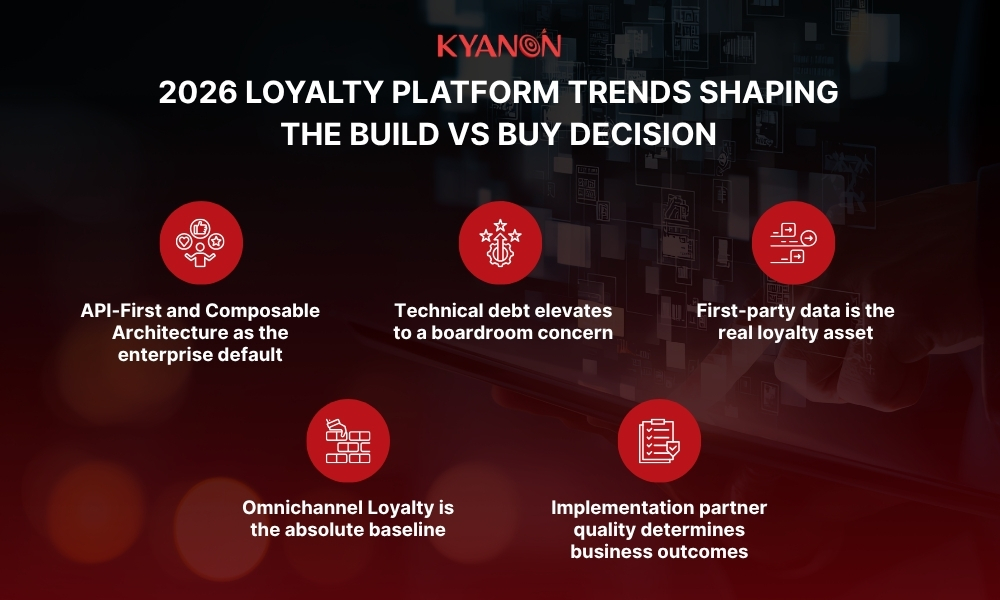
2026 loyalty platform trends shaping the build vs buy decision
As enterprise digital transformation initiatives mature, technology and marketing leaders are no longer evaluating software through a narrow feature checklist. In 2026, the evaluation metrics have fundamentally shifted toward long-term architectural agility, total cost of ownership (TCO), and data sovereignty.
At Kyanon Digital, our engineering teams have audited and engineered loyalty ecosystems across diverse global markets. From our boots-on-the-ground experience, we have identified five macro trends that are reshaping how enterprise boardrooms approach the definitive “build vs. buy” crossroad.
API-First and Composable Architecture as the enterprise default
The era of the rigid, monolithic all-in-one software suite is officially over. In 2026, enterprise IT infrastructures favor a best-of-breed model, accelerating the adoption of MACH (Microservices, API-first, Cloud-native, Headless) loyalty architectures. Throughout 2025 and moving directly into 2026, we have seen global brands aggressively move away from monolithic systems because they fail to adapt to changing consumer expectations.
When you choose a traditional, closed white label platform, you inherit its front-end limitations and engineering bottlenecks. Conversely, a headless loyalty engine allows you to decouple the complex transactional backend from your customer-facing touchpoints. Our senior architects emphasize that this shift prioritizes long-term operational flexibility over the short-term convenience of pre-packaged, cookie-cutter templates, ensuring your technology stack remains future-proof.
Technical debt elevates to a boardroom concern
Building a proprietary loyalty platform from scratch has historically been viewed as a badge of engineering pride. However, in 2026, the long-term financial reality of custom code has caught up with executive leadership teams. Enterprise loyalty programs require ongoing integration with CRM, POS, e-commerce, mobile, and customer data systems, creating long-term maintenance and support obligations beyond the initial implementation.
This recurring overhead includes:
- Continuous security patching and compliance updates.
- Refactoring codebase to maintain compatibility with updated third-party APIs.
- Cloud infrastructure scaling and performance optimization for high-traffic campaigns.
When these multi-year costs are factored into the financial modeling, entirely custom builds rarely break even. Boardrooms are actively choosing to mitigate this technical debt by buying a proven backend engine, freeing up internal developer headcount to focus on revenue-generating proprietary features.
First-party data is the real loyalty asset
In a modern data ecosystem defined by strict global privacy regulations and the deprecation of traditional tracking mechanisms, first-party data is an enterprise’s most valuable asset. Brands have realized that a loyalty program is not just a mechanism to distribute discount coupons—it is an invaluable first-party data engine.
Consequently, modern brands are refusing to lock their data inside restrictive black-box SaaS systems. The decision to buy or hybridize is now heavily influenced by platforms that offer absolute data ownership guarantees and clean, real-time API data exports. Securely streaming customer behaviors, zero-party preferences, and purchase data directly into your central Customer Data Platform (CDP) or data warehouse is a mandatory requirement for driving true personalization and business growth.
Omnichannel Loyalty is the absolute baseline
The modern consumer journey does not happen in a silo. A customer may discover a reward tier on your mobile application, attempt to earn points during an in-store checkout, and redeem an exclusive perk through a third-party delivery aggregator or eCommerce storefront. Programs that fail to unify these channels instantly lose relevance and erode brand trust.
Legacy white label tools rely on batched data transfers that lead to frustrating delays in point balances. Advanced systems, such as Open Loyalty, are engineered entirely on highly responsive, event-driven architectures that process transactions natively in real time. This technical baseline ensures a happy customer experience by updating account profiles instantly, regardless of where the interaction occurs.
Implementation partner quality determines business outcomes
Platform selection is no longer the primary differentiator; it is simply table stakes. The true competitive advantage does not stem from the software license you purchase, but from how that platform is deployed, integrated, and optimized to fit your unique operational workflows.
Because headless and composable loyalty engines require precise integration to function at maximum capacity, choosing the right digital technology company is just as critical as choosing the software itself. An underconfigured system can result in high latency and broken data syncs. Partnering with a proven technology specialist guarantees that your backend core connects flawlessly with your legacy ERP, POS, and CRM frameworks, transforming raw technical features into sustainable, long-term customer value.
Final thoughts: The right platform is the one you’ll actually launch
The build vs. buy debate regarding how to deploy a white label loyalty platform has reached a definitive conclusion in 2026. Most enterprise brands no longer need to force themselves into a restrictive binary choice between total ownership and renting a rigid software suite. Instead, the most sustainable path to achieving high loyalty program ROI is adopting a hybrid model driven by MACH architecture. Enterprises need a proven backend engine that safely handles complex transactional infrastructure, paired with a trusted implementation partner who can turn that raw technical capability into a highly differentiated, happy customer experience.
This is exactly where our first-hand engineering experience at Kyanon Digital becomes your strategic business advantage. Based on our extensive track record of architecting and deploying complex digital ecosystems across highly competitive markets, including Singapore, Malaysia, Australia, and the UK, we know that software alone does not drive customer retention. While an advanced, headless loyalty engine like Open Loyalty provides the secure, scalable foundation, Kyanon Digital delivers the critical implementation expertise. We manage the entire lifecycle: from initial architecture design and flawless legacy POS/CRM integration to continuous post-launch campaign optimization.
If your enterprise is currently evaluating an Open Loyalty integration or debating the merits of a hybrid model, you need a technology partner who prioritizes your long-term business impact over simply selling a software license. Our digital engineering team is ready to help you map the exact right path forward. We provide an honest, data-driven assessment of whether your specific operational and compliance requirements justify building from scratch, buying off-the-shelf, or combining the best of both worlds.
Ultimately, the best loyalty system is not the one with the most hypothetical features; it is the one you can launch rapidly, maintain cost-effectively, and use to make a genuine digital impact on your bottom line.
Ready to transform your customer retention strategy? Talk to Kyanon Digital’s loyalty team today.



 Create project brief with AI