

You have outgrown your basic cash register. Or perhaps you are setting up a new location and suddenly face two vastly different architectural approaches, each with bold promises. Making the right choice between a cloud POS or a traditional setup is critical; one wrong move and you risk locking your business into an inflexible infrastructure for years.
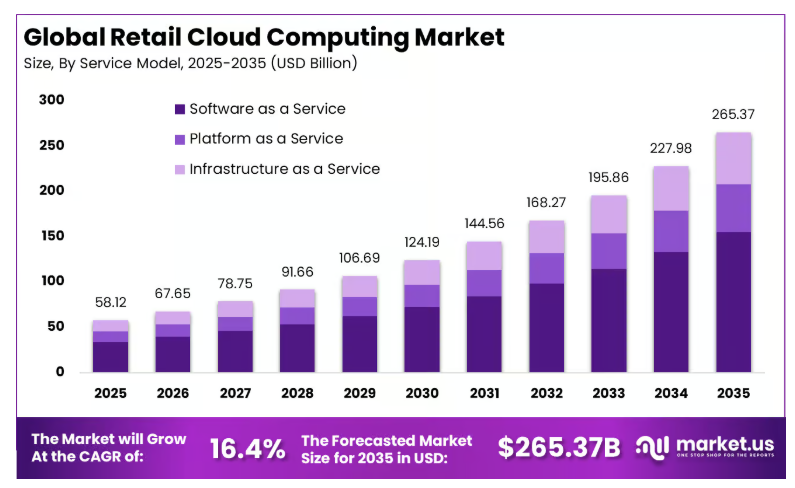
Choosing a point of sale system is no longer just about selecting a “checkout tool.” It fundamentally impacts your daily operations, data visibility, scalability, and long-term cost structure. Stated by Market US, the public cloud deployments account for approximately 60% of retail cloud implementations, while many retailers continue to rely on legacy POS and ERP environments for core transactional workloads.
This guide provides a practical, vendor-agnostic comparison to help you choose the right infrastructure based on your business reality. Grounded in Kyanon Digital’s practitioner expertise, stemming from years of integrating omnichannel, eCommerce, and loyalty stacks for retail and F&B brands across APAC, we will help you make a decision that drives actual digital impact. Read on to discover which system aligns with your growth strategy.
Key takeaways
- Choose a cloud POS if you want remote access, easy multi-location scaling, and affordable monthly subscriptions using standard tablets.
- Choose a traditional POS (on-premise) if you operate a single, stable location and prioritize absolute offline reliability without relying on an internet connection.
- Cloud systems boast low upfront costs and automatic updates but depend heavily on ongoing SaaS fees and stable internet.
- Traditional on-premise setups require significant initial hardware investments and manual IT maintenance but offer predictable long-term costs.
- For seamless integration with modern eCommerce, CRM, and omnichannel loyalty programs, cloud-based architectures are the definitive industry standard.
Further reading:
- How To Design & Manage Omnichannel Customer Experience
- Three Best Practices Omnichannel Fulfillment For Retailers
- Omnichannel Ecommerce Development in Singapore
What is a Cloud POS System?
A cloud POS is point-of-sale software that runs on remote servers, making it accessible via the internet from virtually any device, including standard tablets, laptops, and smartphones. The data flow is straightforward: in-store transactions are encrypted and sent to cloud servers, ensuring real-time synchronization across all your business locations.
Typically deployed using an iPad or Android tablet paired with a web-based dashboard, this architecture thrives on its API-first design. One of its key characteristics is the ability to receive automatic software updates without requiring an on-site IT team. Well-known examples of this pos cloud software include Square, Shopify POS, Lightspeed, and Toast for the food and beverage industry.

What is a Traditional (On-Premise) POS System?
In contrast, a traditional POS is software installed directly onto a local server or computer situated physically within your store, meaning all business data is stored on-site. The transaction data flows directly into a local hard drive, requiring manual backups and offering no remote access by default.
A traditional setup typically involves dedicated, proprietary terminals connected to a back-office local server. A defining characteristic of pos software cloud based alternatives is constant connectivity; however, traditional systems operate completely independent of the internet and usually require a one-time license fee. Legacy players in this space include NCR, Oracle MICROS, and older versions of Revel.
Cloud POS vs. Traditional POS: Side-by-side comparison
When evaluating a core operational system, technical specifications only tell half the story. The true measure of a point-of-sale architecture lies in its impact on your daily operations, total cost of ownership, and ability to seamlessly scale as customer demands shift.
The following side-by-side comparison breaks down these two distinct approaches across the most critical business dimensions, empowering you to make an informed, data-driven infrastructure decision that drives long-term digital impact.
Comprehensive feature matrix
Feature Dimension | Cloud POS Platform | Traditional On-Premise POS |
| Financial Classification | Operating Expense (OpEx) | Capital Expenditure (CapEx) |
Initial Upfront Capital | Low ($400 – $1,500 per station) | High ($4,000 – $11,000+ per store) |
| Recurring Monthly Base | $50 – $150 software subscription | $0 (or $30–$100 optional maintenance contract) |
Database Synchronization | Real-Time. Changes instantly push everywhere. | Batch Syncing. Usually runs at close of day. |
| Internet Dependency | High. Relies on stable broadband. | Zero for core sales. Needs it only for card processing. |
Hardware Ecosystem | Open. Compatible with iOS, Android, and Web. | Proprietary. Tied to specific vendor terminals. |
| Software Maintenance | Automatic, silent overnight updates. | Manual, tech-assisted patches per machine. |
API & App Integrations | Extensible. One-click marketplace connections. | Restricted. Requires custom coding or middleware. |
| System Scalability | Frictionless. Launch a device via an app store. | Complex. Requires manual physical server mapping. |
Disaster Recovery Risk | Local device damage has zero data loss. | Local drive failures can erase historic records. |
The financial parameters highlighted in the architectural comparison matrix are derived from consolidated market intelligence, industry data, and provider.
All stated ranges serve as baseline market estimations. Final implementation pricing varies significantly depending on specific peripheral integrations (such as industrial scale mappings or customer-facing displays), lane configuration density, processing volume discount brackets, and custom technical middleware requirements.
Cloud POS: Strengths, limitations, and when it makes sense
Key advantages of Cloud POS
The primary business advantage of a Cloud POS system is operational agility. By moving the transaction engine to the cloud, retailers replace rigid, expensive on-premise hardware with a flexible software ecosystem that scales instantly.
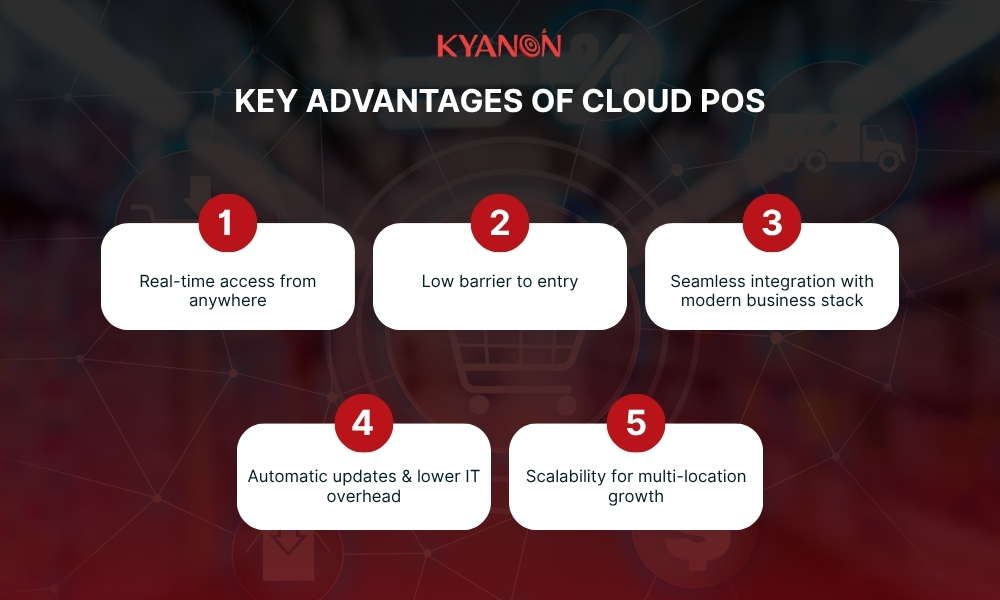
- Real-time access from anywhere: With a cloud point of sale software, you can check sales metrics, inventory levels, and staff performance from your phone or laptop. You do not need to be physically present at the store, providing total visibility without waiting for a store manager’s end-of-day report.
- Low barrier to entry: Hardware requirements are minimal; you can utilize standard iPads or Android tablets costing between $300 and $800 instead of purchasing expensive, dedicated terminals. The software operates on a SaaS subscription model (typically $50–$200/month per location) rather than a hefty upfront license.
- Seamless integration with modern business stack: These systems feature native connectors to platforms like Shopify, Xero, and top delivery apps. From a technical perspective, the API-first architecture allows bidirectional data flow, meaning an in-store purchase can instantly trigger loyalty points and sync inventory across your online channels.
- Automatic updates & lower IT overhead: Security patches and new features are deployed automatically by the vendor, eliminating the need to schedule costly downtime. This significantly reduces your reliance on dedicated on-site IT personnel.
- Scalability for multi-location growth: Adding a new store is remarkably simple. You configure the new location in your centralized dashboard, ship a tablet to the site, and you can go live within 24 to 48 hours, with pricing and inventory instantly synchronized.
Limitations of Cloud POS
While cloud POS systems offer unmatched flexibility, they introduce specific operational risks and vulnerabilities that do not affect traditional on-premise infrastructure.
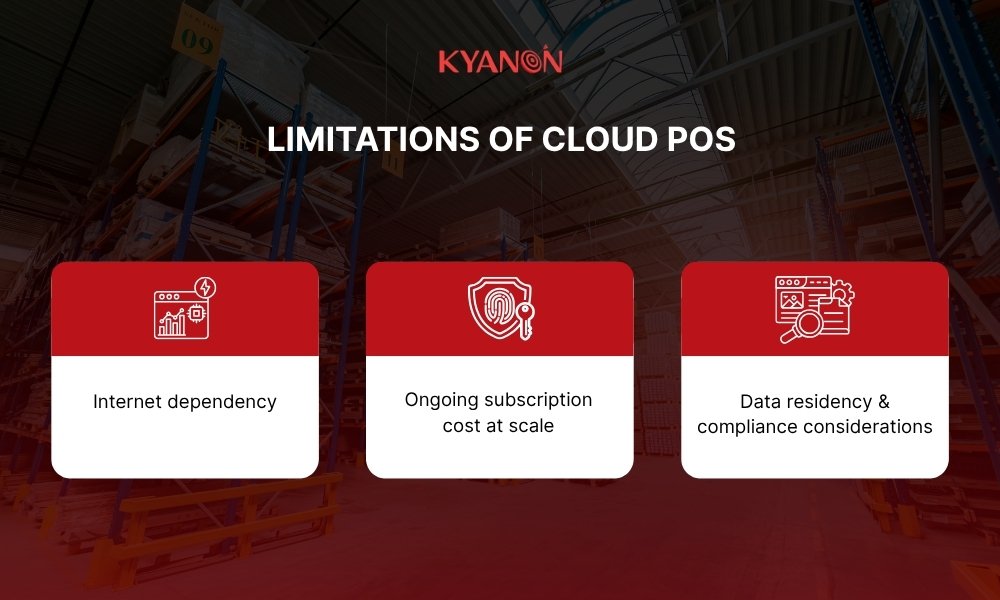
- Internet dependency: The core risk is connectivity. If your internet drops and the system’s offline mode is weak, your operations will stall. It is critical to choose a vendor with a robust offline mode that caches data locally and syncs automatically when the connection is restored.
- Ongoing subscription cost at scale: While the upfront cost is low, ongoing SaaS fees accumulate. Ten locations paying $150 a month equates to $18,000 annually. You must carefully model the total cost of ownership over a 3-to-5-year period. This pricing baseline aligns with actual mid-to-enterprise tier software packages documented in Lightspeed’s Retail Cost Framework and multi-register enterprise rollout parameters outlined by Square POS for Business.
- Data residency & compliance considerations: Because your transaction data is stored on external cloud infrastructure, enterprise businesses must confirm the data center regions (e.g., SG/ANZ/EU) to ensure compliance with strict regulations like PDPA or GDPR.
“Choosing the right POS system is step one. The real complexity begins when you need it to talk to your eCommerce platform, loyalty program, CRM, and inventory management system in real time.” – Kyanon Digital Architect
Traditional POS: Strengths, limitations, and when it still makes sense
Key advantages of Traditional POS
The primary business advantage of a traditional on-premise POS system is absolute operational control. By anchoring the system to an internal physical server, retailers eliminate third-party dependencies, protect profit margins at high volume, and secure data within their own infrastructure.
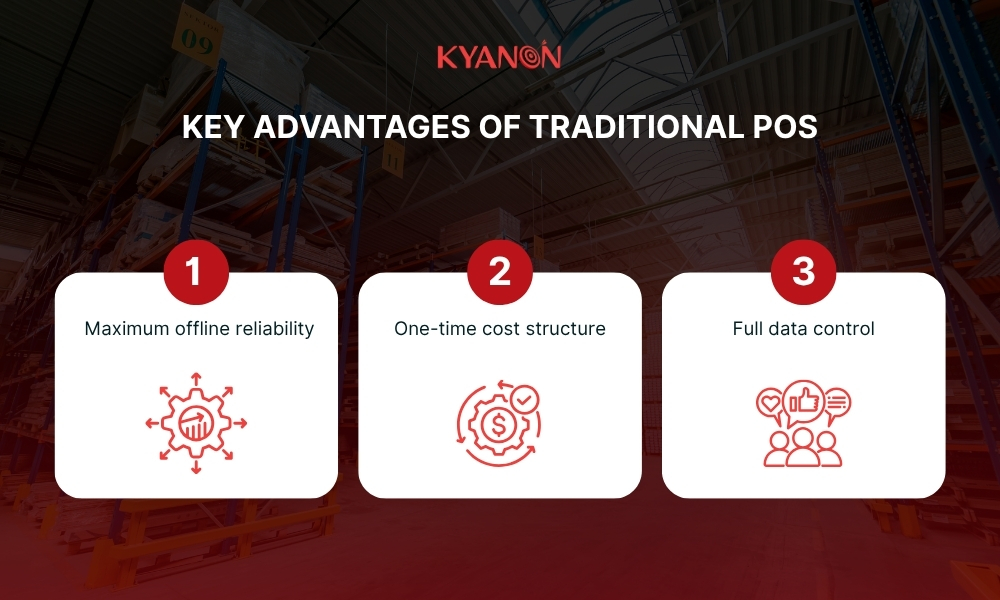
- Maximum offline reliability: For venues in remote areas, basement locations, or developing regions with consistently poor internet, traditional setups offer unmatched stability. They are 100% functional without an internet connection, eliminating third-party uptime risks.
- One-time cost structure: You pay once for the license and own the software. This provides a predictable financial structure for a single, established store and can be more cost-effective than continuous SaaS subscriptions over a long timeline.
- Full data control: All transactional data remains on-site. For businesses with strict data sovereignty mandates, avoiding external vendor hosting is a significant operational advantage.
Limitations of Traditional POS
The primary business limitation of a traditional on-premise POS system is operational rigidity. By anchoring your data to a physical building, you inherit massive upfront costs, ongoing technical debt, and isolated information silos that restrict business growth.
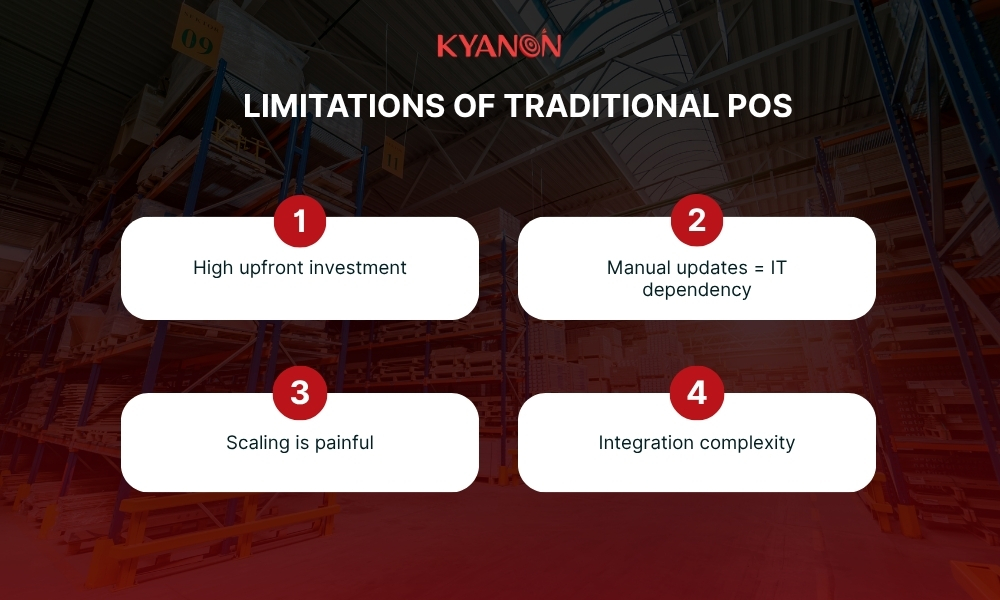
- High upfront investment: Traditional on-premise POS deployments typically require significant upfront investment. Businesses may spend $2,000–$5,000 on local server infrastructure, $1,000–$5,000 on perpetual software licensing, and additional costs for POS terminals, printers, scanners, and installation before operations begin. (Helcim)
- Manual updates = IT dependency: Every necessary software update or security patch requires an IT technician visit or a manual implementation process. Delayed patches translate directly into operational vulnerability and security risks.
- Scaling is painful: Each new retail branch demands a fresh hardware investment and a new local server. Without complex custom integrations, consolidating reports across multiple locations in real time is nearly impossible.
- Integration complexity: These systems rarely offer native API connectors. Integrating them with modern eCommerce stores or CRM platforms usually requires expensive custom middleware, rapidly accumulating technical debt.
Cloud POS or Traditional POS? A decision framework for 2026
To determine which infrastructure is right for your business operations, consider these five critical filters:
Q1: How many locations do you have?
If you operate a single location with no expansion plans, a traditional setup is viable. If you have multiple locations or plan to scale, a cloud based point of sale software is strongly recommended.
Q2: How reliable is your internet?
If you have reliable broadband, cloud systems pose no risk. If you are in a location with consistently poor or no internet connectivity, you must choose a traditional POS.
Q3: What are your integration needs?
Do you need to easily integrate with modern tools like eCommerce, accounting, or loyalty programs? If yes, a cloud-based API-native solution is essential.
Q4: What is your budget structure?
If you prefer lower initial costs via SaaS pricing, cloud is the way to go. If you prefer a one-time upfront software license rather than ongoing monthly subscriptions, choose traditional.
Q5: Do you have an in-house IT team?
If you lack dedicated IT staff, the automatic updates managed by cloud vendors are a lifesaver. Traditional setups require manual IT intervention.
Quick Decision Matrix
Business Scenario | Recommended POS Architecture |
| Multi-location retail, omnichannel strategy | Cloud POS |
Single F&B outlet, reliable internet | Cloud POS |
| Remote store, unreliable connectivity | Traditional POS |
Pop-up shops, temporary locations | Cloud POS |
| Single store, no growth plan, cost-sensitive | Traditional POS |
Enterprise retail chain | Cloud POS (API-first) |
From POS selection to full omnichannel integration
Choosing the right POS system is step one. The real complexity begins when you need it to talk to your eCommerce platform, loyalty program, CRM, and inventory management system in real time.
Kyanon Digital is an APAC-based enterprise transformation partner specialising in omnichannel retail and eCommerce architecture, including cloud POS integration into complex multi-system environments. With offices in Singapore, Australia, Vietnam, and Malaysia, KD’s team has helped Retail and F&B brands build connected commerce infrastructure that scales.
Talk to Kyanon Digital about your POS integration.
Case Study of Kyanon Digital: Strategic Digital Transformation: Re-Engineering The Omnichannel Value Chain For A Leading Luxury Consumer Goods Brands

Kyanon Digital partnered with a leading luxury consumer goods brand to modernize its omnichannel customer experience by integrating loyalty, e-commerce, CRM, ERP, and retail operations into a unified digital ecosystem. The solution included a centralized loyalty and promotion platform, B2C mobile app, e-commerce website, B2B portal, and seamless CRM/POS/ERP integrations, enabling customers to earn and redeem rewards consistently across online and offline channels.
By consolidating customer data and automating personalized engagement, the brand improved customer retention, increased repeat purchases, enhanced marketing effectiveness, and gained a scalable foundation for data-driven growth and premium customer experiences across all touchpoints.
Explore the full case study here: Re-Engineering The Omnichannel Value Chain For A Leading Luxury Consumer Goods Brands
How POS technology is evolving in 2026
In 2026, Point of Sale (POS) technology is shifting from a basic checkout tool into a centralized business operating system. Modern architectures emphasize software flexibility, artificial intelligence, and zero-hardware payment methods over heavy physical infrastructure.
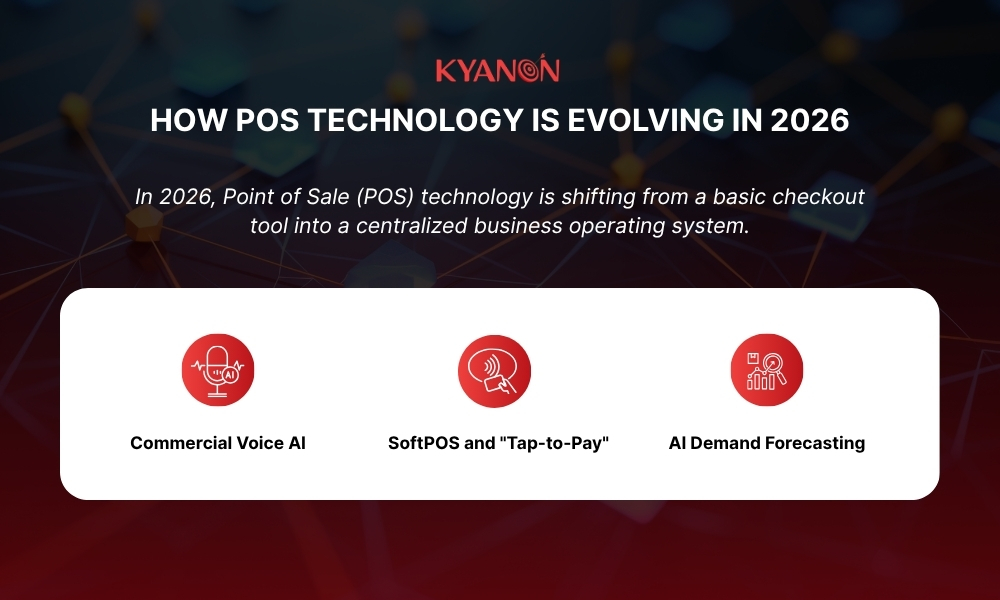
Commercial Voice AI
Quick-service restaurants and warehouses use natural language processing (NLP) to handle drive-thrus, query real-time stock levels, and modify tickets completely hands-free.
SoftPOS and “Tap-to-Pay”
Retailers are bypassing standalone credit card terminals. Using Near Field Communication (NFC), standard consumer smartphones and tablets double directly as payment registers without external hardware plug-ins.
AI Demand Forecasting
Embedded machine learning algorithms track localized sales trends to automatically draft warehouse purchase orders, optimize employee shift schedules, and implement real-time dynamic pricing.
Global checkout compliance frameworks are heavily influencing system designs. International standards, such as PCI DSS v4.0 for tighter transactional tokenization, mandatory e-invoicing laws, and digitized digital identity verification protocols are forcing older legacy systems out of the market entirely.
Future-proofing your retail operations with the right POS infrastructure
Choosing between a cloud POS and a traditional system fundamentally shapes your business’s ability to scale, integrate, and operate efficiently. For most growing businesses in 2026, especially those focused on building omnichannel capabilities, cloud infrastructure is the clear winner due to its flexibility, real-time data access, and API integrations. However, traditional POS remains a valid choice for single locations lacking reliable internet or those requiring strict data sovereignty.
If you are upgrading your POS infrastructure as part of a broader digital transformation and want to get the integration architecture right the first time, Kyanon Digital’s team is here to help. We empower Retail and F&B brands across APAC to build connected commerce systems designed for long-term impact.
Contact Kyanon Digital today for a free consultation to map out your digital transformation strategy.
Disclaimer: All company names, logos, and brands are property of their respective owners. Their mention in this article is for informational and review purposes only and does not imply endorsement or infringement of copyright.





 Create project brief with AI