


Retail digital transformation trends in Australia are entering a new phase, as 85% of Australian businesses are preparing for agentic commerce (Australia Post eCommerce Report 2026). For retailers, the issue is no longer whether digital matters. The harder question is which transformation investments will protect margin, improve customer experience, and reduce operational risk.
Australian retailers are caught between rising wage costs, fragmented legacy systems, value-conscious consumers, and customers who expect real-time service across every channel. At the same time, AI, omnichannel commerce, smart store automation, cybersecurity, and supply chain transparency are becoming practical business priorities rather than future concepts.
This article breaks down the top retail digital transformation trends shaping Australia in 2026, with market data, Australian examples, execution requirements, and decision points for enterprises planning their next transformation roadmap.
Key Takeaways
- Australia’s retail market is recovering, but growth is uneven. Digital channels are expanding faster than many store-only models.
- The five major trends shaping retail transformation are AI personalization, unified omnichannel, smart store automation, supply chain transparency, and cybersecurity.
- AI creates value only when customer, product, inventory, and transaction data are clean and connected.
- Omnichannel is no longer a differentiator. The real challenge is whether POS, eCommerce, loyalty, inventory, and fulfillment systems work as one.
- Smart store technology is becoming a margin-protection tool, especially as wage pressure and inventory accuracy issues continue.
- Sustainability claims now require evidence. Transparency is becoming both a trust issue and a compliance issue.
- Cybersecurity is not a back-office concern. It is a core requirement for digital retail operations.
Australian Retail Is Being Reinvented – But Not Equally
Australian retail is being reshaped by a simple tension: shoppers want better value, faster fulfillment, more personalization, and more trustworthy brands, while retailers face higher operating complexity.
The gap is no longer between “offline” and “online” retailers. It is between businesses that are only adding digital tools and businesses that are genuinely transforming their operating model.
| Retailer Type | What It Looks Like |
Main Risk |
| Digitally active | Has eCommerce, app, digital ads, loyalty emails |
Channels still operate separately |
|
Digitally connected |
POS, inventory, loyalty, CRM, and eCommerce share data | Integration and governance become critical |
| Digitally transformed | Uses unified data, AI, automation, and real-time operations |
Needs disciplined execution, not just tools |
The most important lesson for 2026: transformation is not about adding more platforms. It is about building a connected retail operating system.

The 2026 Australian Retail Landscape – Recovery, Reinvention, and Rising Expectations
Australia’s retail market is showing signs of resilience, but the recovery is not simple. Household spending is still sensitive to cost-of-living pressure, and online retail is becoming a larger part of total retail activity.
|
Market Signal |
Meaning for Retailers |
| Online spend reached A$82.6 billion in 2025 |
Digital commerce is now a core revenue channel, not a side channel |
|
24% of retail spend is now made online |
Store and online planning must be connected |
| Household spending rose year-on-year in early 2026 |
Demand exists, but customers remain careful |
|
National minimum wage rises from July 2026 |
Store automation and workforce productivity become more important |
| Retail AI is a top technology priority globally |
AI adoption is moving from experiment to operating capability |
|
Data breach notifications remain high in Australia |
Cybersecurity and privacy must be part of transformation design |
Source: Australia Post eCommerce Report 2026, Australian Bureau of Statistics 2026,Fair Work Commission 2026, Deloitte 2026 Retail Industry Global Outlook, OAIC Notifiable Data Breaches statistics, Jan–Jun 2025.
For Australian and APAC retailers, the market difference is important. Australia has mature payment behaviour, strong logistics expectations, high labour costs, and strict privacy expectations. These conditions make transformation more complex than simply copying global retail technology trends.
5 Retail Digital Transformation Trends Shaping Australia in 2026
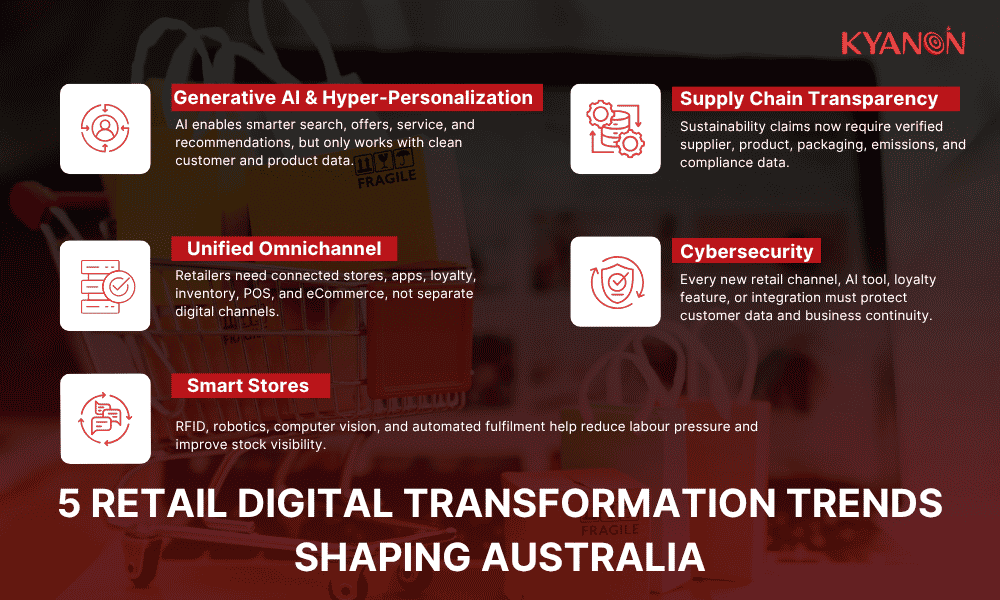
Generative AI and Hyper-Personalization
AI is shifting retail personalization from broad customer segments to real-time, individual-level experiences. The practical use cases include product discovery, loyalty offers, AI shopping assistants, customer service automation, marketing copy, demand forecasting, and smarter search.
In Australia, AI is already becoming visible in fashion, grocery, and home improvement retail. THE ICONIC has worked with Google Cloud on generative AI for search experiences. The important point is not the chatbot itself. The real value comes from the data layer behind it.
What AI personalization requires:
- Unified customer profiles across store, app, website, loyalty, and service channels
- Clean product data, including attributes, taxonomy, images, price, and availability
- Consent-aware data collection and privacy controls
- AI governance for recommendations, offers, and customer-facing responses
- Human review for high-risk content, pricing, and sensitive customer interactions
Business insight: Retailers with fragmented data should not start with advanced AI personalization. They should start with data quality, consent management, and customer identity resolution. AI will not fix poor data foundations; it will amplify them.
Kyanon Digital often sees retailers move too quickly into AI personalization while customer, product, and transaction data remain fragmented. In practice, AI does not solve weak data foundations; it scales them into customer-facing errors faster.
Unified Omnichannel – When “Phygital” Becomes Standard
Omnichannel is no longer about having stores and an online shop. It means the business can recognize one customer, one order, one inventory position, and one loyalty relationship across every touchpoint.
Australian examples show both the promise and the difficulty of omnichannel execution. Bunnings offers Click & Collect and app-based product location features. JB Hi-Fi’s official Click & Collect help page describes Click & Collect as a way to buy online and pick up items from a local JB Hi-Fi store.
The lesson is clear: Omnichannel success depends on integration, not front-end design alone.
|
Omnichannel Capability |
Why It Matters |
| Real-time inventory |
Prevents selling unavailable products |
|
Unified loyalty |
Lets customers earn and redeem across channels |
| Connected POS and eCommerce |
Reduces order errors and manual reconciliation |
|
Mobile-first UX |
Supports in-store research and faster checkout |
| Store fulfilment logic |
Turns stores into local fulfilment nodes |
Common failure point: Many omnichannel projects fail at the integration layer. A modern app cannot compensate for outdated POS, delayed inventory sync, or disconnected loyalty systems.
In Kyanon Digital’s retail transformation engagements across ANZ, the most common mistake is launching omnichannel features before unifying inventory, POS, loyalty, and fulfillment data. This creates the appearance of integration without the operational reliability customers expect.
Smart Stores – Automation Tackles Labour Costs and Inventory Gaps
Smart store technology is becoming a response to two business pressures: high labor costs and poor inventory visibility.
The technologies include RFID, smart shelves, computer vision, automated fulfillment, mobile task management, and warehouse robotics. In grocery and high-volume retail, automation is especially valuable because small errors in availability, picking, replenishment, and shelf execution can quickly affect revenue.
Woolworths’ investment in automated fulfillment and distribution infrastructure shows how Australian retailers are using automation to improve online capacity, faster shelf replenishment, and supply chain resilience. Its Auburn automated customer fulfillment center increased online capacity across Western Sydney by over 50%, while its $1.3 billion Moorebank distribution precinct is designed to move products onto shelves faster through aisle-ready pallets.
Where smart store technology creates value:
- Faster replenishment alerts
- Better shelf availability
- Lower manual stock-counting workload
- More accurate click-and-collect picking
- Reduced fulfilment bottlenecks
- Better labour allocation during peak trading periods
Execution requirement: Smart store tools need integration with inventory management, workforce management, and replenishment systems. Without that integration, sensors and computer vision create more data, but not better decisions.
Business insight: Automation should be designed to support staff productivity, not simply replace labor. The strongest retail use cases reduce repetitive work and help teams act faster.
From Kyanon Digital’s perspective, smart store technology creates value only when it is connected to inventory, workforce, and replenishment workflows. Sensors, RFID, or computer vision alone create more data, but not necessarily better decisions.
Supply Chain Transparency – When Sustainability Becomes a Technology Problem
Sustainability in Australian retail is moving from brand messaging to evidence management. Customers increasingly expect sustainable and ethical claims to be clear, specific, and credible. Regulators are also paying closer attention to misleading environmental claims.
This makes supply chain transparency a digital transformation issue. Retailers need data from suppliers, factories, logistics partners, materials, packaging, emissions, certifications, and audits. In fashion and groceries, this is especially complex because supply chains are multi-tiered and often global.
Country Road Group publicly states its commitment to improving traceability across raw materials, fabrics, and garments. THE ICONIC also references supplier visibility and traceability across its own-brand supply chains.
|
Transparency Need |
Technology Enabler |
|
Supplier visibility |
Supplier portals and onboarding workflows |
| Product origin |
Traceability systems, QR codes, digital records |
|
Sustainability claims |
Evidence repositories and approval workflows |
| Emissions tracking |
IoT, logistics data, carbon accounting tools |
|
Compliance reporting |
Data governance and audit trails |
Business insight: The biggest risk is not failing to publish a sustainability claim. The bigger risk is publishing a claim that cannot be proven. Digital transparency must be built on verified supplier data, not marketing language.
Cybersecurity – The Non-Negotiable Foundation of Retail Digital Transformation
As retailers connect POS, loyalty, eCommerce, customer service, delivery, payments, and third-party platforms, their attack surface grows. Retailers hold valuable customer data and operate many integrated systems, making them exposed to phishing, credential attacks, ransomware, API misuse, and third-party platform risk.
Cybersecurity must be designed into retail transformation from the start.
Core cybersecurity requirements:
- Multi-factor authentication for staff and admin systems
- Secure API design between POS, loyalty, CRM, and eCommerce
- Encryption for customer and payment-related data
- Role-based access control
- Vendor security assessment
- Incident response planning
- Regular access reviews and offboarding controls
- Privacy-by-design for customer data use
Business insight: Cybersecurity is not a final checklist before launch. It is a design principle. Every new digital channel, loyalty feature, AI use case, or third-party integration should be evaluated for privacy, security, and operational continuity.
Kyanon Digital views cybersecurity as part of retail architecture, not a final launch checklist. Every new loyalty feature, AI use case, API, or third-party integration should be assessed for privacy, access control, and operational continuity from day one.
How Australian Retailers Should Prioritize Digital Transformation in 2026
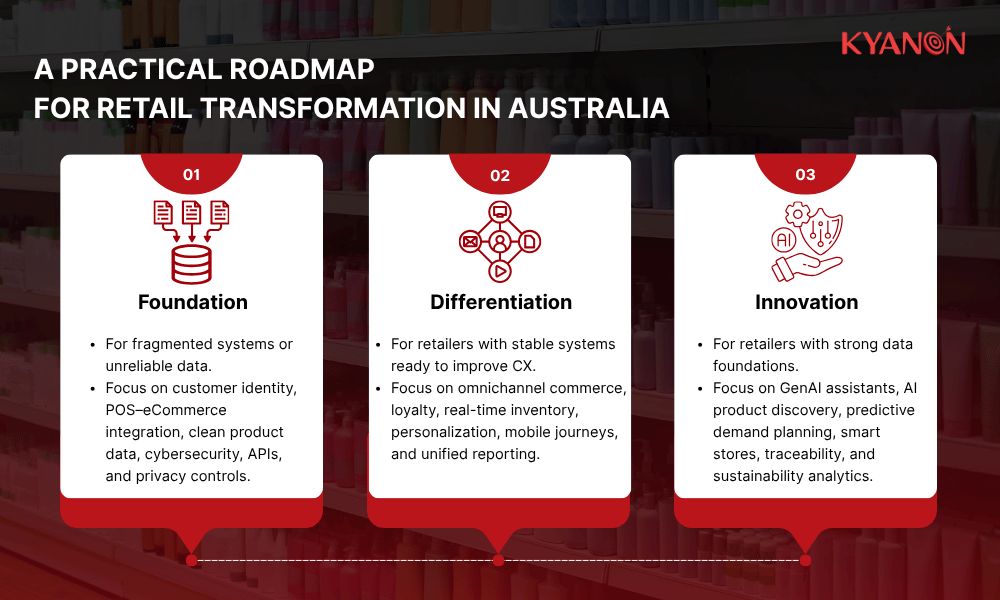
Not every retailer should invest in all five trends at the same time. The right sequence depends on current maturity, data quality, operating pressure, and customer experience gaps.
Stage 1: Foundation
Choose this stage if systems are fragmented or customer data is unreliable.
Priorities:
- Unified customer identity
- POS and eCommerce integration
- Clean product and inventory data
- Cloud migration where legacy systems block scale
- Cybersecurity baseline
- API governance
- Data privacy and consent controls
Best-fit transformation focus: Data infrastructure, integration, security, and operational visibility.
Stage 2: Differentiation
Choose this stage if the business already has stable systems but wants a stronger customer experience and loyalty.
Priorities:
- Omnichannel commerce architecture
- Loyalty program modernization
- Real-time inventory visibility
- Customer segmentation and personalization
- Mobile-first shopping journeys
- Unified reporting across channels
Best-fit transformation focus: Connected commerce, loyalty, data activation, and customer experience.
Stage 3: Innovation
Choose this stage if the business has strong data foundations and wants to move ahead of competitors.
Priorities:
- Generative AI shopping assistants
- AI-powered product discovery
- Predictive demand planning
- Computer vision shelf monitoring
- RFID and smart store automation
- Digital product passports and traceability
- Advanced sustainability analytics
Best-fit transformation focus: AI, automation, transparency, and new operating models.
In practice, retailers who start with Stage 3 (AI, automation) before Stage 1 (data, integration) spend 18–24 months backtracking. We’ve seen this pattern consistently across ANZ retail engagements.
Diagnostic Questions Before Choosing the Next Investment
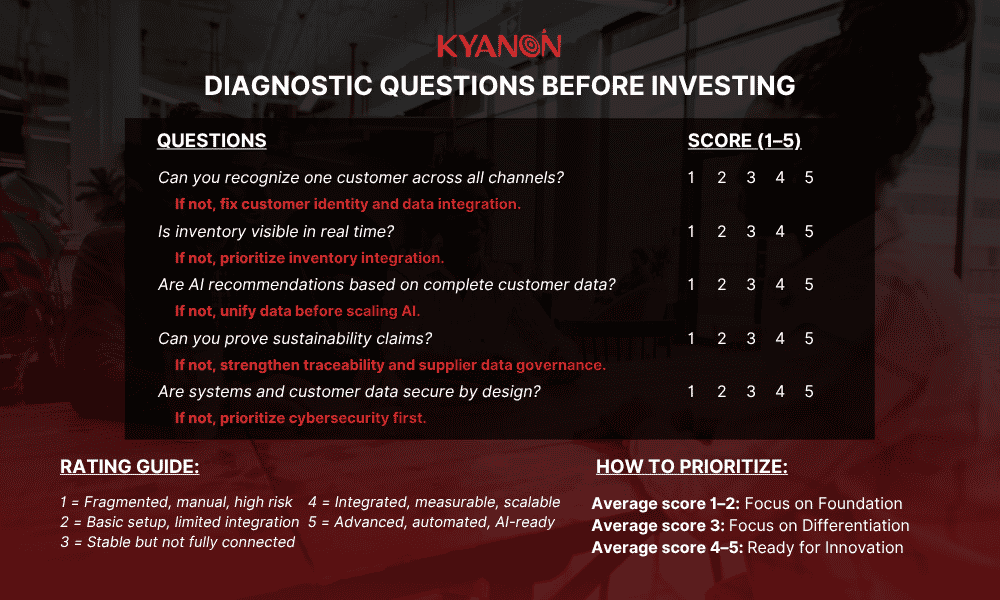
- Can the business recognize the same customer across store, website, app, loyalty, and service channels?
- If not, prioritize customer identity and data integration.
- Is inventory visible in real time across stores, warehouses, and online channels?
- If not, prioritize inventory integration before advanced omnichannel services.
- Are AI recommendations based on full customer behavior or only one channel?
- If only one channel, prioritize data unification before scaling AI.
- Can the business prove sustainability claims with supplier-level evidence?
- If not, prioritize traceability and supplier data governance.
- Are APIs, staff access, third-party tools, and customer data protected by design?
- If not, prioritize cybersecurity before expanding digital services.
In Kyanon Digital’s experience, retailers that start with AI or automation before fixing data, integration, and governance often spend months backtracking. The strongest transformation roadmaps start with operational foundations before scaling innovation.
2026 Retail Digital Transformation Trends at a Glance
| Trend | Key Technology | Australian Examples |
Business Impact |
|
AI & Hyper-Personalization |
GenAI, ML, CDP, recommendation engines | THE ICONIC, Woolworths, Bunnings | Better discovery, loyalty, and service efficiency |
| Unified Omnichannel | API commerce, POS integration, mobile UX | Bunnings, Woolworths, JB Hi-Fi |
Lower friction and stronger cross-channel revenue |
|
Smart Store Automation |
RFID, computer vision, automated fulfilment | Woolworths fulfilment and distribution automation | Better availability and labour productivity |
| Supply Chain Transparency | Supplier portals, traceability, digital product records | Country Road Group, THE ICONIC |
Trust, compliance, and lower greenwashing risk |
|
Cybersecurity & Compliance |
MFA, secure APIs, encryption, access control | Industry-wide requirement |
Data protection and operational resilience |
What Makes Australia Different from Global Retail Transformation
Global retail trends apply to Australia, but local execution conditions are different.
| Area | Global Trend |
Australian Difference |
|
AI |
Retailers are scaling personalization and automation | Data privacy, trust, and customer consent are major constraints |
| Omnichannel | Store and online journeys are converging |
Large geography makes fulfilment and delivery reliability harder |
|
Store automation |
Labour productivity is a global priority | Wage pressure makes automation ROI more urgent |
| Sustainability | Traceability is becoming mainstream |
Environmental claims face stronger scrutiny from regulators |
|
Cybersecurity |
Retail attacks are increasing globally |
Australian breach notification and privacy reform raise accountability |
For APAC retailers using Australia as a benchmark, the key lesson is discipline. Digital transformation succeeds when technology, data, operations, and governance move together.
Common Mistakes in Retail Digital Transformation
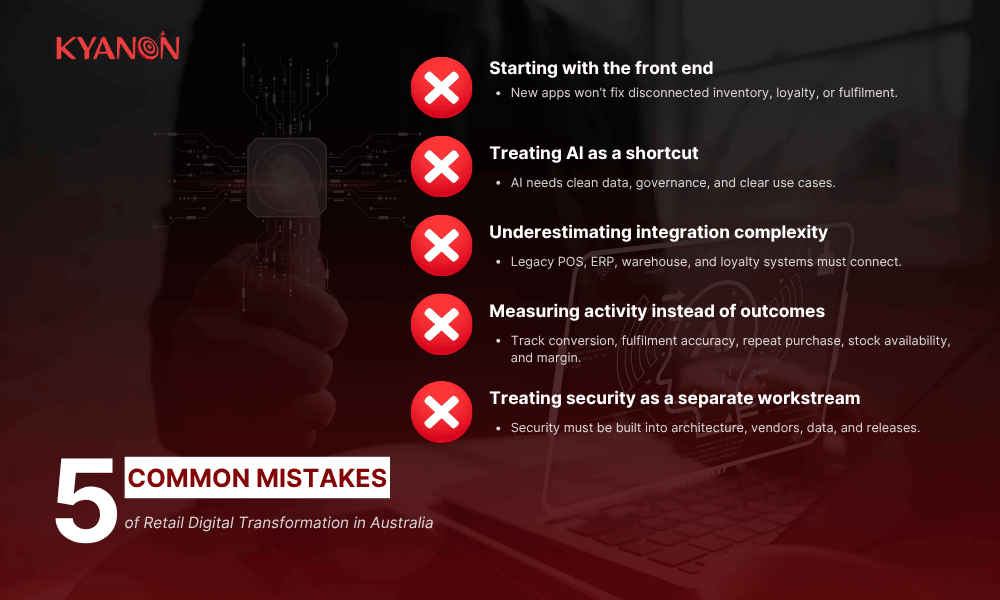
Starting with the front end
A new website, app, or checkout experience may improve perception, but it will not solve disconnected inventory, loyalty, and fulfilment systems.
Treating AI as a shortcut
AI personalization needs clean data, strong governance, and clear use cases. Without these, it can create irrelevant offers, inaccurate recommendations, and privacy risk.
Underestimating integration complexity
Retail transformation often fails because old POS, ERP, warehouse, and loyalty platforms do not connect cleanly.
Measuring activity instead of outcomes
Launching tools is not a transformation. Better metrics include conversion rate, fulfillment accuracy, repeat purchase rate, stock availability, support resolution time, and margin improvement.
Treating security as a separate workstream
Security must be part of architecture, vendor selection, data design, and release governance.
The Retailers Who Transform Now Will Define the Next Decade
The top retail digital transformation trends shaping Australia are not isolated technology themes. AI, omnichannel, smart stores, supply chain transparency, and cybersecurity are converging into one operating challenge: how to build a retail business that is connected, trusted, efficient, and adaptive.
Most businesses cannot execute all five trends at once. The smarter path is sequencing:
- Build the data, integration, and security foundation first.
- Use that foundation to improve omnichannel and loyalty.
- Then scale AI, automation, and transparency with stronger control.
For businesses planning a future retail transformation roadmap, Kyanon Digital can support roadmap validation, omnichannel architecture, loyalty platform integration, AI personalization, data infrastructure, and execution planning across Australia and APAC.
Contact Kyanon Digital to pressure-test your retail transformation roadmap before your next major investment cycle.








 Create project brief with AI