

Choosing an enterprise loyalty platform is no longer a marketing team decision made in isolation. It now sits at the intersection of customer data strategy, integration architecture, and total cost of ownership, which is exactly why so many enterprise buyers get it wrong. If you’re a CTO, CIO, or Head of Digital evaluating loyalty technology for the first time, or re-platforming after a stalled first attempt, the volume of vendor claims can make the decision feel harder than it should be.
What is an enterprise loyalty platform?
An enterprise loyalty platform is a high-availability, mission-critical infrastructure layer engineered to compute complex reward logic, process high-velocity transaction events, and synchronize zero-party customer data across fragmented omnichannel networks in real time under absolute data governance.
Most enterprise loyalty platform evaluations stall for the same reason: teams compare vendors before deciding what architecture they actually need. This guide fixes that, starting with the four platform types that exist, the five criteria that actually separate good fits from expensive mistakes, and a practical checklist you can take into RFP conversations tomorrow. By reading this guide, tech leaders can actively avoid multi-year vendor lock-ins, catastrophic checkout latencies, and millions in un-depreciated technical debt.
Key Takeaways
- Architecture first: decide between a headless, API-first loyalty engine and an integrated suite before comparing vendors; this choice shapes every downstream decision.
- Integration depth matters more than feature lists: sub-150ms API response times and native POS, CRM, and eCommerce connectors determine whether a platform works at enterprise scale.
- Model cost at 10x volume: Pricing that looks reasonable at your current member count can become unpredictable as the program scales, so test both ends before signing.
- Match platform type to in-house capability: teams without dedicated loyalty or engineering resources are usually better served by a managed provider; tech-forward teams gain more from API-first engines.
- Implementation approach is a real differentiator: vendor-led onboarding and self-service API integration carry different support models and long-term flexibility trade-offs, not just different timelines.
Further reading:
- Smart Loyalty: Personalization Beyond Points
- A Practical Guide To Food And Beverage Loyalty Programs
- Customer Loyalty Platform Transformation for Retail Brand
Why the enterprise loyalty platform decision is getting harder
With the global loyalty management market projected to surpass $24 billion by 2029, according to Research and Markets forecast data, and AI-ready marketing organizations allocating 21.3% of their budgets to AI initiatives in the Gartner CMO Spend Survey, re-platforming your enterprise loyalty stack has never been more financially consequential or structurally confusing. Adding to this pressure is the compounding risk of wasting capital on rigid legacy suite licenses, a persistent structural failure pattern highlighted in the Brandmovers 2026 Enterprise Activity Report.
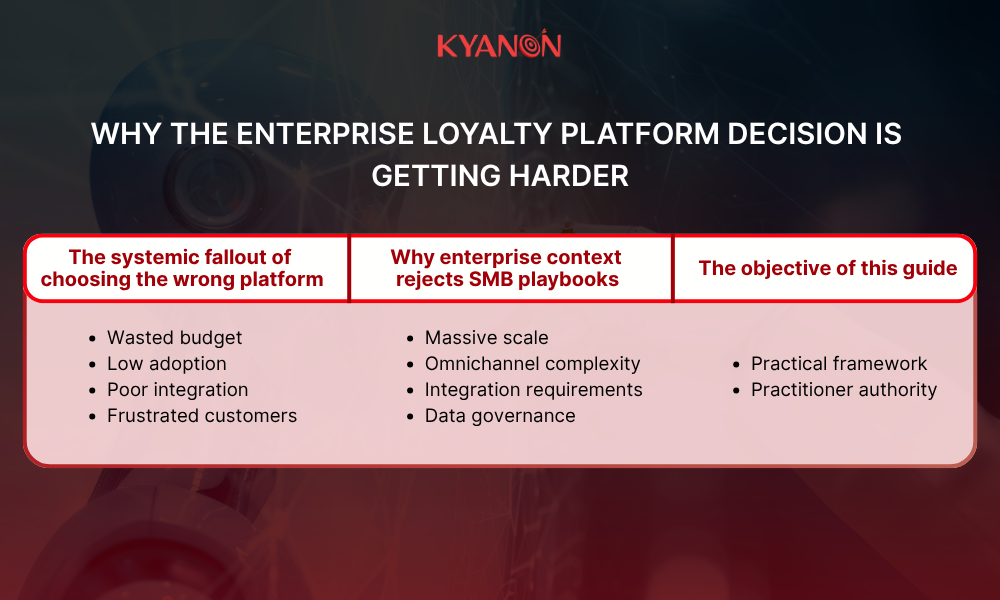
The systemic fallout of choosing the wrong platform
Across Kyanon Digital’s enterprise loyalty implementations in APAC, the most common failure point we observe is brands treating the platform as a superficial marketing tool rather than a core transaction infrastructure. When architects fail to validate baseline backend capabilities early, organizations suffer severe systemic fallout:
- Wasted budget: Millions locked into rigid, multi-year vendor contracts for tools that stall out completely past the pilot phase.
- Low adoption: Internal marketing divisions quickly abandon the tool due to overly complicated or inflexible administrative backends.
- Poor integration: Brittle point-to-point connections that create fragmented, manual data silos instead of a unified customer ecosystem.
- Frustrated customers: High checkout latency and point balance discrepancies that actively undermine the program’s strategic intent.
Why enterprise context rejects SMB playbooks
- Massive scale: The underlying infrastructure must effortlessly compute real-time point distributions and tier states for millions of active members simultaneously.
- Omnichannel complexity: Absolute, real-time balance synchronization is mandatory across physical POS registers, native mobile apps, web checkouts, and customer call centers.
- Integration requirements: The retention ledger must plug seamlessly into complex legacy layers, enterprise CRMs, and regional CDPs.
- Data governance: System compliance requires strict alignment with corporate security protocols and localized data residency mandates.
Unlike shallow promotional vendor lists, this buyer’s guide delivers a practical 5-pillar evaluation framework, an objective vendor type comparison, and an execution-ready implementation guide. The insights ahead are firmly grounded in practitioner authority, synthesized from over 100 regional deployments completed across the Open Loyalty partner network for market-leading CPG, retail, and e-commerce brands like Heineken, limango, and ALDO. By adapting these global architectural benchmarks, this guide provides actionable, execution-focused perspectives tailored for APAC technical divisions looking to engineer high-performance retention.

What’s driving enterprise loyalty investment in 2026
Three shifts are reshaping how enterprises evaluate loyalty technology this year. First, loyalty platforms are increasingly expected to function as foundational data infrastructure rather than a standalone rewards ledger. Based on Kyanon Digital’s systems integration experience in Southeast Asia, these systems must now bi-directionally integrate with broader CRM and CDP architectures, a structural shift detailed in the Voucherify Architecture Overview, to stream customer behavior data in near real time, completely replacing outdated nightly batch jobs.
Second, AI-driven personalization has moved from pilot to baseline expectation. Antavo’s Global Customer Loyalty Report 2026 found that 51.4% of marketers now use AI in loyalty program management, up from 37.1% the prior year, and that 50.9% of program owners report offering AI-driven personalization.
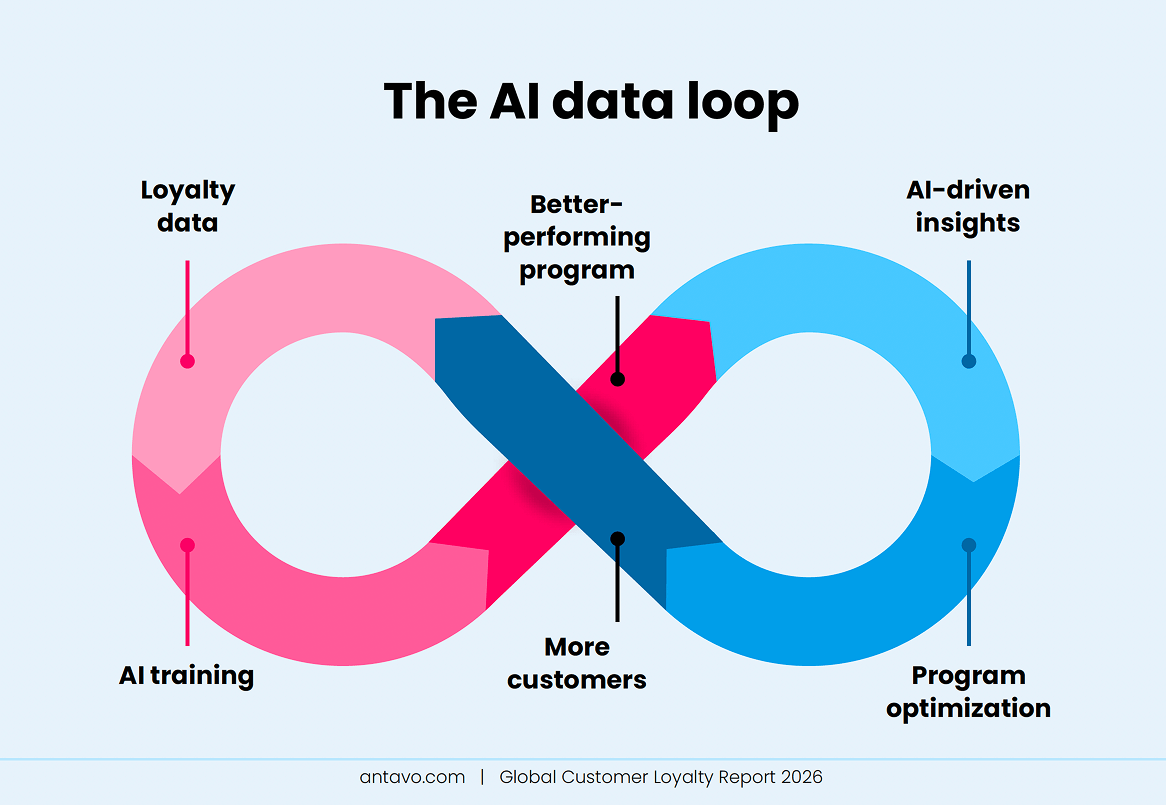
Third, there’s a clear shift toward composable, self-service architecture. Marketing teams want speed and control over campaigns; engineering teams want modularity instead of a monolith. Open Loyalty’s Loyalty Program Trends 2026 report found that 75% of businesses are prioritizing real-time, instant-gratification rewards in their 2026 investment plans, something monolithic suites with batch-based architectures often struggle to deliver.
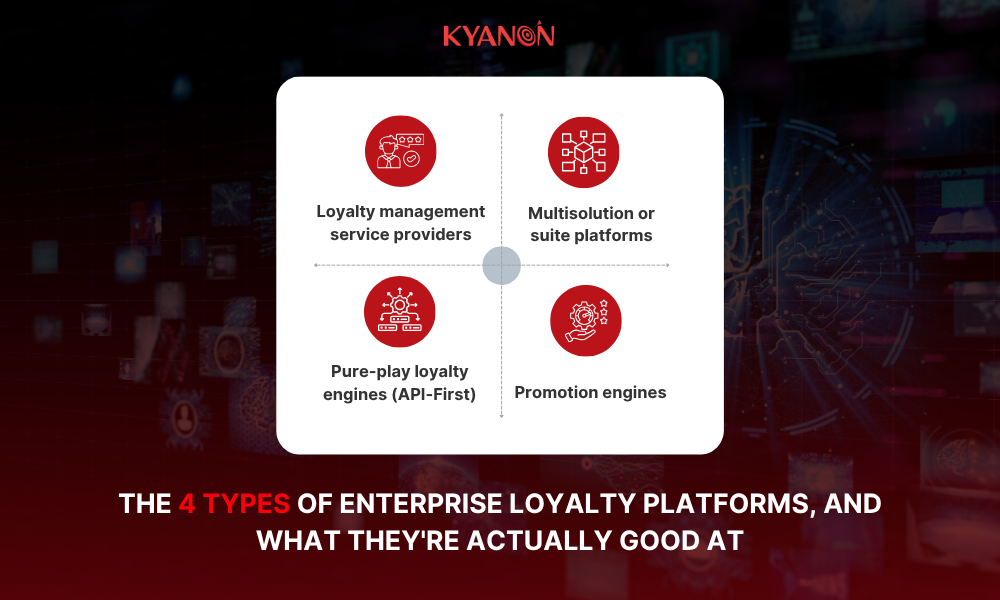
The 4 types of enterprise loyalty platforms, and what they’re actually good at
Before comparing specific vendors, it helps to know which category you actually need. Most enterprise evaluations stall because teams compare a managed service provider’s pricing against a pure-play engine’s pricing without first deciding what kind of support model and architecture they want.
Loyalty management service providers (LMSPs)
LMSPs bundle the platform with consultants and ongoing campaign operations, effectively a done-for-you model. They’re best suited to brands without an in-house loyalty team that needs white-glove setup and ongoing program management. The trade-off is slower iteration speed, dependency on the vendor’s roadmap and capacity, and ongoing service costs that compound over the life of the contract.
Multisolution or suite platforms
These embed loyalty as a module inside a broader CRM or marketing cloud, such as Salesforce Loyalty Management. They suit brands that want a unified customer view and have already invested in that suite’s ecosystem. The trade-off, as the Voucherify buyer’s guide and others in the category note, is that the loyalty module is usually less deep on mechanics than a specialist platform built solely for loyalty.
Pure-play loyalty engines (API-First)
Pure-play engines are specialist platforms focused entirely on loyalty mechanics: headless, API-first, and composable by design. Open Loyalty is a representative example of this category. The platform has earned ISO 27001 and ISO 9001 certification, and in 2023 won the CE Tech Rocketship Award as part of the Deloitte Technology Fast 50 Central Europe Programme, a recognition presented jointly with Google Cloud for high-quality, scalable enterprise technology. This type of platform suits enterprise brands that want flexibility and omnichannel control without vendor lock-in. The trade-off is that it requires an internal or partner development team to handle the integration work.
Promotion engines
Promotion engines provide a broader incentive backend: loyalty mechanics alongside coupons, referrals, and gift cards in a single system. They suit digital-native brands that treat loyalty as part of the product experience rather than a separate marketing initiative. The trade-off is that loyalty-specific depth, particularly around tiers and complex mechanics, can be shallower than what a pure-play engine offers.
Platform type comparison
The table below summarizes how the four categories compare across control, time to launch, and pricing structure.
| Platform type | Control level | Implementation complexity | Platform type | Control level | Implementation complexity |
| LMSP | Low | High vendor dependency | LMSP | Low | High vendor dependency |
| Suite / Multisolution | Medium | Moderate | Suite / Multisolution | Medium | Moderate |
| Pure-Play (API-first) | High | Depends on the integration scope | Pure-Play (API-first) | High | Depends on the integration scope |
| Promotion Engine | High | Typically lighter API integration | Promotion Engine | High | Typically lighter API integration |
Disclaimer: The comparison above is intended as a directional guide based on common enterprise loyalty platform characteristics. Actual platform capabilities, implementation approaches, and commercial models may vary by vendor and deployment scenario.
Not sure which platform type fits your setup?
Kyanon Digital is an APAC-based enterprise transformation partner that helps businesses evaluate, select, and implement loyalty platforms, including Open Loyalty, one of the leading API-first loyalty engines on the market. With a track record of loyalty deployments across Retail, FMCG, and eCommerce brands in Singapore, Australia, and Southeast Asia, Kyanon Digital’s team can assess your tech stack and recommend the architecture that delivers the fastest realistic time-to-value. Talk to Kyanon Digital for deeper consultancy.
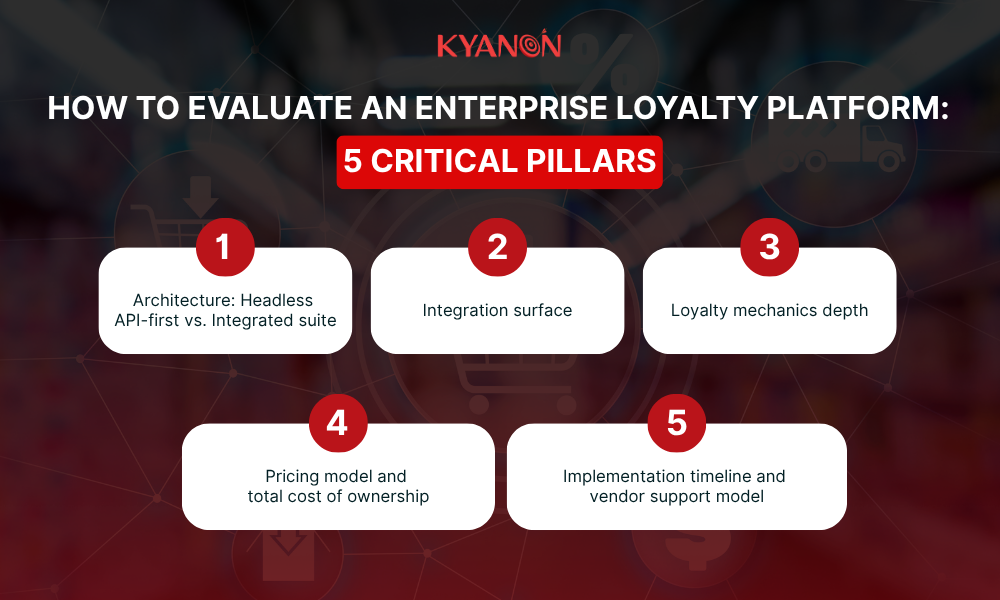
How to evaluate an enterprise loyalty platform: 5 critical pillars
Once you know which platform category fits your situation, the next step is a structured evaluation. These five areas cover both the business and technical perspectives that need to align before a contract gets signed.
Architecture: Headless API-first vs. Integrated suite
- The business trade-off: Total ownership of a bespoke, cross-channel customer experience versus rapid deployment using rigid, pre-molded vendor templates.
- The technical reality: As analyzed in the architectural breakdown of Headless Loyalty Software by Open Loyalty, integrated suites force long-term compromises on frontend UI, whereas a truly headless framework entirely decouples the mathematical ledger to safeguard performance.
- The performance is non-negotiable: A sub-120ms API response time is the mandatory ceiling required to process real-time calculation triggers without introducing checkout friction.
- The C-level qualifying question: “Can your underlying calculation engine serve loyalty events in real time across our POS registers, mobile apps, and web checkouts simultaneously without introducing UI spin?”
Integration surface
- The ecosystem fit: Evaluating whether the platform plugs natively into your established stack or forces expensive, custom-coded middleware replacements.
- The minimum interoperability checklist:
- Bidirectional real-time synchronization for enterprise CDPs and CRMs.
- Certified physical POS connectors (supporting legacy and modern store registers).
- Native eCommerce bridges (Shopify Plus, Magento, SAP Commerce Cloud).
- Secure, lightweight mobile SDKs optimized for native iOS and Android builds.
- The developer toolkit: Demands explicit proof of advanced webhook support, event-driven data streaming, and fully isolated sandbox staging environments.
- The architectural red flag: Reject any vendor that relies on scheduled overnight batch file transfers (SFTP) to update customer point balances.
Loyalty mechanics depth
- Future-proofing program scope: Ensuring the backend engine can scale smoothly from simple points toward multi-brand coalitions, behavioral challenges, and gamified milestones.
- The code efficiency principle: Utilizing native core calculation logic is structurally superior to attaching third-party bolt-on applications.
- The middleware penalty: Every attached external plugin multiplies network latency, introduces separate vendor compliance risks, and creates an unstable point of failure. For business leaders, this architectural clutter translates into a hidden cost that compounds over time. According to global tech budget research by the Software Improvement Group, these unoptimized integration shortcuts cause the average enterprise tech stack to be composed of 20% to 40% pure technical debt. This overhead directly damages business outcomes, consuming up to 40% of ongoing IT budgets solely on maintenance, draining the loyalty program’s projected ROI, and risking catastrophic frontend checkout latencies for customers during peak transaction hours.
- The out-of-the-box benchmark: Dedicated API engines eliminate custom backend engineering; Open Loyalty, for example, natively provides over 50 pre-built loyalty mechanics out of the box.
Pricing model and total cost of ownership
- Stress-testing unit economics: Financial forecasting must model platform costs not just at your current Monthly Active User (MAU) volume, but at 10x that capacity.
- Predictability vs. volatility: Compare variable usage-based billing (per API call or active member) against fixed annual enterprise licensing to safeguard projected operating margins.
- Auditing hidden expenditures: Uncover all secondary capital outlays, including custom integration dev hours, mandatory onboarding retainers, data migration fees, and overage penalties.
- The definitive procurement question: “What does our exact Total Cost of Ownership curve look like as our active database scales across 500K, 1M, and 5M members?”
Implementation timeline and vendor support model
- The true success determinant: Across Kyanon Digital’s regional deployment evaluations, project viability relies less on the software itself and entirely on whether your implementation partner possesses direct, proven experience wiring your specific commerce layer.
- Vendor-led onboarding: Offers structured guidance, but inherently suffers from an extended onboarding duration tied directly to the software vendor’s internal project backlog.
- Partner-led integration: Pairing a composable API engine with an expert regional systems integrator like Kyanon Digital allows agile technical divisions to achieve full deployment in weeks.
Which enterprise loyalty platform is right for you? A decision framework
Three questions narrow the field quickly, before you get into vendor-by-vendor comparisons.
- Do you have in-house loyalty or CRM expertise? If not, an LMSP or an implementation partner is usually the safer path. If yes, a pure-play engine or promotion engine gives you more control.
- What does your current data stack look like? If it’s siloed with no CDP in place, a multisolution suite that unifies data first may be the better starting point. If you already have a strong CDP or CRM, an API-first engine that integrates into that stack will get you more value faster.
- How much customization does your program need? Standard programs (points, tiers, vouchers) are well served by an LMSP or mid-tier suite. Complex programs (gamification, omnichannel, multi-brand) usually need a pure-play API engine.
The matrix below summarizes how those answers typically map to platform type.
Scenario | Recommended Type |
No in-house team, need white-glove support | LMSP |
CRM-centric, unified data needed | Suite / Multisolution |
Tech team available, need flexibility | Pure-Play (e.g., Open Loyalty) |
Composable stack, incentives matter more than loyalty alone | Promotion Engine |
Enterprise loyalty platform evaluation checklist
Use this checklist directly in vendor conversations and RFPs to keep evaluations consistent across the shortlist.
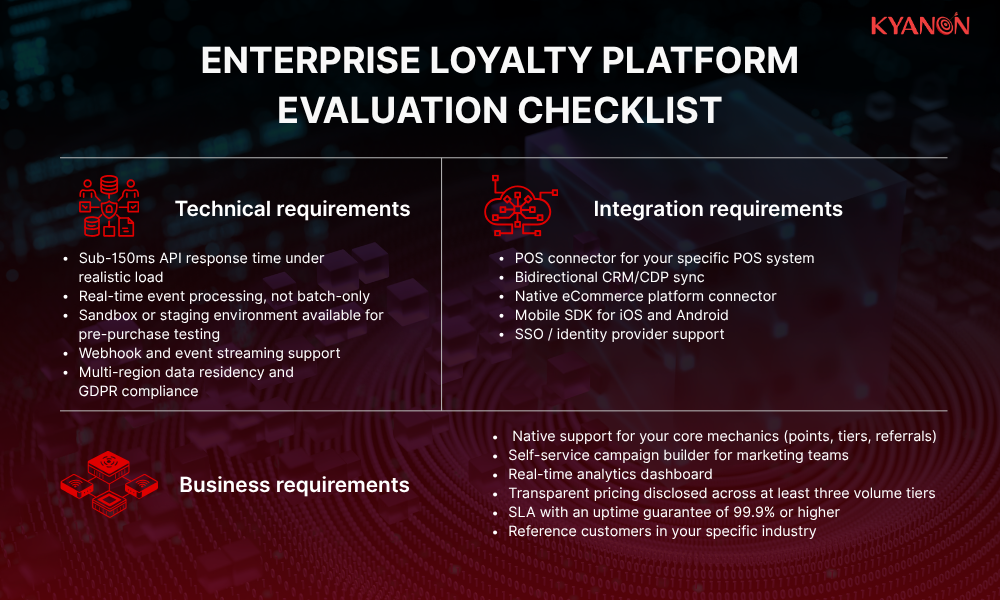
Technical requirements
- Sub-150ms API response time under realistic load
- Real-time event processing, not batch-only
- Sandbox or staging environment available for pre-purchase testing
- Webhook and event streaming support
- Multi-region data residency and GDPR compliance
Integration requirements
- POS connector for your specific POS system
- Bidirectional CRM/CDP sync
- Native eCommerce platform connector
- Mobile SDK for iOS and Android
- SSO / identity provider support
Business requirements
- Native support for your core mechanics (points, tiers, referrals)
- Self-service campaign builder for marketing teams
- Real-time analytics dashboard
- Transparent pricing disclosed across at least three volume tiers
- SLA with an uptime guarantee of 99.9% or higher
- Reference customers in your specific industry
Case study: Loyalty & E-Commerce Mobile App for the leading Coffee Chain in Vietnam with Kyanon Digital
Challenges:
- Severe legacy system fragmentation: Disconnected POS networks and siloed partner databases trapped customer records, challenging the brand’s ability to establish a unified CRM view or track cross-channel journeys.
- Competitive gap in digital retention: While physical cafe operations drove massive daily foot traffic, the brand lacked an automated, centralized calculation engine to execute advanced mobile loyalty against digital-native competitors.
- High-latency integration risks: Delivering advanced capabilities like personalized drink creation and subscription services threatened to introduce frontend app friction during peak morning transaction hours.
Solutions:
- Decoupled composable architecture: Kyanon Digital engineered a modular platform entirely separating the React Native presentation layer from the Magento e-commerce ordering backend and the dedicated loyalty engine.
- High-performance KrakenD API Gateway: Implemented custom middleware and a lightning-fast KrakenD API gateway to bi-directionally wire physical storefront POS registers directly into the central Customer Data Platform (CDP).
- Native omnichannel mechanics: Deployed advanced loyalty logic out of the box, including tier milestones, trophy gamification, and personalized behavioral triggers, without attaching latency-heavy third-party plugins.
Results and impact:
- Real-time behavioral personalization: Unifying offline checkout data with digital app ledgers fed clean zero-party data directly into the CDP, enabling dynamic audience segmentation and maximizing customer lifetime value.
- Accelerated transaction velocity: The decoupled architecture supported complex “Order Ease” features like One-Tap Reorder and instant reward validation, directly driving higher average order values.
- Solidified regional market leadership: Successfully closing the technical gap allowed the F&B giant to scale its digital membership rapidly, gaining a definitive operational advantage over legacy rivals.
Explore the full case study here: Loyalty & E-Commerce Mobile App for the leading Coffee Chain in Vietnam
Final thoughts: Making the right enterprise loyalty platform decision
Choosing an enterprise loyalty platform comes down to five things: the architecture that fits your omnichannel needs, an integration surface that plugs into your existing stack without forcing a rebuild, loyalty mechanics deep enough to support your program without bolt-ons, a pricing model that stays predictable at ten times your current scale, and an implementation path that matches your team’s actual capacity.
The best platform for your organization isn’t necessarily the most feature-rich one on the market; it’s the one that fits your team, your existing stack, and your program’s real complexity. If you’re currently evaluating vendors or need an architecture review before committing, that’s exactly the point at which a conversation with a partner who has implemented these platforms in production, rather than just sold them, tends to be most useful.
Kyanon Digital works with enterprise teams across Retail, FMCG, and eCommerce to evaluate and implement loyalty platforms, including Open Loyalty, suited to their specific architecture and data maturity. Contact Kyanon Digital to review your technical architecture today.

 Create project brief with AI