

The market data reflects this shift. According to Finder Australia, 71% of Australians participate in supermarket loyalty programs, making loyalty one of the most widely adopted customer engagement mechanisms in the country. More broadly, McKinsey & Company estimates that six in ten Australians are enrolled in at least one loyalty program, highlighting how deeply loyalty ecosystems have become embedded in everyday consumer behavior.
The business case is equally compelling. Research from Bain & Company found that increasing customer retention by just 5% can increase profits by 25% to 95%, making retention one of the highest-return growth levers available to retailers and consumer brands.
Despite high adoption, many Australian retailers still struggle with fragmented loyalty ecosystems, disconnected POS and commerce data, and limited personalization capabilities. As a result, selecting the right loyalty platform has become a strategic technology decision rather than a marketing procurement exercise.
At Kyanon Digital, we view a loyalty platform as the technology infrastructure that connects customer data, rewards logic, POS systems, commerce platforms, and marketing tools into a single retention engine. Unlike basic punch-card or points-tracking applications that merely collect customer data, modern loyalty platforms activate that data in real time to drive personalization, engagement, and measurable business outcomes across channels.
If you’re evaluating loyalty platforms for an Australian retail business, you’ve probably noticed that every vendor claims to be omnichannel, API-first, and AI-powered. This guide cuts through that noise by comparing the top 10 platforms across two essential dimensions:
- Business value: ROI, customer retention, and operational efficiency.
- Technical capability: APIs, scalability, integration depth, and compliance readiness.
The analysis is informed by platform capabilities, market adoption signals, G2 and Capterra review trends (Q1 2026), and enterprise implementation experience across retail, FMCG, and hospitality environments in the ANZ region.
Key Takeaways
Company | Key Strengths | Pricing Tier | Key Clients |
| Open Loyalty | Headless API-first engine, high customization | From ~$2,900 | Enterprise retailers |
Talon.One | Real-time, programmable promotion management | From ~$4,350 | Large retail & commerce |
| Marsello | Unified loyalty, email, & SMS for mid-market | From $80 | Retail chains, F&B |
Okendo | Synergized reviews, UGC, & loyalty for Shopify | From ~$144 | Shopify brands |
| LoyaltyLion | Predictive analytics for mid-to-enterprise e-commerce | From ~$579 | Growing eCommerce |
Yotpo Loyalty | Unified retention suite (loyalty, reviews, SMS) | From ~$289 | D2C & Shopify Plus |
| Smile.io | Rapid loyalty deployment for SMBs | From ~$22 | SMB eCommerce |
Stamp Me | Contactless mobile-first digital punch cards | From $49 | Cafés, QSR |
| Square Loyalty | Native, POS-integrated loyalty for Square users | From $49 | Small retail & cafés |
Antavo | Enterprise AI loyalty ecosystem, high configurability | From ~$6,800 | Global enterprise retailers |
Further Reading
- Smart Loyalty: Personalization Beyond Points
- Key Insights For Loyalty Program Success: 2026 Benchmark
- From Transaction to Relationship: Loyalty 4.0
How we evaluated these loyalty platforms
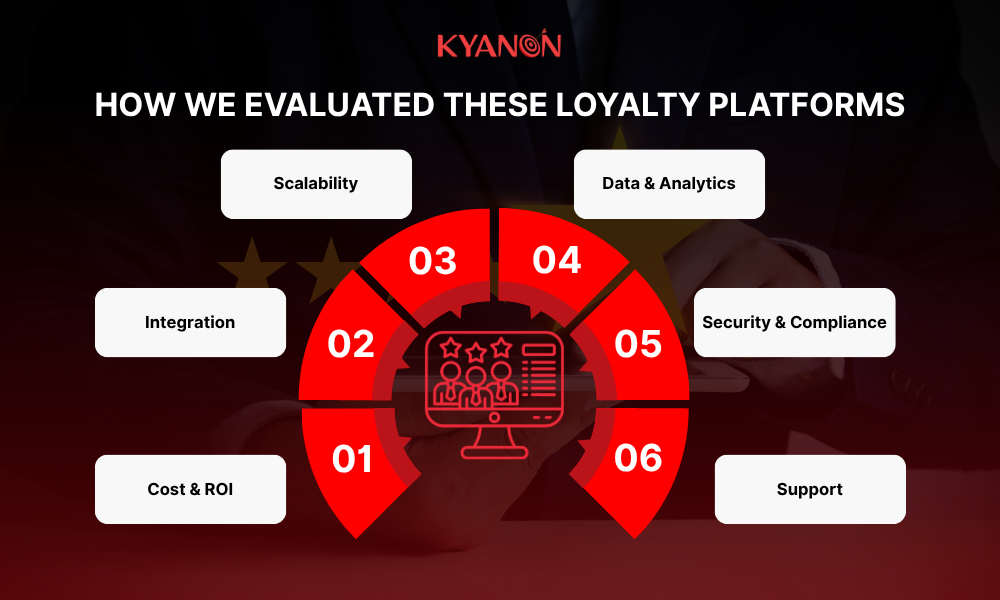
We assessed each loyalty rewards platform using a dual-layer framework combining business and technical criteria. This ensures evaluation reflects both executive outcomes and engineering feasibility.
Enterprise loyalty platform assessment framework
Criterion | Business Perspective | Technical Perspective | Key Metrics | Industry Benchmark |
| Cost & ROI | Optimizing the total cost of ownership while accelerating the payback period and business value realization. | Maximizing infrastructure utilization and achieving high levels of cloud cost efficiency. | TCO, ROI, Payback Period | Loyalty platforms optimized for high-efficiency infrastructure reduce TCO, as demand for AI-driven personalization continues to scale significantly. |
Integration | Creating a unified customer journey by seamlessly connecting POS, CRM, eCommerce, and marketing ecosystems. | Evaluating the strength of API architectures, system interoperability, and the breadth of the connector ecosystem. | API Coverage, Connector Availability, Integration Lead Time | Leading loyalty solutions utilize composable architectures to accelerate time-to-market and ensure seamless interoperability across fragmented retail systems. |
| Scalability | Ensuring the platform effectively supports rapid business growth and manages sudden peaks in demand. | Leveraging elastic infrastructure and distributed systems to maintain consistent performance optimization. | Throughput, Response Time, Concurrent Users | High-performance loyalty systems meet cloud scalability targets by maintaining SLA stability during 2–10× traffic surges. (IBM) |
Data & Analytics | Gaining deep visibility into Customer Lifetime Value (CLV), churn rates, and precise campaign ROI. | Establishing robust data governance while ensuring high data quality, accessibility, and clear ownership. | CLV, Churn Rate, Campaign ROI, Data Quality Score | Retailers leveraging advanced loyalty analytics are 2 to 2.5× more likely to outperform industry laggards in financial and customer retention metrics. (McKinsey) |
| Security & Compliance | Strengthening regulatory readiness and customer trust through proactive risk reduction strategies. | Implementing SOC 2 standards, advanced encryption, rigorous access controls, and full auditability. | Compliance Coverage, Audit Readiness | Maintaining strict alignment with the Australian Privacy Principles (OAIC) and SOC 2 Type II audit standards is the mandatory baseline for enterprise data security. |
Support | Ensuring strong vendor accountability to maintain operational continuity and minimize business disruption. | Prioritizing rapid incident response and continuous monitoring to guarantee overall service reliability. | SLA Compliance, MTTR, Uptime % | The industry benchmark for loyalty platform service reliability is 99.5%–99.999% uptime, mitigating the business impact of unplanned downtime. (IBM) |
Loyalty vendors often excel in simplified demos, but real-world enterprise environments involve complex POS networks and high transactional loads. Common post-implementation failures, such as inconsistent channel redemption, delayed CRM synchronization, and peak-traffic bottlenecks, directly damage customer trust and program effectiveness.
Selecting a loyalty platform without evaluating both business and technical needs leads to integration debt, causing excessive engineering overhead and fragmented architectures. According to McKinsey & Company, for mid-market and enterprise firms, this can increase total cost of ownership by 30% to 60% while restricting strategic growth and real-time personalization. As loyalty programs become vital for first-party data and retention, platform selection must be viewed as a long-term architectural decision rather than a short-term marketing tool.

Top 10 loyalty platforms at a glance
Before selecting a vendor, Australian businesses should understand how platforms differ across use case, architecture, and maturity.
Top 10 loyalty platforms at a glance
Platform | Best For | Pricing (AUD/month) | POS Integration | AI Features | AU Support |
| Open Loyalty | Enterprise retailers and multi-brand ecosystems. | From ~$2,900 | Shopify, Lightspeed, Square, Vend, custom APIs. | Predictive segmentation and CLV modeling. | AWS Sydney residency and APPs compliance. |
Talon.One | Large retailers with complex, high-volume promotions. | From ~$4,350 | Shopify, Lightspeed, Vend, custom stacks. | Real-time dynamic reward decisioning engine. | APAC enterprise support and scalable deployment. |
| Marsello | Mid-market retailers and hospitality brands. | From ~$80 | Shopify, Lightspeed, Square. | AI segmentation and automated win-back campaigns. | NZ-founded with ACMA-compliant SMS delivery. |
Okendo | Shopify brands focused on reviews and UGC. | From ~$144 | Shopify POS. | AI sentiment detection and survey intelligence. | Sydney-based with local ecosystem expertise. |
| LoyaltyLion | Ecommerce brands seeking predictive analytics. | From ~$579 | Shopify, Magento, BigCommerce. | Predictive CLTV and performance forecasting. | UK-based with limited AU timezone overlap. |
Yotpo Loyalty | Brands consolidating reviews, SMS, and loyalty. | From ~$289 | Shopify POS, Magento, BigCommerce. | AI personalization and referral fraud detection. | APAC support and enterprise data residency. |
| Smile.io | SMB merchants seeking rapid loyalty deployment. | From ~$22 | Shopify POS, BigCommerce. | Automation-driven reward triggers. | Global support with strong AU adoption. |
Stamp Me | Local retail/cafes using digital punch cards. | From ~$49 | QR and NFC-based validation (No POS direct). | Visit-frequency and engagement analytics. | Melbourne-based local support and expertise. |
| Square Loyalty | Businesses already in the Square ecosystem. | From ~$49 | Native Square POS integration. | Automated spend and frequency tracking. | Native local support via Square Australia. |
Antavo | Enterprise loyalty ecosystem, AI personalization, high configurability. | From ~$6,800 | Salesforce, Adobe Commerce, Shopify, custom APIs. | AI-driven loyalty logic and personalization. | Enterprise-grade support and implementation. |
Don’t know which platform fits your stack?
Choosing between 10 loyalty vendors is difficult when every platform promises similar capabilities.
As an Enterprise Digital Transformation partner, Kyanon Digital helps mid-market and enterprise businesses across Australia and New Zealand evaluate, integrate, and customize loyalty platforms based on their existing technology stack. Rather than promoting a specific vendor, our team assesses your eCommerce architecture, POS environment, CRM, and customer data infrastructure to identify the best-fit solution and build the integrations required for long-term success.
From platform selection to full-scale deployment, Kyanon Digital builds the integration foundation required to operationalize loyalty programs and maximize long-term customer value. Speak with a Kyanon Digital Loyalty Architect we’ll assess your existing stack and recommend the platform that fits, not the one that demos best.
The Australian Omnichannel Loyalty Landscape
Open Loyalty
Best for: Enterprise retailers, large franchises, and coalition programs requiring a highly customizable, API-first omnichannel infrastructure.
Overview: Open Loyalty is a composable, API-first loyalty platform designed for enterprises that require maximum flexibility and architectural control. As an official Open Loyalty partner, Kyanon Digital helps Australian businesses accelerate implementation and maximize ROI through tailored loyalty solutions built around their unique customer engagement strategies.
Business value: For business impact, Open Loyalty empowers brands to create differentiated loyalty experiences, unify customer data across channels, and execute sophisticated reward mechanics that drive retention, repeat purchases, and customer lifetime value. Its composable approach allows businesses to evolve loyalty programs alongside changing customer expectations.
Technical capability: From an architectural standpoint, Open Loyalty provides a developer-friendly, headless architecture that integrates securely with existing ERP, CRM, CDP, eCommerce, and POS environments through API-first connectivity. Australian enterprises benefit from flexible deployment options, scalable performance, and AWS Sydney hosting capabilities that support local data governance and compliance requirements.
Pricing: From ~$2,900 AUD/mo.
Pros | Cons |
|
|
A leading choice for large Australian enterprises seeking complete architectural flexibility, local data residency, and advanced loyalty customization. The combination of Open Loyalty’s API-first platform and Kyanon Digital’s proven implementation expertise makes it particularly suitable for organizations that require enterprise-grade loyalty programs without compromising integration flexibility, scalability, or customer data ownership.
Talon.One

Best for: High-volume enterprises requiring real-time, programmable promotion management and omnichannel orchestration across extensive tech stacks.
Overview: Talon.One is a centralized incentive and promotion engine designed for retailers managing complex loyalty and promotional programs across physical and digital channels. It enables businesses to orchestrate loyalty points, coupons, discounts, referrals, and personalized offers from a single platform while supporting omnichannel customer experiences.
Business value: To drive strategic growth, Talon.One helps retailers protect margins and improve campaign efficiency by eliminating promotional overlap. Its visual rule builder enables marketing teams to manage loyalty rewards, VIP benefits, flash sales, and coupon campaigns from a single platform, reducing operational complexity while accelerating campaign execution across channels.
Technical capability: On the technical front, Talon.One is built for composable and enterprise-grade commerce environments. Its headless architecture, REST APIs, and SDKs support integration with ERP, CDP, and leading Australian retail platforms such as Shopify, Lightspeed, Square, and Vend. Integrations with Snowflake and AWS Sydney further support secure data management, scalability, and Australian Privacy Act compliance.
Pricing: From ~$4,350 AUD/mo.
Pros | Cons |
|
|
Top choice for large AU firms requiring real-time control and headless integration maturity.
Marsello
Best for: Mid-market Australian retailers and hospitality brands wanting to consolidate loyalty, email marketing, and SMS into a single platform.
Overview: Founded in New Zealand, Marsello is a loyalty and customer engagement platform with a strong APAC presence. It combines loyalty, email, SMS, and review generation into a single platform while connecting online and in-store customer data through leading Australian retail systems.
Business value: With respect to organizational outcomes, Marsello creates a unified customer view that enables more personalized marketing and stronger retention. By consolidating loyalty, email, and SMS into one platform, retailers can reduce technology costs and simplify campaign management.
Technical capability: In terms of system connectivity, Marsello provides native integrations with Shopify, Lightspeed, and Square, reducing implementation complexity. Its omnichannel architecture supports customer data synchronization, while built-in SMS compliance features align with Australian regulatory requirements.
Pricing: From $80 AUD/mo.
Pros | Cons |
|
|
Ideal for AU omnichannel retailers seeking to unify data and tech without enterprise-level costs.
Okendo
Best for: High-growth Shopify brands wanting to synergize customer reviews, User-Generated Content (UGC), and loyalty programs within a single ecosystem.
Overview: Headquartered in Sydney, Okendo has evolved from a reviews platform into a customer marketing suite that combines Reviews, Loyalty, Referrals, and Surveys. Built for Shopify, it helps retailers connect customer engagement activities with loyalty programs to drive retention and advocacy.
Business value: Regarding strategic market presence, Okendo helps retailers generate more user-generated content by rewarding customers for reviews, referrals, and survey participation. Its bundled approach reduces tool sprawl while improving customer engagement, retention, and social proof generation.
Technical capability: When considering integration capabilities, Okendo is purpose-built for Shopify, with native integrations across Shopify, Shopify POS, and Shopify Flow. Its streamlined architecture minimizes implementation effort, while Snowflake integration supports scalable customer data management and Australian data residency requirements.
Pricing: From ~$144 AUD/mo.
| Pros | Cons |
|
|
The top choice for Australian Shopify brands seeking to link social proof with retention while avoiding enterprise billing volatility.
LoyaltyLion
Best for: Mid-market to enterprise e-commerce brands on Shopify, Magento, or BigCommerce requiring deep insights, predictive modeling, and highly customizable tiers.
Overview: LoyaltyLion is an eCommerce-focused loyalty platform known for its advanced analytics, customer segmentation, and retention capabilities. Popular among online retailers, it helps brands leverage customer data to build more personalized loyalty and engagement programs.
Business value: From a commercial effectiveness lens, LoyaltyLion enables data-driven customer retention through advanced segmentation, VIP tiers, and rewards for both purchases and non-transactional behaviors. Its integrations with platforms like Klaviyo support highly targeted campaigns and more effective lifecycle marketing.
Technical capability: Regarding backend implementation, LoyaltyLion integrates natively with Shopify, BigCommerce, and Magento, while REST APIs and webhooks provide additional flexibility for custom implementations. However, some developer features and API capabilities are reserved for higher-tier plans, which may influence scalability and integration planning.
Pricing: From ~$579 AUD/mo.
Pros | Cons |
|
|
A robust, analytics-driven engine for high-revenue AU operators prioritizing data segmentation.
Yotpo Loyalty

Best for: Established e-commerce brands aggressively consolidating their retention stack by combining loyalty, reviews, and SMS under a single vendor.
Overview: Yotpo is a customer retention platform that combines Loyalty, Reviews, Referrals, and SMS marketing into a unified ecosystem. It is particularly popular among eCommerce brands seeking to centralize customer engagement and retention activities.
Business value: To enhance customer equity, Yotpo connects loyalty, reviews, referrals, and SMS campaigns to create more seamless customer journeys. Its unified approach reduces tool sprawl and improves marketing automation efficiency.
Technical capability: Looking at the engineering landscape, Yotpo integrates with Shopify, BigCommerce, Magento, and Shopify POS. APIs and advanced customization are available for enterprise use cases, although some capabilities are limited to higher-tier plans.
Pricing: From ~$289 AUD/mo.
Pros | Cons |
|
|
Logical for Australian brands seeking vendor consolidation, if they can manage peak-season overage costs.
Smile.io

Best for: Entry-level to mid-market Shopify/BigCommerce merchants wanting a visually polished platform deployed rapidly without developers.
Overview: Smile.io is a popular loyalty platform known for its simplicity and fast deployment. Designed for digital-first brands, it enables businesses to launch points, rewards, and VIP programs quickly with minimal technical effort.
Business value: From an operational agility perspective, Smile.io helps teams launch and manage loyalty programs without dedicated IT resources. Its built-in rewards, VIP tiers, and conversion-focused engagement features make it an effective option for growing eCommerce brands.
Technical capability: In terms of ecosystem synergy, Smile.io offers straightforward integration with Shopify and Klaviyo, enabling rapid implementation and automated customer engagement. However, API access and advanced customization options are primarily available on higher-tier plans.
Pricing: From ~$22 AUD/mo.
Pros | Cons |
|
|
Best for emerging AU Shopify brands needing quick, budget-friendly deployment.
Stamp Me
Best for: Australian cafes, QSRs, salons, and indie retailers seeking a simple, contactless digital alternative to paper punch cards.
Overview: Stamp Me is an Australian loyalty platform focused on simple, digital punch-card experiences for cafes, restaurants, salons, and local retailers. It helps businesses digitize traditional loyalty programs while capturing valuable customer data.
Business value: Regarding localized business value, Stamp Me makes customer retention easy through digital rewards, push notifications, and built-in messaging tools. Its straightforward approach helps increase repeat visits while reducing the operational burden of managing traditional loyalty programs.
Technical capability: From a deployment perspective, Stamp Me minimizes implementation complexity by using QR codes and NFC technology instead of deep POS integrations. Its cloud-based architecture enables fast deployment and centralized customer data management without extensive technical resources.
Pricing: From $49 AUD/mo.
Pros | Cons |
|
|
Best for small Australian cafes seeking an affordable, foolproof digital punch-card solution with built-in messaging.
Square Loyalty
Best for: High-volume Australian hospitality and retail businesses entrenched in the Square payments ecosystem looking for zero-friction checkouts.
Overview: Square Loyalty is a loyalty solution built directly into the Square ecosystem. Designed for simplicity and speed, it enables businesses to launch loyalty programs that are tightly integrated with Square POS and Square Online.
Business value: To maximize checkout efficiency, Square Loyalty reduces customer enrollment friction by allowing rewards to be earned directly at checkout. Its unified dashboard and built-in customer communications help businesses drive repeat purchases without adding extra marketing tools.
Technical capability: From an infrastructure standpoint, Square Loyalty operates natively within the Square platform, eliminating the need for complex integrations or data synchronization. While this simplifies deployment and maintenance, it offers less flexibility for businesses requiring advanced omnichannel workflows or custom integrations.
Pricing: From $49 AUD/mo.
Pros | Cons |
|
|
Optimal for Square-based merchants valuing checkout speed and simplicity over complex automation.
Antavo
Best for: Global enterprise brands and omnichannel retailers needing a highly customizable, API-first loyalty platform with strong gamification and no-code management.
Overview: Antavo is a cloud-based loyalty platform designed for complex omnichannel programs across online, mobile, and in-store channels. It supports unified customer profiles, advanced segmentation, and flexible loyalty mechanics for enterprise retailers.
Business value: In terms of strategic organizational impact, Antavo enables a single customer view across channels, helping brands deliver more personalized loyalty experiences and automated campaigns. Its broad engagement capabilities can reduce reliance on multiple marketing and loyalty tools, improving operational efficiency and ROI visibility.
Technical capability: Regarding architectural scalability, Antavo offers an API-first architecture with integrations across Shopify, Salesforce, Adobe Commerce, and leading POS systems. Its cloud-based infrastructure supports scalable enterprise deployments while meeting security, compliance, and data residency requirements based on implementation needs.
Pricing: From ~$6,800 AUD/mo.
Pros | Cons |
|
|
A powerful enterprise loyalty platform for large brands focused on advanced, omnichannel, experience-driven customer retention at scale.
How to choose the right loyalty platform for your Australian business
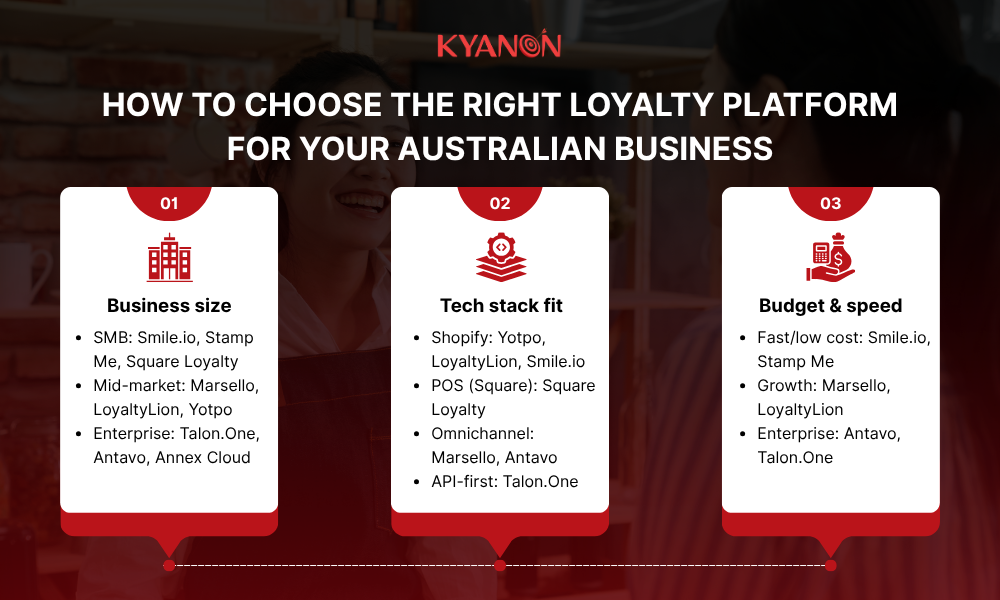
Selecting the right loyalty platform is less about feature comparison and more about alignment with business scale, technology architecture, and execution speed. In the Australian market, where omnichannel retail and data privacy requirements are increasingly important, the wrong choice often creates integration debt rather than customer retention gains.
The selection process can be simplified into three practical dimensions that reflect how loyalty systems are deployed in real retail environments.
Business size and operating complexity
Select a loyalty platform by balancing scale and operational needs. The table below matches solutions to business size and complexity.
Recommended loyalty platforms by business size and complexity
Business Segment | Recommended Platforms | Primary Focus |
|---|---|---|
SMB Retailers | Stamp Me, Square Loyalty, Smile.io | Rapid deployment, ease of use, and budget-friendly contactless solutions. |
| Mid-Market Brands | Marsello, LoyaltyLion, Yotpo Loyalty | Advanced segmentation, automated omnichannel engagement, and ROI-driven marketing. |
Enterprise Organizations | Talon.One, Antavo, Open Loyalty | Scalable architectures, API-first control, and complex promotional orchestration. |
Technology stack alignment
Technology fit is often the biggest predictor of long-term success.
Recommended loyalty platforms by technology stack
Existing Stack | Recommended Platforms |
| Shopify-first | Yotpo Loyalty, LoyaltyLion, Smile.io, Okendo |
Square POS | Square Loyalty |
| Custom or headless commerce | Talon.One, Open Loyalty, Antavo |
Omnichannel retail environments | Marsello, Antavo |
A platform that integrates cleanly with your existing POS, CRM, eCommerce, CDP, and marketing systems will typically deliver faster ROI and lower operational overhead than a feature-rich platform that requires extensive customization.
Budget and implementation timeline
Balancing financial investment with deployment timelines is essential. The table below outlines trade-offs between speed and functional depth to help guide your choice.
Recommended loyalty platforms by budget
Category | Recommended Platforms | Key Focus |
|---|---|---|
Tight budget, fast launch | Stamp Me, Square Loyalty, Smile.io | Speed and ease of use |
| Mid-range budget | Marsello, LoyaltyLion | ROI and segmentation |
Enterprise investment | Talon.One, Open Loyalty, Antavo | Complex requirements and scale |
This reflects a consistent pattern across Australian retail transformation programs. Loyalty performance is rarely constrained by platform capability alone. More often, it is limited by fragmented customer data, disconnected customer journeys, and weak integration between commerce, POS, CRM, and marketing systems.
“A loyalty platform isn’t just a rewards engine. It’s the technology infrastructure that connects customer data, rewards logic, POS, commerce, and marketing systems into a single retention engine. The real value comes not from collecting customer data, but from activating it in real time across every customer touchpoint.”
– Head of Loyalty Solutions, Kyanon Digital
Having delivered loyalty solutions across multiple industries and partnered with leading loyalty technology providers such as Open Loyalty, Kyanon Digital has seen that the strongest programs combine business strategy, customer experience design, and scalable technology architecture.
For that reason, loyalty platform selection should be viewed as both a business decision and an architectural decision.
For enterprise businesses: Platform selection is only half the battle
Many enterprise organizations are increasingly evaluating Open Loyalty as the foundation for modern loyalty ecosystems because its API-first architecture provides greater control over customer data, loyalty logic, and integration workflows. However, choosing the right platform is only the first step. The real challenge is integrating loyalty with CRM, POS, eCommerce, CDP, and analytics systems to deliver a seamless omnichannel experience.
This is especially critical in Australia’s retail market, where customers expect consistent rewards and personalized experiences across every touchpoint.
Based on Kyanon Digital’s implementation experience, enterprises that delay loyalty-to-CRM and commerce integration can incur 20–30% higher delivery costs by the second year, driven by custom middleware, fragmented customer data, and integration rework. Building an integrated loyalty architecture from the start reduces technical debt while accelerating personalization and long-term ROI.
As an official Open Loyalty implementation partner, Kyanon Digital helps enterprises across Australia and New Zealand design, customize, and scale loyalty ecosystems that fit their existing technology landscape. Beyond implementation, Kyanon Digital supports customer data unification, omnichannel integration, promotion engine development, and personalization strategies, helping businesses build scalable loyalty ecosystems that drive retention and long-term customer value.
Learn more about Kyanon Digital’s Loyalty & Rewards Solutions.
2026 Loyalty trends shaping platform choice in Australia

- Key loyalty trends in 2026, including digital wallets, AI personalization, gamification, data ownership, and emotional loyalty
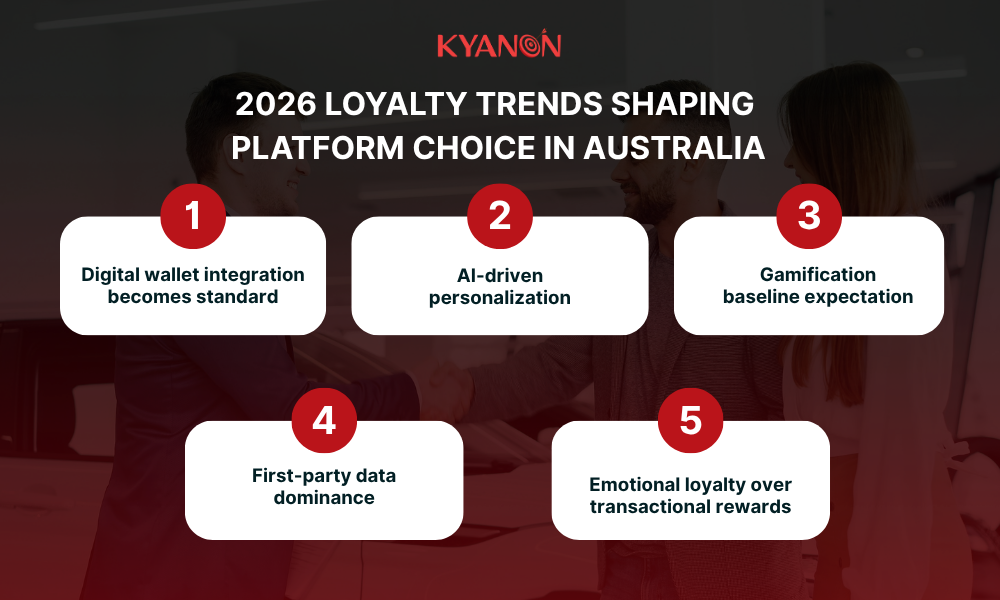
As loyalty programs in Australia continue to mature, platform selection in 2026 is being shaped by a clear shift from transactional systems to experience-led, data-driven ecosystems. Businesses are no longer just evaluating reward mechanics, they are prioritizing real-time engagement, behavioral intelligence, and omnichannel consistency across the entire customer journey.
- Digital wallet integration becomes standard: Loyalty is shifting from apps to Apple Wallet and Google Wallet experiences.
- AI-driven personalization: Platforms now predict next-best offers using behavioral models and transaction history.
- Gamification baseline expectation: Progress bars, streaks, and challenges are now standard UX patterns.
- First-party data dominance: Loyalty platforms are becoming critical infrastructure for post-cookie customer identity.
- Emotional loyalty over transactional rewards: Engagement signals like reviews and UGC are now rewarded alongside purchases.
Together, these shifts highlight a broader transformation: loyalty is no longer a points-based mechanism, but a continuous engagement system powered by data, personalization, and experience design.
For enterprises looking to operationalize these trends, Kyanon Digital provides practical perspectives on customer retention strategy and how to build a loyalty program. These insights explore how organizations can move from fragmented loyalty initiatives to unified engagement ecosystems, where data, experience, and marketing execution work together to drive long-term customer value.
Read more:
Case study: How Kyanon Digital transformed a retail loyalty platform to drive personalized customer engagement at scale
Kyanon Digital partnered with a leading nationwide retail brand to revamp its customer loyalty mobile app. The existing platform suffered from low engagement, limited personalization, and weak visibility into customer behavior, restricting its ability to drive repeat purchases and long-term loyalty.
The initiative focused on transforming the app into a data-driven engagement platform that enables real-time personalization, smarter communication, and measurable improvements in customer lifetime value.
Challenges:
- Declining engagement and retention
- Impersonal communication and poor segmentation
- Lack of behavioral insights and real-time performance data
Solution:
- Redesigned app with superior UX and behavior-based notifications
- Advanced behavioral analytics and customer segmentation
- Scalable data foundation for ongoing optimization
Business Impact:
- Increased engagement and retention through personalization
- Targeted, more effective marketing campaigns
- Improved data-driven decision-making and app performance
Business value:
This transformation shows how loyalty platforms evolve from basic reward systems into intelligent engagement engines. By combining UX redesign, behavioral analytics, and personalization, retailers can significantly improve customer loyalty, marketing effectiveness, and long-term customer value.
Read more: Customer Loyalty Platform Transformation for Retail Brand
Final thoughts: Which loyalty platform is right for you?
Australian businesses entering 2026 face a loyalty landscape defined by data integration, AI-driven personalization, and omnichannel execution. Selecting the right platform requires balancing business outcomes with technical feasibility.
If your organization is evaluating loyalty platforms or planning a full-scale customer retention transformation, the next step is not choosing software. It is designing the architecture that will support it.
Talk to Kyanon Digital to design and implement a loyalty ecosystem that actually scales with your business.
Disclaimer: All company names, logos, and brands are property of their respective owners. Their mention in this article is for informational and review purposes only and does not imply endorsement or infringement of copyright.





 Create project brief with AI