

AI customer service helps Singapore manufacturers respond to customers faster, automate repetitive inquiries, and provide 24/7 support. It can connect customer service with product knowledge, ERP, CRM, inventory, and other enterprise data to deliver more accurate and context-aware responses. Singapore businesses are already adopting AI across customer-facing functions. According to IMDA’s 2025 data, 43% of AI-using firms apply AI to customer service, making it one of the most common business functions for AI adoption.
Kyanon Digital sees AI customer service as more than a chatbot. Its real value comes from connecting trusted enterprise data with customer-facing workflows to deliver more relevant responses and improve service efficiency.
Key takeaways
- AI for customer service helps manufacturers scale support by handling repetitive inquiries 24/7 and responding faster across markets.
- Enterprise data makes AI more valuable. Connecting AI with ERP, CRM, inventory, and product knowledge enables more accurate, contextual answers.
- AI reduces repetitive workload by automating RFQ qualification, technical questions, order inquiries, and first-line support.
- The right AI solution depends on the use case. Basic FAQs may need only a chatbot, while order, product, and transaction queries require deeper system integration.
- Kyanon Digital views AI customer service as more than a chatbot, connecting AI with trusted data and workflows to automate routine interactions while keeping humans in control of complex cases.
Further reading:
- Building The Next Generation AI-Powered Chatbots & Generative AI
- Embrace The Power of AI To Enhance Customer Experience
- Delivering a Seamless Customer Experience with Chatbots
What are the benefits of AI customer service for manufacturers?
AI customer service is most valuable when it removes repetitive work from sales and support teams while giving customers faster access to reliable information.
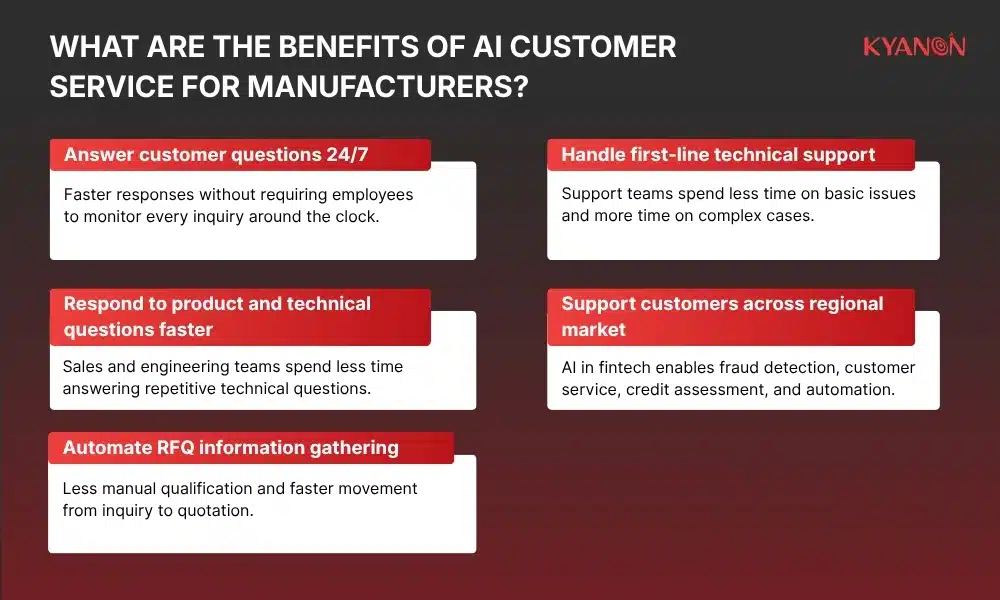
Answer customer questions 24/7
AI customer service agents can answer routine customer questions around the clock without requiring employees to monitor every inquiry. For Singapore manufacturers serving international customers, this means fewer delays caused by different time zones.
Business impact: Faster responses without requiring employees to monitor every inquiry around the clock.
Respond to product and technical questions faster
AI customer service software can retrieve information from approved product documentation, manuals, specifications, and certifications. Customers can find relevant information without waiting for a sales or engineering employee to search through multiple documents.
Business impact: Sales and engineering teams spend less time answering repetitive technical questions.
Automate RFQ information gathering
AI can collect basic RFQ requirements before handing the request to sales or engineering teams. For example, an AI agent can ask for:
- Product requirements
- Quantity
- Dimensions
- Required certifications
- Delivery location
- Target delivery date
The result is a more structured RFQ that is easier for the appropriate team to review.
Business impact: Less manual qualification and faster movement from inquiry to quotation.
Handle first-line technical support
An AI agent for customer service can provide guided troubleshooting based on approved technical documentation. If the issue requires engineering expertise, the AI can collect the relevant information and escalate the case to a human specialist.
Business impact: Support teams spend less time on basic issues and more time on complex cases.
Support customers across regional markets
An AI agent for customer service can handle basic troubleshooting using approved technical documentation and predefined workflows. However, language support should be based on the manufacturer’s actual target markets and approved terminology, particularly for technical products.
Business impact: More consistent communication across regional customers.

Where does the cost saving actually come from?
The main saving does not necessarily come from reducing headcount. It comes from allowing the existing team to handle more customer interactions with less repetitive work.
Manual process | With AI for customer service | Potential impact |
| Staff answer repetitive order questions | AI retrieves order information | Less manual support |
Engineers answer basic technical questions | AI retrieves approved documentation | More engineering capacity |
| Sales manually collect RFQ details | AI gathers requirements | Faster RFQ qualification |
Staff monitor after-hours inquiries | AI handles first-line questions | Lower support workload |
| Employees search multiple documents | AI retrieves relevant information | Faster responses |
This productivity angle is increasingly relevant in Singapore. IMDA’s 2025 research found that 85% of surveyed AI-using workers reported improvements in productivity, time savings, or work quality.
For manufacturers, the stronger business case is therefore not simply “AI replaces employees.” It is using the same workforce more efficiently while increasing customer-service capacity.
How does AI customer service work for manufacturers?
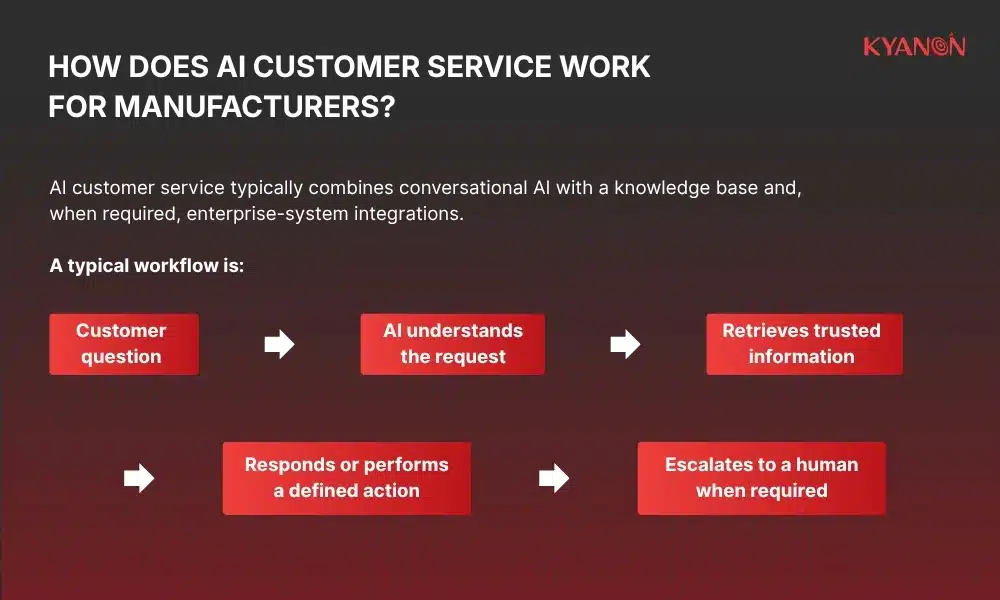
AI customer service typically combines conversational AI with a knowledge base and, when required, enterprise-system integrations. A typical workflow is:
Customer question → AI understands the request → Retrieves trusted information → Responds or performs a defined action → Escalates to a human when required.
This is why AI customer service should not be treated as only a chatbot project. The value increases when AI can access trusted business data and workflows.
When do you need more than a basic chatbot?
The right level of AI depends on the type of questions your customers ask.
- A basic chatbot is enough when customers mainly need fixed information such as business hours, policies, FAQs, product overviews, or contact details. It is relatively simple and fast to deploy.
- A more integrated AI customer service solution is needed when customers ask about specific orders, product specifications, inventory, delivery status, or quotations. In these cases, AI needs access to trusted business data and systems such as ERP, CRM, inventory, or order management. Without that access, the AI may provide incomplete answers or escalate too many requests to employees.
Before choosing a vendor, ask one question: “Do my customers mainly ask about the business, or do they ask about their specific orders, products, and transactions?”
Scaling Singapore Retail Operations with Intelligent Supply Chain Automation
Client overview
A leading Singapore-based retail enterprise operating across stores, eCommerce, and B2B wholesale channels, with thousands of supplier invoices, delivery orders, and inventory transactions processed daily.
Challenge
The retailer relied heavily on manual document processing, finance reconciliation, and inventory updates. Fragmented data across SAP, POS, eCommerce, and wholesale systems caused reconciliation delays, inventory discrepancies, and fulfillment issues.
Solution
Kyanon Digital implemented an intelligent supply chain automation platform that integrated AI-powered document processing, automated reconciliation, and real-time inventory synchronization with the client’s SAP, POS, and omnichannel systems.
Impact
- 90% reduction in manual data-entry time
- Invoice processing reduced from days to under 30 minutes
- Over 80% reduction in omnichannel inventory discrepancies
- Automated three-way reconciliation between invoices, goods receipts, and SAP records
- Improved inventory accuracy and operational visibility without adding headcount
Why it matters for manufacturers: The case shows that AI delivers greater operational value when it is connected to real enterprise data and workflows, rather than operating as a standalone chatbot.
Explore the full case study here: Scaling Singapore Retail Operations with Intelligent Supply Chain Automation
Conclusion
AI for customer service can help Singapore manufacturers respond faster, automate repetitive inquiries, and support customers across markets without adding the same level of manual workload. For manufacturers, the goal is not to replace customer service teams. It is to give them an AI layer that handles routine interactions, retrieves trusted information, and escalates complex requests to the right people.
Looking to automate customer service with AI? Talk to Kyanon Digital to discuss your customer service use cases and find the right AI solution for your manufacturing business.






 Create project brief with AI