


Artificial Intelligence (AI) is transforming healthcare customer service in Singapore by shifting from reactive administrative workflows to proactive, personalized, and 24/7 patient support. As Singapore’s public healthcare clusters (SingHealth, NHG, and NUHS) manage an aging population, the national healthtech agency Synapxe and local public hospitals are leveraging AI to eliminate wait-time bottlenecks, streamline communication, and reduce clinician burnout.
Key takeaways
- Automate routine patient enquiries: AI customer service agents can provide 24/7 multilingual assistance, support appointment management, and answer common administrative questions.
- Improve service efficiency: AI can reduce repetitive contact-centre tasks, streamline patient communication, and help staff focus on complex or sensitive cases.
- Integrate AI with existing workflows: Reliable knowledge sources, connected systems, and clear human handover procedures are essential for accurate responses and effective service delivery.
- Prioritize safety and governance: Singapore healthcare providers need appropriate data protection, accountability, and ongoing monitoring to deploy AI responsibly.
- Kyanon Digital approaches AI customer service as an implementation and integration partner, helping healthcare providers connect AI with existing workflows, approved knowledge sources, and human support to improve service outcomes.
Where does AI customer service deliver real value in healthcare?
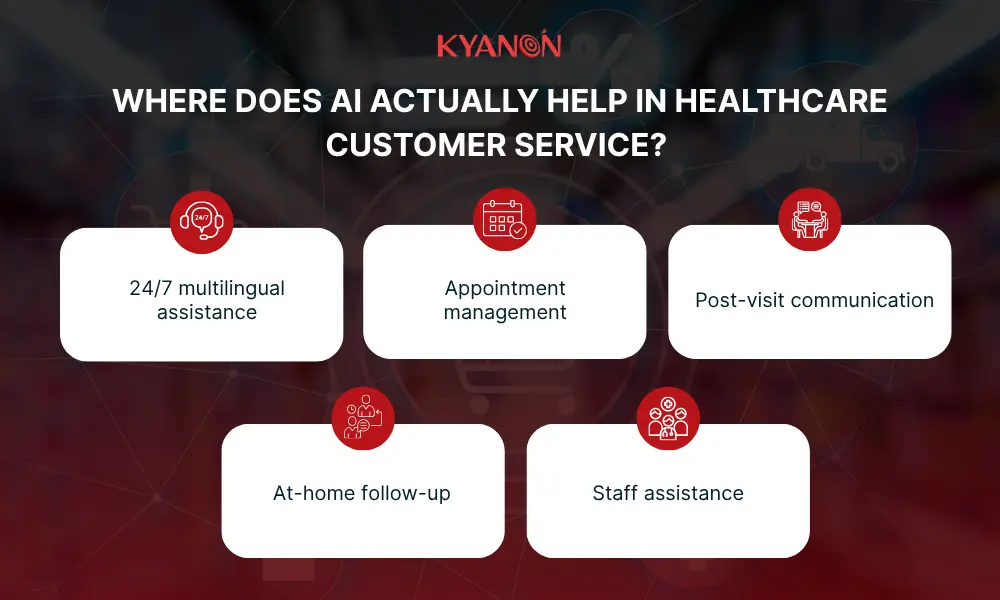
AI can automate routine patient enquiries, streamline appointment workflows, simplify approved post-visit information, and support follow-up communication. For Singapore healthcare providers, the priority is to automate high-volume, low-risk tasks while keeping clinical decisions and sensitive cases under human oversight.
- 24/7 multilingual assistance: Answer routine questions about clinic locations, operating hours, and appointment instructions.
- Appointment management: Support booking, rescheduling, and reminders through integration with scheduling systems.
- Post-visit communication: Simplify approved instructions and explain general medical terminology without replacing clinical advice.
- At-home follow-up: Send reminders and collect patient updates, with clear escalation paths for concerning responses.
- Staff assistance: Classify enquiries, summarize conversations, and suggest responses based on approved knowledge.
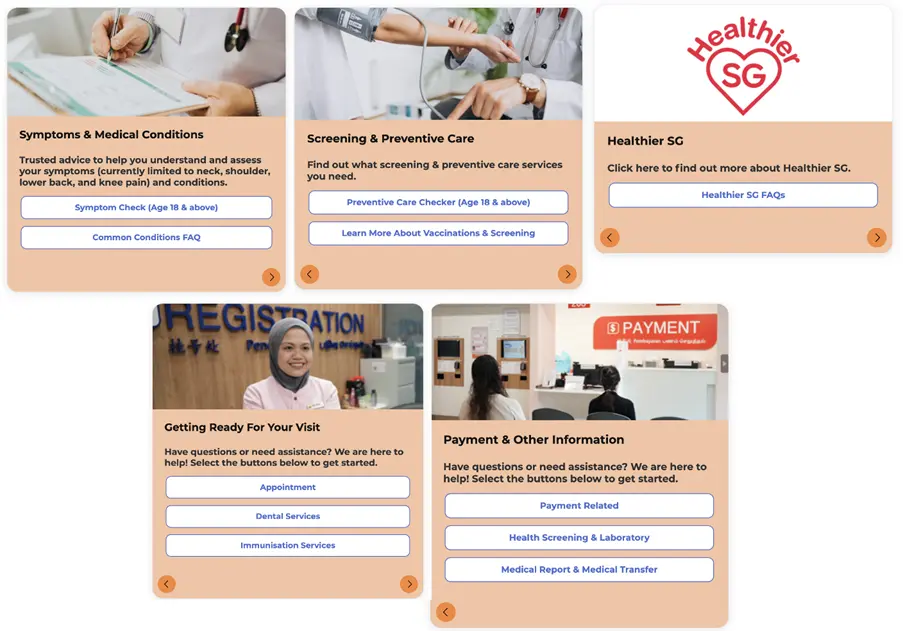
For instance, an AI customer service example – launched on the SingHealth Polyclinics portal, SPARKI (SingHealth Polyclinics Patient Assistant) provides 24/7 service. It assists patients with local administrative inquiries, such as checking clinic opening hours, booking appointments, and identifying available immunisation services or consultation costs. It also functions as a basic symptom checker for muscle or joint pain, advising whether self-management or an appointment with a doctor is necessary.
For healthcare providers, Kyanon Digital recommends starting with a clearly defined workflow and reliable, approved information. Integrating AI with existing systems and establishing human handover procedures can help improve service efficiency without compromising patient safety or response accuracy.

What are the benefits of AI customer service for Singapore healthcare?
AI customer service can help healthcare providers in Singapore improve patient access, reduce repetitive administrative work, and deliver more consistent support. The impact depends on the quality of the underlying information, integration with existing systems, and how effectively complex cases are escalated to staff.
|
Benefit |
Healthcare AI customer service impact |
| Faster responses |
Handles routine enquiries 24/7, including outside operating hours. |
|
Lower contact-centre workload |
Automates repetitive questions so staff can focus on complex cases. |
| Smoother appointment management |
Supports booking, rescheduling, and reminders through connected systems. |
|
Better patient access |
Provides support across digital channels and relevant languages. |
| More consistent information |
Uses approved knowledge sources to deliver standardized responses. |
|
Higher staff productivity |
Reduces repetitive administrative tasks and manual enquiry handling. |
| More effective escalation |
Routes sensitive or complex enquiries to the appropriate staff. |
To realize these benefits, Kyanon Digital recommends measuring operational outcomes such as response time, successful self-service resolution, repeat enquiries, and staff handling time. These metrics help healthcare providers determine whether AI is improving the patient experience and reducing workload, rather than simply increasing chatbot usage.
What needs to be in place before deploying AI customer service?
Healthcare providers should validate the service workflow, data quality, system integration, and governance before deploying AI customer service. Starting with a clearly defined, low-risk use case helps teams measure value and identify issues before expanding automation.
The Ministry of Health says the guidance clarifies responsibilities for developers, healthcare organisations deploying AI, and healthcare professionals using it. It also emphasizes transparency and risk assessment. This gives your discussion of accountability, human oversight, and patient safety a strong local policy foundation.
|
Check |
What to confirm first |
| Service value |
Identify high-volume, low-risk enquiries and define success metrics such as response time, resolution rate, and handover rate. |
|
Workflow integration |
Connect AI to relevant booking systems, patient information where authorized, and customer-service tools to keep answers current and preserve context during handovers. |
| Data readiness |
Ensure the knowledge base and supporting data are accurate, approved, and regularly updated. |
|
Governance |
Establish PDPA-aligned data handling, clear accountability, appropriate access controls, and transparency when patients interact with AI. |
| Scale and upkeep |
Assign responsibility for monitoring performance, reviewing failed responses, and updating knowledge and system configurations after launch. |
Kyanon Digital recommends validating these requirements through a focused pilot before scaling. If information is unreliable or existing workflows cannot support effective human handovers, address those gaps first. AI should improve service delivery, not add another layer of complexity.
When NOT to automate yet
- Do not automate where staff cannot override or take over. Automation bias is a documented risk under time pressure.
- Do not launch without testing across languages and patient groups. Performance differences across groups are well documented.
- Do not treat go-live as the finish line. Post-deployment monitoring and recalibration are part of scaling.
How does Kyanon Digital approach AI customer service for Singapore healthcare?
Kyanon Digital approaches AI customer service as an implementation and integration partner, helping healthcare providers connect AI capabilities with approved knowledge sources, existing service workflows, and human support teams. The focus is not simply deploying a chatbot, but making sure it addresses a defined service problem while maintaining information accuracy, appropriate data access, and clear escalation paths.
A practical implementation starts by identifying repetitive, low-risk enquiries, assessing data and system readiness, and defining measurable outcomes. AI can then be integrated into the relevant workflows, with monitoring and human handover procedures established before the solution is expanded.
Case study: Scaling customer service with an AI chatbot

A private healthcare provider in Singapore needed to manage growing customer enquiries while maintaining consistent information and human oversight. Kyanon Digital implemented an AI-powered chatbot for routine, non-clinical support.
Challenges
- High volumes of repetitive enquiries about appointments, services, locations, and operating hours.
- Fragmented knowledge and manual request routing.
- The need to scale self-service without automating clinical decisions.
Solution
- Used retrieval-augmented generation (RAG) to ground chatbot responses in approved service knowledge.
- Integrated the chatbot with existing customer-service workflows through APIs and automation.
- Established human escalation, conversation monitoring, and knowledge-update processes.
Results and Impact
The published case study reported:
- 38% fewer routine manual enquiries.
- 32% faster response times.
- 28% of eligible enquiries resolved through self-service.
- 24% reduction in repetitive agent workload.
These results demonstrate the potential of combining AI with knowledge management and workflow integration. Actual outcomes will depend on each provider’s enquiry volume, system readiness, and implementation scope.
Read the full healthcare AI chatbot case study: Scaling Customer Service with an AI Chatbot for Healthcare
Conclusion
AI customer service can help Singapore healthcare providers improve patient access, reduce repetitive enquiries, and streamline service workflows. Success depends on reliable data, integration with existing systems, and clear human escalation for sensitive or clinical cases.
Planning an AI customer service solution for healthcare? Talk to Kyanon Digital about your integration requirements, data readiness, and a practical implementation roadmap.
References
- Emerging regulatory policy issues: AI in Healthcare Guidelines (AIHGle 2.0) – Ministry of Health, Singapore, 2026.
- Speech at HIMSS26 APAC Health Conference and Exhibition – Ministry of Health, Singapore, 2026.
- Data Protection Obligations under the Personal Data Protection Act – Personal Data Protection Commission, Singapore.
- Scaling Customer Service with an AI Chatbot for Healthcare – Kyanon Digital.
- Increasing efficiency with smart technology – Singapore National Eye Centre, 2021.
- Singapore launches Asia’s first allergic rhinitis database to transform chronic ENT care – National University Health System, 2025.
- AI chatbot to help SGH save money and time with pre-surgery assessments – SingHealth, 2025.
- Meet SPARKI – SingHealth Polyclinics’ New Online Chatbot – SingHealth







 Create project brief with AI