

AI ecommerce automation helps Singapore healthcare businesses streamline online orders, inventory, fulfilment, reminders, and customer queries while maintaining PDPA compliance and human oversight of clinical decisions. To help businesses understand how to apply it effectively, this article explores key use cases, operational benefits, and essential safeguards.
As online demand for healthcare products grows, businesses face increasing pressure to handle higher order volumes without proportionally increasing operational resources. Manual workflows and disconnected systems can limit productivity and slow growth.
To capture these benefits, healthcare leaders must identify which ecommerce processes to automate and where human oversight remains essential. This balance enables operational efficiency without compromising patient data, clinical safety, or regulatory compliance.
Key Takeaways
- Separate transactional workflows from clinical decisions to maintain patient safety and regulatory compliance across automated healthcare channels.
- Consolidate product and patient data across inventory, pricing, and order records before deploying automated routing rules.
- Build privacy and security safeguards into every workflow to align healthcare automation with Singapore’s PDPA and applicable cloud security requirements.
- Partnering with Kyanon Digital provides healthcare brands with experienced integration architectures that unify front-end e-commerce storefronts with back-end enterprise ERPs.
- Start with a focused proof of concept: Kyanon Digital recommends validating a high-volume workflow, such as inventory replenishment or invoice matching, before expanding automation across channels.
- Apply a Human-in-the-Loop framework to flag high-risk transactions and prescription discrepancies for review by licensed healthcare professionals.
What does AI ecommerce automation mean in a healthcare context?
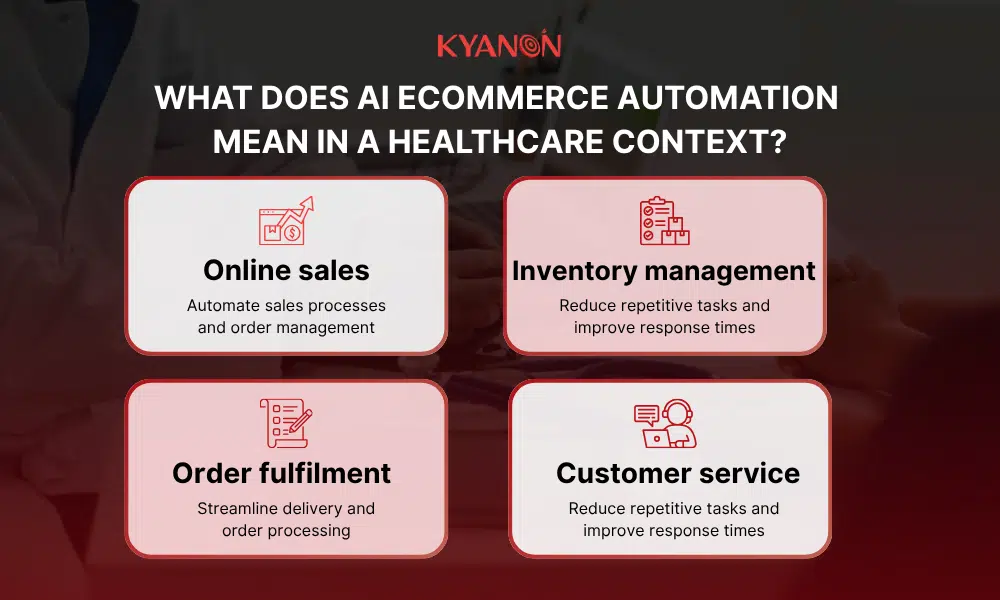
AI ecommerce automation helps healthcare businesses streamline online sales, order processing, inventory management, delivery coordination, and customer service. It applies to both B2C businesses, such as retail pharmacies and wellness brands, and B2B operations, including MedTech suppliers and healthcare distributors.
Unlike clinical AI, which supports tasks such as medical documentation and imaging, ecommerce automation focuses on the commercial operations behind healthcare services. By reducing repetitive manual work and improving coordination across orders, inventory, and fulfilment, it helps businesses serve customers more efficiently as demand grows.

Where does AI ecommerce automation create the most value for Singapore healthcare?
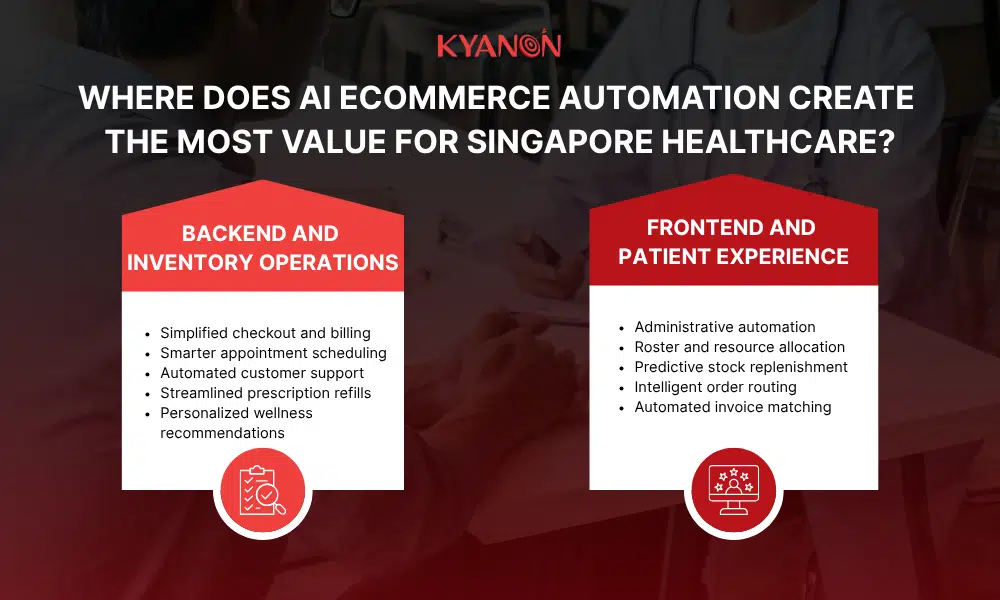
Frontend and patient experience
Singapore’s digital healthcare services are making it easier for people to access healthcare information and services online. AI-powered automation can further improve the experience by simplifying bookings, payments, product searches, and recurring orders.
- Simplified checkout and billing: Automated workflows help process online payments, match billing records, and route financial assistance forms for review, reducing manual work and delays.
- Smarter appointment scheduling: AI helps forecast appointment demand and identify suitable time slots, making it easier to manage bookings and reduce scheduling inefficiencies.
- Automated customer support: AI chatbots answer routine questions about clinic locations, opening hours, product availability, delivery status, and appointments, while directing more complex enquiries to staff.
- Streamlined prescription refills: Digital workflows help manage refill requests, check order details and stock availability, and coordinate payment and delivery or collection, subject to prescription and dispensing requirements.
- Personalized wellness recommendations: Healthcare retailers and wellness brands can use customer preferences and permitted purchase data to suggest relevant products, such as vitamins and seasonal wellness packages, with appropriate privacy safeguards.
Backend, agentic AI & inventory operations
Applying e-commerce inventory and supply chain logic directly minimizes clinical downtime and saves massive capital resources:
- Agentic administrative automation: Agentic AI platforms can support public healthcare workers by automating administrative tasks, such as documenting medical histories and summarizing pre-consultation notes. These capabilities can reduce preparation time from 45 minutes to 20–25 minutes, representing an approximately 50% reduction.
- Roster and resource allocation: Systems automate complex internal operations like staff roster creation, mirroring algorithmic workforce management used in major fulfillment centers.
- Predictive stock replenishment: Algorithms analyze historical purchasing trends, regional disease patterns (such as seasonal dengue or influenza spikes), and supplier lead times to automate reorder triggers for key pharmaceuticals.
- Predictive maintenance: Automating the monitoring of high-value MedTech machinery (like CT scanners) helps institutions decide whether to upgrade existing parts or replace them, avoiding millions in procurement costs and cutting weeks of clinical downtime.
- Automated pharmacovigilance: Systems track post-market drug safety data across digital platforms to flag early risks or side effects faster than manual reporting chains.
- Intelligent order routing: Multi-branch health networks use smart routing rules to send online orders to the nearest pharmacy or warehouse holding available stock, reducing delivery times and cold-chain logistics friction.
- Automated vendor invoice matching: Optical Character Recognition (OCR) extracts transaction data from supplier invoices, purchase orders, and delivery slips. The system automatically flags pricing discrepancies and pushes verified data directly to accounting software.
Strategic comparison: E-commerce logic vs. clinical reality
Although healthcare ecommerce borrows automation principles from retail, such as demand forecasting, order routing, and inventory management, healthcare operations involve stricter requirements for patient safety, data privacy, and clinical oversight. Understanding these differences helps businesses identify which workflows can be automated efficiently and where human review remains essential.
Feature | E-Commerce automation | Singapore healthcare AI automation |
| Primary goal | Maximize sales and speed up deliveries. | Augment human capacity and reduce clinician cognitive burnout. |
Data context | Broad consumer behavioral metrics. | Localized medical data tailored specifically to multi-ethnic Singaporean patient demographics (e.g., the SIMFONI initiative). |
| Risk factor | Low risk (e.g., incorrect item sent). | High risk; requires mandatory human-in-the-loop safeguards to override automation bias. |
Healthcare businesses can apply proven ecommerce practices to streamline purchasing, manage inventory, and coordinate fulfillment, but they cannot simply automate every workflow in the same way. The most effective approach is to automate repetitive, rules-based tasks while retaining appropriate human oversight for sensitive data, prescription handling, and clinical decisions. This balance helps organizations improve efficiency without compromising patient safety, regulatory compliance, or trust.
What guardrails apply in Singapore?
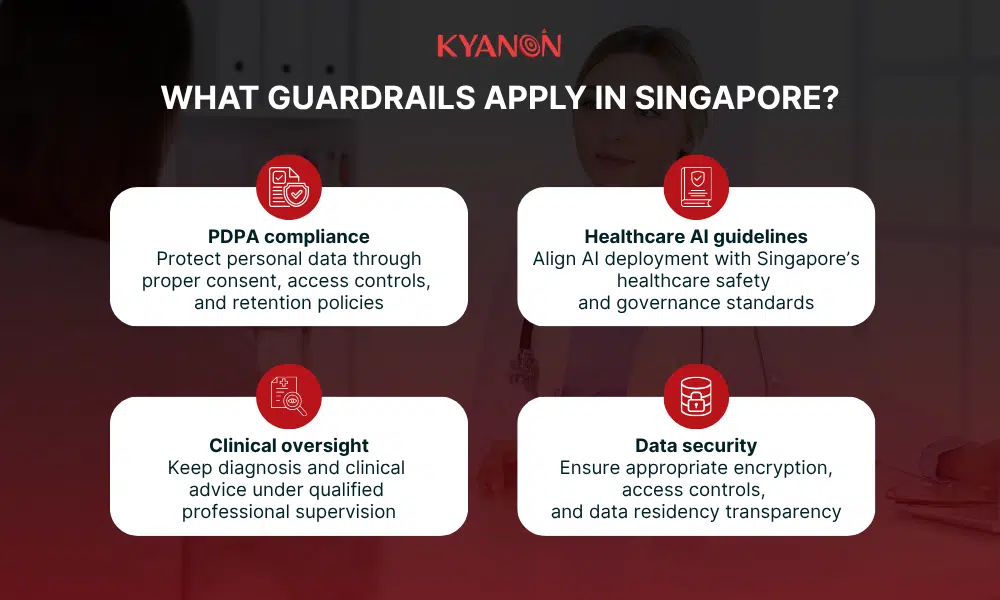
Healthcare automation operates within a strict regulatory framework in Singapore:
- Personal Data Protection Act (PDPA): All personal and medical data captured across digital sales flows must comply strictly with PDPA rules regarding collection, usage consent, and retention.
- Healthcare AI guidelines: Singapore’s healthcare AI guidelines establish safety principles and operational standards for the responsible development, deployment, and use of AI across healthcare settings.
- Clinical oversight and governance: Autonomous systems must maintain clear boundaries. While AI can handle transactional routing, product indexing, and administrative scheduling, clinical advice and diagnostic decisions must remain under the direct control of licensed clinicians.
- Data hosting and infrastructure: Public health data is managed on dedicated government cloud infrastructure. Private healthcare operators must demand full transparency from technology vendors regarding data residency, encryption standards, and access control policies.
When back-office systems operate in silos, manual exception handling can quickly degrade order accuracy and delay fulfillment schedules across channels. Healthcare businesses evaluating their current systems can consult Kyanon Digital’s integration and automation services to assess system readiness and build secure, compliant data pipelines.
What does the data and integration layer need to look like before automating?
Before introducing AI ecommerce automation, healthcare businesses need to ensure their data and integration layers can support reliable, secure workflows. A reliable data foundation helps prevent inconsistent records and outdated inventory information from disrupting automated workflows. Healthcare businesses should address three prerequisites:
- Catalog and inventory harmonization: Standardize product identifiers, SKU naming, pricing rules, and inventory records across warehouses, pharmacies, and ecommerce channels.
- Data access and retention controls: Define how customer and patient data is collected, accessed, stored, and retained, with appropriate safeguards aligned with Singapore’s PDPA requirements.
- Exception management: Establish clear escalation rules and assign human ownership for stock discrepancies, prescription validation issues, failed transactions, and other exceptions that automated workflows cannot safely resolve.
From an implementation perspective, Kyanon Digital recommends consolidating master product data and establishing reliable inventory visibility across core ERP and ecommerce systems before deploying automated order routing or replenishment rules.
Once these foundations are in place, businesses can better evaluate whether a technology partner has the integration, security, and governance capabilities required to scale automation safely.
How to choose an AI ecommerce automation healthcare vendor in Singapore?
Deploying AI automation at the intersection of e-commerce and healthcare requires a technology partner that balances digital retail efficiency with strict medical compliance. Standard e-commerce agencies often lack regulatory context, while pure healthtech vendors may lack expertise in retail logistics.
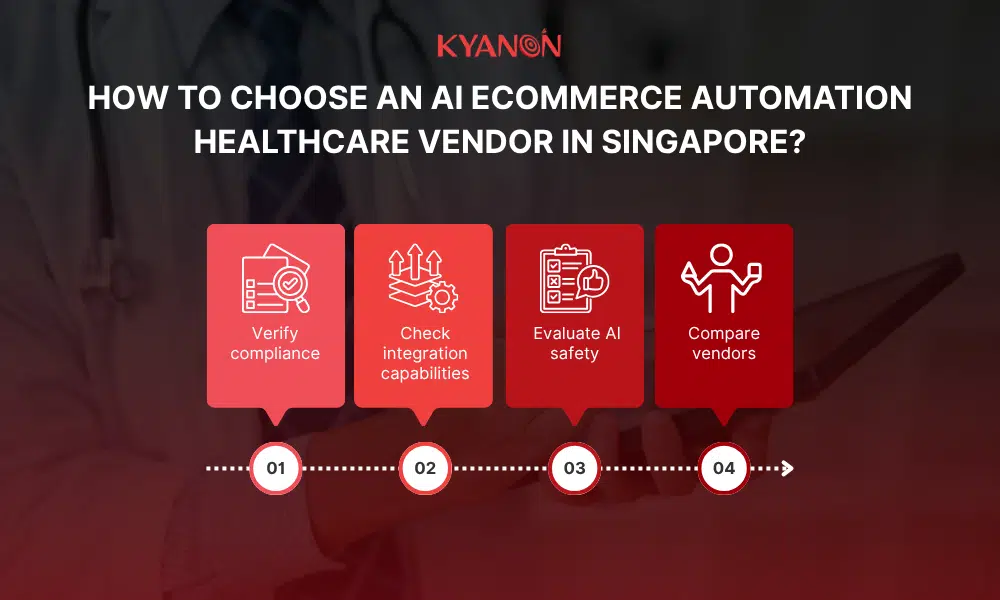
Evaluate potential technology partners using this four-step selection framework:
Step 1: Verify Singapore healthcare compliance (non-negotiable)
Filter out vendors that cannot meet essential security and regulatory standards:
- HSA medical device registration: If the software provides symptom assessments, patient triage, or medical treatment recommendations, check whether it qualifies as Software as a Medical Device (SaMD) and requires registration with Singapore’s Health Sciences Authority (HSA).
- PDPA and cloud security requirements: Ensure the vendor has appropriate data protection controls and can demonstrate compliance with Singapore’s Personal Data Protection Act (PDPA). Assess cloud hosting, data residency, access controls, encryption, and relevant security certification requirements based on the sensitivity of patient data and applicable regulations.
- Healthcare system integration and governance: If the solution connects with existing healthcare systems, verify that the vendor can meet relevant interoperability, security, access control, and data governance requirements to support secure data exchange across platforms.
Step 2: Assess dual-domain integration capabilities
Ensure the vendor possesses proven experience connecting back-end medical and enterprise databases with customer-facing e-commerce platforms:
- E-commerce & ERP synchronization: Verify native integration capabilities between front-end e-commerce platforms (such as Shopify Plus, Magento, or WooCommerce) and back-end systems (such as SAP, Oracle, or Salesforce Health Cloud).
- Automated prescription validation: Ensure automated workflows can securely cross-reference digital prescription records with live inventory databases to confirm product availability and authorization before permitting transaction completion.
Step 3: Evaluate safety frameworks (“Human-in-the-Loop”)
In healthcare automation, system errors introduce severe operational and legal risks:
- Clinical guardrails: Select platforms designed with a Human-in-the-Loop (HITL) architecture. Automated agents should process routine orders but instantly pause and route transactions to a licensed pharmacist or clinician if high-risk drug interactions or conflicting prescription data are detected.
- Audit trails: Confirm that the vendor provides immutable system logs detailing the decision logic behind every automated approval, flag, or order routing action.
Step 4: Use a vendor selection matrix
Use this targeted matrix during vendor evaluations to score prospective technology partners:
Evaluation criteria | Target capabilities (What to look for) | Red flags (What to avoid) |
| Industry focus | Dedicated portfolio in health-retail, digital pharmacies, or clinic workflow automation. | General e-commerce agencies with no prior medical or regulated sector experience. |
AI data privacy | Zero-retention data pipelines; customer data is never used to train public LLM models. | Vendors using standard consumer-grade APIs that expose sensitive patient data. |
| Localization | NLP models trained to understand Singaporean addresses, postal codes, and local product naming. | Systems optimized solely for foreign markets that fail on local address formats. |
Scalability | API-first architecture capable of handling seasonal volume spikes (e.g., flu season order surges). | Monolithic, rigid software that requires expensive custom recording for basic workflow changes. |
From an execution standpoint, Kyanon Digital advises starting vendor engagements with a bounded proof-of-concept on a single high-volume flow, such as automated inventory reordering or invoice matching, to validate integration stability before expanding to automated customer-facing checkouts.
Conclusion
Automating digital commerce operations in healthcare offers significant efficiency gains, provided organizations establish robust data foundations and clear clinical guardrails. By focusing automation on repeatable administrative, transactional, and logistics workflows while maintaining human oversight for medical decisions, healthcare providers in Singapore can scale their online operations safely.
Mapping which commerce flows in your healthcare business are ready for automation? Speak with Kyanon Digital’s data and automation consultants to conduct an operational readiness review.
References
SIMFONI National Healthcare AI Framework — CRIS / SIMFONI, 2026.
Personal Data Protection Act (PDPA) — Personal Data Protection Commission Singapore, 2026.





 Create project brief with AI