

Custom AI chatbot development can help Singapore healthcare providers answer routine enquiries, route service requests and connect patients with staff. A suitable implementation uses approved knowledge, controlled system access and clear human escalation. Patient-facing service automation should remain separate from diagnosis, treatment recommendations and clinical triage unless those functions undergo appropriate clinical and regulatory assessment.
For a clinic operations manager, the immediate problem may be repeated booking questions across WhatsApp and web channels. For an IT leader, the harder question is whether automation can access reliable information without exposing patient data or creating unsafe answers.
The decision is therefore about scope and readiness: which enquiries can be automated, which systems must connect, and who takes responsibility when the chatbot cannot help?
Key takeaways
- Start with one defined workflow supported by approved information, a responsible team and a measurable service goal.
- Custom AI chatbot development is most relevant when existing tools cannot meet integration, multi-site, or governance requirements.
- Reliable operation requires tested answers, verified data controls and human handoffs; RAG or private hosting alone is insufficient.
- Kyanon Digital’s Singapore healthcare implementation demonstrates how approved knowledge and API-connected workflows can support non-clinical automation while preserving human oversight.
- Expand beyond the pilot only when answer quality, successful escalations and staff handling time meet agreed acceptance criteria.
Why is a custom AI chatbot becoming necessary for Singapore healthcare centers?
A custom AI chatbot becomes necessary when routine patient inquiries depend on clinic-specific information, connected systems and data controls that packaged tools cannot adequately support. It can reduce repetitive administrative work and improve response consistency while directing clinical, sensitive or unsupported questions to qualified staff.
The need becomes clearer when everyday service encounters three operational challenges:
- Reduce repetitive work: Automate approved enquiries about appointments, services and operating hours so staff can focus on requests requiring judgment.
- Connect service workflows: Route requests into existing systems with the context staff need, reducing manual transfers and repeated explanations.
- Control information and access: Maintain approved answers, restrict patient-data access and define when human intervention is required.
Custom development is worth considering when these requirements exceed what an existing platform can reliably deliver. For straightforward FAQs and standard booking journeys, a well-configured packaged solution may be sufficient.
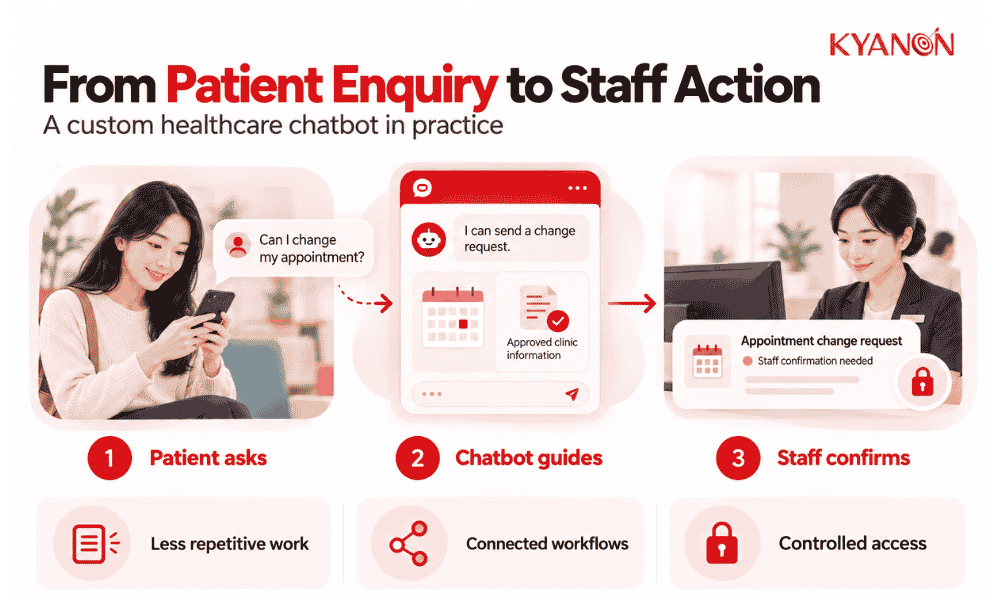
Demonstrate how approved answers, connected workflows and human escalation would work within the clinic’s existing service process. If a packaged solution already meets these operational and governance requirements, custom development may not be necessary.

How does an AI chatbot reduce medical hallucinations and understand Singapore healthcare terminology?
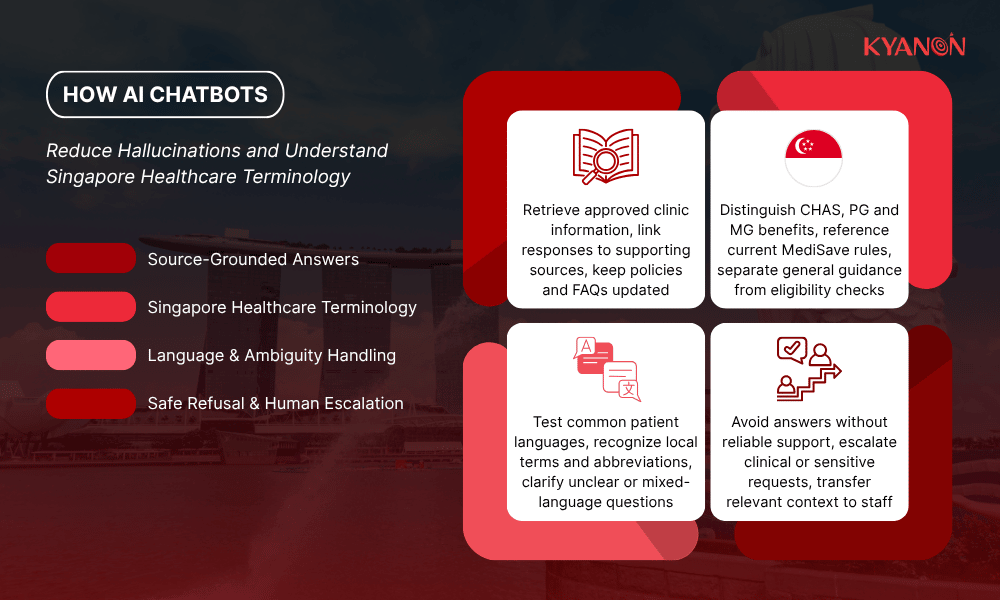
An AI chatbot can reduce hallucination risk by retrieving approved information, recognizing local terminology and escalating questions it cannot reliably answer. In practice, reliability depends on accurate answers and appropriate handling of uncertainty. RAG, fine-tuning, or low-temperature settings alone do not guarantee correct responses.
For example, when a patient asks, “Can I use MediSave for this treatment?” the chatbot should clarify which treatment they mean, retrieve the relevant current rules, and explain any conditions. If eligibility remains unclear; it should refer the inquiry to the clinic’s billing team rather than confirm coverage.
Reliable responses depend on how the chatbot handles both the information it retrieves and the questions patients ask:
- Source-grounded answers: Retrieve information from approved clinic content and relevant official sources, with traceable references and update controls. Retrieval-Augmented Generation (RAG) supplies supporting context; it does not automatically eliminate unsupported answers.
- Singapore-specific terminology: Test distinctions between CHAS tiers, Pioneer and Merdeka Generation benefits, and MediSave rules. General scheme information should remain separate from confirmation of an individual’s eligibility.
- Language and ambiguity testing: Require examples using the languages, abbreviations and mixed-language questions your patients actually use. Ambiguous wording should trigger clarification rather than an assumed clinical interpretation.
- Safe refusal and escalation: Test missing sources, conflicting policies and requests for diagnosis. The chatbot should acknowledge its limits and transfer the request with relevant context.
If your chatbot must combine proprietary healthcare knowledge with enterprise systems, Kyanon Digital’s Generative AI consulting services in Singapore cover RAG architecture, private deployment, data integration and custom GenAI applications.
What security architecture must an AI chatbot have to guarantee strict PDPA compliance?
A healthcare AI chatbot needs three connected safeguards: personal-data redaction, verified model-provider retention controls, and secure hosting with restricted access. These safeguards support PDPA compliance alongside clear data-handling policies, defined responsibilities and ongoing monitoring.
MOH confirmed that patient-data security requirements apply to AI tools hosted on both third-party clouds and on-premise infrastructure. Hosting location alone, therefore, does not establish compliance.
The following layers address different points where patient information could be exposed:
Security layer | How it protects patient data | What to verify |
PII redaction & masking | Uses NER and identifier-detection rules to mask unnecessary names, NRIC numbers and sensitive details before external model processing. | Redaction tests cover missed identifiers; diagnostic logs do not retain unfiltered data. |
| Model-provided retention controls | Limits how external providers retain prompts and responses or use them for training. | ZDR claims match the selected endpoint’s contract and configuration, including exceptions; clinic records have separate retention rules. |
Secure hosting & access | Combines encryption, private network controls, least-privilege permissions and staff MFA. | Access tests enforce user permissions; the data-flow review covers model services, backups and overseas processing. |
Before deployment, document what data leaves the clinic, who can access it, and when it is deleted. This makes security commitments assessable across the full service.
When should an AI chatbot step back and escalate the conversation to a human medical professional?
A non-clinical healthcare chatbot should stop automated answering when a request involves medical judgment, possible emergencies, mental health crises or information it cannot reliably interpret. Patients should also be able to request human support, while emergency guidance must appear immediately rather than depend on a clinic callback.
Clear scope and medical boundaries
Introduce the chatbot as an administrative assistant that cannot diagnose, recommend treatment or replace a clinician. Explain which enquiries it supports and how patients can reach staff.
A disclaimer must be backed by enforced boundaries. MOH’s February 2026 guidance warns that generative AI chatbots should not replace qualified mental health providers and may produce harmful responses during serious mental health crises.
Defined escalation triggers
Use clinician-approved rules and response templates for potential emergencies, clinical questions and crisis cues. Escalation should also cover unclear requests, repeated failures and explicit requests for a person.
For a medical emergency in Singapore, direct the patient to call 995 without waiting for a chat handoff. Keyword detection can support safety routing, but it does not constitute validated triage or establish that unflagged messages are safe.
Context-preserving human handoff
Where supported, use an authenticated API or webhook to create a case in the clinic’s CRM or connected messaging inbox. Transfer the escalation reason, relevant conversation context and actions already attempted to authorized staff.
Route clinical questions to qualified professionals and administrative exceptions to service teams. Define receiving-team ownership, service hours and a fallback for failed transfers. Never imply that a clinician is reviewing a conversation unless this has been confirmed.
Defining where automation should stop is part of designing a dependable service workflow. Explore Kyanon Digital’s guide to AI chatbot use cases in Singapore for practical considerations on connecting routine enquiries, service systems and human support.
What is the step-by-step roadmap to safely launch a compliant AI chatbot in your clinic?
Start with one clearly defined service workflow, then validate its knowledge, safeguards, integrations and staff handoffs before a controlled launch. The scope should reflect your clinic’s specialty, patient population and operational goal, for example, answering appointment inquiries versus explaining approved preparation instructions.
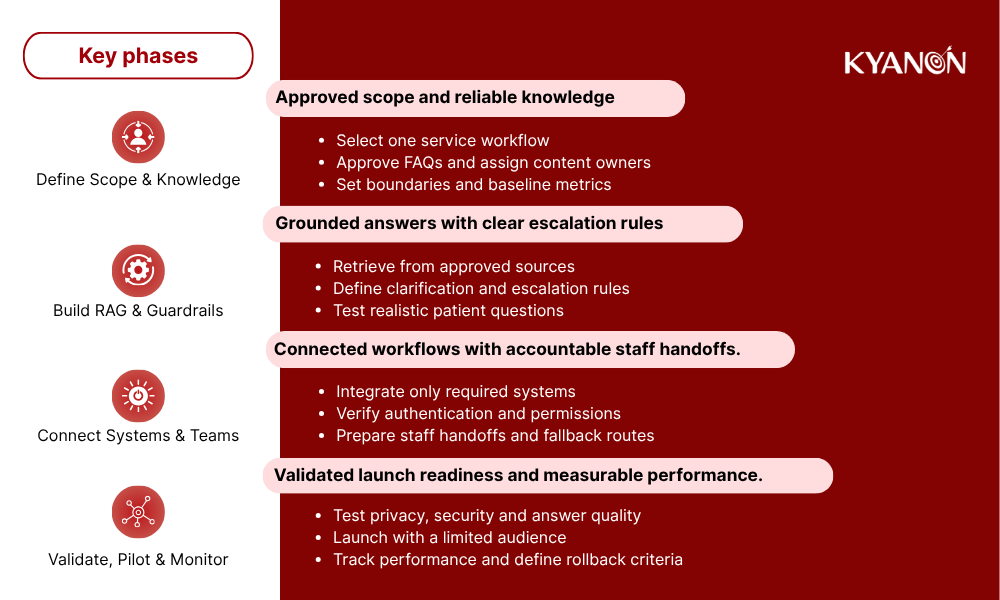
Phase 1: Define scope and audit knowledge
Choose a recurring service problem and establish a baseline, such as staff handling time or routine enquiry volume. Consolidate approved FAQs, clinic procedures and billing information with named owners responsible for updates. Document prohibited topics and escalation routes. A pediatric clinic should account for parent or caregiver interactions; a mental health clinic needs particular attention to distress and crisis-related messages.
Phase 2: Build RAG and safety guardrails
Configure retrieval from approved sources, document update controls and responses for missing or conflicting information. Define when the chatbot should clarify, decline or escalate.
Create test conversations using realistic patient language, including ambiguous requests and attempts to obtain medical advice. Have qualified clinical staff review safety wording and escalation rules relevant to the intended scope.
Phase 3: Connect the required systems
Integrate only the CMS, scheduling, CRM, or messaging functions needed for the selected workflow. General FAQs may require no patient-record access; appointment changes require authentication, permissions and confirmation.
Prepare staff to receive escalations with relevant context. Confirm service hours, receiving-team ownership and fallback routes when an integration fails.
Phase 4: Validate, pilot and monitor
Complete privacy and security reviews, access-control tests, vulnerability assessment and appropriate penetration testing. Test answer quality, unsafe requests, handoff failures and staff acceptance before releasing to a limited audience.
Assign an operational owner to monitor unsupported answers, successful handoffs and staff handling time against the baseline. Define rollback conditions and expand only when the agreed safety and service criteria are met.
Before development begins, document the clinic type, first workflow, systems involved and escalation owner. This gives the implementation team a concrete basis for defining safeguards, delivery scope and launch readiness.
How Kyanon Digital built a healthcare service chatbot for a Singapore provider
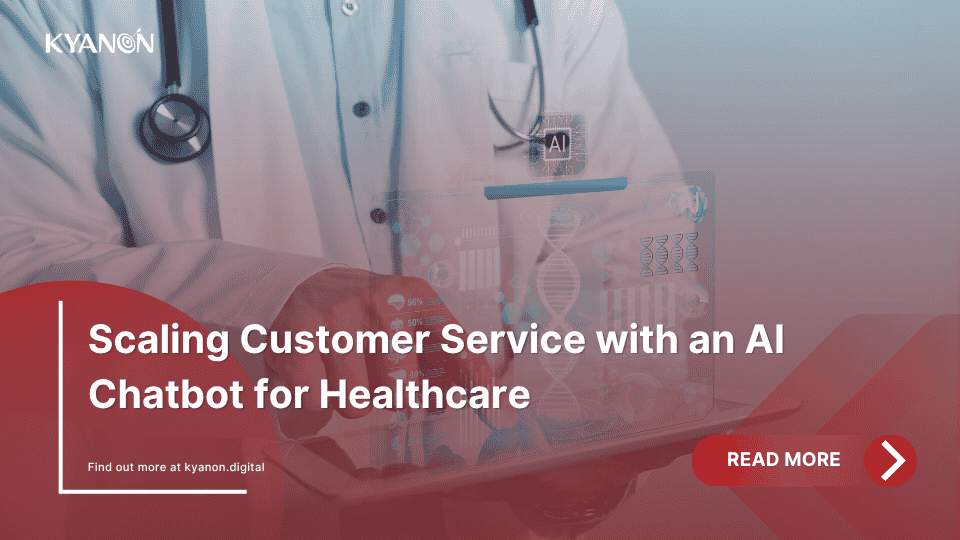
Kyanon Digital helped a private healthcare provider in Singapore automate routine enquiries by connecting approved service knowledge, existing workflows and human escalation. The implementation focused on non-clinical customer service.
Challenges
- Repetitive appointment, location and service inquiries consumed staff capacity.
- Fragmented information made consistent responses difficult.
- Manual routing slowed requests requiring specialist support.
Solution from Kyanon Digital
- Consolidated approved FAQs and defined which inquiries could be automated.
- Built a RAG-based chatbot grounded in organizational knowledge.
- Connected service requests and escalation workflows through APIs, preserving conversation context.
- Added role-based access, response guardrails and monitoring to support ongoing improvements.
Results and impact
- 38% reduction in routine manual inquiries.
- 32% faster response times.
- 28% of eligible enquiries resolved through self-service.
- 24% reduction in repetitive agent workload.
The project demonstrates how a defined service scope and connected workflows can support healthcare automation. These results apply to this implementation; diagnosis, treatment recommendations and personalized medical advice remained outside its scope.
Explore the full healthcare AI chatbot case study for the implementation details.
Conclusion
Custom AI chatbot development is most appropriate when a Singapore healthcare organization needs more than static FAQs, particularly when proprietary knowledge, patient workflows, multiple systems or sensitive data are involved.
The safest first move is to define one bounded use case, determine its clinical and data risk, establish baseline metrics and validate the governance model before widening automation.
Planning a patient-service or healthcare AI initiative? Discuss your AI chatbot architecture and integration requirements with Kyanon Digital, including knowledge sources, privacy boundaries, system dependencies and the first workflow worth validating.
References
- Using MediSave for outpatient treatments — Central Provident Fund Board.
- Retrieval augmented generation (RAG) and indexes — Microsoft Learn.
- Cards & Subsidies — Community Health Assist Scheme.
- Building Generative AI Consulting Company in Singapore — Kyanon Digital.
- Data security requirements apply to AI tools that process patient data — Ministry of Health Singapore.
- Data Protection Obligations — Personal Data Protection Commission Singapore.
- Use of AI chatbots for counselling and mental health support — Ministry of Health Singapore.
- Emergency Medical Services — Singapore Civil Defence Force.
- What Are Top AI Chatbot Use Cases for Service in Singapore? — Kyanon Digital.
- Scaling Customer Service with an AI Chatbot for Healthcare — Kyanon Digital.




 Create project brief with AI