



Modernize commerce platforms by connecting patient-facing digital services with the systems that support appointments, payments, and relevant product purchases. For Singapore clinic chains, effective platform modernization improves service accessibility, maintains consistent information across branches, and reduces manual work as the network grows.
As clinic chains expand, separate booking, payment, teleconsultation, and inventory systems can create duplicated work and inconsistent information. Without a coordinated digital platform modernization strategy, updating the website alone will not resolve problems caused by disconnected systems behind it.
Platform modernization addresses these gaps by improving how digital channels exchange information with clinic management, payment, and inventory systems. The right approach may involve upgrading existing software, adding secure integrations, or restructuring selected components instead of rebuilding the entire platform.
Key takeaways
- Connect digital patient journeys with core operational systems to support effective platform modernization and reduce manual work across branches.
- Prioritize platform modernization by business impact, focusing first on booking, payment, and other high-friction workflows.
- Integrate inventory and procurement where relevant to improve stock visibility and reduce manual ordering.
- Build security and data governance into system integrations based on applicable privacy and healthcare requirements.
- Use a phased digital platform modernization approach to control migration risk, preserve daily operations, and validate business value before expanding.
- Kyanon Digital recommends a phased modernization approach that aligns platform architecture, system integration, and data governance with business priorities to minimize disruption and support scalable growth.
Why are Singapore clinic chains modernizing their commerce platforms?
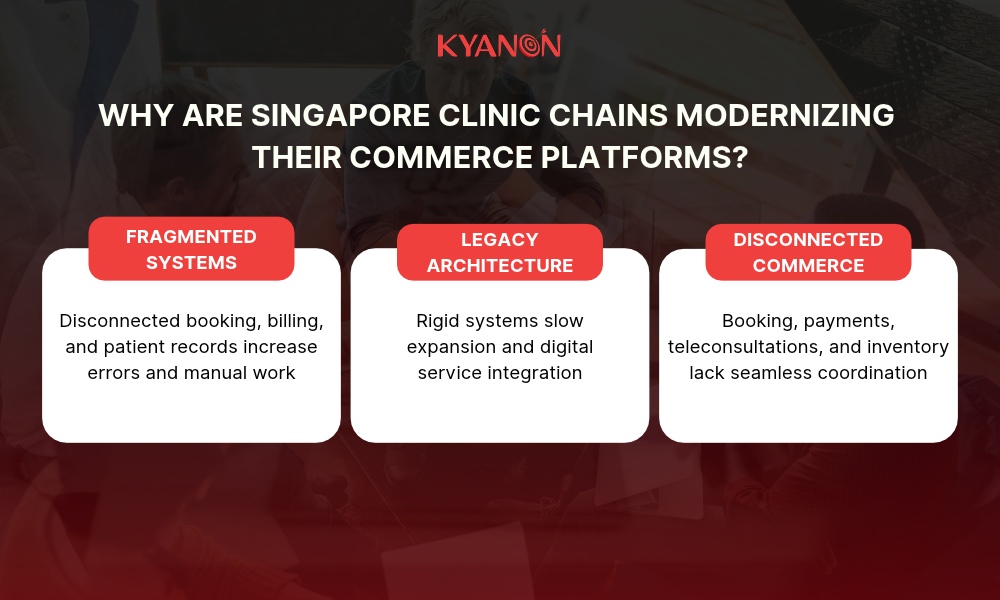
Fragmented systems create friction across patient journeys
As clinic chains expand across multiple physical locations, operating separate software platforms for patient discovery, appointment booking, teleconsultations, billing, and follow-up care introduces administrative friction. When patient records and transaction logs remain stored in siloed databases, staff must manually reconcile appointments, update medical details, and verify payment statuses.
This fragmentation leads to duplicated administrative entry, higher operational costs, and mismatched patient records. For instance, a patient booking an appointment online might encounter conflicting schedules at the physical clinic counter, while teleconsultation payments may fail to register automatically within the central clinic management system (CMS). Sustaining multi-branch growth requires an integrated digital architecture that synchronizes data across physical and online channels.
Legacy architecture limits scalability and integration
Many established healthcare networks depend on legacy monolithic software or localized servers physically located inside individual clinics. While these setups historically managed local operational records, their rigid structures create significant bottlenecks when deploying new digital channels, expanding physical clinic networks, or connecting external services.
Adding new booking channels, payment methods, or business partnerships can become costly when each change requires modifications to tightly connected legacy software. Modernization helps clinic chains introduce new services with less disruption to existing operations.
Commerce extends beyond online booking and payment
For clinic chains, digital commerce can include service discovery, appointment booking, payment, teleconsultation access, and purchases of relevant health or wellness products where these services are offered. The scope depends on the clinic’s business model and the services it provides.
Where clinics manage physical products or medical supplies, linking inventory systems with ordering workflows can improve stock visibility and reduce manual reconciliation. These capabilities should be prioritized when they address a documented operational need, rather than treated as mandatory components of every commerce modernization program.
A full system replacement is not always necessary. Clinic chains can begin with specific bottlenecks, such as booking inconsistencies or disconnected payment records, and expand modernization as business needs evolve.

What are the five key strategies for modernizing clinic platforms?
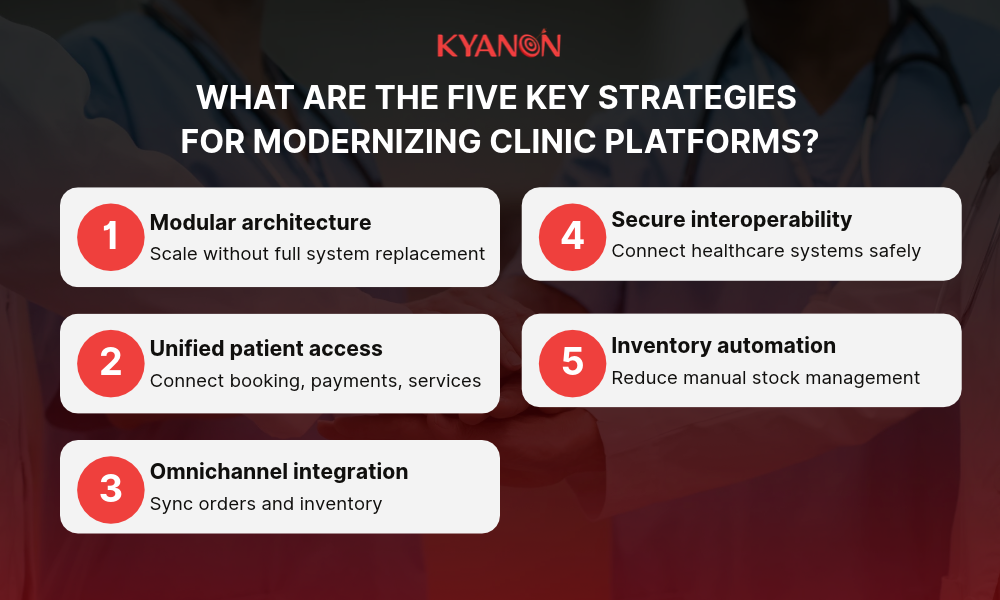
Modernize legacy architecture with scalable, modular services
Modernizing legacy architecture is a core part of platform modernization, helping clinic chains improve existing systems without replacing everything at once. Depending on the scale and complexity of their operations, this may involve upgrading the current platform, separating tightly connected functions, or introducing independent services for high-demand workflows such as booking and payment.
Comparison of legacy monolith and modernized modular platform
|
Architectural layer |
Legacy monolith model | Modernized modular platform |
| Infrastructure | On-premise physical servers inside individual clinics |
Cloud-native distributed edge / cloud infrastructure |
|
Integration pattern |
Tight point-to-point database queries | API-first microservices architecture |
| Data synchronization | Manual batch export and end-of-day reconciliation |
Real-time bi-directional system synchronization |
|
Scaling flexibility |
Full application deployment required for minor updates |
Independent scaling of high-demand service modules |
A modular approach can reduce the impact of individual updates and make it easier to scale high-demand services. However, the right architecture depends on business requirements, existing systems, and the cost of ongoing maintenance.
Build a unified digital front door for patients
A modern ecommerce platform can provide a unified digital front door, allowing patients to access teleconsultations, branch appointments, payments, and relevant health or wellness product purchases through a more consistent experience.
A unified web or mobile experience can bring appointment search, booking, payment, and access to relevant digital services into one journey. For clinic chains, connecting these touchpoints with branch availability and booking systems helps reduce friction between online interactions and in-person visits. Additional features should be introduced based on patient needs and the clinic’s service model.
Connect omnichannel commerce and fulfillment
Clinic chains that offer health or wellness products across online and physical channels need consistent product, order, payment, and inventory information. Integrating these channels with relevant back-office systems helps reduce manual order handling and discrepancies between online and branch transactions.
Where product delivery is part of the business model, integrations with fulfillment partners can further streamline order processing. These capabilities should be prioritized according to actual demand and operational requirements.
Strengthen interoperability and healthcare data integration
Secure interoperability is a critical requirement for digital platform modernization in Singapore healthcare, where clinic chains must protect sensitive data while enabling reliable communication between connected systems.
Healthcare organizations maintain regulatory compliance by leveraging secure cloud environments and standardized API frameworks, such as HL7 FHIR protocols supported by Synapxe, for cross-system data exchange. Implementing granular role-based access control, automated audit logging, and robust end-to-end encryption ensures patient medical records and transaction data remain fully protected.
Modernize procurement and inventory operations
For clinic chains that manage medical supplies or retail products, platform modernization can also improve inventory and procurement workflows. Connecting stock records with ordering processes gives teams better visibility into availability across branches and reduces the need for manual reconciliation.
Where supported by existing systems, automated reorder rules can help teams identify when stock needs replenishing and prepare purchase requests. The business case should be assessed using measures such as stock discrepancies, manual processing time, and order turnaround time.
What risks must clinic chains address during platform modernization?
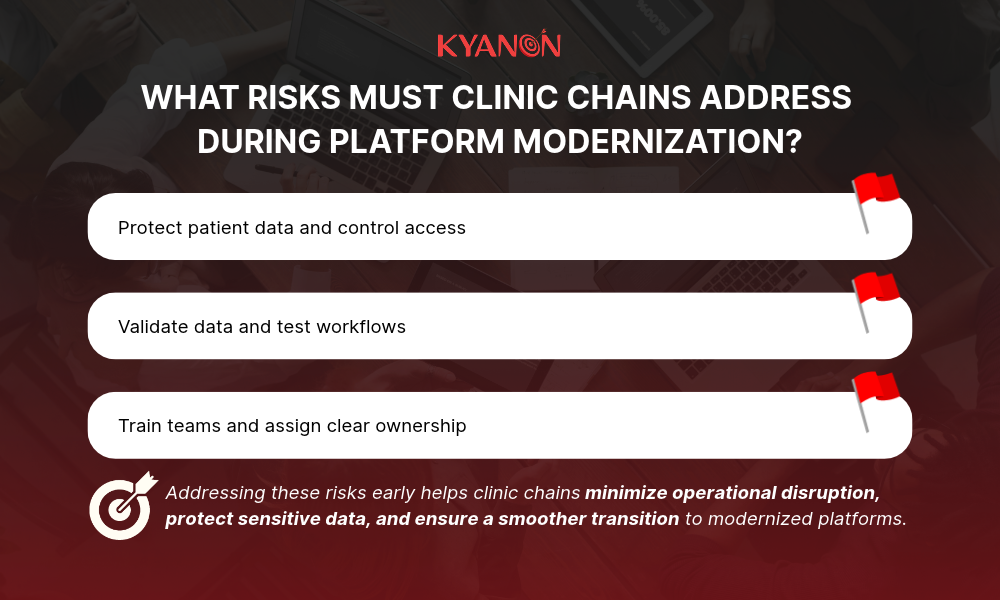
Patient data security and regulatory requirements
Connecting more systems creates additional points where patient and transaction data must be protected. Clinic chains should assess the privacy and security requirements that apply to their services, vendors, and data flows before introducing new integrations.
Mitigating security risks requires establishing strict technical safeguards before deploying new software layers:
- Access control: Limit system and patient-data access according to staff responsibilities.
- Data protection: Apply appropriate safeguards when data is stored or transferred.
- Auditability: Maintain records of relevant access and system activities.
- Third-party risk: Review how integration, payment, hosting, and delivery partners handle data.
When legacy systems make secure data access difficult, Kyanon Digital’s database development services can help assess database integration options and plan a phased implementation.
Legacy integration and data migration
Migrating historical patient records, appointment logs, and inventory data from legacy systems carries technical risk. Inconsistent, duplicated, or unformatted legacy data can trigger system errors after cutover if not properly cleansed.
Before switching systems, clinic chains should verify that important records transfer correctly, test critical workflows, and prepare a fallback plan if issues arise. AA phased digital platform modernization approach helps teams identify migration issues early and validate critical workflows before changes affect all branches.
Staff adoption and operational ownership
New digital workflows can fail if frontline clinic staff find them complex or counterintuitive. Clinic managers, nurses, front-desk staff, and finance teams should participate in workflow mapping and user acceptance testing early in the software development lifecycle.
Organizations must assign clear operational ownership for platform maintenance, API integration monitoring, and issue resolution. Providing structured staff training and tracking adoption metrics post-rollout ensures operational teams transition effectively to the modernized platform.
In Kyanon Digital’s experience, platform modernization works best when technical changes, data governance, and staff workflows are planned together. Addressing these areas as part of one program helps reduce avoidable disruption during rollout.
How should clinic chains choose a platform modernization strategy?
Should you replatform, refactor, or rebuild?
Choosing the right platform modernization strategy depends on existing technical debt, internal engineering capacity, implementation budget, integration requirements, and target business outcomes.
Platform modernization approaches
|
Approach |
Operational fit | Primary technical consideration |
| Replatform | Existing application code remains functional, but legacy hosting infrastructure restricts overall performance. |
Infrastructure is modernized, but underlying application codebase constraints remain unresolved. |
|
Refactor |
Core business logic and clinical rules are valuable, but the codebase is difficult to extend or maintain. | Requires comprehensive regression testing and incremental microservice rollout. |
| Rebuild | Legacy architecture cannot support mandatory APIs, security standards, or multi-branch workflows. |
Involves higher initial capital expenditure, complex data migration, and elevated operational change risk. |
According to Kyanon Digital’s technical advisors, clinic chains should choose the least disruptive approach that addresses their main business constraints. Before committing to a rebuild, compare implementation costs, integration needs, future requirements, and the risk of disrupting daily operations.
How can clinic chains modernize without disrupting operations?
A structured digital platform modernization roadmap helps clinic chains prioritize high-value changes, test critical workflows, and scale validated solutions without disrupting daily operations.
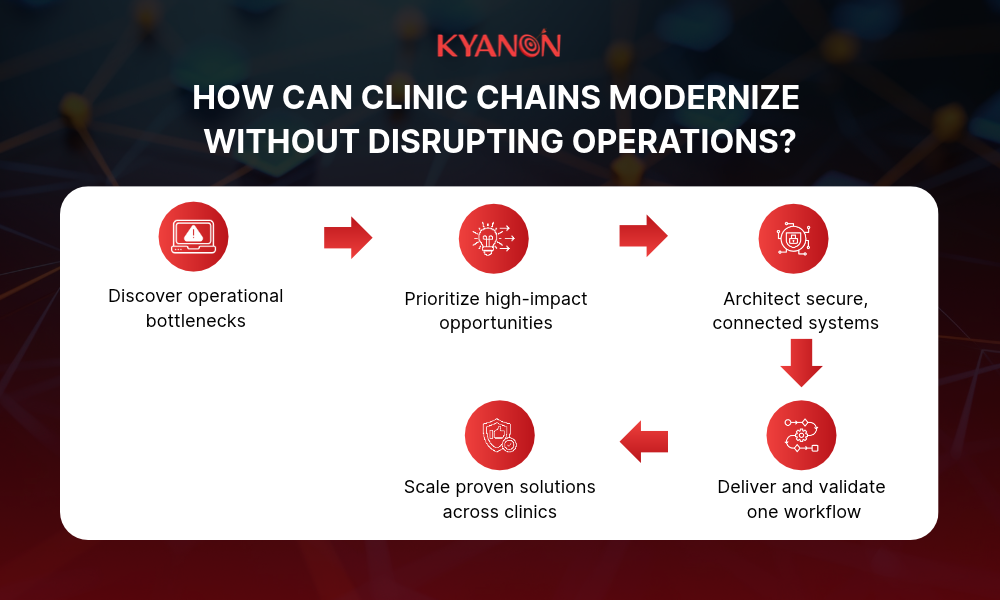
- Discover: Map end-to-end patient pathways, underlying database structures, external integrations, and administrative friction points.
- Prioritize: Rank modernization opportunities based on measurable business impact, implementation effort, and technical risk.
- Architect: Define data ownership boundaries, integration patterns, security controls, and standardized API specifications.
- Deliver: Implement and test a single high-value workflow, such as digital appointment scheduling linked directly to real-time clinic availability, to validate operational stability.
- Scale: Systematically extend validated microservices and integration patterns across additional branches and service lines.
A clear modernization plan helps prevent individual projects from creating new disconnected systems. Each pilot should follow the broader business and technology roadmap, with lessons from implementation used to guide subsequent changes.
How can Kyanon Digital support Singapore clinic platform modernization?
Platform modernization services for Singapore clinic chains require coordination across digital experiences, application architecture, integrations, data, and business workflows. Kyanon Digital helps enterprises assess these dependencies and design technology solutions around measurable business objectives, rather than treating modernization as an isolated website or application project.
Assess platform dependencies and business needs
- Identify fragmented data, disconnected digital touchpoints, and workflow inefficiencies.
- Assess integration requirements across customer-facing platforms and operational systems.
- Prioritize modernization opportunities based on business objectives and measurable KPIs.
Connect digital channels and enterprise systems
- Integrate digital platforms with customer data and operational systems.
- Centralize relevant data to support consistent customer experiences across channels.
- Streamline workflows to improve operational consistency and scalability.
Measure outcomes and plan for scale
- Define KPIs to evaluate customer engagement and operational efficiency.
- Monitor performance to identify opportunities for improvement.
- Assess readiness to extend successful capabilities across additional locations and digital touchpoints.
How Kyanon Digital modernized omnichannel commerce capabilities for a pharmacy network in Thailand

Pharmacy loyalty program strategies for improving customer retention across channels.
Kyanon Digital connected loyalty management, customer data, and digital commerce channels to create consistent customer experiences and scalable operations.
Challenges
- Fragmented customer data limited visibility across physical and digital channels.
- Inconsistent membership, rewards, and campaigns created disconnected customer experiences.
- Manual campaign operations slowed execution and limited personalization.
Solution from Kyanon Digital
- Standardized loyalty rules, membership tiers, and rewards across channels.
- Centralized member profiles, points, rewards, and campaign management.
- Integrated POS, eCommerce, mobile apps, CRM, and customer data systems.
- Enabled customer segmentation and campaign performance analytics.
Results and impact
- 18% increase in campaign participation through improved customer segmentation.
- 28% faster campaign execution through centralized loyalty management.
- 12% increase in repeat member engagement through consistent rewards and communications.
- 23% growth in active membership across the network.
- Scalable loyalty operations to support additional stores and digital touchpoints.
Although this case study focuses on a pharmacy network, it demonstrates how platform modernization can connect customer data and digital commerce channels. Similar integration principles can inform clinic chains modernizing booking, payment, and customer engagement workflows.
Explore how Kyanon Digital helps businesses connect commerce platforms, customer data, and omnichannel experiences.
Conclusion
To modernize an ecommerce platform successfully, clinic chains need to address fragmented systems, improve integration, and align digital services with operational requirements. A structured platform modernization strategy can help healthcare operators improve patient experiences, streamline relevant inventory workflows, and strengthen data governance while preserving daily operations. The right digital platform modernization approach should prioritize business-critical improvements, manage migration risks, and support scalable growth.
Planning your next digital platform modernization initiative? Speak with Kyanon Digital’s transformation team to evaluate your application architecture, establish clear integration priorities, and define a practical execution roadmap.
References
Digital Leaders Programme — Infocomm Media Development Authority (IMDA), 2026.
Smart Strategies to Control Corporate Medical Costs in Singapore — Alliance Medinet, 2026.










 Create project brief with AI