

Building a Generative AI (GenAI) Center of Excellence (CoE) in Singapore requires aligning business strategy, local regulatory standards (such as MAS guidelines), funding incentives, and a cross-functional hub-and-spoke delivery model. (EDB Singapore)
Key takeaways
- Start with business outcomes: A GenAI CoE should prioritise measurable productivity improvements and scalable use cases rather than accumulating disconnected AI experiments.
- Choose the right operating model: Centralised structures suit early-stage adoption, while hub-and-spoke models support growing enterprise demand.
- Make data ownership explicit: Every priority dataset needs a named owner, defined access controls and an agreed governance process before production deployment.
- Treat responsible AI as an operational requirement: Model evaluation, privacy controls, security testing and human oversight must be embedded before applications reach production.
- Use Singapore’s AI ecosystem strategically: IMDA initiatives and workforce programmes can support capability development, but eligibility and programme scope must be checked individually.
What is a GenAI Center of Excellence (CoE)?
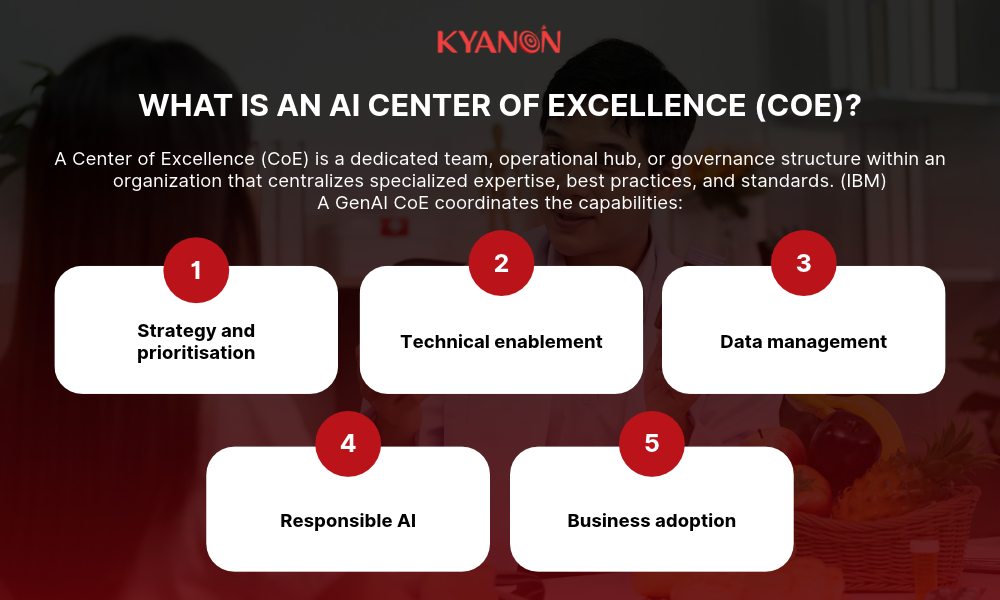
A Center of Excellence (CoE) is a dedicated team, operational hub, or governance structure within an organization that centralizes specialized expertise, best practices, and standards. Rather than operating as an isolated research lab, it acts as a central “mission control” to guide strategy, share resources, and scale adoption smoothly across different departments. (IBM)
Unlike a conventional AI team focused on individual models or analytics projects, a GenAI CoE coordinates the capabilities required to deploy and maintain GenAI applications across an enterprise.
Its responsibilities typically include:
- Strategy and prioritisation: Identifying business opportunities and maintaining a pipeline of high-value GenAI use cases.
- Technical enablement: Establishing reusable architectures, LLM integrations, RAG patterns and development standards.
- Data management: Preparing proprietary information, knowledge bases and enterprise data pipelines.
- Responsible AI: Defining evaluation criteria, privacy controls, security requirements and human oversight.
- Business adoption: Training employees, supporting implementation teams and measuring business outcomes.
GenAI Center of Excellence examples: Three operating models
There is no single operating model suitable for every enterprise. The appropriate structure depends on AI maturity, internal technical expertise and how many business units need GenAI capabilities.
|
Operating model |
Who owns delivery? | Best fit | Main risk |
| Centralised | The CoE builds and operates all GenAI applications. | Early-stage organisations with limited use cases and scarce AI expertise. |
The central team becomes a delivery bottleneck. |
|
Hub-and-spoke |
The CoE owns standards, platforms and governance; business units develop applications. | Mid-to-large enterprises with several active AI initiatives. | Business units may deviate from shared standards without clear accountability. |
| Federated | Individual business units own delivery while the CoE provides guidance and oversight. | Mature enterprises with established AI teams across departments. |
Duplicated tooling, inconsistent governance and fragmented investments. |
At Kyanon Digital, we see the CoE as more than a central team responsible for technology standards. It should also build the processes, knowledge and engineering capabilities that allow an organisation to scale delivery sustainably.

How do you build a GenAI Center of Excellence?
Building a GenAI Center of Excellence requires five coordinated steps, from defining business objectives to scaling enterprise AI capabilities. Each step should establish clear responsibilities, deliverables and readiness criteria before the organisation moves forward.
|
Step |
What to do | Expected output | Readiness checkpoint |
| Define the mandate, vision and leadership | Establish measurable business objectives, appoint an executive sponsor (CTO, CDO or CoE Director), and form a cross-functional team covering AI engineering, data, business operations, legal and change management. | Written CoE mandate, executive sponsor, team structure and prioritised use-case pipeline. |
Executive sponsorship confirmed and budget owner agreed. |
|
Establish data readiness and architecture |
Prepare proprietary data and knowledge bases, assign data owners, implement access controls, and design a model-agnostic architecture supporting LLM integration, RAG and cloud or hybrid deployment. | Enterprise data inventory, named data owners and reference architecture. | Data ownership and access permissions confirmed for priority datasets. |
| Embed responsible AI and governance | Establish model evaluation, hallucination monitoring, security testing, privacy controls, human oversight and AI-use policies. Align governance with relevant IMDA guidance and Singapore’s PDPA obligations. | AI-use policy, model evaluation checklist and governance procedures. |
Governance policies and production approval responsibilities established. |
|
Develop technical capabilities and workforce readiness |
Equip teams with GenAI engineering, data integration, AI orchestration and MLOps capabilities. Train employees to identify appropriate use cases and adopt AI responsibly. | Technical capability roadmap, workforce training plan and reusable AI development standards. | Core technical capabilities and responsible AI training available to relevant teams. |
| Leverage Singapore’s AI ecosystem and scale adoption | Explore relevant IMDA initiatives, research institutions, technology partners and workforce programmes. Validate programme eligibility and scale proven use cases across business units. | Partnership roadmap, programme shortlist and enterprise AI scaling plan. |
Business value demonstrated, scaling priorities agreed and programme eligibility verified. |
Important: Steps 1–3 establish the organisational, technical and governance foundations. Steps 4–5 help the CoE develop sustainable internal capabilities and expand adoption across the enterprise.
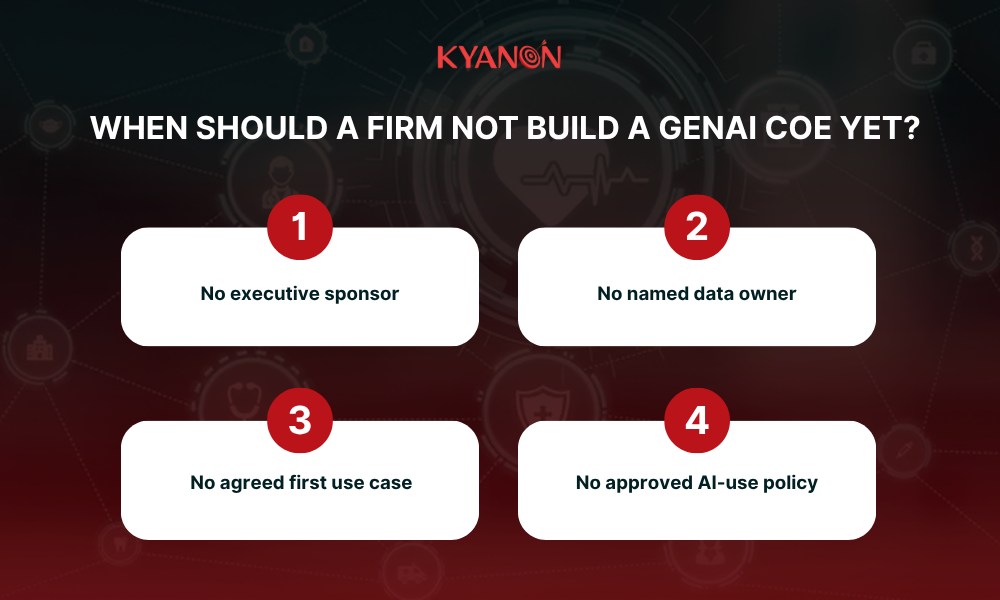
When should a firm NOT build a GenAI CoE yet?
Establishing a full GenAI CoE too early can create unnecessary organisational overhead. Before committing to a permanent team, enterprises should confirm that the necessary business, data and governance foundations exist.
Four conditions indicate that an organisation is not yet ready:
- No executive sponsor: There is no senior leader accountable for AI priorities, funding and cross-functional coordination.
- No named data owner: Priority datasets lack clear ownership, access permissions or governance arrangements.
- No agreed first use case: The organisation has broad AI ambitions but cannot identify a business problem with measurable outcomes.
- No approved AI-use policy: Employees and development teams lack clear rules for handling enterprise information and using external AI services.
Kyanon Digital believes a GenAI Center of Excellence should address a defined business need, not become an organisational layer created simply to follow the AI trend. Establishing a CoE too early can introduce additional costs, governance overhead and coordination challenges without delivering measurable business value.
How Kyanon Digital supports GenAI CoE work in practice
Establishing a GenAI Center of Excellence requires more than access to foundation models. Enterprises need engineering capabilities that connect proprietary business data, AI orchestration, enterprise applications and operational workflows.
As an Enterprise Digital Transformation & AI Partner, Kyanon Digital supports organisations across digital engineering, data and analytics, enterprise integration, AI applications and technology modernisation.
Case study: Empowering Cynopsis Solutions with Scalable RegTech Development & a Center of Excellence (CoE)
Empowering Cynopsis Solutions with Scalable RegTech Development & a Center of Excellence (CoE)
Client overview
Cynopsis Solutions is a Singapore-based RegTech (Regulatory Technology) company specializing in compliance solutions for financial institutions, fintech firms, and regulated entities.
Challenges
As Cynopsis expanded its RegTech product offerings, it faced key challenges:
- Scalability & Rapid Development Needs – The demand for AML, KYC, and digital onboarding solutions was rising, requiring fast and scalable product development.
- Keeping Pace with Regulatory Changes – With constantly evolving compliance regulations, Cynopsis needed a flexible and adaptive product development strategy.
- Onboarding & Training New Team Members Efficiently – The onshore team was spending significant time training offshore members, leading to inefficiencies and slower delivery.
- Maintaining High Performance & Product Quality – As the platform grew, ensuring continuous improvement and minimal downtime became critical.
Results and business impact
The collaboration delivered four key outcomes:
- Faster product launches: Three RegTech solutions, Transaction Monitoring, eKYC, and Digital Onboarding, were launched within a few months.
- Stronger compliance capabilities: The solutions strengthened Cynopsis’ AML/KYC capabilities and helped its clients manage regulatory risks.
- More scalable team operations: The CoE enabled offshore engineers to onboard new members independently, reducing the onshore team’s repetitive training workload.
- Improved delivery processes: Agile development, CI/CD, and structured knowledge-sharing practices supported continuous product improvement and adaptability.
Explore the full case study here: Empowering Cynopsis Solutions with Scalable RegTech Development & a Center of Excellence (CoE)
Conclusion
The appropriate engagement depends on the enterprise’s starting point. Some organisations need help validating an initial use case, while others require engineering support to integrate and scale applications across multiple business units. Rather than treating a CoE as a standalone technology project, enterprises should connect its technical roadmap to business priorities, data readiness and long-term operating requirements.
Considering a GenAI Center of Excellence for your enterprise? Contact Kyanon Digital to discuss your enterprise AI priorities, technical readiness and implementation requirements.







 Create project brief with AI