

Building an enterprise AI ROI framework in Singapore requires aligning AI investments with measurable business outcomes, calculating total ownership costs, evaluating financial returns, and incorporating workforce readiness and data governance. The framework should also account for industry-specific requirements and the choice between off-the-shelf AI solutions and custom development, as both influence investment costs and potential returns.
For Singapore enterprises, the critical AI investment decision is not whether to adopt AI, but which use cases can deliver measurable returns and justify the total investment. Business leaders must assess whether to buy ready-made AI solutions or develop custom systems and how to account for integration and governance costs, and what evidence supports scaling beyond a pilot. Without a structured ROI framework, organizations risk investing in AI initiatives that improve operational efficiency but fail to generate sufficient financial value.
As an enterprise digital transformation and AI partner, Kyanon Digital helps enterprises evaluate AI opportunities, assess implementation readiness, and connect AI solutions to measurable business outcomes. This guide explains how to build an enterprise AI ROI framework that supports investment prioritization, financial justification, and informed scaling decisions.
Key takeaways
- Prioritize measurable AI investments: Select use cases based on expected financial returns, business impact, technical feasibility, and implementation risks.
- Evaluate total ownership costs: Compare off-the-shelf and custom AI solutions using development, integration, licensing, governance, and ongoing maintenance expenses.
- Validate actual financial returns: Distinguish productivity improvements from realized cost savings, using pre-AI baselines and attributable financial outcomes.
- Account for Singapore-specific requirements: Include workforce costs, PDPA obligations, AI governance, and applicable government grants in investment assessments.
- Scale based on proven outcomes: Kyanon Digital recommends starting with a measurable, high-value AI use case and validating operational and financial performance before enterprise-wide deployment.
Further reading:
- The Next Frontier: Data-Driven CX Strategy 2026
- Building CX Intelligence for the Next Decade
- How Can Digital Commerce Improve Singapore Healthcare CX?
- How to Measure CX ROI for Singapore Enterprises?
What metrics should you include in an enterprise AI ROI framework?
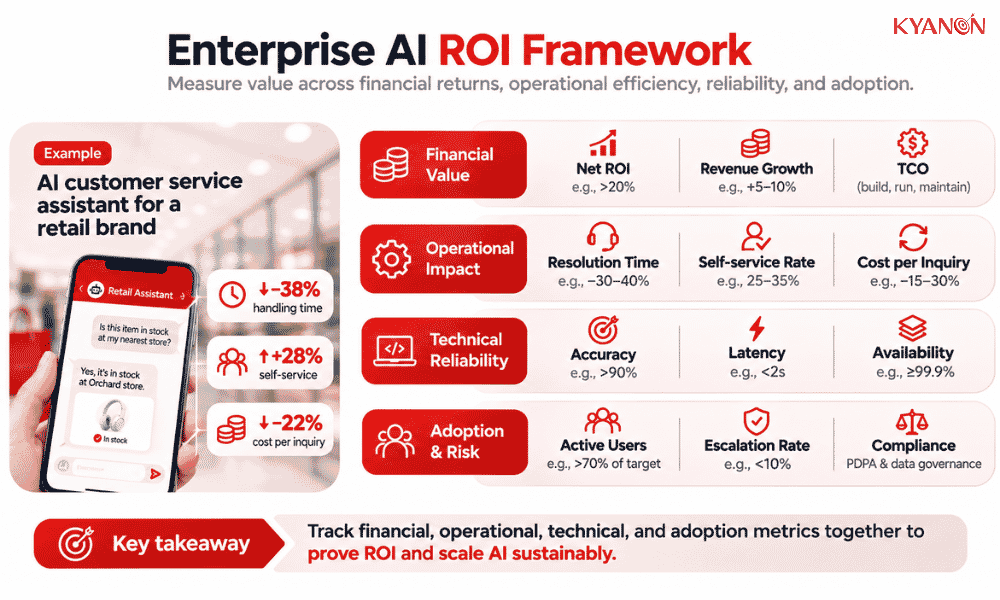
An enterprise AI ROI framework should measure financial returns, operational efficiency, technical reliability, and workforce adoption to determine whether AI investments deliver sustainable business value. The most relevant KPIs depend on the AI use case, business objectives, and solution type. However, operational improvements alone do not guarantee positive financial returns.
Which financial KPIs demonstrate AI business value?
Financial KPIs determine whether an AI investment delivers enough measurable value to justify its total cost.
|
Financial KPI |
What to measure |
|
Net ROI |
Financial benefits relative to total investment costs |
| Revenue growth |
Incremental sales, conversion improvements, and contribution margin |
|
Cost reduction |
Verified operating savings, reduced rework, and external expenditure |
| Cost per transaction |
Cost of completing each successful task or transaction |
|
Total cost of ownership (TCO) |
Development, licensing, infrastructure, integration, and maintenance |
Key consideration: Compare off-the-shelf and custom AI solutions using the same financial assumptions and evaluation period. Lower upfront investment does not always translate into better long-term ROI.
For a closer look at AI cost drivers, explore Kyanon Digital’s guide on the true cost of AI in manufacturing in Singapore.
Which operational and productivity metrics should you track?
Operational metrics show whether AI improves workflow efficiency, service quality, and employee productivity.
| AI use case |
Priority KPIs |
|
Customer service |
Resolution time, successful self-service rate, cost per resolved inquiry |
| Finance and document processing |
Processing time, error rate, rework costs |
|
Software engineering |
Delivery cycle time, accepted code changes, defect rate |
| Sales and marketing |
Conversion rate, customer acquisition cost, campaign efficiency |
|
Enterprise knowledge assistants |
Time-to-insight, task completion, employee productivity |
Key consideration: Time saved is not automatically a financial saving. Enterprises must verify whether improvements reduce actual expenditure, increase profitable output, or release capacity for higher-value work.
Beyond financial and operational results, enterprises need indicators that demonstrate whether AI can be adopted safely and scaled sustainably.
- Technical reliability: Model accuracy, response latency, hallucination rates, and system availability.
- Risk and governance: Data privacy incidents, compliance exceptions, and human escalation rates.
- Workforce adoption: Active users, successful task completion, and employee utilization.
- Strategic value: Faster decision-making, improved scalability, and reduced operational risk.
Key consideration: Adoption and model performance are leading indicators, while verified cost savings and revenue gains demonstrate realized financial value. For Singapore enterprises, scaling decisions should also account for applicable PDPA obligations and governance requirements.
The investment decision: Prioritize AI solutions that demonstrate measurable financial value, meet operational quality standards, and remain economically sustainable at enterprise scale.

How do you build an enterprise AI ROI framework step by step?
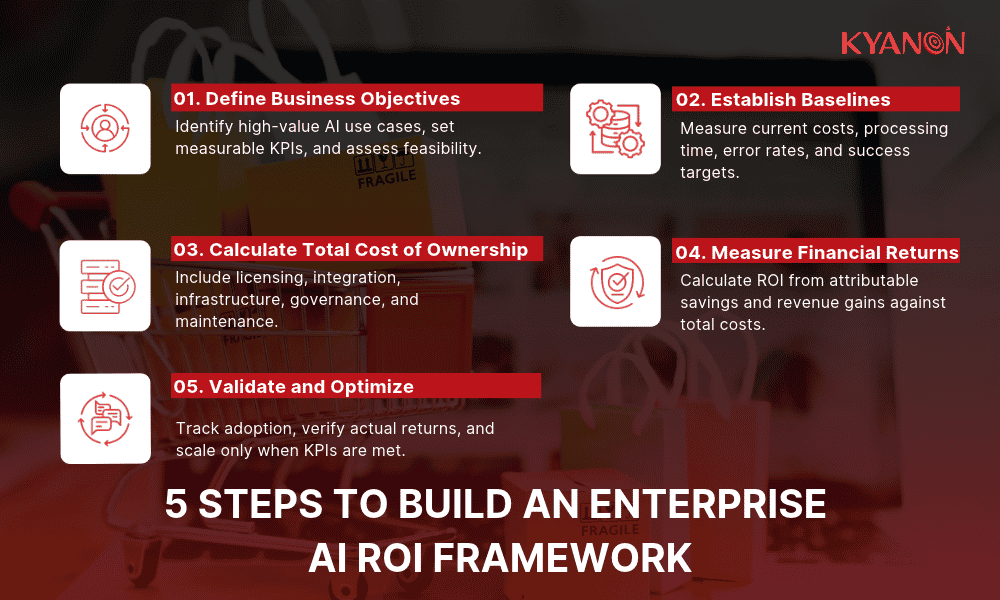
Building an enterprise AI ROI framework requires five steps: prioritize high-value use cases, establish performance baselines, calculate total ownership costs, measure financial returns, and validate outcomes. For Singapore enterprises, each step should support a clear decision on whether to invest, which AI solution to choose, and when to scale.
Step 1. Align AI investments with measurable business objectives
Start with a business problem rather than an AI technology.
- Identify the use case: Customer service automation, financial document processing, or AI-assisted software development.
- Define success KPIs: Cost reduction, incremental revenue, processing time, or error rates.
- Prioritize investments: Compare expected business value, data readiness, integration complexity, and implementation risk.
Decision point: Prioritize use cases with measurable financial potential and sufficient technical readiness. Defer projects where the business case or required data is unclear.
Step 2. Establish a baseline and define success criteria
Measure existing performance before deployment to create a reliable comparison.
- Baseline: Current operating costs, transaction volumes, processing times, and error rates.
- Success targets: Measurable improvements within an agreed evaluation period.
- Quality guardrails: Minimum accuracy, service quality, security, and compliance requirements.
Decision point: Proceed with a pilot only when business owners can verify the baseline and agree on measurable success criteria.
Step 3. Calculate the total cost of ownership
Evaluate the full AI lifecycle rather than upfront licensing or development costs alone.
| Cost category |
What to include |
|
Technology |
Software licenses, model APIs, cloud infrastructure |
| Implementation |
Data preparation, engineering, system integration, testing |
|
Governance |
Security, compliance, human oversight |
| Operations |
Training, monitoring, maintenance, model updates |
Kyanon Digital perspective: When evaluating off-the-shelf versus custom AI, enterprises should assess existing system compatibility and integration requirements before comparing costs. A lower initial price may not deliver better long-term value if substantial customization or ongoing support is required.
Step 4. Measure attributable benefits and calculate ROI
Estimate financial returns from verified cost reductions, incremental revenue, and avoided expenditure.
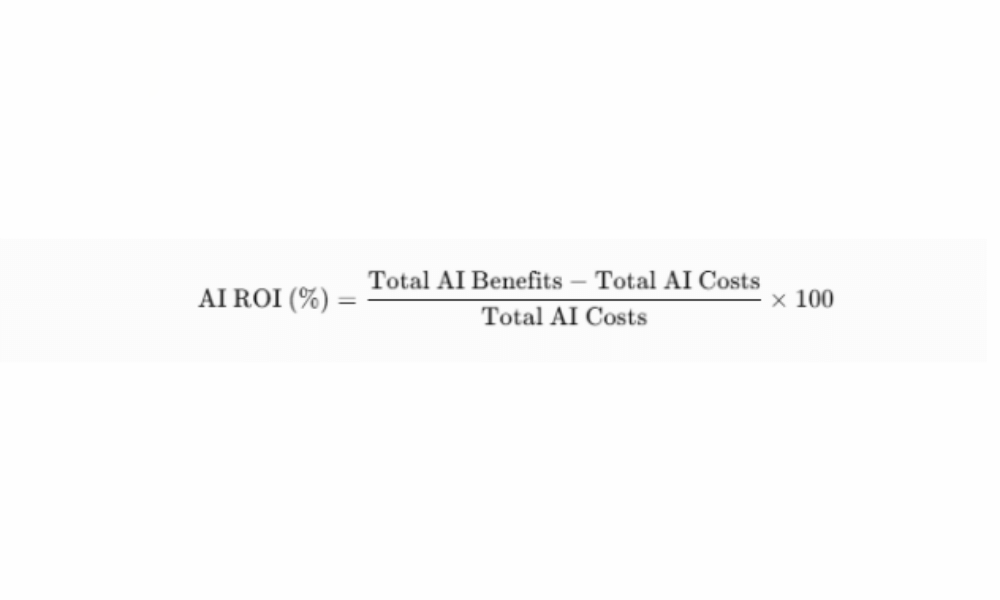
Decision point: Compare projected ROI, payback periods, and financial risks across off-the-shelf and custom AI solutions. Use consistent measurement periods and avoid counting employee hours saved as direct financial savings unless expenditure actually decreases.
Step 5. Track adoption, validate outcomes, and refine the business case
After deployment, monitor actual adoption, workflow completion, service quality, and recurring AI costs against agreed KPIs. Finance and business owners should review results periodically to determine whether projected benefits are being realized.
Decision point: Scale when financial returns and operational quality meet agreed targets; optimize or discontinue initiatives that consistently underperform.
How can Singapore businesses calculate and validate AI ROI in practice?
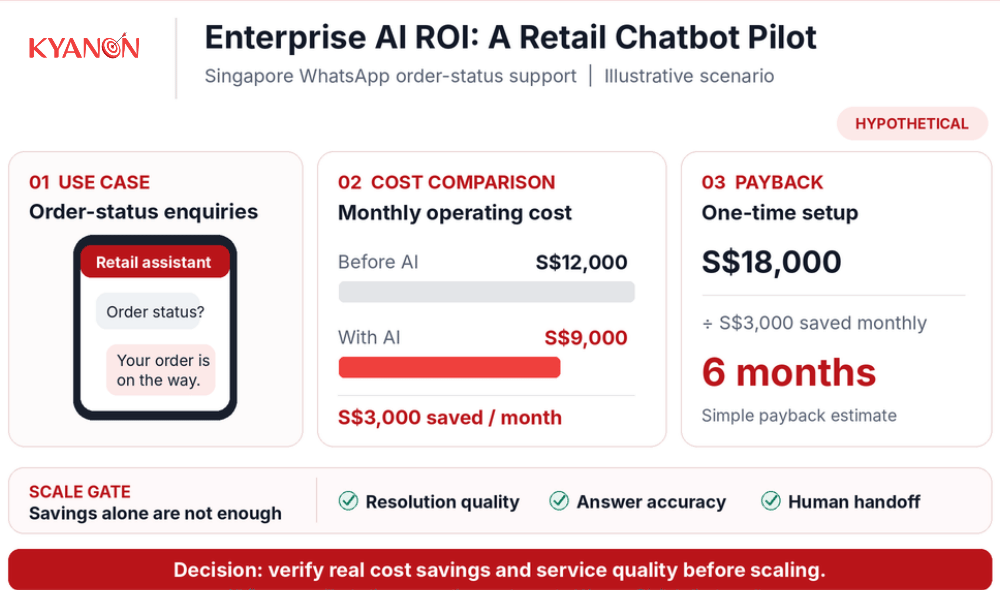
Singapore enterprises should calculate AI ROI using actual process costs, attributable financial benefits, and total implementation expenses. A practical business case must also show whether AI improves operational performance enough to justify further investment.
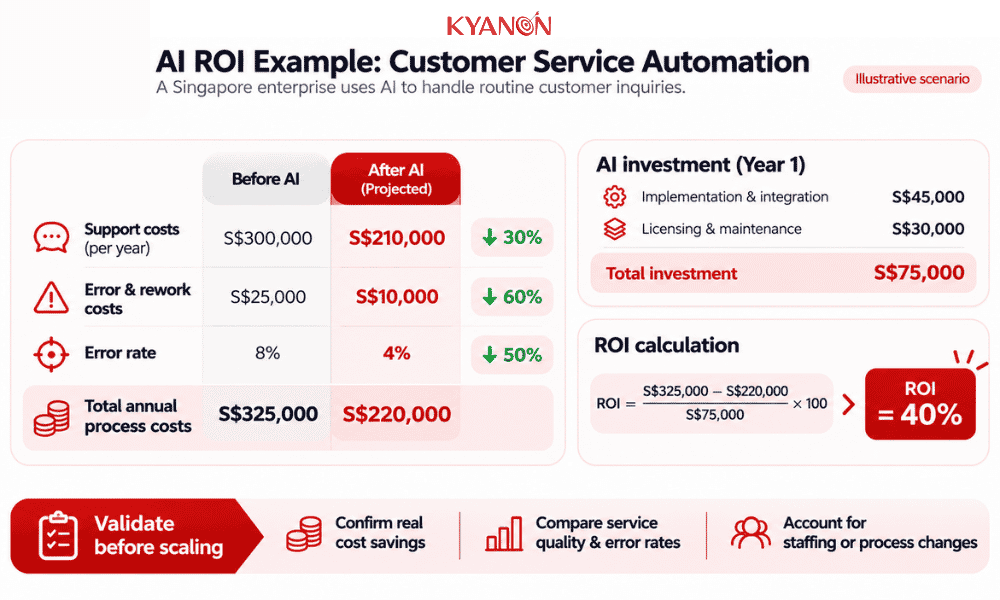
| Measurement | Before AI |
After AI (Projected) |
|
Annual customer inquiries |
100,000 | 100,000 |
| Annual support processing costs | S$300,000 |
S$210,000 |
|
Annual error and rework costs |
S$25,000 | S$10,000 |
| Error rate | 8% |
4% |
|
Total annual process costs |
S$325,000 |
S$220,000 |
First-year AI investment costs:
- Implementation, integration, and training: S$45,000
- Licensing, monitoring, and maintenance: S$30,000
- Total first-year investment: S$75,000
Example calculation:
The projected first-year ROI is 40%, assuming S$105,000 in annual savings are financially realized and attributable to AI.
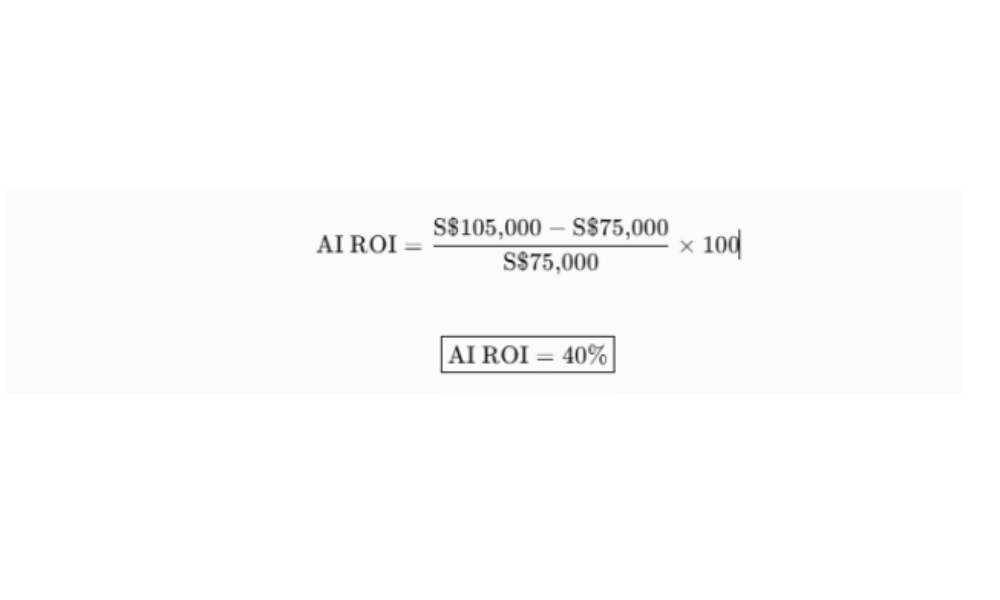
Validation before scaling: Finance and operations teams should confirm actual expenditure reductions, compare service quality and error rates against the baseline, and account for staffing changes or other process improvements. Positive projected ROI alone is insufficient for enterprise-wide deployment.
How should you account for AI ROI over different time horizons?
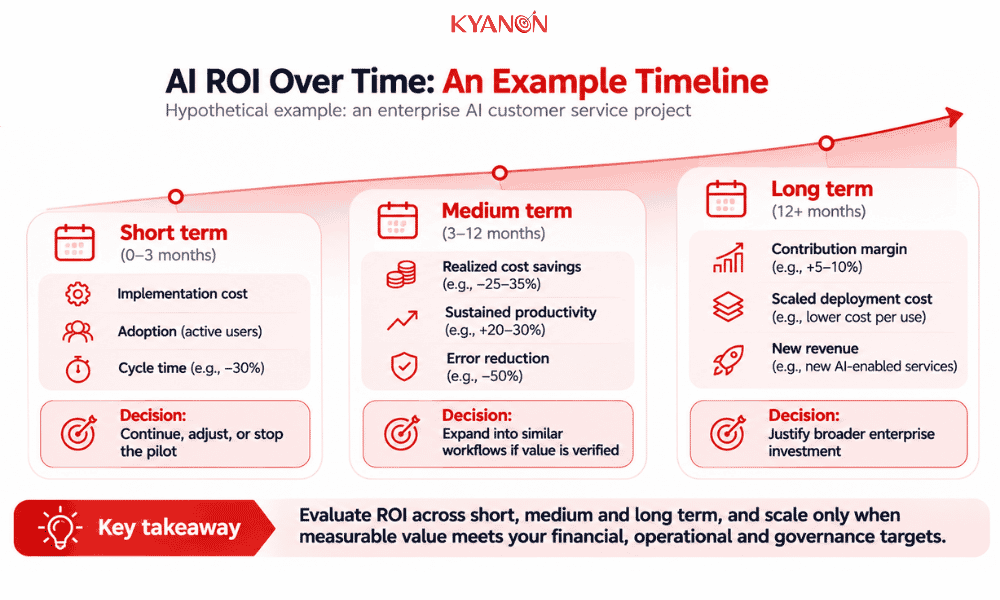
AI ROI should be evaluated across three horizons because early productivity improvements may not immediately translate into financial returns.
| Time horizon | What to measure |
Business decision |
|
Short term |
Implementation costs, adoption, task completion, cycle time | Continue, adjust, or stop the pilot |
| Medium term | Realized savings, sustained productivity, error reduction |
Expand into similar workflows if value is verified |
|
Long-term |
Contribution margin, scaled deployment costs, new revenue |
Justify broader enterprise investment |
Key consideration: There is no guaranteed payback period for enterprise AI. Returns depend on the use case, data readiness, integration complexity, adoption, and recurring operating costs. Enterprises should scale only when measured benefits meet their financial targets without compromising service quality or governance.
What Singapore-specific factors should shape your AI ROI framework?
Singapore enterprises should account for local workforce costs, data protection requirements, AI governance, and government funding when evaluating AI ROI. These factors influence the total investment, financial returns, and feasibility of scaling AI across business operations.
| Key factor | What Singapore enterprises should consider |
Impact on AI investment decisions |
|
Workforce costs and adoption |
Fully loaded salaries, applicable employer CPF contributions, training, and employee adoption | Determine whether productivity gains translate into actual financial savings |
| Data protection (PDPA) | Personal data handling, access controls, retention, and third-party processing |
Include compliance and security costs when comparing AI solutions |
|
AI governance |
Model reliability, human oversight, operational risks, and ongoing monitoring | Evaluate whether the solution can scale safely and reliably |
| Government funding | Eligibility for Enterprise Singapore’s EDGE Grant and other applicable support |
Assess potential funding offsets against total investment costs |
|
Regional operations |
Multi-market integrations, currencies, data flows, and operating requirements |
Avoid overstating ROI by combining profitable and unprofitable markets |
Singapore’s PDPC AI guidelines and IMDA’s 2026 Model AI Governance Framework for Agentic AI provide relevant guidance for managing personal data and agentic AI risks.
For government support, the EDGE Grant launched on 30 September 2026, replacing new applications under EDG, PSG, and MRA. Funding depends on project eligibility and should not be treated as guaranteed savings.
Key decision: When comparing off-the-shelf and custom AI solutions, prioritize the option that meets business requirements while accounting for Singapore-specific operating costs, governance obligations, and long-term scalability. Avoid using fixed payback assumptions without verified project evidence.
How can Kyanon Digital help you build an enterprise AI ROI roadmap?
As an enterprise digital transformation and AI partner, Kyanon Digital helps Singapore enterprises evaluate AI investment opportunities, assess implementation readiness, and translate business objectives into measurable outcomes.
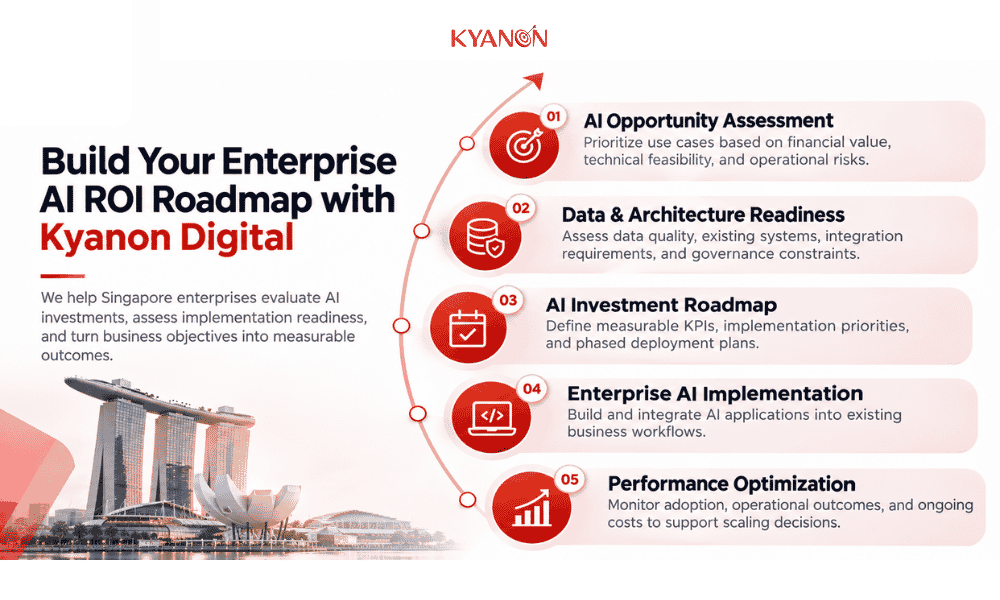
Our approach supports five key areas:
- AI opportunity assessment: Prioritize use cases based on expected financial value, technical feasibility, and operational risks.
- Data and architecture readiness: Assess data quality, existing systems, integration requirements, and governance constraints.
- AI investment roadmap: Define measurable KPIs, implementation priorities, and phased deployment plans.
- Enterprise AI implementation: Build and integrate AI applications into existing business workflows.
- Performance optimization: Monitor adoption, operational outcomes, and ongoing costs to support scaling decisions.
Deciding between off-the-shelf AI and custom development? Explore Kyanon Digital’s AI Integration Services to understand how we connect AI solutions with enterprise systems, address integration challenges, and support scalable implementation aligned with your business priorities.
Case study: How did Kyanon Digital improve measurable AI outcomes for a Singapore healthcare provider?
A Singapore healthcare provider partnered with Kyanon Digital to automate routine customer inquiries while maintaining service quality and appropriate human oversight.
Challenges
- Growing volumes of routine inquiries increased customer-service workloads.
- Fragmented knowledge and manual routing slowed responses.
- Limited self-service capabilities created pressure to expand support capacity.
Solution from Kyanon Digital
- Developed a RAG-powered AI chatbot using approved healthcare service knowledge.
- Integrated the chatbot with existing customer-service workflows through APIs.
- Implemented automated request routing, human escalation, and performance monitoring.
Results and Impact
The implementation delivered measurable operational improvements:
- 38% reduction in routine manual inquiries.
- 32% faster customer response times.
- 28% of eligible inquiries resolved through self-service.
- 24% reduction in repetitive agent workload.
These results demonstrate how AI can improve operational efficiency and service capacity. However, calculating financial ROI requires additional evidence of total implementation costs, ongoing expenditure, and realized savings.
Explore the full Kyanon Digital healthcare AI chatbot case study.
Kyanon Digital’s recommendation: Start with a high-impact AI use case supported by reliable baseline data, measurable financial objectives, and clear governance requirements. Validate operational and financial outcomes before committing to enterprise-wide deployment. For enterprises comparing commercial AI platforms with custom development, Kyanon Digital can help evaluate integration complexity, implementation costs, and long-term scalability to build an AI investment roadmap aligned with business priorities.
Conclusion
Building an effective AI ROI framework helps Singapore enterprises move beyond AI experimentation toward financially justified investment decisions. The priority is not choosing the most advanced AI technology but identifying solutions that deliver measurable business value relative to their total costs, implementation complexity, and operational risks.
Before scaling, enterprises should validate financial returns against actual performance, confirm workforce adoption, and ensure governance requirements are met. Positive projected ROI alone is not sufficient to justify enterprise-wide deployment.
Ready to evaluate your AI investment opportunities? Discuss your enterprise AI ROI roadmap with Kyanon Digital to assess use cases, implementation requirements, and the evidence needed to support investment decisions.
References
- Advisory Guidelines on Use of Personal Data in AI Recommendation and Decision Systems — Personal Data Protection Commission (PDPC), Singapore, 2024.
- Updated Model AI Governance Framework for Agentic AI — Infocomm Media Development Authority (IMDA), 2026.
- EDGE Grant — Enterprise Singapore, 2026.
- Scaling Customer Service with an AI Chatbot for Healthcare — Kyanon Digital, 2026.
- What Is the True Cost of AI in Manufacturing in Singapore? — Kyanon Digital.








 Create project brief with AI