

The true cost of AI in Singapore manufacturing can range from US$10,000–US$200,000 for SME projects to over US$1 million for mid-sized and enterprise-scale transformation. The final investment depends on the AI use case, deployment scope, data readiness, infrastructure, and ongoing operations. Data engineering, model retraining, cloud inference, compliance, and workforce readiness can add significantly to the initial build cost.
Kyanon Digital believes manufacturers should evaluate AI investment beyond the AI model or initial build fee. In our experience, data readiness and integration complexity are often among the strongest cost drivers because they determine how much work is required before an AI solution can operate reliably within existing factory systems. A lower-cost AI pilot can therefore become significantly more expensive when OT/IT integration, data preparation, governance, and post-launch operations are not properly scoped from the beginning.
Key takeaways
- Data engineering demands a larger share of the initial budget than building the AI model itself.
- Manufacturers must evaluate their data readiness before requesting a vendor quote. The team at Kyanon Digital has seen that build estimates are simply guesses unless a thorough data audit is performed first to ensure the operational data is clean and structured.
- Government grants significantly soften the financial impact of AI adoption in Singapore. Our team at Kyanon Digital notes that co-funding can offset up to 70 percent of eligible expenses, provided the manufacturer applies these funds to upfront implementation rather than long-term daily operations.
- Project scope strictly dictates the final price of the technology investment.
Further reading:
- How Can AI Customer Service Help Singapore Manufacturers?
- How Can AI-Enabled Workflows Help Singapore Manufacturers?
- 2026 Guide: Hire AI Dedicated Developers in Manufacturing
What determines the cost of AI in manufacturing?
The cost of AI in manufacturing mainly depends on:
- Use case and scope: A focused pilot costs less than an enterprise-wide deployment across multiple factories and systems.
- Data readiness: Fragmented, unstructured, or inaccessible production data requires additional engineering before AI can operate reliably.
- System integration: Connecting AI with existing OT, MES, ERP, and other factory systems increases implementation complexity and cost.
- Ongoing operations: Model retraining, cloud infrastructure, monitoring, maintenance, compliance, and workforce training add to the total cost after deployment.
Manufacturers should assess the full cost of making AI operational, rather than comparing vendors based only on the initial AI development fee.

How much does AI in manufacturing cost in Singapore?
There is no single price for manufacturing AI because the investment depends heavily on what the manufacturer is trying to achieve.
A focused AI use case such as predictive maintenance or computer vision quality inspection requires a different level of data, infrastructure, integration, and deployment effort than a broader AI transformation across multiple production systems.
Solution type | Indicative cost band (USD) | What drives the price |
| Predictive maintenance analytics | US$35,000–US$95,000 | Data integration, sensor coverage, asset criticality, model configuration and CMMS integration |
Computer vision quality control | US$45,000–US$140,000 | Camera/edge infrastructure, model complexity, image labelling and deployment scope |
| Custom AI platform / operations optimization | US$95,000–US$280,000+ | Number of integrated systems, data infrastructure, AI capabilities and deployment scope |
Industrial AI transformation | ~US$1.2M+ | Multiple AI use cases, infrastructure, integration, deployment, change management and ongoing operations |
Disclaimer: These figures are indicative benchmarks, not fixed market prices or vendor quotations. Actual AI implementation costs vary significantly by use case, data readiness, infrastructure, integration complexity, deployment scale, compliance requirements and ongoing operating needs. The ranges above combine published industry/vendor estimates and should be used for early-stage budgeting only. A project-specific assessment is required to determine the actual implementation cost.
AI implementation costs vary significantly by project scope. SME projects can require tens or hundreds of thousands of US dollars, while full-process manufacturing automation can exceed S$1 million. Singapore government grants can offset part of eligible project costs, with EDG supporting up to 50% of eligible costs and up to 70% for qualifying sustainability projects. (Singapore Manufacturing Federation)
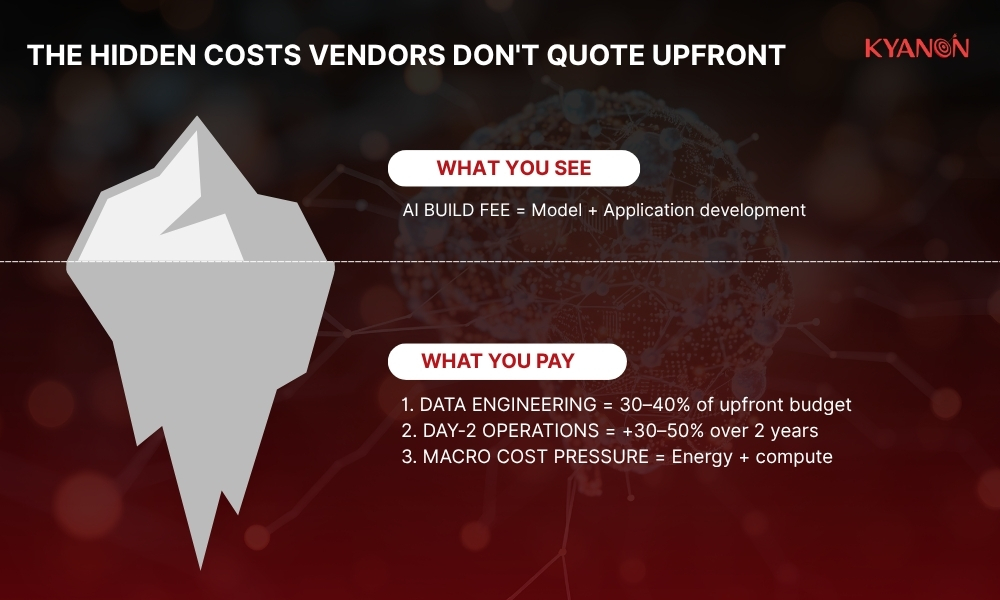
The build fee is rarely the full story. Three cost categories tend to surface only after a project starts:
- Data engineering (30–40% of upfront budget). Legacy OT and IT integration – connecting sensors, historians, and production systems that were never designed to talk to each other is usually the largest line item, bigger than the AI model itself.
- Day-2 operations (30–50% added over two years). Continuous model retraining, cloud inference fees, and compliance updates (PDPA, CSA guidelines) compound steadily after go-live.
- Macro cost pressure. Rising energy and compute costs compound further as AI workloads scale up on the factory floor.
Budgeting for the build alone, without these three, is the single most common way manufacturers underestimate what an AI project actually costs.
How can manufacturers estimate their own AI investment?
Before requesting a quote, manufacturers can build a first-pass estimate using three inputs:
- Match your use case to a cost band: Use the table above – a single-line predictive maintenance pilot and an enterprise-wide rollout sit on entirely different bands.
- Check your data starting point: If OT and IT systems aren’t already integrated, add another 30–40% on top of the base build for data engineering.
- Plan for a two-year operating horizon, not just the build: Add another 30–50% for retraining, cloud inference, and compliance updates over the first two years.
What to consider before asking an AI vendor for a quote
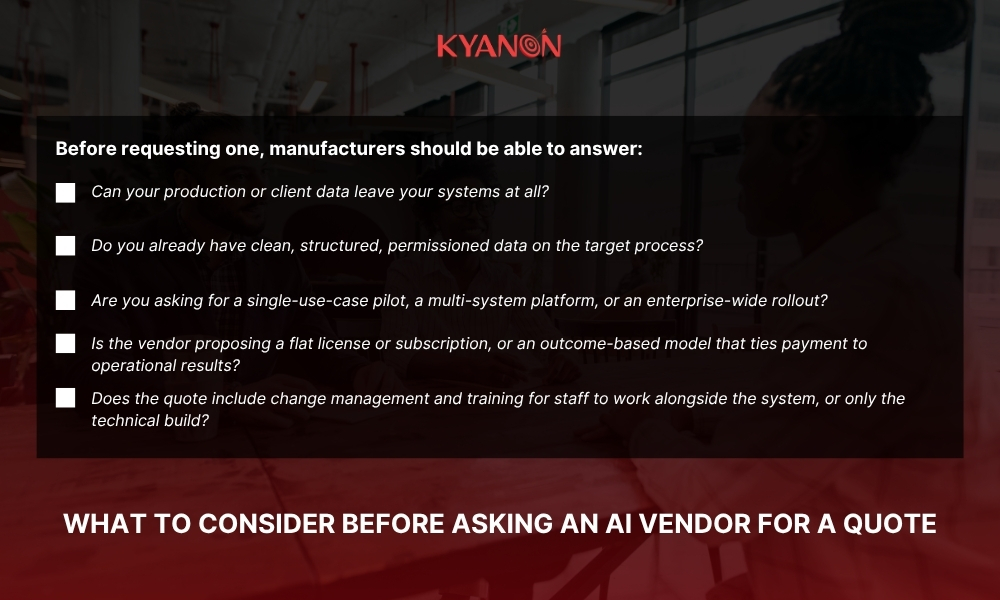
Before requesting one, manufacturers should be able to answer:
- Data readiness: Do you already have clean, structured, permissioned data on the target process? If not, ask the vendor to scope a data audit first – a build quote without this is a guess.
- Scope tier: Are you asking for a single-use-case pilot, a multi-system platform, or an enterprise-wide rollout? Get every vendor to quote against the same tier so the numbers are apples-to-apples.
- Pricing model: Is the vendor proposing a flat license or subscription, or an outcome-based model that ties payment to operational results? SMF’s own guidance favors shifting toward risk-sharing models so pilots survive past the point where government subsidies end.
Conclusion
The true cost of AI in Singapore manufacturing isn’t one number – it’s a range shaped by scope, data readiness, and how much of the “hidden” 30–70% in data engineering and day-2 operations gets planned for upfront.
Kyanon Digital works with manufacturers across Singapore and the wider APAC region as a strategic transformation partner, not a software vendor selling a fixed license. If you’re considering predictive maintenance, computer vision quality control, or a broader AI-driven transformation program, book a 30-minute with Kyanon Digital to estimate your potential investment, identify hidden cost drivers, and understand relevant grant opportunities before requesting a vendor quote.







 Create project brief with AI