




To safely hire offshore developers for Singapore healthcare AI, define your patient data boundaries before starting the search. Confirm compliance obligations under the Personal Data Protection Act (PDPA), select an engagement model based on data governance needs, and grant remote engineers access only to de-identified or synthetic data.
Singapore healthcare organizations are increasingly integrating artificial intelligence into diagnostics, administrative workflows, and clinical decision support. However, specialized machine learning and data engineering talent is scarce locally, prompting engineering leaders to look for external support to maintain their product roadmaps.
Before you hire offshore software developers, the primary hurdle is regulatory compliance rather than technical coding capability. Medical data carries strict legal obligations under Singapore’s regulatory frameworks, and any external vendor becomes a data intermediary under the law. The operational decision is how to balance the need for scalable AI talent with absolute accountability for patient data privacy, secure architecture, and system interoperability.
Key takeaways
- Establish strict data boundaries before engaging a partner; offshore engineers should build and train models primarily on de-identified or synthetic data.
- Match the engagement model to your governance requirements, using staff augmentation for specific skills or a dedicated offshore development center for long-term product roadmaps.
- Screen technical candidates for medical data handling experience, including role-based access control, encryption standards, and HL7 FHIR interoperability.
- To expand your AI capabilities while maintaining architectural control, integrate Kyanon Digital’s outcome-based agile teams directly into your existing engineering workflows.
- Secure legal protections early by signing a customized Data Protection Agreement (DPA) that specifies breach notification timelines before sharing any specifications.
What must be in place before you hire offshore AI developers for healthcare?
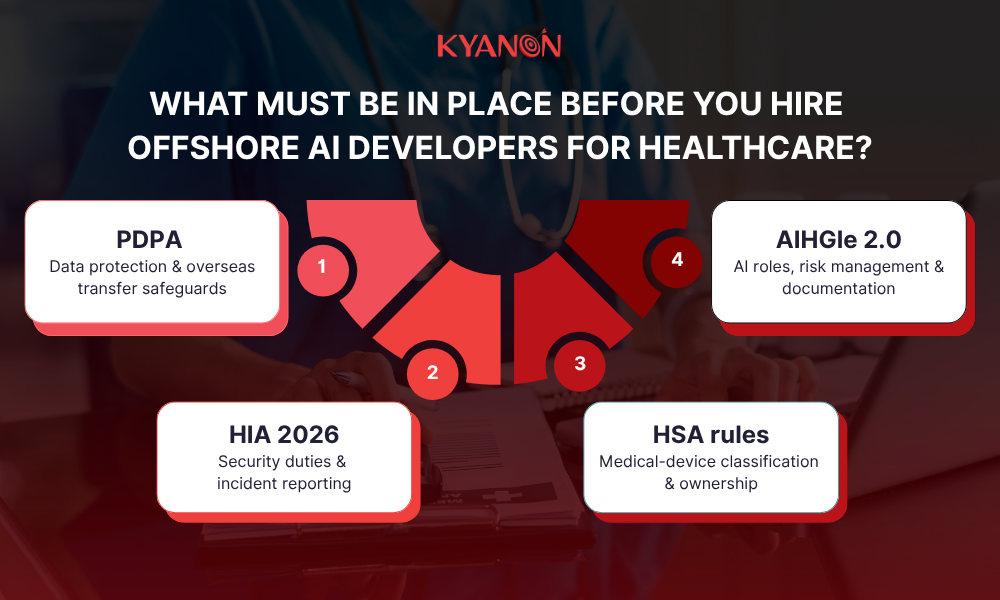
Four Singapore frameworks decide how far an offshore team can go. Confirm each with your legal and compliance owners before shortlisting candidates to ensure any proposed architecture meets regulatory standards.
Regulatory frameworks for healthcare AI in Singapore
|
Framework |
What it means for offshore hiring | Check before you sign |
| PDPA (PDPC) | The organization remains responsible for personal data processed by a vendor (data intermediary). Overseas transfers must maintain a comparable protection standard. |
Data Protection Agreement, transfer safeguards, and breach-notification timelines in the contract. |
|
Healthcare Services Act + Health Information Act 2026 (MOH) |
Enacted in February 2026 and taking effect in early 2027, the HIA sets cybersecurity and data-security duties for providers and health information management system (HIMS) vendors, requiring incident reporting to MOH. | Whether your AI touches NEHR-connected or HIMS data, and the vendor’s ability to meet security measures. |
| HSA medical-device rules | AI intended for diagnosis, treatment, or patient monitoring is regulated as a medical device. Administrative uses (e.g., appointment scheduling) generally are not. |
Intended purpose of the AI, who is designated the “manufacturer,” and who owns regulatory submissions. |
|
MOH/HSA AI in Healthcare Guidelines (AIHGle 2.0) |
Sets responsibilities for AI developers, deployers, and users, along with transparency and risk-management expectations. |
Which role your organization holds, and exactly what documentation your vendor must provide. |
These frameworks establish that compliance cannot be outsourced. Even when utilizing an offshore partner for development, the Singapore-based healthcare entity remains the accountable data controller, requiring strict auditing of vendor security measures and clear, documented boundaries on data residency.

Which engagement model works best for healthcare AI?
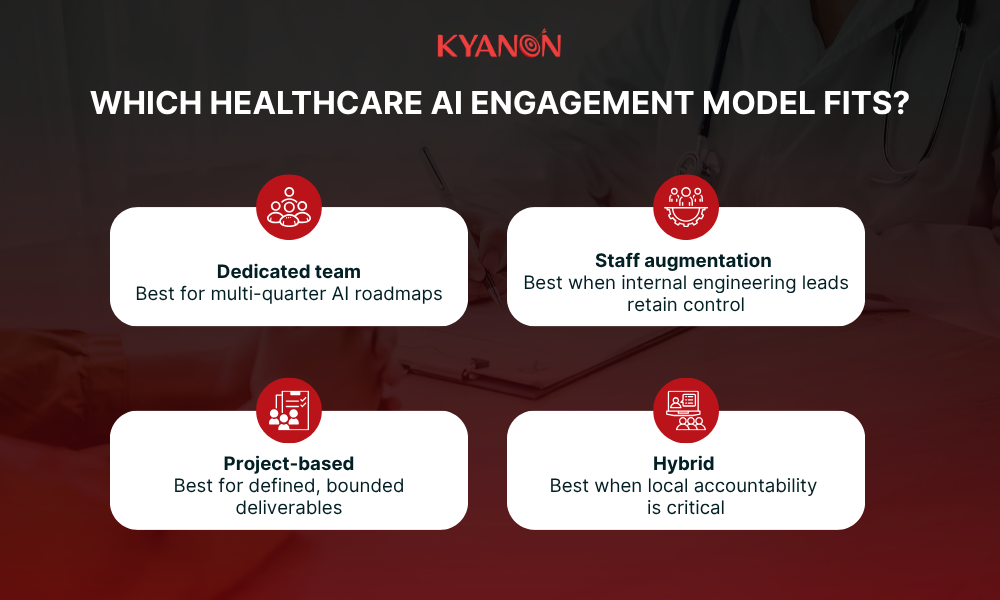
The right engagement model depends on how much architectural control you need to retain and whether the project involves a defined deliverable or an ongoing product roadmap. Compare these options against your internal governance capabilities.
Healthcare AI engagement models
|
Model |
Best when | Who holds architecture and clinical decisions | Healthcare watch-out |
| Dedicated offshore team (dedicated offshore developers, offshore dedicated developers) | Executing a multi-quarter AI roadmap; you want continuity of domain knowledge. | Shared: your product owner sets scope, the team designs within your standards. |
Needs a named in-house clinical/product owner from day one. |
|
Staff augmentation |
You already have an engineering lead and need specific ML/data/MLOps skills. | You, fully. | Onboarding to your access controls takes time; each hire needs vetting. |
| Project-based / full outsourcing | Delivering a defined, clear specification (e.g., an EMR integration or triage-support module). | Vendor delivers, you validate. |
Requires clear acceptance criteria and documentation for audit. |
|
Hybrid (Singapore lead + offshore delivery) |
Regulated data or stakeholder-facing work needs a local point of accountability. | The local lead owns the compliance interface; the offshore team executes. |
Clear split of who touches which environment. |
Selecting the appropriate model determines who owns the compliance risk and technical oversight. For highly regulated clinical data, a hybrid approach or strict staff augmentation ensures your local leads maintain direct oversight of the environment, whereas defined administrative modules can be safely outsourced as project-based deliverables.
How do you screen offshore developers for healthcare AI work?
Technical coding assessments are insufficient for medical AI. You must evaluate how an offshore team handles data restrictions, clinical standards, and production-grade machine learning deployments before granting system access.
Screening criteria for offshore healthcare AI developers
|
Area |
Ask for | Red flag |
| Healthcare delivery | Past EMR/EHR integration, clinical decision-support, or diagnostic-support work (standards such as HL7 FHIR). |
Only generic AI demos or consumer chatbots. |
|
Data handling |
Experience with de-identification, role-based access control, encryption at rest and in transit, and immutable audit logs. | Expects security to be “handled solely by the client.” |
| Technical & AI competency | Production ML experience: validation, drift monitoring, documentation (Python, PyTorch/TensorFlow paired with secure backends). |
No evidence of models successfully running in a production environment. |
|
Compliance readiness |
Willingness to sign an NDA and DPA before specs or code are shared; documented incident processes. | Resists contract clauses on data location or breach reporting. |
| Working model | Overlapping hours, mandatory code reviews, and agile rituals inside your tooling. |
Separate, unmonitored tooling and opaque reporting structures. |
If a candidate or vendor cannot demonstrate production experience with secure, de-identified data and strict audit logging, they are not ready for healthcare integration. A vendor’s willingness to integrate into your existing, audited tooling is the strongest signal of compliance maturity.
When you encounter systemic gaps in data handling capabilities during screening, a structured capability assessment can help. Explore how Kyanon Digital’s offshore developers for hire can embed secure engineering practices into your healthcare delivery.
What should Singapore healthcare enterprises look for in an offshore development partner?
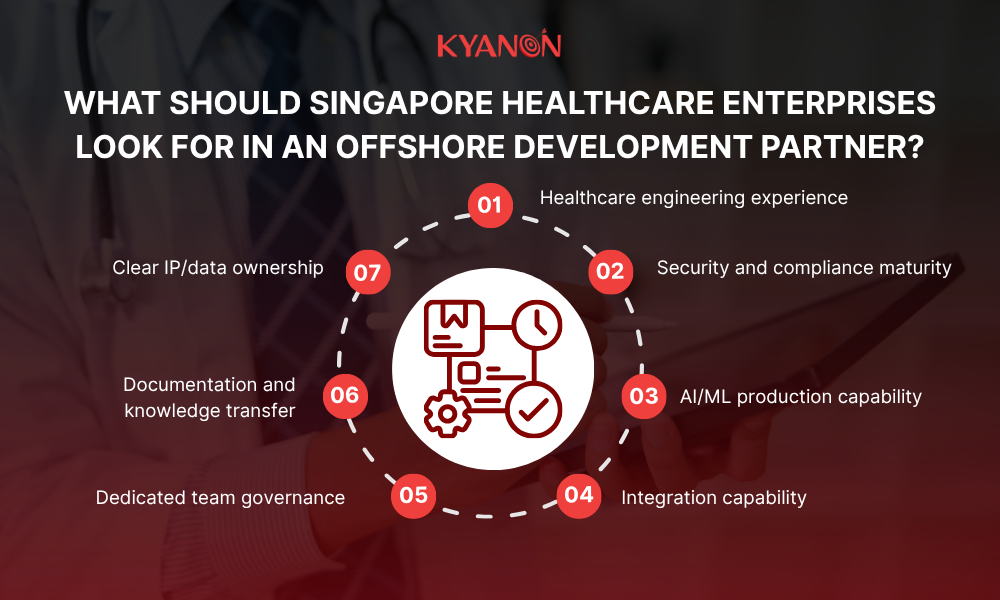
Selecting an offshore development partner is not only a technical decision for Singapore healthcare enterprises. The right partner must reduce delivery risk while protecting sensitive healthcare data, supporting regulatory requirements, and maintaining clear ownership throughout the development lifecycle. These are the key criteria to evaluate before engagement:
- Healthcare engineering experience: A proven track record of building medical diagnostic tools, EMR integrations, or clinical decision-support systems rather than just consumer applications.
- Security and compliance maturity: Deep understanding of Singapore’s PDPA and secure handling of Protected Health Information (PHI).
- AI/ML production capability: Proficiency in standard AI frameworks deployed alongside highly secure backend systems, such as PostgreSQL with AES-256 encryption.
- Integration capability: The ability to smoothly connect offshore development environments with existing on-premise or cloud healthcare architecture.
- Dedicated team governance: Clear ownership frameworks where offshore teams execute the heavy model training while the local client retains clinical validation.
- Documentation and knowledge transfer: Rigorous tracking of model parameters, training data origins, and security audits.
- Clear IP/data ownership: Contracts that guarantee the enterprise retains full intellectual property rights and data sovereignty.
What is the process to hire offshore developers with Kyanon Digital?
For a healthcare enterprise, the onboarding process is built around compliance and ownership first, and team selection second. The following sequence ensures legal protections are established before any technical work begins.
Onboarding process for hiring offshore developers with Kyanon Digital
|
Step |
What happens | Who owns it |
| 1. Scope the use case | Define the AI use case, the data types involved, and whether the system is administrative or clinical to determine medical-device regulations. |
Client clinical/product owner + Kyanon Digital |
|
2. Sign NDA and DPA first |
Agree on contract terms before any specifications, data samples, or codebase are shared, locking in data location, access rules, and breach-notification timelines. | Client legal/compliance + Kyanon Digital |
| 3. Choose the engagement model | Pick from Outcome-Based AI Dedicated Agile Team, AI-Enabled Staff Augmentation, or AI-Assisted Full Software Outsourcing. |
Client sponsor + Kyanon Digital |
|
4. Compose the team |
Review proposed profiles for AI engineers and supporting roles (backend, DevOps, QA) against a strict healthcare competency checklist. | Kyanon Digital proposes, client approves |
| 5. Set up environments and access | Restrict development and training strictly to de-identified or synthetic data. Enforce role-based, logged access for any production environments. |
Client IT/security + Kyanon Digital |
|
6. Onboard, deliver and review |
The team joins the client’s sprint planning, standups, and code reviews. Clinical validation and go-live decisions remain strictly with the client. |
Shared |
By sequencing legal agreements and data environments before team composition, this process prevents unauthorized data exposure. It ensures that the offshore team can immediately begin productive work on synthetic data while the local client retains full authority over clinical validation and final production deployment.
Conclusion
Hiring offshore AI developers for the Singapore healthcare sector requires far more than evaluating Python skills; it demands strict adherence to local data privacy laws and medical interoperability standards. By mapping your data boundaries early, selecting the right governance model, and requiring rigorous security compliance from your vendor, you can safely scale your engineering capacity. Ensure that offshore teams operate on de-identified data while your in-house clinical leaders maintain ultimate decision-making authority over the final product.
Planning your next scaling initiative? Discuss your scaling roadmap with our team to evaluate how an offshore-plus-Singapore model fits your data governance rules.




 Create project brief with AI