

Not universally. AI-enabled workflows outperform traditional automation on unstructured, judgment-heavy tasks like interpreting emails and routing exceptions. However, traditional automation remains faster and more cost-effective for fixed, high-volume, rule-based processes. Most businesses that scale successfully combine both, using AI to interpret data and automation to execute actions.
When operations leaders look to streamline processes, they often ask if investing in AI-enabled business workflows makes traditional automation redundant. The short answer is no. Using a large language model to handle a highly predictable, rule-based process adds unnecessary cost and latency.
The real decision is identifying where a workflow stalls because it requires human interpretation, and where it simply requires faster execution. Understanding this operational boundary dictates whether a process needs a deterministic script or a cognitive workflow, preventing costly over-engineering in core business systems.
Key takeaways
- Traditional automation excels at execution but fails when inputs vary; prioritize it for predictable, high-volume tasks with structured data.
- AI-enabled workflows handle interpretation, making them ideal for dynamic processes like document review, incoming customer queries, and unstructured exception handling.
- A resilient architecture separates the two: let AI interpret the messy input, and let traditional automation execute the approved action.
- Kyanon Digital perspective: Start with a measurable business decision, not a model. Fix the specific data path required for the workflow rather than attempting to overhaul your entire data estate before launching an AI agent.
What’s the real difference between AI-enabled workflows and traditional automation?
Traditional automation executes predefined rules. When a trigger occurs, the system follows a known sequence and produces a predictable result.
AI-enabled workflows add an interpretation layer. Instead of requiring every possible input to be explicitly defined in advance, an AI model can process information such as emails, documents, conversations, or images and turn it into structured information that the workflow can act on.
For example, an AI-enabled workflow could read an incoming customer email, identify the request, extract relevant information, and route it to the appropriate process. Traditional automation can then handle the downstream steps.
The distinction can be summarized as:
Area | Traditional automation | AI-enabled workflow |
| Primary role | Execute defined actions | Interpret variable inputs and support decisions |
Input | Structured and standardized | Structured or unstructured |
| Rules | Explicit and predefined | Model-based interpretation combined with workflow logic |
Predictability | Highly deterministic | Probabilistic and requires validation |
| Best suited to | Repetitive, stable processes | Variable, information-heavy processes |
Typical examples | Data synchronization, notifications, status updates | Document extraction, request classification, conversational routing |
When a workflow combines structured transactions with unstructured inputs, a hybrid approach may be more appropriate than relying on either technology alone. If you are assessing where integration and automation fit into that workflow, explore Kyanon Digital’s integration and automation services.

When should a business choose AI over traditional automation (or both)?
The decision depends on three factors: process stability, input structure, and the level of judgment required.
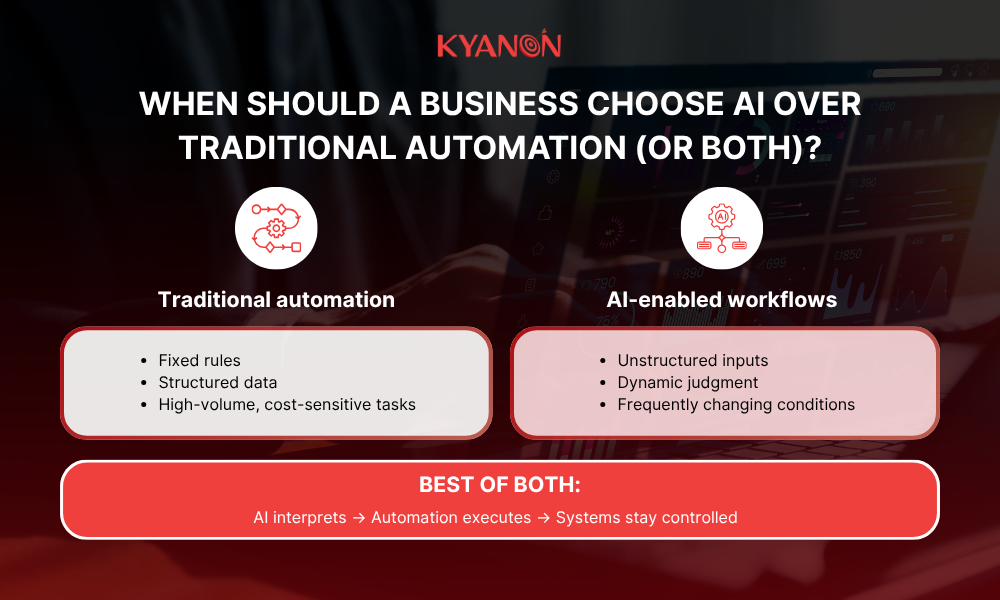
Start with traditional automation when:
- The rules are fixed: Processes like payroll runs, scheduled data syncs, or standard invoice approvals require deterministic, auditable outputs.
- The data is clean: The inputs are already structured in databases or standardized forms.
- Volume is high and cost-sensitivity is critical: Running thousands of daily transactions through an LLM is inefficient if a simple script can do the job instantly.
Consider an AI-enabled workflow when:
- Inputs are messy or unstructured: Processing incoming customer support tickets, extracting data from varied vendor PDFs, or analyzing voice recordings requires cognitive interpretation.
- The task requires dynamic judgment: Routing exceptions based on intent or summarizing long-form communications cannot be hardcoded effectively.
- Conditions change frequently: AI-enabled workflows can handle variable inputs and adapt certain steps without relying entirely on hardcoded rules.
For many enterprise operations, a blended approach can be practical. Businesses can use AI to interpret unstructured incoming data, then pass structured outputs to traditional automation for controlled execution in systems such as ERP or CRM platforms.
How can businesses mitigate the risk of AI hallucinations in core systems?
A reliable workflow needs more than a capable model. Connecting AI directly to a system of record without appropriate guardrails can introduce significant operational risk. If an AI misinterprets an instruction, it could mistakenly approve an invalid claim or alter critical customer data.
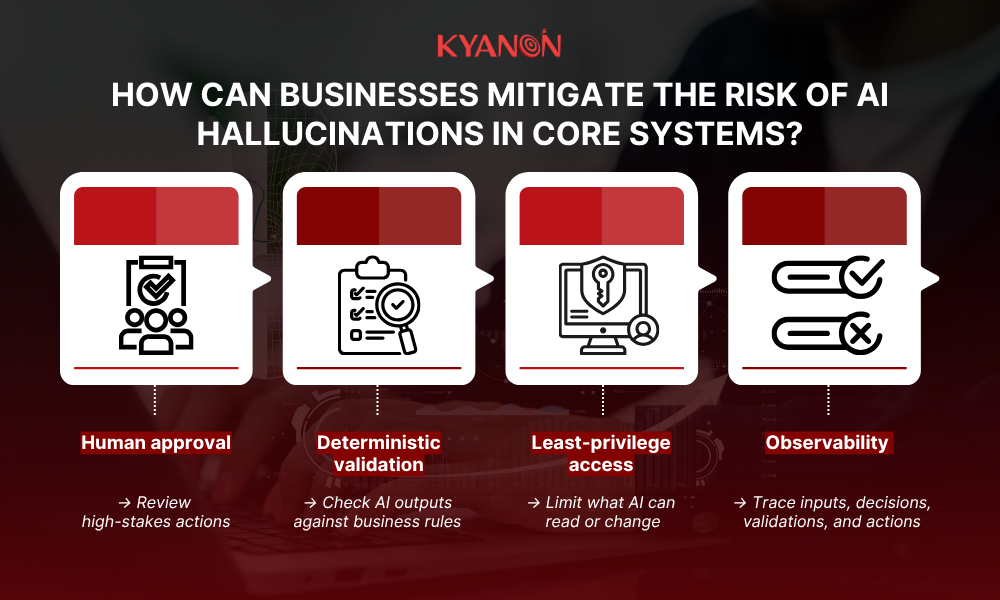
To mitigate these risks, businesses must separate interpretation from execution.
- Implement human-in-the-loop (HITL) checkpoints: For high-stakes decisions, the AI should stage the work (e.g., drafting a response or calculating a refund) and pause for explicit human approval before execution.
- Use traditional logic for validation: After the AI extracts data, pass it through deterministic business rules. If the AI extracts a purchase order amount, the workflow should check if it exceeds standard limits before proceeding.
- Restrict agent permissions: Apply the principle of least privilege. An AI agent reading incoming emails should not have write access to the financial ledger.
- Focus on observability: Instrument every AI decision so teams can trace what triggered the workflow, what the model produced, which validation rules applied, and what action was taken.
How Kyanon Digital scaled retail recruitment with AI-enabled workflows for a Singapore retailer
Challenges
- Manual bottlenecks in high-volume hiring: The client faced intense pressure to fill frontline retail roles quickly while managing high turnover and seasonal demand.
- Inefficient screening: HR teams were overwhelmed by repetitive manual screening, document collection, and interview scheduling.
- High candidate drop-off: Slow response times led to qualified candidates accepting competing offers before the first interview could be scheduled.
Solution from Kyanon Digital
- AI-driven recruitment chatbot: Implemented an intelligent agent on the career page to instantly interact with candidates, pre-screen applicants based on role requirements, and answer queries.
- Automated workflow sequencing: Designed a scalable hiring infrastructure that automated reminders for document submission, background check follow-ups, and training tasks.
- Hybrid workflow: Combined AI-driven candidate engagement with automated scheduling, onboarding, and status-tracking workflows.
Results and Impact
- Time-to-hire: Reduced by up to 60%.
- HR administration: Repetitive HR work was reduced by over 70%.
- Onboarding: Automated document collection, training reminders, and status tracking reduced manual follow-ups across the hiring journey.
This case demonstrates that improving a process does not always mean replacing the human team. By deploying AI to handle unstructured candidate interactions and automation to manage the scheduling logic, the retailer created a more scalable recruitment workflow that could support seasonal hiring demand.
Explore the full case study here: AI Recruitment Automation for Retail’s Frontline Workforce in Singapore
Conclusion
AI-enabled workflows are not a blanket replacement for traditional automation. They extend automation into processes that involve unstructured data, variable inputs, or contextual interpretation. While rule-based automation remains the standard for fast, deterministic, and highly structured execution, AI unlocks the ability to automate messy, unstructured, and judgment-heavy processes. The most effective architectures do not force a choice between the two. Instead, they use AI to interpret the real world and traditional automation to execute the business rules.
Before investing in a major workflow transformation, evaluate where your processes actually fail. If the bottleneck is interpretation, an AI-enabled workflow may be appropriate. If the bottleneck is execution speed, traditional automation may be sufficient.
Ready to scale with confidence? Discuss your integration and automation roadmap with Kyanon Digital to design a workflow that fits your business.
References
AI Recruitment Automation for Retail’s Frontline Workforce in Singapore — Kyanon Digital, 2026.
How Do You Bridge Data and AI Consulting with Execution? — Kyanon Digital, 2026.







 Create project brief with AI