


Hiring specialized eCommerce developers helps Singapore enterprises modernize legacy platforms, connect fragmented business systems, improve scalability, and deliver better digital shopping experiences. The need is becoming more strategic as Singapore continues to deepen enterprise digitalisation. In 2025, Singapore’s eCommerce platform market grew 21% year on year to US$5.9 billion (approximately S$7.5 billion), according to Momentum Works. This continued market growth increases the importance of scalable commerce platforms, seamless integrations, and digital experiences that can support rising transaction volumes and evolving customer expectations.
Kyanon Digital suggests that eCommerce modernization should not start with replacing the storefront. It should start with identifying where the existing commerce ecosystem is slowing growth, increasing operational costs, or limiting customer experience.
Key takeaways
- Warns against initiating eCommerce modernization through a front-end redesign, as the team at Kyanon Digital routinely observes in the field, when primary growth bottlenecks reside in unintegrated back-end systems.
- Clarifies why enterprises should refrain from complete platform rebuilds, drawing from hands-on legacy migration engagements, unless a phased modernization roadmap is put in place first to reduce technical debt systematically.
- Cuts through conventional developer rate comparisons, in Kyanon Digital’s implementation experience, by showing that true investment depends on cross-functional engineering capabilities rather than individual hourly headcount when tackling complex architectures.
- Explains when standard off-the-shelf commerce tools must be replaced, across enterprise digital transformation projects, once operational requirements demand deep multi-system integration to support complex workflows and compliance mandates like Singapore’s GST InvoiceNow.
Further reading:
- Enterprise Digital Commerce Transformation in Singapore
- Omnichannel Ecommerce Development in Singapore
- Top 10 Omnichannel E-commerce Developers in Singapore
When should Singapore enterprises hire ecommerce developers?
Singapore enterprises should hire eCommerce developers when their existing platform can no longer keep pace with business growth, customer expectations, or operational complexity. This typically happens when performance declines, integrations become difficult to maintain, or the platform cannot support requirements such as B2B pricing, omnichannel commerce, or new business workflows.
The need for deeper digital capabilities is growing across Singapore retail. In its 2026 Retail Industry Digital Plan, IMDA reported that more than 75% of SME retailers had adopted entry-level digital solutions, while 45% had adopted intermediate solutions, highlighting the shift from basic digitalisation toward more advanced capabilities.
Kyanon Digital sees eCommerce development as the next step when off-the-shelf tools can no longer support the full commerce ecosystem. The priority is to modernize the architecture and integrate systems such as ERP, CRM, PIM, WMS, and POS so the business can scale without adding unnecessary technical complexity.

What business benefits can ecommerce developers deliver?
The key benefits include better performance and scalability, stronger system integration, greater flexibility for complex commerce needs, and lower technical debt.
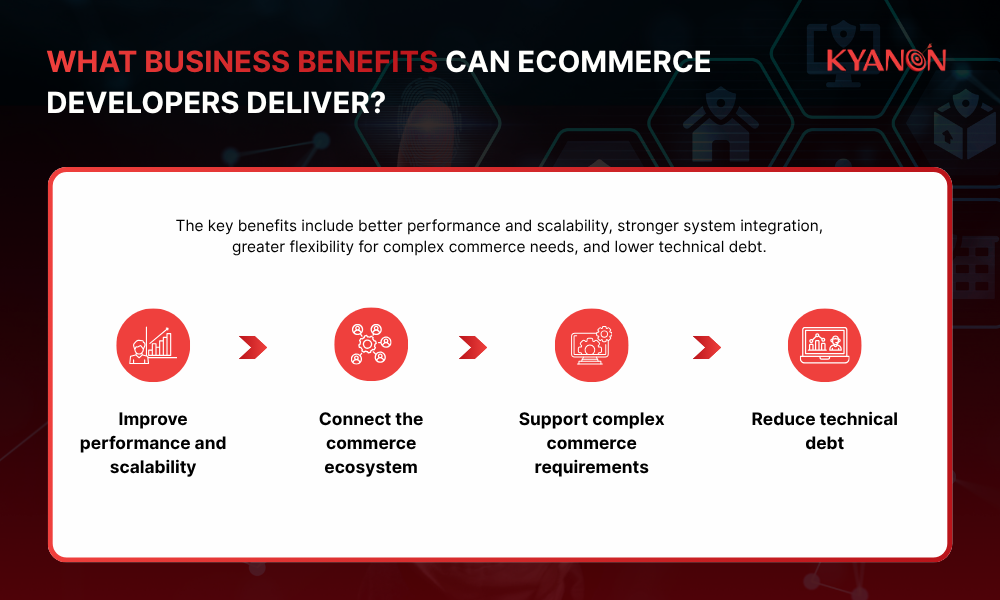
Improve performance and scalability
Developers can optimize application architecture, APIs, databases, caching, and front-end delivery to support higher traffic and transaction volumes.
- Business impact: Better performance reduces friction during shopping journeys, supports more concurrent transactions, and gives the business capacity to scale without constantly rebuilding the platform.
- Real-world context: Adobe Commerce’s current cloud architecture uses CDN, caching, and DDoS protection as part of its performance and security infrastructure, showing why enterprise commerce performance depends on the architecture behind the storefront.
Connect the commerce ecosystem
Modern commerce rarely operates as a standalone website. Developers can connect the storefront with ERP, CRM, PIM, WMS, POS, payment, and loyalty systems. This becomes particularly relevant in Singapore as businesses prepare for GST InvoiceNow. IRAS requires GST-registered businesses to progressively submit invoice data through InvoiceNow, with all GST-registered businesses expected to be onboarded by April 2031.
- Business impact: Better system integration reduces manual data entry, duplicate records, reconciliation work, and delays between sales, inventory, finance, and customer operations.
Support complex commerce requirements
Standard templates work well for straightforward stores, but enterprise commerce often requires B2B pricing, customer-specific catalogs, product configuration, advanced promotions, multi-store operations, or custom workflows. Professional Magento ecommerce developers can extend Adobe Commerce where the platform needs to accommodate complex business rules.
- Business impact: A commerce platform that reflects actual business processes can support more customer segments, pricing models, and sales channels without forcing teams to rely on manual workarounds.
Reduce technical debt
Legacy commerce platforms often accumulate outdated integrations, duplicated business logic, obsolete modules, and fragile dependencies. Developers can identify these issues during modernization and gradually replace high-risk components instead of rebuilding everything at once.
- Business impact: Lower technical debt can reduce maintenance effort, minimize integration failures, simplify future upgrades, and make it easier to introduce new commerce capabilities as the business grows.
How much does it cost to hire ecommerce developers?
The cost depends on modernization complexity rather than developer headcount alone. In Singapore, current 2026 market data from Clutch shows eCommerce development rates ranging from under US$25 to US$199 per hour, while many providers fall around US$25–49/hour. For larger Magento and enterprise commerce projects, Clutch listings show project costs ranging from US$50,000 to US$199,999 or more.
Platform choice, legacy code, integrations, data migration, customization, architecture, testing, and ongoing support all affect the final investment. A relatively contained Adobe Commerce upgrade is very different from modernizing a commerce ecosystem connected to ERP, CRM, PIM, WMS, POS, loyalty, and finance systems.
Kyanon Digital suggest enterprises should estimate the cost based on the modernization roadmap and required engineering capabilities, not simply an hourly developer rate. A complex project may require a solution architect, eCommerce developers, QA engineers, DevOps specialists, and project management in addition to front-end and back-end development.
How to choose the right ecommerce development partner in Singapore?
Use this checklist to evaluate whether an eCommerce development partner can support both modernization and long-term growth.
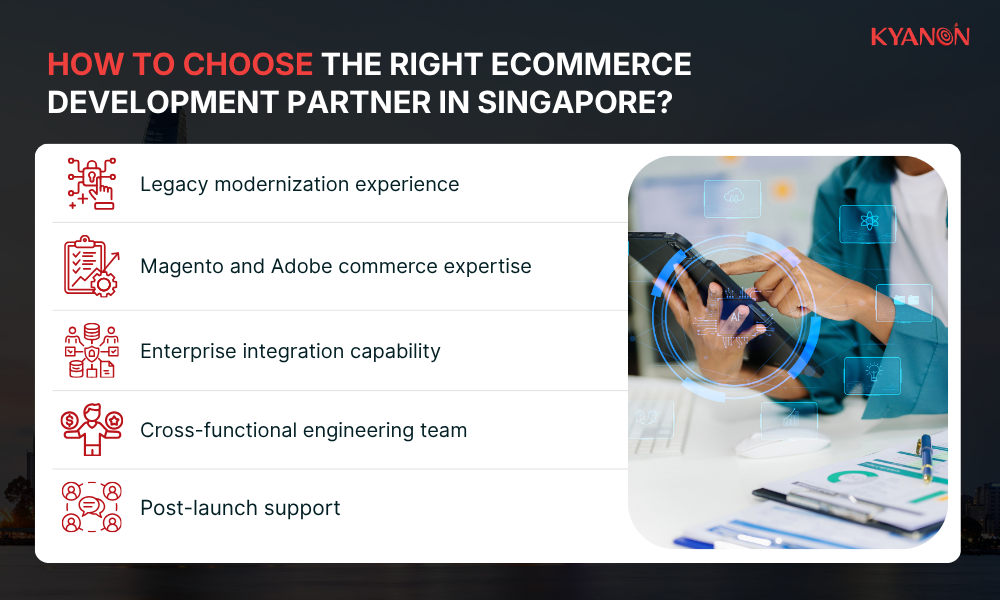
Legacy modernization experience
- Has experience modernizing legacy eCommerce platforms, not only building new stores.
- Can assess legacy code, integrations, technical debt, and migration requirements.
- Provides a phased modernization roadmap instead of recommending a full rebuild by default.
Magento and Adobe commerce expertise
- Has experienced certified Magento developers and Magento ecommerce developers.
- Understands Adobe Commerce architecture, customizations, extensions, upgrades, and security.
- Can maintain upgradeability while adapting the platform to complex business requirements.
Enterprise integration capability
- Can integrate eCommerce with ERP, CRM, PIM, WMS, POS, payment, loyalty, and financial systems.
- Understands APIs, data synchronization, middleware, and integration dependencies.
- Can identify integration risks before they affect migration or business operations.
Cross-functional engineering team
- Can provide the right mix of solution architects, eCommerce developers, QA engineers, DevOps specialists, and project managers.
- Has clear ownership across architecture, development, testing, deployment, and support.
- Can scale the team according to project complexity rather than relying on a single developer.
Post-launch support
- Provides ongoing platform upgrades, performance optimization, security maintenance, and feature development.
- Can support new integrations and changing business requirements after launch.
- Has a clear support and maintenance model beyond the initial implementation.
Explore Kyanon Digital’s eCommerce Solutions to build a scalable, integrated commerce ecosystem aligned with your business goals.
How Kyanon Digital delivers dedicated ecommerce development teams for Singapore?
Kyanon Digital approaches eCommerce modernization as part of broader enterprise digital transformation rather than as a standalone website project.
- Step 1 – Commerce Strategy and Technical Discovery: Assess the existing commerce ecosystem, identify technical constraints, map integrations, and define the modernization roadmap.
- Step 2 – eCommerce Architecture and Development: Modernize or build commerce platforms across front-end, back-end, APIs, integrations, and commerce services.
- Step 3 – Enterprise System Integration: Connect commerce platforms with ERP, CRM, PIM, WMS, POS, loyalty, payment, and other enterprise systems.
- Step 4 – Dedicated eCommerce Engineering Teams: Build a team around the project’s requirements, including solution architecture, eCommerce development, front-end development, QA, DevOps, and project management.
Case study: E-Commerce System For Coway
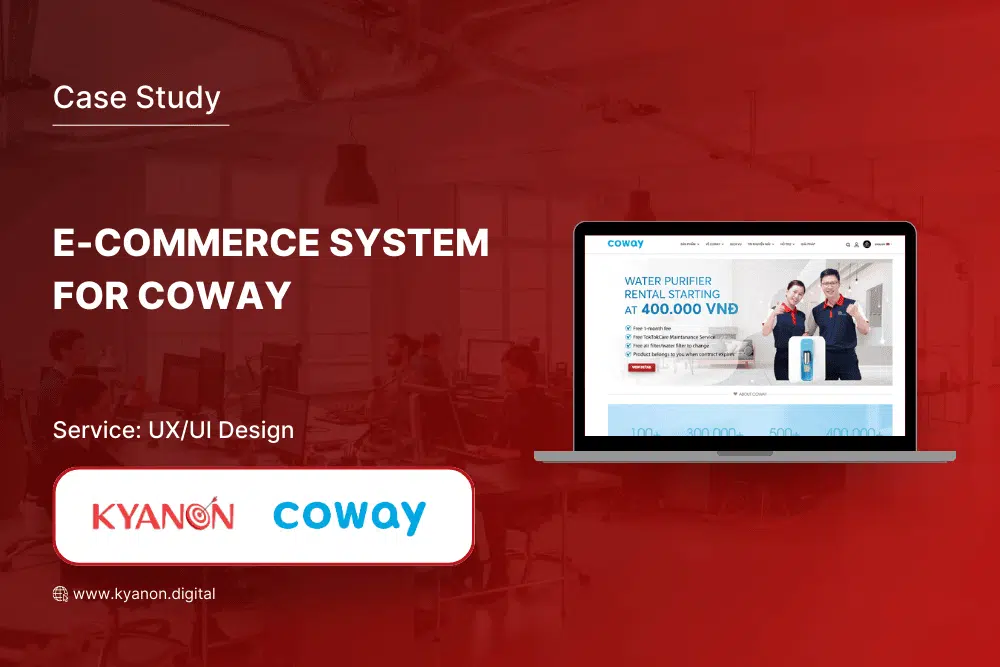
Client Overview
Coway is a South Korean global home wellness brand specializing in water and air purification solutions. The company needed to strengthen its digital commerce capabilities to support online sales and improve operational efficiency.
Challenges
- Limited eCommerce capabilities: Coway lacked a robust digital platform to deliver a seamless online shopping experience.
- Inefficient sales management: The business needed better systems to manage sales agents and track their performance.
- Limited sales visibility: Agent commissions and sales records required a more integrated and efficient tracking process.
- Scalability requirements: Coway needed a digital commerce foundation that could support growing customer demand.
Results
Kyanon Digital developed an integrated eCommerce system that combined customer-facing commerce capabilities with internal sales management. The solution included an eCommerce platform, an administration portal, and integration with Coway’s agent management system.
Business Impact
- Improved customer experience: Customers can browse, compare, and purchase Coway products through a smoother online shopping journey.
- Higher operational efficiency: The eCommerce admin portal enables teams to manage products, content, orders, inventory, and promotions more efficiently.
- Better sales management: Integration with the agent management system enables more efficient commission calculation and sales tracking.
- Stronger digital commerce foundation: The platform gives Coway a centralized system to expand its online presence and support future sales growth.
Explore the full case study here: E-Commerce System For Coway
Conclusion
Hiring an eCommerce developer becomes increasingly valuable when a legacy platform limits performance, integration, scalability, or business flexibility. For Singapore enterprises, initiatives such as the 2026 Retail Industry Digital Plan and GST InvoiceNow also highlight the growing need for connected, scalable digital infrastructure.
The priority should not be simply replacing an outdated storefront. It should be building a commerce architecture that connects business systems, reduces technical debt, improves operational efficiency, and supports future growth.
Ready to modernize your eCommerce platform? Talk to Kyanon Digital to assess your current architecture, define a practical modernization roadmap, and build a dedicated eCommerce development team to turn your commerce goals into a scalable digital solution.
References
- E-Commerce System For Coway – Kyanon Digital, 2025
- Omnichannel eCommerce Solutions – Kyanon Digital
- Top E-Commerce Developers in Singapore – Clutch, 2026
- GST InvoiceNow Requirement – Inland Revenue Authority of Singapore
- Refreshed Industry Digital Plan to Support Retailers in Accelerating Technology Adoption and Driving Business Growth – Infocomm Media Development Authority, 2026
- Singapore’s e-commerce platform market expands by 21%, led by Shopee – The Stair Times, 2026









 Create project brief with AI