

Choosing the wrong BFSI software development company can create more than delivery delays. Financial institutions must manage sensitive data, regulatory controls, legacy-system dependencies and high-availability requirements while still improving time to market. IBM’s 2026 research puts the average cost of a financial-services data breach at US$6.3 million, reinforcing why security and operational resilience belong in vendor selection from the start.
This guide provides enterprise technology executives with a practical framework for evaluating custom BFSI software development companies. It covers eight key criteria, requirements briefing, commercial models, and risk controls to align technology decisions with business goals.
Key takeaways
- 8-criterion framework: Evaluate vendors on domain expertise, security, compliance, integration, scalability, TCO, governance, and technical depth.
- RFP & requirements: Define clear outcomes, user journeys, dependencies, and constraints before vendor selection.
- Security & modernization: Require Secure SDLC, compliance-by-design, and API-driven modernization to reduce legacy risks.
- Commercials & support: Match Fixed-Price, T&M, or Dedicated Team models to project scope, with clear SLAs and support terms.
- Evidence-based selection: Validate vendors through case studies, peer references, and PoC testing, while checking for red flags such as weak regulatory expertise or vague security claims.
Further reading
- Digital Transformation in BFSI: A Framework for APAC Banks in 2026
- What Is BFSI Domain? Definition, Scope & Industry Overview
- Hyper Personalization in Banking With AI
How to evaluate a BFSI software development company: 8 criteria
The right BFSI software development partner should be evaluated across eight key areas. Each criterion connects business priorities with technical capabilities, operational risk, and expected time to value.
Key evaluation criteria for BFSI software development partners
Criterion | Business priority | Technical focus | Key risk / value |
| Domain experience | Financial product expertise | Core Banking Systems (CBS), Loan Origination Systems (LOS), Policy Administration Systems (PAS), payment systems | Comparable BFSI case studies and references |
Regulatory & compliance | Audit readiness | Policy controls, privacy, data residency | Certifications and audit documentation |
| Security standards | Trust and transaction protection | Secure Software Development Life Cycle (SSDLC), Identity and Access Management (IAM), encryption, Static Application Security Testing (SAST), Dynamic Application Security Testing (DAST) | Security certifications and assessment reports |
Technical expertise | Future-ready architecture | Cloud, microservices, Application Programming Interface (APIs), AI, Machine Learning (ML) | Architecture samples and project examples |
| Integration capability | Protects existing systems | Core banking, APIs, data migration | Integration case studies and migration examples |
Methodology & communication | Predictable delivery | Agile, Continuous Integration/Continuous Delivery – Deployment (CI/CD), DevOps, Quality Assurance (QA) | Delivery methodology and governance model |
| Scalability & performance | Supports growth | High Availability (HA), multi-region, cloud | Performance benchmarks and SLA examples |
Pricing & value | Optimizes TCO | Fixed-Price, Time and Materials (T&M), Dedicated Team | Pricing model and TCO breakdown |
Ultimately, enterprises should weigh these eight criteria based on the project archetype. Core infrastructure modernization should prioritize integration, security, compliance, and scalability, while greenfield fintech initiatives may place greater emphasis on development velocity, API flexibility, and technical innovation. Looking beyond hourly rates helps procurement teams reduce technical and operational exposure while selecting a partner built for long-term value.

Before you shortlist: define your business requirements
A clear enterprise specification helps you find the right BFSI technology partner.
Before sending a Request for Proposal (RFP), technology leaders should define the business outcomes they want to achieve. Focus on measurable results, not just a list of features.
To create a brief that helps you screen vendors effectively, structure your requirements around four key areas:
- Business outcomes and impact goals: Define targets such as lower acquisition costs, reduced onboarding drop-off, and faster processing.
- User personas and workflows: Map key journeys for retail banking customers, commercial underwriters, wealth advisors, and insurance agents.
- Architectural dependencies: Identify systems the solution must integrate with, including core banking, payment, policy, credit, and identity systems.
- Governance and commercial constraints: Set timelines, budgets, data location, processing and cross-border transfer requirements where applicable.
- Risk and non-functional requirements: Define availability, transaction volumes, recovery objectives, security classification, audit requirements and acceptable production downtime.
Setting these requirements early makes the RFP more useful. It helps you compare vendors more objectively, identify misaligned suppliers early, and reduce procurement risk.
Look for proven BFSI domain & compliance expertise
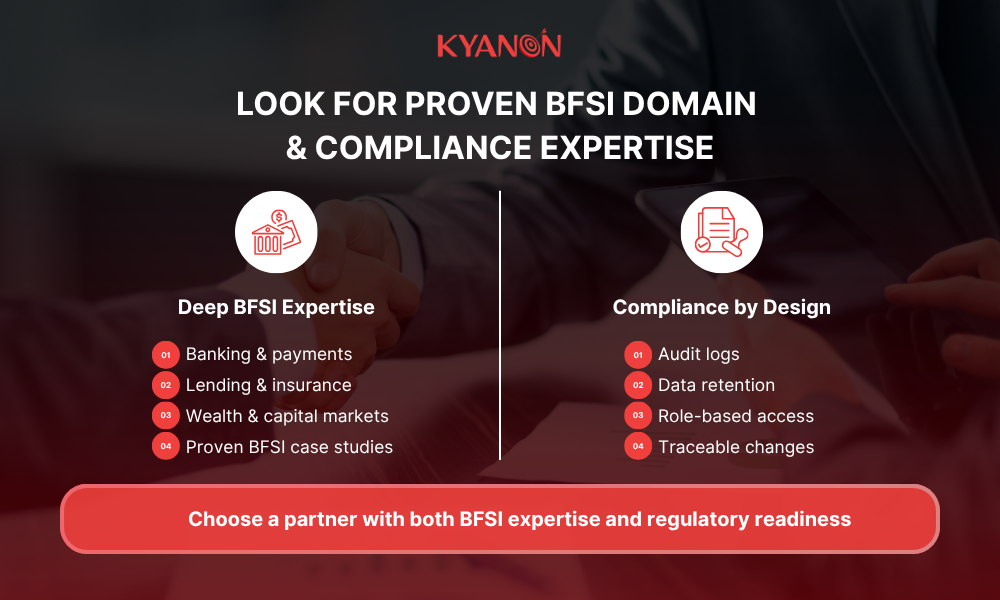
When evaluating a BFSI software development partner, technical capability alone is not enough. Prioritize vendors with proven BFSI domain expertise and a strong track record of building systems that meet complex regulatory and compliance requirements.
Deep vertical domain experience
BFSI software involves complex business rules, calculations, and edge cases. Errors in areas such as interest calculations, multi-currency reconciliation, loan schedules, risk scoring, or claims processing can lead to costly rework.
Before choosing a vendor, verify their experience across four key BFSI areas:
- Core banking and payment rails: Core transaction ledgers, clearing systems, SWIFT messaging, instant payments, and multi-currency systems.
- Lending and underwriting: Loan origination, automated decisioning, risk scoring, collateral management, and debt recovery.
- Insurance and reinsurance: Policy administration, claims processing, actuarial systems, and agent portals.
- Wealth management and capital markets: Portfolio management, trading APIs, robo-advisory, custodian integrations, and investor platforms.
Vendors do not need equal depth across every BFSI segment. They should demonstrate experience that closely matches the institution’s specific product, workflow, regulatory perimeter and system landscape.
Ask vendors for relevant case studies covering systems such as Core Banking Systems (CBS), Loan Origination Systems (LOS), Policy Administration Systems (PAS), and multi-currency payment gateways.
Regulatory traceability and audit-ready architecture
BFSI software must meet both local regulations and international standards. Depending on jurisdiction and activity, relevant requirements may include:
- Financial regulators: MAS, APRA, FCA, RBI.
- Prudential / risk frameworks: Basel requirements.
- Payments security: PCI DSS.
- Financial crime controls: KYC, AML/CFT.
- Privacy: GDPR, DPDP and local privacy laws.
A qualified BFSI technology partner should build compliance into the SDLC, not treat it as a final-stage check.
Look for:
- Immutable audit logs
- Automated data retention
- Role-based access and segregation of duties
- Traceable change management
- Audit-ready technical documentation
This helps ensure the platform can meet both internal risk reviews and external regulatory audits.
Assess security standards & technical capability
Evaluate security and technical maturity together when selecting a BFSI technology partner. A vendor may offer advanced technologies, but without strong security practices and reliable engineering foundations, those capabilities can introduce additional operational and compliance risks.
Security-first software development life cycle (SSDLC)
For BFSI software, security should be built into the system from the start, not added after deployment. IBM reported that one in four malicious breaches were AI-enabled in 2026, with these incidents costing organizations nearly $1 million more than the global average breach.
This makes a mature Secure SDLC essential. Security controls should be built into every stage of development, from architecture through ongoing operations:
- Threat modelling before development
- Secure coding and dependency scanning
- SAST/DAST integrated into CI/CD
- Secrets and access-control management
- Penetration testing before production
- Continuous vulnerability and runtime monitoring
Why it matters: A vendor should be able to show where security controls enter the delivery lifecycle, who owns remediation and what evidence is retained for audit—not simply state that development is “secure.”
Technical depth and capability matrix
Security is only one part of technical readiness. Enterprise BFSI leaders should also assess whether a vendor has the core capabilities required for reliable, scalable financial systems.
Technical depth and capability matrix
Capability | Baseline requirements | Advanced capabilities |
| Cloud architecture | Cloud orchestration, IaC | Sovereign cloud and data residency controls |
API & integration | REST APIs, OAuth 2.0, OpenID Connect | Kafka, event-driven architecture, ISO 20022 |
| Data & analytics | ACID-compliant databases, automated backups | Real-time transaction monitoring, DLT |
AI & automation | Workflow automation, basic RPA | GenAI underwriting, automated risk scoring, LLM security |
Baseline capabilities create the secure technical foundation required for BFSI applications. Advanced capabilities can then support more complex use cases, such as real-time payments, automated risk assessment, and AI-powered underwriting.
Enterprise technology leaders should therefore avoid choosing vendors based only on emerging technology expertise. The right partner should first demonstrate strong security, cloud, integration, and data foundations before introducing GenAI, blockchain, or other advanced technologies.
Evaluate methodology, integration & scalability
A BFSI technology partner must be able to balance delivery speed with operational stability. Evaluate how the vendor manages Agile governance, legacy modernization, system integration, and scalability to ensure new capabilities can be introduced without compromising critical financial operations.
Agile governance and continuous delivery
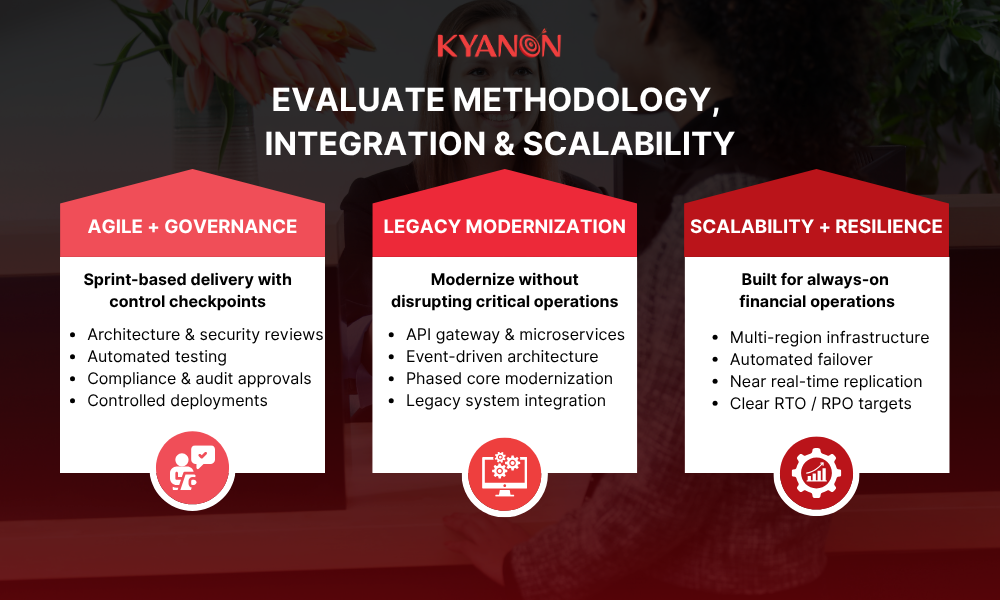
BFSI projects require both Agile delivery and strong regulatory controls. BFSI programs often combine iterative development with formal architecture, security, compliance and release gates. The important question is not whether the vendor labels its approach Agile or Waterfall, but how evidence, approvals, testing and change control are integrated into delivery. and delay time to market.
A strong technology partner should use a hybrid delivery model combining sprint-based development with governance checkpoints. Teams should review architecture, compliance, and security before development, run automated testing throughout each sprint, and complete penetration testing, audit approval, and controlled deployment before production.
Legacy core modernization and integration architecture
Modernizing a legacy core without disrupting live operations is a major challenge. A big-bang replacement can introduce significant risk, while a phased approach allows institutions to modernize while keeping critical systems running.
McKinsey reports that organizations applying its next-generation legacy-modernization approach have cut typical transformation timelines in half and costs by 70%, while achieving similar benefits.
A composable modernization strategy typically includes:
- Digital engagement layer: Mobile apps, web portals, and agent applications.
- API gateway and service mesh: Secure routing, authentication, rate limiting, and traffic management.
- Decoupled microservices: Independent services for onboarding, loan scoring, payments, and other capabilities.
- Asynchronous event bus: Platforms such as Apache Kafka for real-time event distribution.
- Legacy core system of record: Existing mainframes continue to manage core accounting and transaction data.
High availability and composable systems
For critical BFSI applications, high availability is an important architectural requirement because even short outages can affect transactions, customer experience, and operational continuity. Technology partners should demonstrate multi-region infrastructure, automated failover, near-real-time replication, zero-downtime deployment, and clearly defined RTO and RPO targets.
Finastra’s 2026 research found that 84% of financial institutions use some cloud solutions and 87% plan to increase modernization investment over the next 12 months.
These requirements also shape how large-scale enterprise systems are engineered. Kyanon Digital’s Large-Scale Software Development service brings together modular architecture, cloud infrastructure, microservices, and Agile/DevOps practices, with support for integrations across 10+ systems. This provides a practical foundation for modernizing complex platforms while keeping performance, integration, and future scalability in view.
Kyanon Digital perspective: For BFSI modernization, architecture should be evaluated against the institution’s existing systems, operational dependencies, regulatory controls and cutover risk—not simply the target technology stack. Kyanon Digital supports enterprise modernization through software engineering, integration, data, automation and controlled go-live readiness across complex environments.
Explore the Large-Scale Software Development approach for complex enterprise modernization.
Communication, support & pricing models
A strong technical partner should provide more than engineering capacity. Enterprises also need clear communication, dependable post-launch support, and a commercial model that aligns incentives with the project’s scope, complexity, and delivery risk.
Governance and dedicated support cadence
Offshore and nearshore development can provide access to technical talent and cost efficiency. However, enterprise delivery still requires clear governance and communication.
A strong delivery model should include dedicated project management, regular communication across time zones, transparent tracking through tools such as Jira and Confluence, and clear escalation paths. After launch, the partner should also provide Tier-3 and Tier-4 production support with defined SLAs and response times for critical incidents.
Engagement model evaluation
Different engagement models suit different project types. The right choice depends on scope clarity, project complexity, and the level of governance the enterprise can provide.
Engagement model evaluation
Model | Best suited for | Main watch-out |
| Fixed price | Clear, bounded scope | Change-request friction |
T&M | Evolving modernization | Requires strong backlog and budget governance |
| Dedicated team | Continuous development | Requires internal product ownership |
Hybrid | Complex programs with clear discovery phases | Contract boundaries must be explicit |
Choosing the wrong model can create misaligned incentives. Fixed-price contracts can create change-order friction when requirements evolve, while unmanaged T&M engagements can lead to budget overruns. Enterprise procurement teams should therefore match the commercial model to the project’s scope, complexity, and internal governance capacity.
Red flags to watch for (and questions to ask)
Even vendors with strong technical capabilities can introduce delivery, security, or compliance risks if their experience and processes are not properly validated. Procurement and technology teams should use the following red flags and questions to identify potential gaps before signing a contract.
Critical vendor red flags
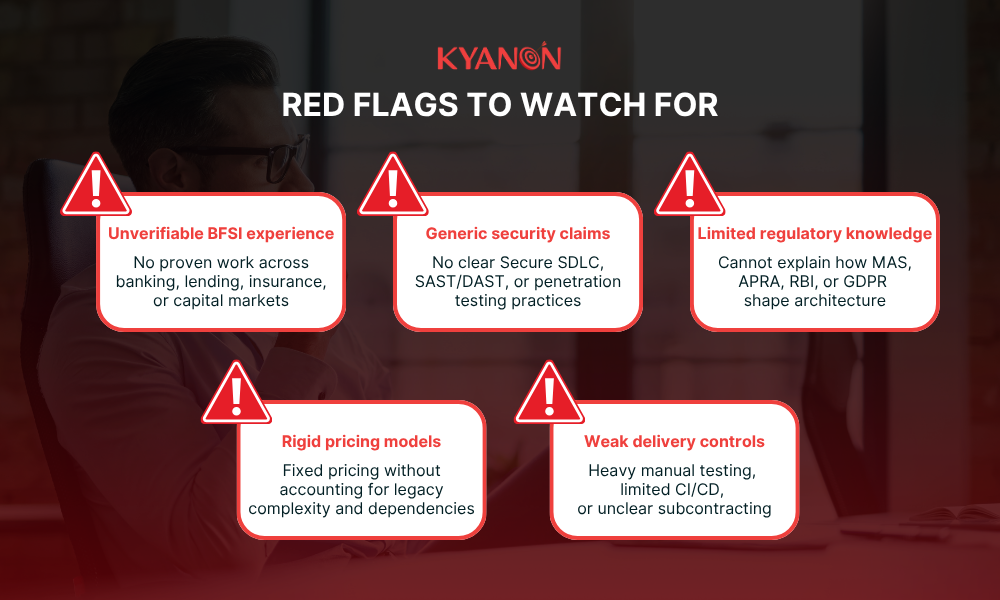
When screening a BFSI software development partner, watch for these warning signs:
- Unverifiable BFSI experience: No proven work across banking, lending, insurance, or capital markets.
- Generic security claims: Security statements without clear Secure SDLC practices, SAST/DAST, or penetration testing.
- Limited regulatory knowledge: Unable to explain how MAS, APRA, RBI, or GDPR affect system architecture.
- Rigid fixed-price models: Fixed pricing for complex legacy modernization with unknown dependencies.
- Heavy manual testing: Limited automated testing, CI/CD, or security testing.
- Unclear subcontracting: Core engineering work outsourced without clear disclosure or oversight.
- No named technical leadership: senior architects appear during sales but are not allocated to delivery.
- Unclear production ownership: the vendor cannot explain who owns incidents, monitoring, patching and knowledge transfer after launch.
Essential screening questions
Before selecting a vendor, procurement teams should ask:
- What BFSI applications has your team built, and can you provide relevant client references?
- How is regulatory compliance built into your software delivery process?
- Which threat modeling, SAST/DAST, and penetration testing practices do you use?
- How do you manage legacy integration, data migration, and zero-downtime deployment?
- What post-launch support, incident SLAs, and maintenance do you provide?
- Who owns the IP rights to the source code, architecture, and custom business logic?
Verify reputation & client feedback
Independent verification is essential when assessing a BFSI technology partner. Public review platforms such as Clutch, GoodFirms, and G2 can provide useful initial signals, but they should not be treated as equal to direct evidence from comparable financial-sector engagements.
The strongest evidence should come from a comparable production case, followed by a reference call with a relevant client stakeholder such as a CTO, CIO, or Head of Digital Transformation. Enterprises should also review the named delivery team, technical artefacts and architecture documentation, and relevant certifications and security documentation.
Reference checks should focus on how the vendor handled real delivery challenges, including legacy integration issues, security audit findings, regulatory requirements, and critical deployment deadlines. This provides a more reliable view of whether the partner can deliver secure, resilient, and compliant solutions in a BFSI environment.
2026 trends shaping BFSI software development
The BFSI technology landscape is evolving quickly. Enterprise technology leaders should look for software engineering partners that can support these key shifts:
- AI-native development and security: Financial applications are increasingly using AI for development, automation, and risk detection. Partners must also apply strong security controls to AI-assisted development and AI-enabled systems.
- Composable, API-first modernization: Institutions are moving away from large-scale core replacements toward modular architectures that connect microservices with legacy systems through secure APIs.
- Regulator-aligned cloud adoption: Cloud architecture must support data residency, encryption, access controls, and other requirements set by local regulators.
- Automated RegTech and compliance: KYC, fraud monitoring, regulatory reporting, and other compliance processes are moving into real-time application workflows.
- Embedded finance: Financial services are increasingly integrated into non-financial platforms, increasing demand for secure, scalable, and developer-friendly open banking APIs.
Final thoughts
Choosing a BFSI software development partner should ultimately come down to evidence, not vendor claims. Enterprises should validate domain experience, security and compliance practices, integration capability, delivery governance, and commercial fit through case studies, technical discussions, references, and, where appropriate, a proof of concept.
The right partner should not only build software. They should understand the regulatory environment, existing technology landscape, operational risks, and long-term business goals behind the transformation.
Ready to evaluate your BFSI software development requirements and identify the right technology partner?
Contact Kyanon Digital to discuss your next modernization initiative.






 Create project brief with AI