
To modernize an eCommerce platform for healthcare, organizations should assess existing workflows, data architecture, system integrations, security controls and regulatory obligations before choosing a migration strategy. Replatforming, refactoring or rebuilding may each be appropriate, depending on technical constraints and business priorities. The objective is to improve operational reliability and service delivery without introducing unnecessary migration, compliance or integration risk.
Singapore’s healthcare priorities make interoperability and responsible data management especially relevant. The Healthier SG strategy emphasizes preventive care and stronger relationships between residents and primary care providers, while the Health Information Act 2026 establishes a legal framework for health information sharing and protection. The Act was enacted in February 2026, but its commencement and applicable implementation requirements must be checked against current official guidance.
Key takeaways
- Warns against prioritizing technology trends over regulatory compliance, as the team at Kyanon Digital has observed that modernization only succeeds when clear data flows and access permissions are established first.
- Clarifies that a full platform rebuild is often an unnecessary migration risk, which practical engineering experience shows should be avoided unless fundamental architecture constraints completely prevent the system from meeting critical business needs.
- Shows how connected operational workflows dictate project success just as much as the user interface, a reality Kyanon Digital has validated through actual digital implementations as long as organizations maintain clear escalation rules for sensitive patient requests.
- Explains that deploying high-priority capabilities in controlled, measured phases protects ongoing daily operations, an approach field execution proves is useful only if each phase contributes to a defined, coherent target architecture.
Further reading:
- How To Implement AI in Singapore Healthcare?
- How Can AI Ecommerce Automation Help Singapore Healthcare?
- How to Build a Healthcare MVP for Singapore Enterprises?
Modernize healthcare commerce platform: What to consider?
Healthcare organizations should assess five areas before modernizing: regulatory compliance, system integration, identity and payments, operational data, and long-term maintainability. These factors help determine the right architecture and minimize migration risks.
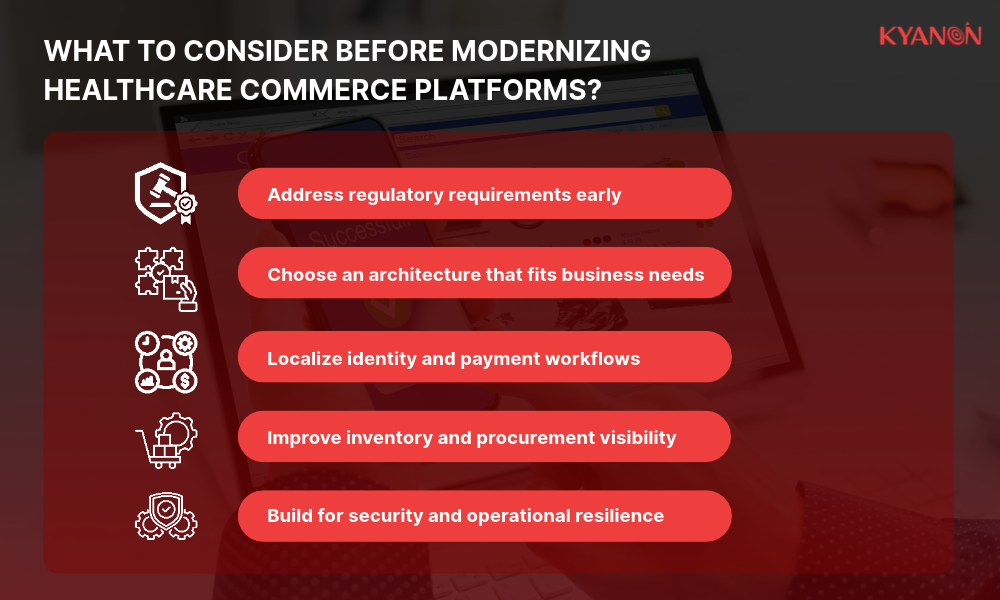
Address regulatory requirements early
Design the platform around applicable regulations from the start:
- PDPA: Protect personal data through appropriate collection, access, retention, and disclosure controls.
- HCSA: Determine whether the platform supports a licensable healthcare service or provides commerce functionality only.
- HSA advertising rules: Ensure health product descriptions and promotional claims are accurate and substantiated.
- HIA and NEHR: Verify whether the organization must comply with relevant health information contribution, access, and security requirements. Not every commerce platform requires direct NEHR integration.
Translate these obligations into clear data flows, access permissions, audit logs, and testing requirements.
Choose an architecture that fits business needs
Select the modernization approach based on existing system limitations:
- Replatforming: Move to a supported platform while retaining core workflows.
- Refactoring: Improve specific components without replacing the entire system.
- Rebuilding: Replace the platform when its architecture cannot meet essential requirements.
APIs and modular architecture can improve interoperability. However, microservices may introduce unnecessary complexity for smaller operations. Prioritize measurable business needs and lifecycle costs over technology trends.
Localize identity and payment workflows
Support the requirements of actual users, whether patients, staff, suppliers, or procurement teams. Assess account management, role-based permissions, appointment bookings, refunds, purchase orders, and approvals.
For Singapore transactions, verify whether payment providers support relevant methods such as PayNow, including reconciliation and refund workflows.
Improve inventory and procurement visibility
Integrate product catalogues, stock records, purchase orders, supplier confirmations, and delivery statuses where needed. Define a reliable source of truth for each data element and account for product traceability or distribution requirements where applicable. Start with a measurable problem, such as inventory discrepancies or procurement delays, rather than integrating every system at once.
Build for security and operational resilience
Prioritize:
- Security: Authentication, access controls, vulnerability management, and audit logging.
- Resilience: Monitoring, backups, recovery procedures, and handling of failed transactions or integrations.
- Maintainability: Documented interfaces, automated testing, controlled deployments, and clear ownership.
Before launch, test data accuracy, access permissions, integration failures, transaction recovery, and operational handoffs. A successful modernization must improve reliability and maintainability, not just the user interface.

What is the difference between legacy and modernized healthcare commerce platforms?
The main difference is whether the platform can support reliable, connected workflows without excessive manual reconciliation or disproportionate maintenance effort. Modernization should be judged by measurable operational improvements, not by the number of technologies adopted.
|
Capability |
Legacy platform | Modernized healthcare commerce platform |
| Architecture | Tightly coupled components and fragile integrations |
Modular components with documented, governed interfaces |
|
Data management |
Duplicated records and manual reconciliation | Defined data ownership, validation and synchronization |
| Identity and access | Inconsistent account management and permissions |
Role-appropriate authentication and access controls |
|
Procurement |
Manual purchasing and limited stock visibility | Connected ordering, inventory visibility and rule-based automation |
| Customer experience | Disconnected booking, ordering and payment journeys |
Consistent digital journeys connected to operational systems |
|
Security and resilience |
Reactive maintenance and limited monitoring | Defined controls, observability, recovery and maintenance processes |
| Analytics | Fragmented reports and limited workflow visibility |
Operational metrics that support measurable improvement |
Disclaimer: These are comparison patterns, not claims that every legacy platform has all the listed weaknesses or that every modern platform automatically resolves them.
A well-maintained legacy application may already meet its business needs. Conversely, a newly built platform can remain fragmented if data ownership, integration contracts and operational responsibilities are poorly defined.
How should healthcare organizations plan a platform modernization roadmap?
A practical modernization roadmap connects business priorities to architecture decisions, delivery phases and measurable acceptance criteria. The sequence should reduce uncertainty before major migration commitments are made.
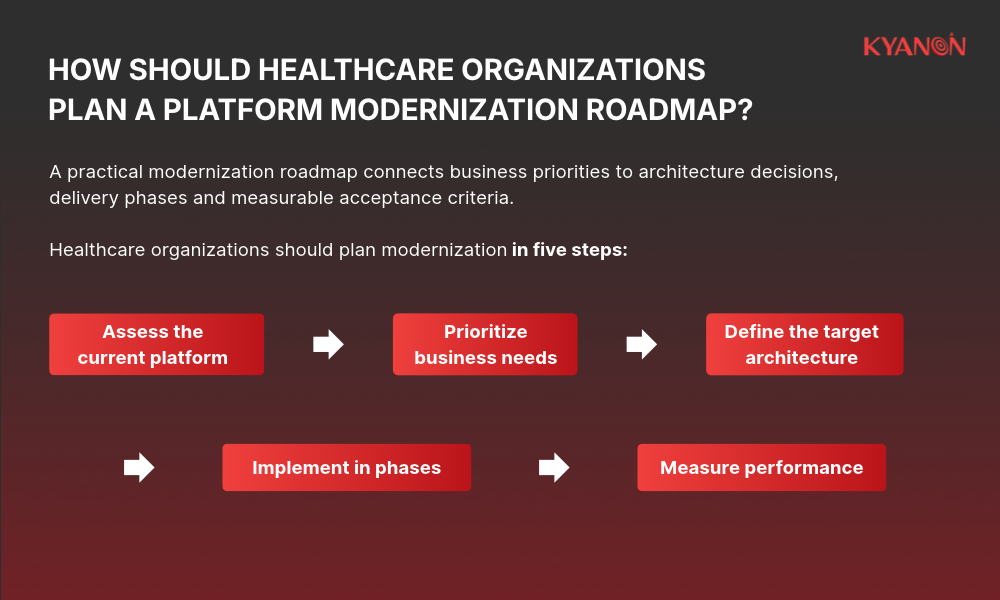
Healthcare organizations should plan modernization in five steps:
- Assess the current platform: Identify legacy constraints, integration gaps, security risks, and operational bottlenecks.
- Prioritize business needs: Rank improvements by business impact, urgency, cost, and risk.
- Define the target architecture: Set integration, data governance, security, and scalability requirements.
- Implement in phases: Start with high-priority capabilities, validate results, and expand incrementally.
- Measure performance: Track system reliability, integration errors, maintenance costs, and workflow efficiency.
A phased roadmap helps control migration risks, protect ongoing operations, and demonstrate value before scaling further.
A phased roadmap is useful only when each phase contributes to a coherent target architecture. Isolated pilots can create new data silos or expensive rework if teams do not define reusable integration patterns, system ownership and measurable acceptance criteria from the start.
When should an organization replace the whole platform?
A full rebuild is more defensible when fundamental architecture constraints prevent the platform from meeting critical business, security or integration requirements, and targeted remediation cannot address them economically.
If the main issues are isolated to a few components, refactoring or replatforming may reduce migration risk and preserve functioning capabilities. The decision should account for total cost of ownership, operational disruption, migration complexity and the remaining useful life of existing systems.
When uncertainty is high, compare a targeted modernization scenario with a full replacement scenario before committing to either approach.
How can Kyanon Digital support healthcare commerce platform modernization?
Kyanon Digital provides software development, custom application engineering, cloud application development, integration and maintenance capabilities that are relevant to healthcare commerce modernization. The appropriate scope depends on the existing architecture, business workflows and regulatory requirements.
- Assess the existing platform and define priorities
- Design and integrate the target platform
- Deliver modernization in controlled phases
- Build for continuous improvement
What Kyanon Digital’s healthcare AI case demonstrates
Kyanon Digital’s published healthcare AI chatbot case study documents work for a private healthcare provider in Singapore. It demonstrates relevant experience with healthcare digital solutions and connected customer-service workflows, but it is not evidence of a completed healthcare commerce platform modernization project.
Challenges
- Growing customer-service enquiries placed pressure on staff capacity.
- Service information was fragmented across documents, systems and teams.
- The provider needed to improve self-service while retaining human oversight of complex and sensitive requests.
Solution from Kyanon Digital
- Implemented a non-clinical AI chatbot using retrieval-augmented generation and approved organizational knowledge.
- Connected the chatbot to existing customer-service workflows through APIs and automation.
- Established escalation rules and monitoring to keep complex or sensitive requests under appropriate human ownership.
Results and Impact
The published case study reports a 38% reduction in routine manual enquiries, 32% faster response times, self-service resolution of 28% of eligible enquiries, and a 24% reduction in repetitive agent workload. These results apply to the documented customer-service project, not to commerce modernization generally.
Explore the full case study here: Scaling Customer Service with an AI Chatbot for Healthcare.
The relevant lesson is that system integration and operational workflow design can matter as much as the customer-facing interface. Healthcare organizations considering platform modernization should apply that principle to their own workflows, while defining separate success criteria for commerce, inventory, procurement and payments.
Conclusion: Modernize around measurable business outcomes
A successful healthcare commerce modernization initiative begins with a clear understanding of the platform’s business model, operational constraints and regulatory obligations. The right approach may involve replacing the platform, improving selected components or strengthening integration between existing systems.
Before committing to a major migration, establish baseline performance, identify the highest-value workflow and define the architecture and acceptance criteria needed to improve it. Expand only when testing demonstrates reliable transactions, accurate data, appropriate security controls and measurable operational benefits.
Planning your healthcare commerce modernization? Talk to Kyanon Digital to explore relevant engineering and integration capabilities, clarify technical constraints and identify the decisions needed to plan your next phase.
References
- Health Information Act: Overview – Ministry of Health, Singapore
- Health Information Act 2026 – Singapore Statutes Online
- Healthcare services regulation and licensing – Ministry of Health, Singapore
- Advertisements and promotions of therapeutic products – Health Sciences Authority, Singapore
- Health supplement claims – Health Sciences Authority, Singapore
- Scaling Customer Service with an AI Chatbot for Healthcare – Kyanon Digital
- Custom Software Development Services – Kyanon Digital








 Create project brief with AI