


Building a healthcare MVP in Singapore starts with defining a high-value use case, assessing regulatory requirements, and developing a secure, focused solution for enterprise validation. However, the right approach depends on whether the product involves clinical decisions, sensitive patient data, or existing healthcare systems, factors that directly influence development costs and launch timelines.
In August 2026, Singapore’s Ministry of Health (MOH) confirmed that data security requirements apply to AI tools processing patient data, whether hosted on third-party cloud services or on-premise. For healthcare enterprises, this reinforces a critical consideration: security and regulatory requirements must be addressed before launching a digital health product.
But how can businesses balance compliance, development costs, and speed to market without overbuilding their healthcare MVP?
Drawing on its experience delivering healthcare AI automation and supporting Electronic Medical Records (EMR) operations in Singapore, Kyanon Digital shares a practical approach to scoping, securing, budgeting, and piloting a healthcare MVP, including when a 90-day delivery target is realistic.
Key takeaways
- Start with regulatory classification: Determine whether the MVP requires HSA medical device registration before finalizing features and delivery timelines.
- Build security into the architecture: Address PDPA obligations, data access, encryption, and auditability from the outset. Kyanon Digital’s experience supporting a Singapore hospice’s EMR platform highlights the importance of incident management, controlled changes, and operational governance beyond deployment.
- Budget beyond development: Account for security testing, regulatory assessments, integrations, and post-launch support when comparing vendor quotations.
- Prioritize a realistic 90-day pilot: Focus on essential workflows, continuous QA, and measurable acceptance criteria, subject to regulatory and institutional approvals.
- Drawing on its healthcare AI automation and EMR platform experience in Singapore, Kyanon Digital helps enterprises align MVP development with operational requirements, security considerations, and long-term scalability.
Further reading:
- AI MVP Development: How to Build, Launch, and Iterate Faster
- How Much Does AI Development Cost in Singapore Healthcare?
- How Can Custom AI Chatbots Support Singapore Healthcare?
- From MVP to Robust Product: Hire Dedicated Development Team For Startup Growth
- AI-Native Software Development for Enterprises in Singapore
Does your software require HSA medical device registration?
Not necessarily. Singapore’s Health Sciences Authority (HSA) determines registration requirements based on the software’s intended medical purpose and risk classification. Administrative and wellness applications generally do not require registration, while diagnostic or clinical decision-support software may qualify as Software as a Medical Device (SaMD).
Which healthcare MVP features trigger HSA registration?
| MVP functionality | HSA registration consideration |
Appointment booking, service FAQs, wellness tracking | Generally not required without a medical purpose |
| Clinical Decision Support Software (CDSS) | May be excluded if HSA’s criteria are met |
AI diagnosis, clinical monitoring, treatment recommendations | May require SaMD registration |
| Class A medical device software | Exempt from product registration; other requirements may apply |
Class B/C medical device software | Registration and supporting evidence generally required |
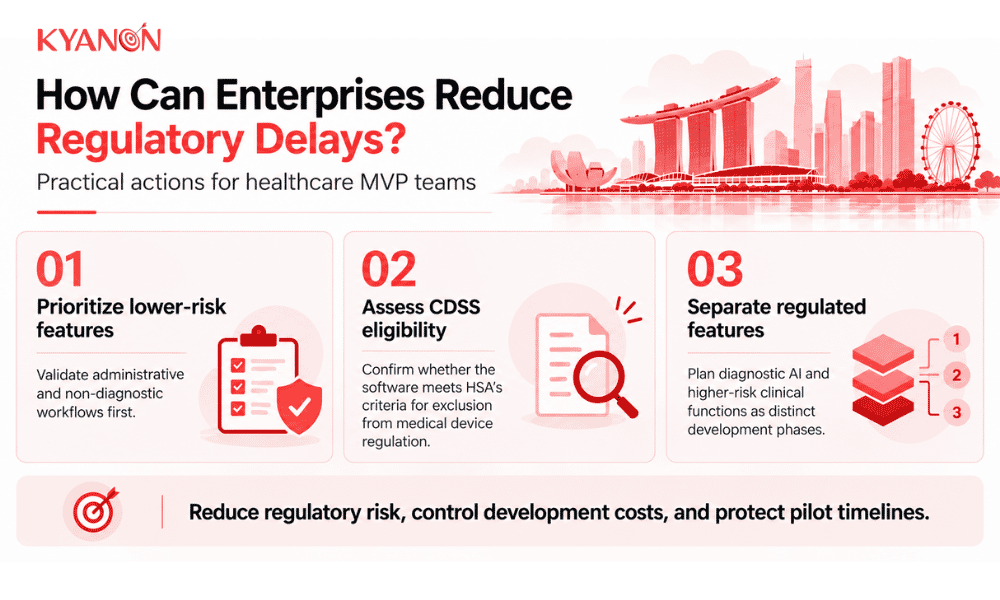
How can enterprises reduce regulatory delays?
Unexpected SaMD classification can increase development costs and delay pilot launches. Enterprises should:
- Prioritize lower-risk features: Validate administrative and non-diagnostic workflows first.
- Assess CDSS eligibility: Confirm whether the software meets HSA’s criteria for exclusion from medical device regulation.
- Separate regulated features: Plan diagnostic AI and higher-risk clinical functions as distinct development phases.
Before selecting an MVP development partner, confirm the product’s intended use, HSA classification, and regulatory dependencies to avoid costly scope changes later.

How do you protect patient data under the strict limits of the PDPA?
Protecting patient data in a Singapore healthcare MVP requires privacy-by-design architecture, secure data hosting, encryption, role-based access, and auditable data handling. Singapore-only hosting is not universally required under the Personal Data Protection Act (PDPA), but enterprise and healthcare-specific requirements may impose stricter controls.
For organizations with annual turnover in Singapore exceeding S$10 million, PDPA financial penalties can reach 10% of annual Singapore turnover. For other organizations, the statutory maximum is generally S$1 million.
Which security controls should your healthcare MVP include?
Priority | Recommended implementation | Business value |
Data residency | Evaluate AWS, Azure, or Google Cloud Singapore regions; assess overseas transfers and subprocessors | Supports data governance and enterprise hosting requirements |
| Encryption | AES-256 at rest, TLS 1.3 in transit, and managed encryption keys | Reduces exposure of sensitive patient information |
Access control | Role-based access control (RBAC), MFA, and least-privilege permissions | Restricts patient records to authorized personnel |
| Consent and retention | Purpose-specific notices, appropriate consent mechanisms, and configurable retention policies | Supports lawful data handling and retention obligations |
Audit and incident response | Protected audit logs, breach detection, escalation workflows, and recovery procedures | Supports investigations and operational accountability |
For example, a corporate HR administrator may need aggregated healthcare utilization data, while an authorized clinician requires access to individual patient records. These permissions should be separated at the architecture level.
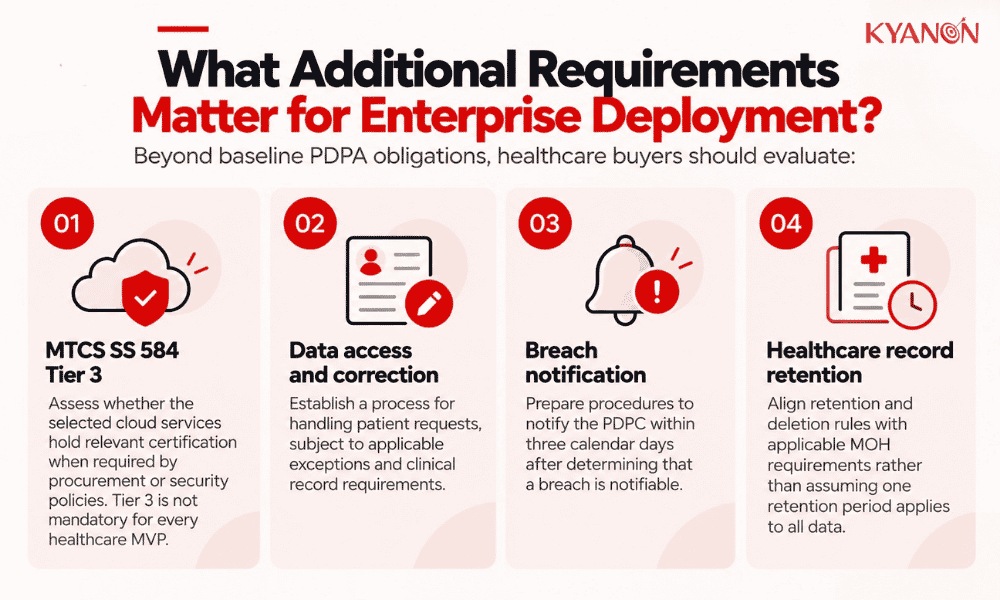
What additional requirements matter for enterprise deployment?
Beyond baseline PDPA obligations, healthcare buyers should evaluate:
- MTCS SS 584 Tier 3: Assess whether the selected cloud services hold relevant certification when required by procurement or security policies. Tier 3 is not mandatory for every healthcare MVP.
- Data access and correction: Establish a process for handling patient requests, subject to applicable exceptions and clinical record requirements.
- Breach notification: Prepare procedures to notify the PDPC within three calendar days after determining that a breach is notifiable.
- Healthcare record retention: Align retention and deletion rules with applicable MOH requirements rather than assuming one retention period applies to all data.
Drawing on the experience supporting a Singapore hospice provider’s Microsoft Dynamics 365-based EMRx platform, Kyanon Digital understands the importance of maintaining secure and reliable healthcare systems beyond deployment. The team implemented structured incident management, severity-based L1–L3 support, controlled change processes, and SLA monitoring to strengthen operational governance and service continuity.
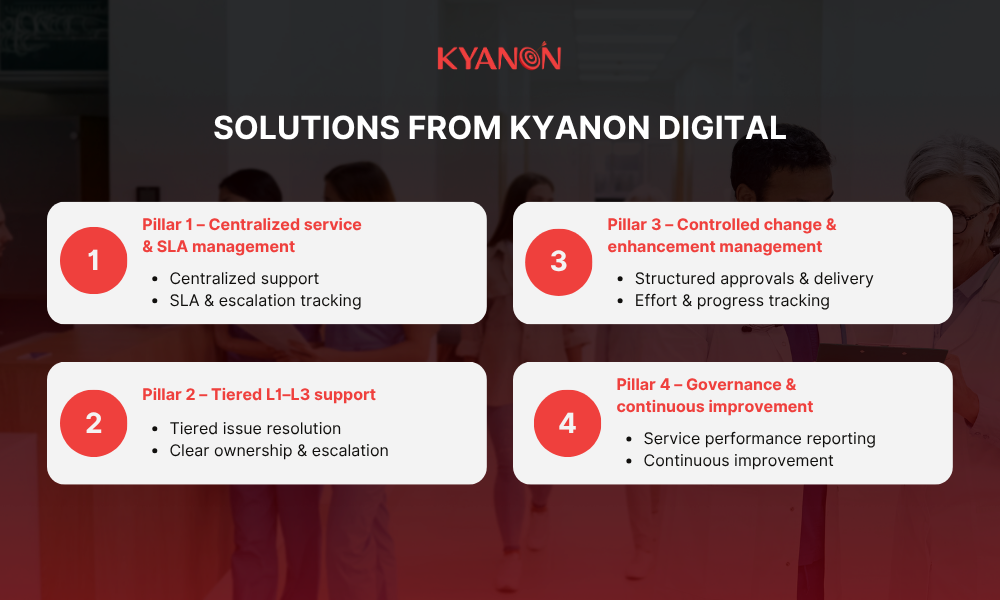
This experience highlights why healthcare enterprises should evaluate not only an MVP’s initial security controls but also their development partner’s ability to manage incidents, system changes, and ongoing operations.
Before signing with a development partner, request: A data-flow diagram, access-control matrix, cloud security documentation, penetration-testing plan, and incident-response responsibilities.
How much does it cost to build a healthcare MVP in Singapore?
Healthcare MVP development costs vary significantly by complexity. According to GoodFirms’ 2026 research, general app development ranges from USD 15,000–40,000 for basic applications to USD 250,000–500,000+ for enterprise-level solutions. Healthcare projects require additional consideration of clinical functionality, regulatory obligations, security assurance, and system integrations, which can substantially affect the final investment.
How much does healthcare MVP development cost by complexity?
| Development complexity | Estimated cost (USD) | Potential healthcare MVP scope |
Basic application | 15,000–40,000 | Appointment booking, basic patient onboarding, wellness features |
| Mid-level application | 40,000–120,000 | Patient portals, payments, role-based workflows, selected APIs |
Advanced application | 100,000–250,000+ | AI-enabled workflows, multi-role platforms, advanced integrations |
| Enterprise-level application | 250,000–500,000+ | Complex clinical systems, enterprise integrations, extensive security requirements |
Note: Cost ranges are global app development benchmarks from GoodFirms. Healthcare MVP examples are illustrative mappings, not healthcare-specific quotations from the study. Actual Singapore costs vary with development scope, PDPA obligations, HSA classification, integrations, and security assurance.
What costs are often excluded from an MVP quotation?
The lowest development quote is not necessarily the lowest total investment. Before selecting a vendor, clarify whether the proposal covers:
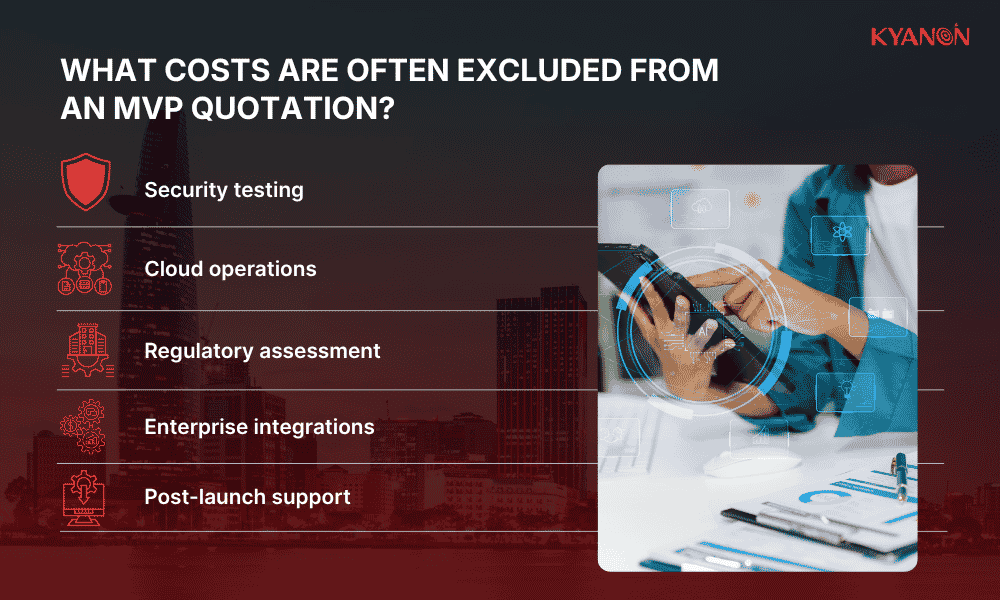
- Security testing: Independent VAPT, remediation, and retesting.
- Cloud operations: Hosting, monitoring, backups, and disaster recovery.
- Regulatory assessment: HSA classification, clinical evidence, and external specialist fees where applicable.
- Enterprise integrations: EHR/EMR APIs, third-party licensing, and integration testing.
- Post-launch support: Incident resolution, maintenance, and improvements following pilot feedback.
Practical insight: Ask vendors to distinguish included costs, optional features, third-party expenses, and recurring charges. A lower initial quote may require significant additional spending before the MVP is approved for enterprise testing.
How should enterprises compare healthcare MVP development partners?
Beyond price, evaluate whether the partner can demonstrate:
- Healthcare experience: Relevant delivery experience with patient-facing workflows, healthcare data, or clinical systems.
- Regulatory awareness: A clear approach to HSA classification, PDPA responsibilities, and security requirements.
- Transparent delivery scope: Defined milestones, acceptance criteria, deliverables, and change-request procedures.
- Long-term support: Ownership of security remediation, maintenance, system integrations, and future product development.
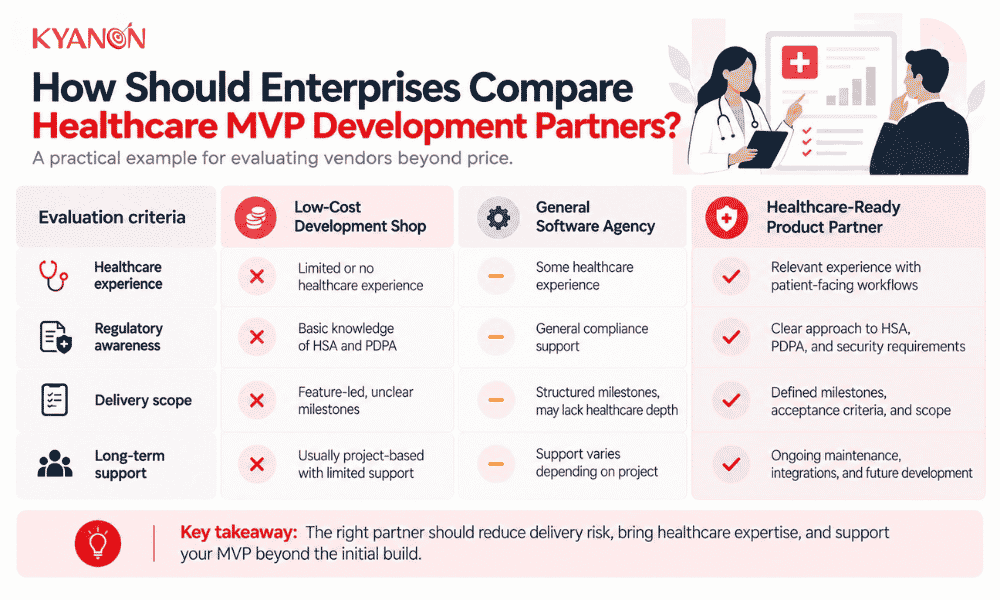
Kyanon Digital applies a lean, agile approach to MVP development, combining technical discovery, feature prioritization, engineering, testing, and post-launch optimization. Its experience supporting healthcare AI automation and EMR operations in Singapore provides relevant insight into healthcare workflows and ongoing system governance.
Through MVP Development Services, Kyanon Digital helps enterprises assess technical feasibility, prioritize essential features, and establish a delivery roadmap before committing to full-scale development.
Can Singapore enterprises reduce MVP costs through government support?
Eligible Singapore businesses can explore the Enterprise Development Grant for a New Era (EDGE), launched on 30 September 2026. Under its product development activity, eligible companies may receive:
- Up to 50% support for SMEs and 30% for non-SMEs, subject to eligibility.
- An overall S$100,000 annual grant cap across eligible EDGE activities.
However, costs related to a company’s first product are excluded under the Product Development activity, making early eligibility assessment important for HealthTech startups. The IMDA Open Innovation Platform also offers opportunities to participate in challenge-based prototype development, although awards are competitive and not guaranteed.
Before committing your budget: Confirm grant eligibility, regulatory dependencies, and the full cost of achieving a secure, enterprise-approved pilot.
How can you launch an enterprise-ready MVP in just 90 days?
A 90-day healthcare MVP pilot can be feasible when development focuses on a clearly defined workflow and security assurance proceeds alongside engineering. Clinical approvals, third-party integrations, and hospital procurement processes may require a longer timeline.
Kyanon Digital’s agile product engineering approach emphasizes early scope definition, iterative development, quality gates, and measurable launch readiness.
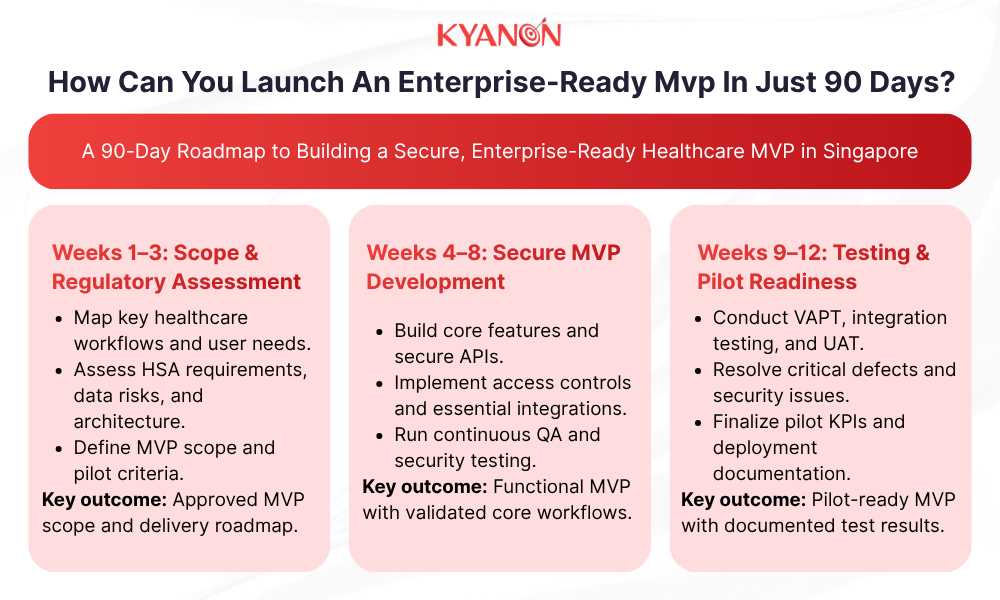
Weeks 1–3: Clinical workflow mapping and regulatory risk isolation
Begin by identifying the healthcare problem, stakeholders, and minimum user journeys.
Prioritize:
- Business and clinical workflow requirements.
- Regulatory classification and data-flow assessment.
- MVP feature prioritization and architecture.
- Pilot acceptance criteria and delivery dependencies.
Key outcome: An agreed MVP scope, architecture, risk register, and delivery roadmap.
Weeks 4–8: Secure architecture and core feature engineering
Develop essential workflows through controlled agile sprints, with security and QA embedded throughout the delivery cycle.
Prioritize:
- Core web or mobile functionality.
- Role-based access and secure APIs.
- Essential integrations and workflow automation.
- Automated testing and ongoing backlog refinement.
Key outcome: A working MVP with validated core journeys and documented security controls.
Weeks 9–12: Security validation and enterprise pilot preparation
Complete functional validation, VAPT where required, remediation, and pilot documentation.
Prioritize:
- End-to-end workflow and integration testing.
- Security findings and remediation.
- User acceptance testing (UAT).
- Pilot KPIs, operational handover, and release readiness.
Key outcome: A pilot-ready release candidate supported by test evidence and defined acceptance criteria.
Case study: How Kyanon Digital accelerated enterprise app pilot readiness for leading insurance in Singapore
In a Singapore digital insurance app project, Kyanon Digital strengthened pilot readiness through agile governance, engineering quality controls, and structured issue resolution.
Challenges
- Limited visibility into pilot readiness and unresolved defects.
- High-priority frontend issues affecting critical user journeys.
- Launch blockers are creating uncertainty around release timelines.
Solutions
- Applied AI-driven agile practices to improve sprint execution and issue tracking.
- Strengthened quality assurance and prioritized critical defects.
- Standardized smoke testing across priority launch journeys.
Results & Business Impact
- 62% → 91%: Improvement in pilot readiness.
- 72% reduction in open launch blockers.
- 46% reduction in high-priority frontend defects.
- 100% smoke testing coverage across priority launch journeys.
Key takeaway: Although delivered in digital insurance, this project demonstrates how structured QA, transparent release criteria, and agile engineering can improve enterprise pilot readiness, practices relevant to healthcare MVP development. A technology partner should provide visibility into delivery risks and acceptance criteria throughout the project, allowing business stakeholders to make informed launch decisions.
For healthcare enterprises seeking an accountable delivery model, Kyanon Digital’s MVP Development combine product discovery, engineering, QA, and release management to support iterative product delivery.
Conclusion
Building a healthcare MVP in Singapore requires balancing development speed with regulatory requirements, patient data protection, and enterprise readiness. Success depends on selecting the right features, understanding total development costs, and establishing a realistic pilot roadmap.
With experience in healthcare AI automation, EMR platform operations, and enterprise product engineering, Kyanon Digital helps businesses turn complex technical requirements into practical, scalable digital solutions. Whether you’re validating a new HealthTech solution or preparing an enterprise pilot, Kyanon Digital can help you assess technical feasibility, prioritize features, and plan your development roadmap.
Talk to Kyanon Digital to discuss your healthcare MVP requirements and next steps.
References
- Data Security Requirements Apply to AI Tools That Process Patient Data — Ministry of Health Singapore, August 2026.
- Digital Health — Health Sciences Authority.
- Registration Overview of Medical Devices — Health Sciences Authority, 2026.
- Medical Device Registration and Licensing Tools — Health Sciences Authority 2026.
- Data Protection Obligations — Personal Data Protection Commission.
- How Much Does It Cost to Develop an App in 2026? — GoodFirms 2026.
- EDGE Grant – Product Development — Enterprise Singapore.
- Open Innovation Platform — Infocomm Media Development Authority.
- Scaling Customer Service with an AI Chatbot for Healthcare — Kyanon Digital.
- Microsoft Dynamics 365 Managed Services for Hospice in Singapore — Kyanon Digital.
- Accelerating Singapore Digital Insurance App Launch Readiness with an AI-Driven Agile Team — Kyanon Digital.
- MVP Development Services — Kyanon Digital.
- AI-Driven Product Engineering Services — Kyanon Digital.








 Create project brief with AI