

AI and logistics companies include Kyanon Digital for AI integration and custom engineering, Kinaxis for supply-chain planning, FourKites for execution visibility, and Dexory for warehouse intelligence. The right choice depends on whether businesses need a packaged platform, physical automation, or AI integrated into existing supply-chain systems.
AI and logistics are shifting from predictive analytics toward systems that support and automate operational decisions across planning, transportation, inventory and fulfillment.
In April 2026, Gartner forecast that spending on supply chain management software with agentic AI capabilities will increase from less than $2 billion in 2025 to $53 billion by 2030.
However, businesses still face a fundamental decision: should they replace an existing logistics platform, add AI capabilities to it, or integrate intelligence across multiple systems?
The right starting point is the operational problem—not the AI platform.
Key takeaways
- Choose the decision layer before the vendor. Planning, visibility, warehouse automation, and AI integration address different operational problems.
- Extend existing systems when replacement is unnecessary. In a Singapore retail project, Kyanon Digital integrated AI-powered document processing and inventory automation with existing SAP and POS systems, an approach suited to businesses with functional but disconnected platforms.
- Build a reliable data foundation before scaling AI. Connected supplier documents, goods receipts, and inventory records are essential when automation depends on consistent information across systems.
- Measure operational outcomes, not AI features alone. Kyanon Digital’s Singapore retail project reported 90% less manual data-entry time and over 80% fewer inventory discrepancies. Results depend on the specific workflow and operating environment.
Further reading:
- AI Integration Services Company In Vietnam
- Logistics Automation with AI: What Works in 2026
- Logistics Data at Source: Why Input Quality Matters
- AI-Native Software Development for Enterprises in Singapore
Which AI logistics platforms best fit your supply chain?
The right AI logistics solution depends on whether the main challenge is planning, execution, physical automation, or connecting existing systems. Kyanon Digital approaches this evaluation by identifying the business decision to improve, assessing existing technology investments, and determining whether integration or replacement delivers a more practical outcome.
| Category | What it solves | Best fit |
AI integration & custom engineering | Connects AI, data and automation across enterprise systems | Businesses extending existing ERP, WMS and TMS environments |
| Enterprise planning platforms | Forecasting, supply planning, inventory and procurement optimization | Complex, multi-entity planning environments |
Visibility & execution platforms | Shipment tracking, predictive ETAs, fleet and exception management | Businesses improving operational visibility without replacing core systems |
| Warehouse & physical AI | Robotics, inventory intelligence and automated material handling | High-volume distribution and fulfillment operations |

When should businesses choose an AI integration partner instead of buying another platform?
An AI integration partner is relevant when existing systems already support core logistics operations but lack reliable data connectivity, intelligent decision-making or cross-system automation.
For example, a business may have a functioning ERP and WMS but still reconcile supplier invoices manually or struggle to maintain consistent inventory across sales channels.
In these situations, Kyanon Digital’s AI Integration Services provide an implementation approach built around connecting AI capabilities with existing applications, databases and workflows.
This approach is relevant when:
- Existing ERP, WMS or TMS platforms do not need complete replacement.
- AI must use data from several operational systems.
- Standard software cannot support specific business workflows.
- Integration and data ownership are critical to long-term scalability.
A new platform is not always necessary. Sometimes the missing capability is the intelligence and integration connecting the systems already in place.
What are the top AI logistics companies for supply chains?
AI logistics companies serve different parts of the supply chain. The following companies illustrate four distinct approaches: custom AI integration, enterprise planning, execution visibility and physical automation.
AI integration & custom logistics engineering
Kyanon Digital
Kyanon Digital provides AI integration, data engineering and custom software development for enterprise logistics and supply-chain environments. Rather than selling a standalone logistics platform, it implements intelligent workflows and connects AI with existing business systems.
- Website: https://kyanon.digital/
- Founded: 2012
- Team size: 500+
- Key clients: Large logistics operators, retailers, manufacturers and regional enterprises, Fortune 500
Strengths:
- Combines AI engineering, data platforms and enterprise system integration.
- Supports modernization without requiring complete platform replacement.
- Demonstrated experience integrating AI with existing ERP and omnichannel systems to improve supply-chain operations.
Enterprise planning platforms
Blue Yonder

Blue Yonder provides an AI-driven supply-chain platform spanning planning, inventory, fulfillment, transportation, warehouse management, and order management. Its breadth makes it most relevant when several connected supply-chain functions require modernization.
- Founded: 1985
- Team size: 5,000–10,000
- Key clients: DHL, Carlsberg, Walgreens
Strengths:
- Broad planning-to-execution coverage.
- Strong fit for complex retail, manufacturing, and logistics networks.
- Extensive enterprise supply-chain implementation base.
Kinaxis
Kinaxis focuses on concurrent supply-chain planning and orchestration through its Maestro platform, connecting demand, supply, inventory, capacity, scenarios, and execution decisions. It is particularly relevant where disruptions in one area need to be evaluated rapidly across the wider supply chain.
- Founded: 1984
- Team size: 1,000–5,000
- Key clients: Unilever, Volvo Cars, BAT, Schneider Electric
Strengths:
- Strong concurrent and scenario-planning capabilities.
- Designed for complex multi-tier supply chains.
- Combines predictive, generative, and agentic AI.
o9 Solutions

o9 Solutions provides AI-powered integrated planning through its Digital Brain platform, linking supply-chain, commercial, and financial decisions through an Enterprise Knowledge Graph. It is best suited to businesses seeking broader integrated business planning rather than a standalone logistics tool.
- Founded: 2009
- Team size: 1,000–5,000
- Key clients: Walmart Canada, PepsiCo, AB InBev
Strengths:
- Strong enterprise digital-twin and knowledge-graph architecture.
- Connects planning across business functions.
- Expanding generative and agentic AI capabilities.
Coupa

Coupa combines supply-chain design and planning with sourcing, procurement, and spend management. It is particularly relevant where logistics decisions need to be evaluated alongside procurement costs, network design, inventory, and transportation economics.
- Founded: 2006
- Team size: 1,000–5,000
- Key clients: Schneider Electric, Nestlé, Odyssey Logistics, ADM
Strengths:
- Strong supply-chain network optimization.
- Connects sourcing and supply-chain economics.
- Large enterprise procurement and supplier ecosystem.
Visibility & execution specialists
FourKites

FourKites focuses on real-time supply-chain visibility and increasingly on AI-driven execution. Its platform connects shipment, carrier, inventory, facility, and order signals so businesses can detect exceptions and automate operational responses.
- Founded: 2014
- Team size: 500+
- Key clients: Coca-Cola, First Solar, Church & Dwight
Strengths:
- Large logistics data and carrier network.
- Strong real-time visibility and exception management.
- Moving from visibility toward AI-assisted execution.
Motive

Motive provides AI-powered technology for fleets and physical operations, combining vehicle telematics, driver safety, equipment monitoring, maintenance, and operational workflows. It fits logistics environments where vehicles and field assets are the primary operational concern.
- Founded: 2013
- Team size: 1,000–5,000
- Key clients: KONE, Carvana, Western Express
Strengths:
- Strong fleet and driver intelligence.
- Combines telematics, safety, maintenance, and operations.
- Suitable for asset-intensive logistics operations.
Samsara
Samsara provides a connected operations platform for fleets, vehicles, equipment, sites, and frontline workflows. AI is used across safety, maintenance, telematics, route operations, and increasingly agent-based operational automation.
- Founded: 2015
- Team size: 1,000–5,000
- Key clients: DHL, XPO, Werner Enterprises
Strengths:
- Unified platform for physical operations.
- Strong fleet telematics and operational data.
- Broad integration capabilities for enterprise environments.
Warehouse & physical AI companies
Symbotic
Symbotic combines AI software with high-density robotics to automate warehouse receiving, storage, retrieval, sequencing, and pallet building. Unlike software-only providers, it targets the physical execution layer of large distribution operations.
- Founded: 2007
- Team size: 1,000–5,000
- Key clients: Walmart, Target, Albertsons, Medline
Strengths:
- End-to-end AI-powered warehouse automation.
- Designed for high-throughput distribution environments.
- Strong large-scale retail and grocery deployments.
Covariant

Covariant develops AI models that enable robots to perceive and manipulate varied warehouse items, supporting picking, sortation, induction, and related fulfillment tasks. Its technology is relevant where conventional rule-based robotics struggles with changing product assortments.
- Founded: 2017
- Team size: 51–200
- Key clients: Otto Group, Radial; deployments through KNAPP
Strengths:
- Specialized AI for robotic manipulation.
- Handles high product variability.
- Proven fulfillment-center use cases.
Important consideration: Amazon hired Covariant’s founders and licensed its robotic foundation models in 2024, so current product ownership, roadmap, and long-term support should be verified during vendor evaluation.
Dexory

Dexory combines autonomous inventory-scanning robots with DexoryView, a digital twin that gives warehouses near-real-time visibility into stock location, occupancy, and operational conditions. It is more focused on warehouse intelligence than physical picking automation.
- Founded: 2015 as BotsAndUs; renamed Dexory in 2022
- Team size: 201–500
- Key clients: Maersk, DB Schenker, DCL Logistics
Strengths:
- Automated warehouse inventory capture.
- Real-time digital-twin visibility.
- Can complement existing WMS environments.
Where is your supply chain on the AI readiness journey?
AI logistics readiness depends on whether operational data and systems can support reliable AI decisions. Businesses should establish trusted data and connected workflows before introducing higher levels of automation.
From Kyanon Digital’s implementation perspective, assess AI readiness by whether data can reliably move from existing systems into actionable workflows, not by how many AI tools a business has deployed.
Stage | Current state | Appropriate investment |
1. Connected | Fragmented systems and reporting | Data integration and governance |
| 2. Predictive | Trusted operational data available | Forecasting, ETA, anomaly detection |
3. Prescriptive | AI supports recurring decisions | Optimization and scenario recommendations |
| 4. Semi-autonomous | Systems can safely initiate actions | AI agents, orchestration, robotics |
Do not buy Stage 4 technology to solve a Stage 1 data problem. The objective is not to reach the highest stage everywhere. Different supply-chain processes may justify different levels of AI autonomy.
Choosing the right AI logistics partner for your supply chain
The right AI logistics solution depends on whether the main challenge is planning, execution, physical automation, or connecting existing systems. Kyanon Digital approaches platform selection by identifying which existing systems should remain, where intelligence is missing, and whether integration or replacement offers a more practical path.
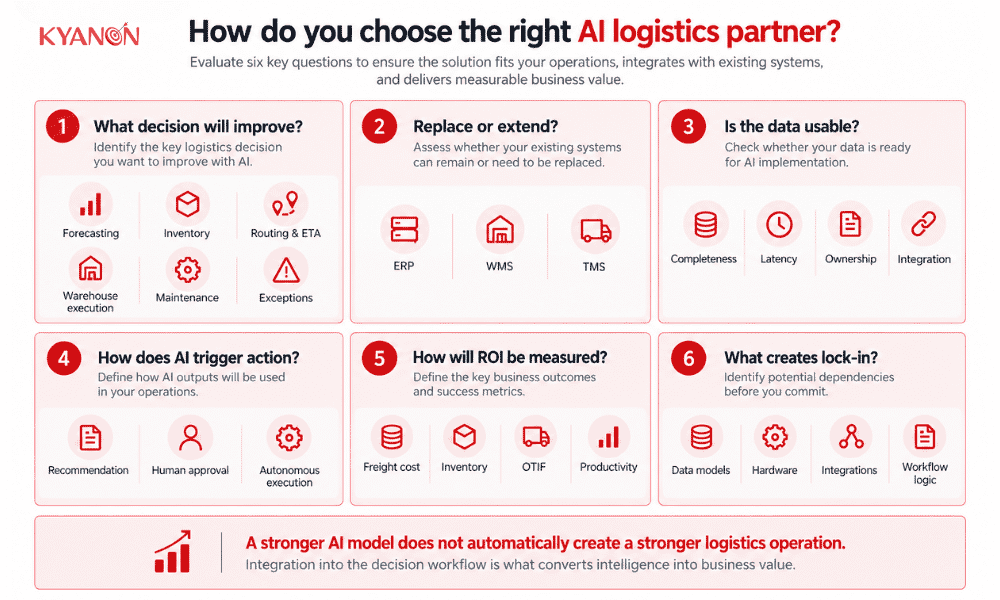
The main questions are
- What decision will improve? Forecasting, inventory, routing, ETA, warehouse execution, maintenance, or exceptions?
- Replace or extend? Can the existing ERP, WMS, TMS, or planning environment remain?
- Is the data usable? Check completeness, latency, ownership, and integration.
- How does AI trigger action? Recommendation, human approval, or autonomous execution?
- How will ROI be measured? Freight cost, inventory, OTIF, forecast accuracy, productivity, dwell time, or manual effort?
- What creates lock-in? Data models, hardware, integrations, workflow logic, and exit costs?
A stronger AI model does not automatically create a stronger logistics operation. Integration into the decision workflow is what converts intelligence into business value.
Where does Kyanon Digital fit among AI logistics companies?
Kyanon Digital implements AI capabilities within existing enterprise environments, particularly where fragmented data and disconnected workflows limit the value of current technology investments.
This model is relevant when businesses need to:
- Integrate AI with ERP, WMS, TMS, OMS, and logistics platforms.
- Build an AI-ready operational data foundation.
- Develop custom decision or automation workflows.
- Combine packaged platforms with proprietary systems.
How Kyanon Digital automated supply chain operations for a Singapore retailer
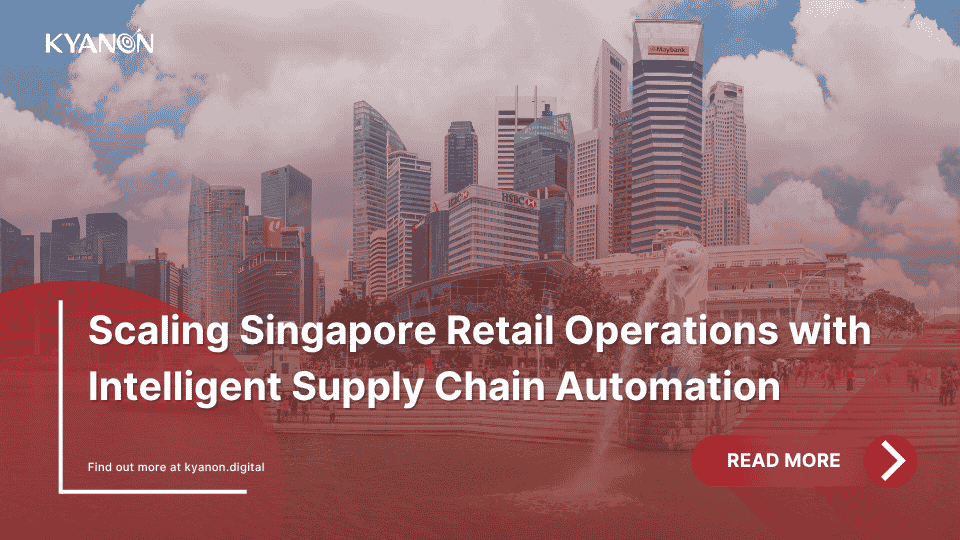
Kyanon Digital helped a Singapore-based retail enterprise modernize supplier document processing, inventory management, and financial reconciliation across its omnichannel operations.
The business already used SAP and other enterprise systems but struggled with manual data entry, inconsistent inventory information, and fragmented supplier workflows.
Challenges:
- Thousands of supplier invoices and delivery documents required manual processing.
- Disconnected inventory records created stock discrepancies across retail, e-commerce and wholesale channels.
- Manual reconciliation delayed financial reporting and increased operational effort.
Solution:
- Implemented AI-powered document processing to extract and validate supplier information.
- Automated reconciliation between supplier invoices, goods receipts and SAP records.
- Connected inventory data across existing SAP, POS and omnichannel systems through an event-driven integration architecture.
Impact:
- 90% Reduction in manual data-entry time
- 80%+ Reduction in omnichannel inventory discrepancies
- Supplier invoice processing also decreased from days to under 30 minutes. These results are reported in Kyanon Digital’s published case study.
Explore more: Scaling Singapore Retail Operations with Intelligent Supply Chain Automation
In conclusion
The right AI logistics company depends on whether the priority is planning, visibility, fleet operations, warehouse automation, or integrating AI into existing supply-chain systems.
To assess the right architecture and implementation approach for your logistics environment, contact Kyanon Digital.
Disclaimer: All company names, logos, and brands are property of their respective owners. Their mention in this article is for informational and review purposes only and does not imply endorsement or infringement of copyright.






 Create project brief with AI