


Digital commerce development in Vietnam requires a partner with proven integration expertise, regulatory readiness, a suitable engagement model, and clear post-launch SLAs. Prioritize partners that can demonstrate these capabilities through architecture reviews and practical technical assessments, not just sales portfolios.
Enterprise digital commerce involves more than building an online store. A platform must connect product catalogs, pricing, inventory, payments, orders, and delivery operations. Businesses need a clear digital commerce strategy to choose the right platform and ensure it supports their sales channels and future growth.
Comparing ecommerce implementation partners solely by hourly rates can lead to fragile systems, delivery delays, and costly rebuilds. Evaluate each eCommerce development partner based on technical depth, compliance readiness, and commercial governance, ensuring its capabilities align with internal resources and business goals.
Key takeaways
- Evaluate monolithic and headless or composable commerce based on sales channels, product catalogs, system integrations, and expansion plans.
- Review previous commerce projects, integration experience, technical quality, security practices, and post-launch support.
- Compare fixed-price delivery, dedicated teams, and staff augmentation based on project scope, budget, and internal resources.
- Kyanon Digital’s perspective: A successful digital commerce strategy should connect the storefront with the business systems behind product management, inventory, payments, and order fulfillment, rather than focus on the online shopping experience alone.
- Kyanon Digital helps enterprises develop, integrate, and improve digital commerce platforms as business requirements and sales channels evolve.
Further reading:
- Top 14 E-commerce Migration Agencies in Vietnam
- Why Choosing Vietnam for High-Value Software Projects?
- Custom ECommerce Systems for Complex Retail Ops
- E-Commerce Trends in Southeast Asia: What Global Brands Miss
What technical capabilities should an enterprise digital commerce development partner have?
An enterprise digital commerce development partner should do more than build an online store. The partner must understand how product information, pricing, inventory, payments, and orders work together. These capabilities help businesses manage sales across channels, reduce manual work, and support future growth.
Digital commerce platforms and architecture
The right commerce platform depends on how a business sells, manages orders, and plans to expand. A company selling through one website may have different needs from a retailer managing multiple brands, markets, and sales channels.
Two common approaches are monolithic and headless or composable commerce. Their suitability depends on the business’s current operations and future plans.
Monolithic vs. headless/composable commerce comparison
|
Business needs |
Monolithic commerce | Headless or composable commerce |
| One online store | Built-in storefront and checkout |
May require more setup |
|
Multiple brands or markets |
More complex customization | Separate storefronts with shared commerce functions |
| Multiple sales channels | Additional customization may be needed |
Supports web, mobile, and other channels |
|
System integration |
Uses built-in integrations or extensions | Connects separate business systems through APIs |
| Future expansion | Platform changes may require major upgrades |
Individual components can be expanded or replaced |
A monolithic platform may suit businesses operating a relatively straightforward online store that want to launch with built-in commerce features. Headless or composable commerce may be more suitable for businesses managing multiple brands, markets, sales channels, or complex system integrations.
An experienced eCommerce development partner should assess the business’s current sales operations before recommending a platform. The recommendation should explain how the platform supports product management, pricing, inventory, orders, and future expansion, rather than focusing only on the storefront design.
Enterprise commerce system integration
A digital storefront cannot operate efficiently when its back-office systems are disconnected. For example, outdated inventory information can lead to overselling, while delayed order synchronization can slow fulfillment and create additional manual work.
An experienced digital commerce development team should demonstrate the ability to connect commerce platforms with essential business systems:
- Enterprise resource planning (ERP): Connect inventory, orders, pricing, and financial records.
- Customer relationship management (CRM): Keep customer profiles, purchase history, and loyalty information connected.
- Product information management (PIM): Manage product descriptions, images, and pricing across sales channels.
- Payment processing: Support online payments, local payment methods, and transaction management.
- Order management: Track orders, inventory, fulfillment, and returns across sales channels.
- Logistics and fulfillment: Connect delivery providers and warehouse operations.
When evaluating ecommerce implementation partners, businesses should ask how they handle incorrect inventory information, delayed orders, failed payments, and other issues that can disrupt daily commerce operations.
For enterprises dealing with disconnected systems or outdated integrations, Kyanon Digital’s software engineering services can support the development and modernization of connected commerce solutions, with a focus on integration reliability and long-term maintainability.
Scalable and secure digital commerce development
An enterprise commerce platform must handle increasing transaction volumes, protect customer information, and support new business requirements without disrupting daily operations. Evaluate prospective partners against three practical capabilities:
- Platform performance: Check whether the partner can keep the online store fast and stable during high-traffic periods, such as major sales campaigns.
- Data and payment security: Ask how the partner protects customer information, payment processes, and access to business systems.
- Ongoing support: Check how the partner handles website issues, failed transactions, system updates, and urgent technical problems after launch.
A reliable digital commerce development partner in Vietnam should be able to build, maintain, and support the platform after launch. This helps businesses protect customer transactions and keep daily sales operations running as the business grows.

How can you verify a Vietnam partner’s enterprise delivery experience?
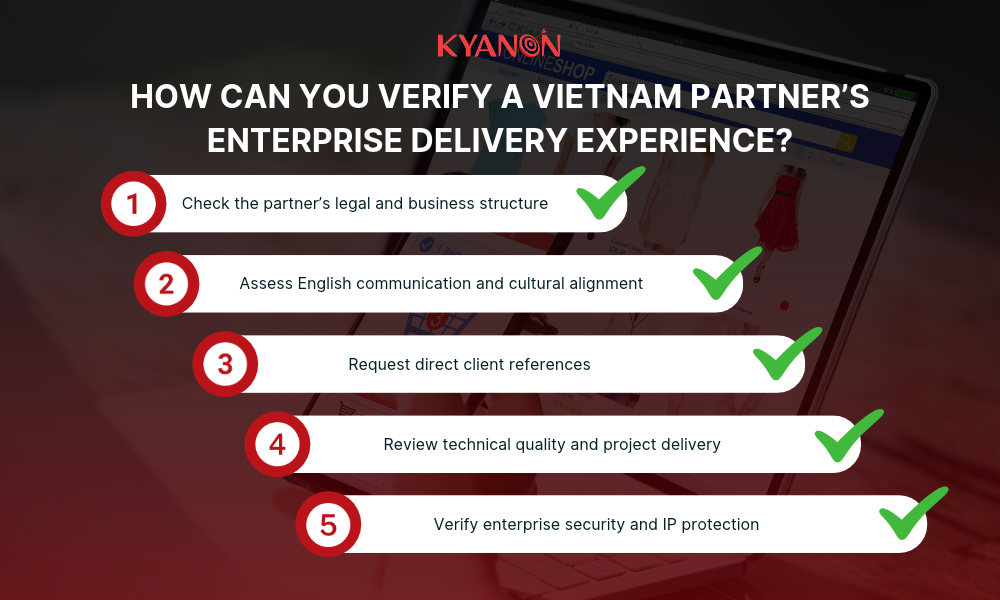
When evaluating a digital commerce development partner in Vietnam, look beyond its service offerings and hourly rates. Assess whether its team size, pricing, engagement options, and international experience match your project scope and business needs.
- Check the partner’s legal and business structure: Verify business registration, company history, team size, and delivery capacity.
- Assess English communication and cultural alignment: Hold live discussions to evaluate communication skills, business understanding, time zone coordination, and project management.
- Request direct client references: Speak with previous enterprise clients about delivery quality, communication, issue resolution, and project outcomes.
- Review technical quality and project delivery: Request code reviews or architecture walkthroughs. Check commerce development experience, system integrations, testing, and documentation.
- Verify enterprise security and IP protection: Review security practices, relevant certifications, data protection policies, source code ownership, and confidentiality agreements.
The right partner should offer the resources, delivery flexibility, and international experience needed to support your digital commerce operations as the business grows.
Which engagement model and pricing structure best fit your enterprise?
Choosing an engagement model for digital commerce development requires balancing budget predictability, project flexibility, and internal management capacity. Comparing ecommerce implementation partners solely by developer rates can overlook scope changes, management overhead, and long-term maintenance costs.
The three common engagement models offer different levels of flexibility and accountability:
Digital commerce engagement models comparison
|
Engagement model |
Core structure | Key benefits | Trade-offs | When to choose |
| Fixed-Price Delivery | Agreed scope, milestones, and total project cost. | Predictable budget and limited daily management. | Less flexibility when requirements change. |
Well-defined MVPs or platform migrations with clear specifications. |
|
Dedicated Team |
Dedicated developers, architects, and QA specialists on recurring contracts. | Flexible capacity, consistent team involvement, and ongoing development. | Requires an internal product owner to manage priorities. | Multi-brand expansion, long-term digital commerce strategy execution, and platform modernization. |
| Staff Augmentation | Individual specialists integrated into the internal team. | Fills skill gaps quickly and provides direct team control. | Higher internal management responsibilities; overall delivery remains with the business. |
Internal teams needing temporary capacity or specialized technical expertise. |
The right model depends on project complexity and internal resources. Businesses with evolving requirements may benefit from dedicated teams, while projects with clearly defined deliverables are generally better suited to fixed-price contracts.
Beyond the initial development cost, businesses should consider the ongoing costs of building and running an eCommerce platform:
- Initial setup and data migration: Platform setup, custom development, and transferring existing customer, product, and order information.
- Hosting and third-party services: Cloud hosting, payment services, search tools, and other subscriptions.
- Maintenance and support: Platform updates, security checks, issue resolution, and ongoing testing.
- Internal management and business risks: Time spent managing the partner, reviewing work, and handling potential sales disruptions caused by platform issues.
When choosing between fixed-price delivery and a dedicated team, businesses should consider how often requirements may change. Fixed-price contracts offer budget certainty for stable scopes, while dedicated teams provide greater flexibility and continuity for complex platforms with ongoing integration and customization needs. Explore Kyanon Digital’s software development services to find a delivery model that fits project scope, internal resources, and long-term goals.
How can Kyanon Digital support your enterprise digital commerce strategy?
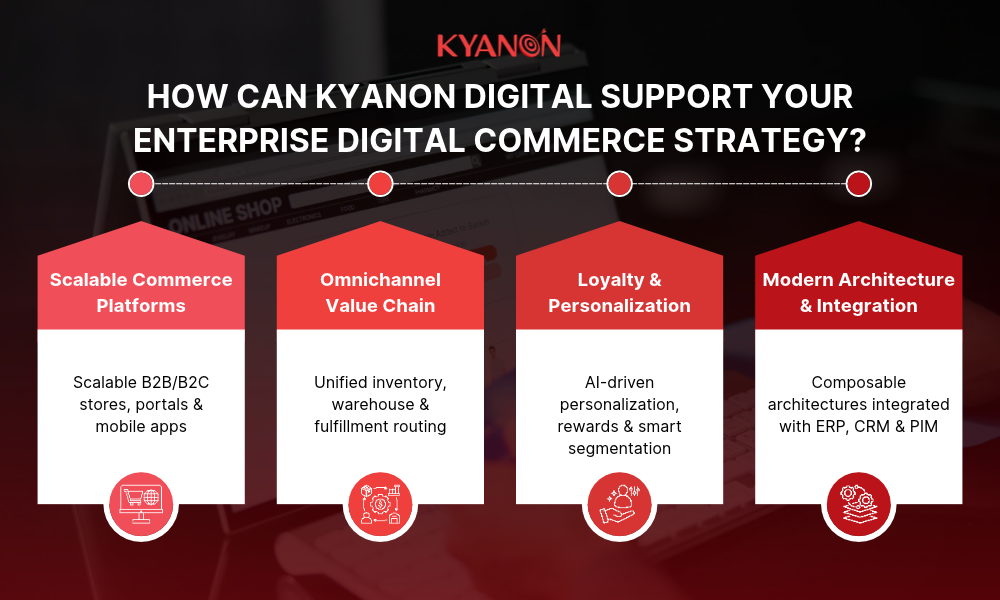
Kyanon Digital helps enterprises build, integrate, and modernize connected digital commerce ecosystems to improve customer experiences, operational efficiency, and business growth.
Comprehensive e-commerce solutions
- Build scalable B2B, B2C, and omnichannel commerce platforms.
- Develop e-commerce websites, mobile apps, and B2B ordering portals.
- Integrate shopping, payment, checkout, and order management.
Omnichannel value chain re-engineering
- Connect marketplaces, online stores, mobile apps, and physical stores.
- Integrate inventory, warehouse, and transportation systems.
- Optimize order routing, fulfillment, delivery, and returns.
Digital loyalty and commerce transformation
- Develop digital loyalty and rewards solutions.
- Connect customer data, segmentation, and marketing automation.
- Enable personalized experiences through analytics and AI.
Technology platform modernization
- Modernize commerce platforms with scalable, cloud-ready architectures.
- Implement composable and API-first commerce solutions.
- Integrate ERP, CRM, PIM, OMS, and WMS systems.
How Kyanon Digital built an integrated e-commerce and agent management platform for a global home wellness brand

Case study: How Kyanon Digital built a centralized B2B/B2C e-commerce and agent management system for Coway.
Kyanon Digital developed an integrated eCommerce platform for a global home wellness brand, connecting online sales with product, customer, and agent management operations.
Challenges
- Disconnected systems: Separate sales channels and agent networks limited inventory visibility and pricing consistency.
- Manual administration: Fragmented workflows slowed agent performance tracking and commission calculations.
- Customer experience: The business needed a reliable, high-performance online shopping experience.
Solution from Kyanon Digital
- Centralized commerce platform: Connected customer transactions and back-office operations using .NET, ReactJS, and AWS.
- Agent management portal: Automated sales tracking and commission calculations.
- Data synchronization: Unified product, customer, and sales records across operations.
Results and impact
- Automated administration: Streamlined commission processing and transaction reporting.
- Improved shopping experience: Delivered a reliable online purchasing journey.
- Scalable operations: Enabled teams to manage catalogs, monitor performance, and launch regional promotions through one portal.
Explore how Kyanon Digital helps businesses build integrated digital commerce platforms and streamline operations.
Conclusion
Choosing a digital commerce development partner in Vietnam requires more than comparing prices and reviewing portfolios. Businesses should evaluate the partner’s commerce experience, ability to connect business systems, delivery approach, and ongoing support.
Before signing a contract, review relevant project experience and validate the partner’s capabilities through a practical technical assessment. Planning a new commerce platform or upgrading an existing one? Book a consultation with Kyanon Digital to discuss architecture, integration needs, and delivery priorities.
References
- The surprising economics of B2B growth — McKinsey & Company, 2026.
- Magic Quadrant for Digital Commerce Platforms — Gartner, 2026.
- New E-Commerce Law establishes comprehensive framework for cross-border trade — Vietnam Law & Legal Forum, 2026.
- Vietnam Personal Data Protection Legal Framework — Asia Counsel, 2026.
- E-Commerce System For Coway — Kyanon Digital, 2025.









 Create project brief with AI