

Retail procurement automation in Singapore involves digitizing how retailers request stock, manage supplier orders, verify deliveries, and process invoices. By standardizing purchasing approvals and connecting procurement with existing inventory and accounting systems, retailers can reduce manual work, improve spending control, and manage replenishment across multiple outlets.
For multi-outlet retailers, the key is to identify manual bottlenecks and connect disconnected procurement processes. This article explores the essential steps, technologies, and considerations for making that transition.
Key takeaways
- Fix item master data and approval thresholds before buying software; automating poorly defined authorization rules only accelerates purchasing mistakes across outlets.
- Target automated three-way matching as the first technical milestone to deliver the fastest reduction in finance overhead and billing discrepancies.
- Kyanon Digital recommends reviewing how supplier documents are received and processed first. Automating data extraction from PDFs, scanned invoices, and messaging app photos can reduce repetitive data entry across supplier networks.
- Prioritize solutions that support API-based integration and centralized data exchange rather than introducing another disconnected purchasing platform.
Further reading:
- Retail Supply Chain Digitalization: A Guide for Singapore Brands
- Business Process Automation in Singapore: Top Solutions
- Retail Inventory Tracking Software: How to Cut Stockouts & Loss
What should you fix before automating retail procurement?
Introducing procurement software before standardizing existing processes can create more errors instead of reducing manual work. Before automating store requests and purchase orders (POs), multi-outlet retailers should address three areas: how requests are handled, who approves purchases, and how product and supplier records are maintained.
First, audit manual touchpoints. Document precisely where store managers, central buyers, and accounts payable teams handle data by hand. Common friction points include floor supervisors sending stock requests over WhatsApp, purchasing clerks re-keying quantities into spreadsheets, and accounts teams chasing store staff via email to confirm physical deliveries. Identifying these handoffs reveals whether processing delays stem from communication lag, data re-entry, or missing physical delivery verifications.
Second, establish an explicit approval matrix. In many growing retail businesses, purchasing thresholds remain informal or vary by store location. The system needs clear rules to know who can approve each purchase and when a request must be escalated. Organizations must document:
- Spending limits for store managers, regional leads, and operations directors.
- Departmental and store-level budget ownership to route requests to the appropriate approvers.
- Escalation rules for supplier quotations that exceed agreed pricing thresholds.
Finally, standardize product and supplier records. Procurement automation depends on accurate information being shared across purchasing, inventory, and accounting systems.
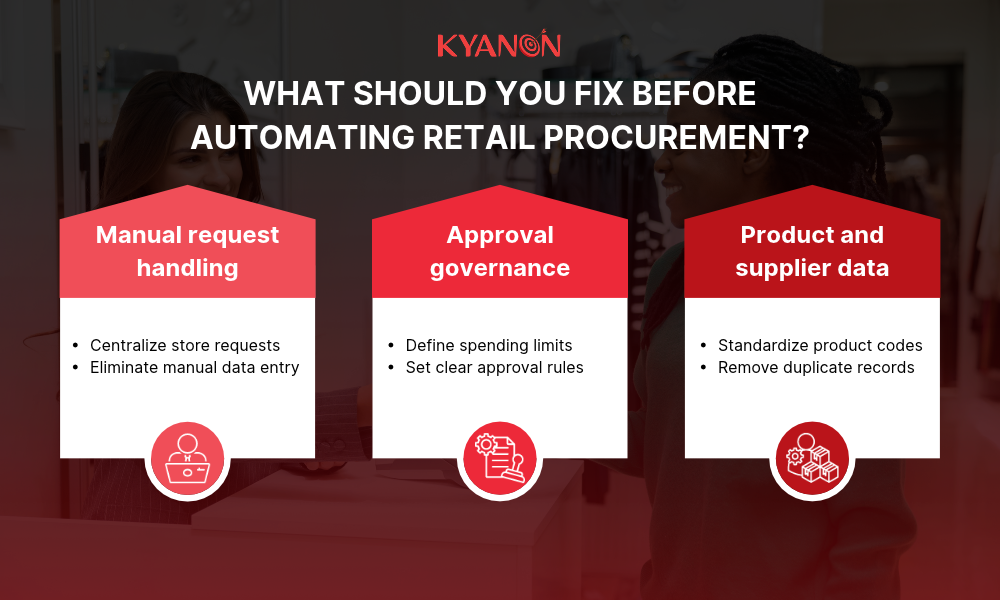
For example, if the same product has different codes in the sales and warehouse systems, the software may fail to recognize that both records refer to the same item. Retailers should remove duplicate supplier records, standardize payment terms, and ensure each product has a consistent identifier across systems before automating purchasing and invoice checks.
Pre-automation operational fixes
|
Operational area |
Common bottleneck | Required pre-automation fix |
| Requisition intake | Orders sent via WhatsApp, phone, or email |
Centralized digital intake template |
|
Approval governance |
Informal verbal sign-offs and uneven limits | Documented, role-based approval matrix |
| Product and supplier records | Different product codes and duplicate supplier records across systems |
Consistent product identifiers and updated supplier records |

What does an automated retail procurement stack include?
Effective retail procurement digitization connects the activities that happen before and after a purchase: stores request stock, buyers place orders, warehouses receive goods, and finance teams process supplier payments. An automated system links these activities through five core components.
Automated retail procurement stack components
|
Component |
What it does | Retail operating impact |
| Store requisitions and supplier RFQs | Collects stock requests from stores and helps purchasing teams request prices and availability from suppliers. |
Gives central buyers a consolidated view of store demand and reduces back-and-forth communication. |
|
Purchase order automation |
Converts approved requests into purchase orders (POs) that record agreed products, quantities, and prices. | Reduces manual order preparation and gives retailers a clear record of authorized purchases. |
| Invoice matching | Validates supplier billing records against authorized purchases and confirmed receipts. |
Helps finance teams identify incorrect quantities or prices before approving payments. |
|
Inventory synchronization |
Shares stock updates between stores, warehouses, and eCommerce channels when goods are received or moved. | Helps reduce stock discrepancies and gives teams a more consistent view of available inventory. |
| ERP and accounting integration | Transfers approved purchase and invoice information to existing business systems such as SAP or Xero. |
Reduces duplicate data entry and keeps purchasing and financial records aligned. |
These components deliver the most value when purchasing, inventory, and accounting information can move between existing systems without repeated manual entry. For retailers dealing with mismatched delivery records and inventory data, intelligent retail supply chain automation can help connect existing ERP and operational systems without replacing the core infrastructure.
How can retail procurement digital solutions protect your capital and growth?
Retail procurement digital solutions help retailers reduce the administrative work behind purchasing, improve invoice accuracy, and maintain better control over inventory and supplier payments. In Singapore’s high-cost retail environment, reducing manual errors and delays can help protect operating margins. The following solutions address three common sources of inefficiency across multi-outlet operations.
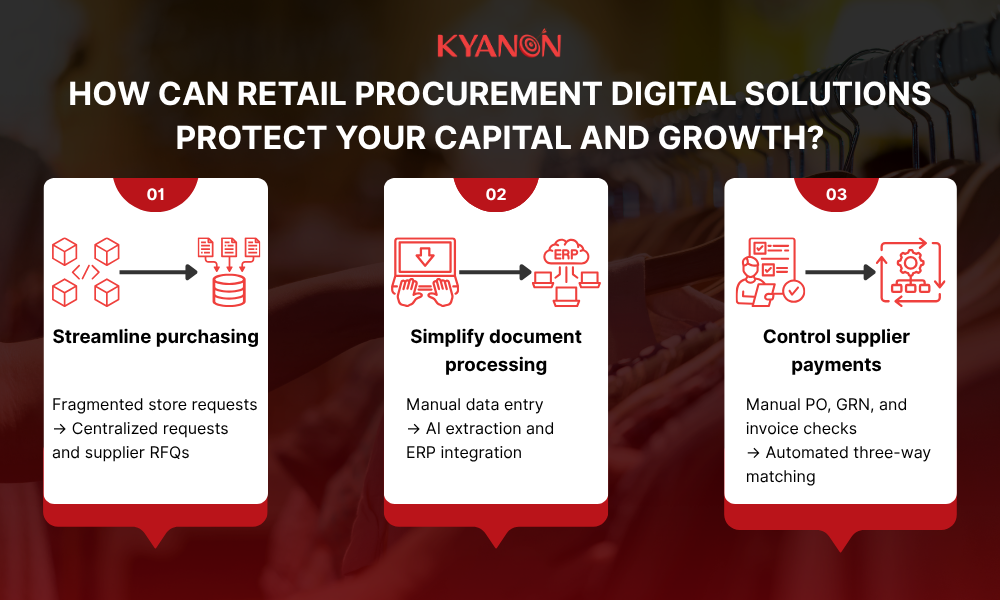
Streamlining requisitions and vendor RFQs
Store-level stockouts can occur when replenishment requests take too long to reach the purchasing team. For example, a store manager may notice that a popular product is running low but still need to send a message, complete a spreadsheet, or wait for approval before the store can reorder it.
A digital requisition system allows store managers to submit the product, quantity, and delivery requirements through a centralized process. Central buyers can then review requests from multiple outlets in one place instead of collecting information from separate messages and spreadsheets.
When several stores need the same products, purchasing teams can consolidate demand before requesting supplier quotations. This can reduce fragmented orders, simplify supplier communication, and create opportunities to negotiate better pricing.
AI-powered document reading and vendor integration
Supplier documents often arrive in different formats, including PDF invoices, scanned delivery notes, paper receipts, and photos shared through messaging apps like WhatsApp. Finance teams may need to open each document, check the details, and enter the information into the ERP manually. Across multiple suppliers and outlets, this repetitive work increases processing time and the risk of data-entry errors.
Document processing technology can read these files and extract key information, such as supplier names, product quantities, unit prices, and delivery references. The extracted details can then be checked and transferred into the ERP, reducing the amount of information finance staff need to enter manually.
Kyanon Digital practitioner perspective: Retailers in Southeast Asia should account for supplier adoption constraints when designing procurement automation. Smaller suppliers may lack the resources or willingness to use dedicated vendor portals. Supporting document-based submissions through existing communication channels can make supplier onboarding easier while allowing retailers to centralize data validation internally.
Automating procurement workflows with three-way invoice matching
Before paying a supplier, finance teams need to confirm that the business ordered the goods, received the correct quantities, and was billed at the agreed prices. Three-way matching helps automate this check by comparing three records:
- Purchase Order (PO): What the procurement team authorized at the agreed unit cost.
- Goods Received Note (GRN): Records the quantities of goods physically received and verified at the warehouse, distribution centre, or retail outlet.
- Supplier Invoice: What the vendor billed for the shipment.
When product quantities and prices match within the retailer’s predefined limits, the system can mark the invoice as matched and route it for payment approval. For example, if a supplier invoices the retailer for 100 units at S$12 each but the goods receipt record confirms that only 80 units arrived, the system flags the discrepancy for review. Finance staff can then resolve the discrepancy with the supplier before approving payment, reducing the risk of paying for goods that were not delivered.
Automate retail procurement processes in Singapore: Step-by-step
To automate procurement workflows without disrupting daily store operations, retailers should prioritize processes based on transaction volume, manual effort, and their impact on purchasing, finance, and inventory accuracy.
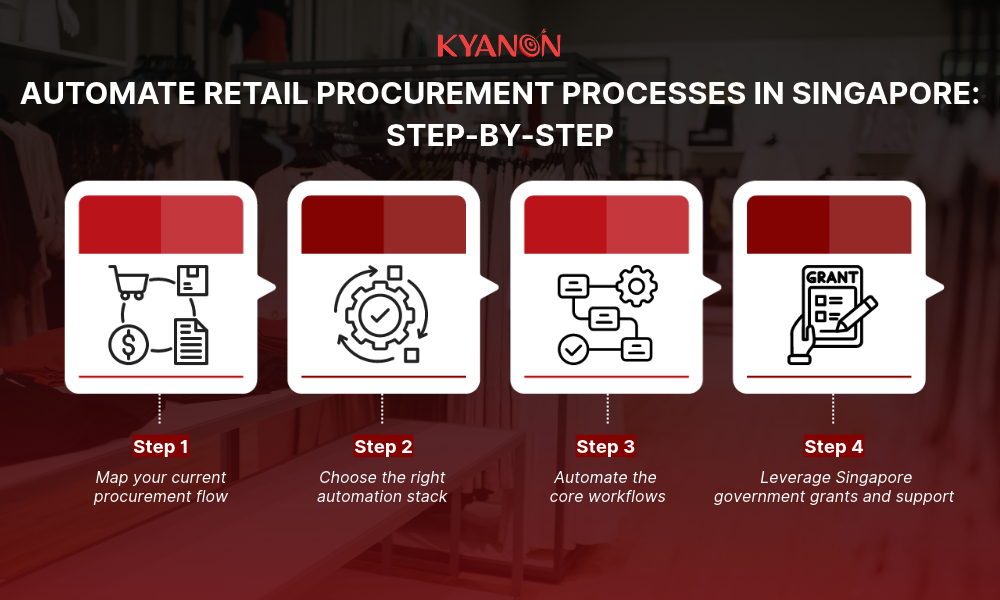
Step 1: Map your current procurement flow
- Identify high-volume manual tasks: Track how store requests are submitted, how supplier invoices are processed, and how delivery records are checked. Record processing time, recurring errors, and the teams involved.
- Set clear purchasing responsibilities: Define who can request, review, and approve purchases at each store and head-office level, including spending limits and escalation procedures.
Step 2: Choose the right automation stack
- Validate integration architecture: Review available APIs, data synchronization frequency, supported connectors, and compatibility with the retailer’s existing enterprise architecture.
- Evaluate document processing accuracy: Test how reliably the solution extracts supplier details, quantities, prices, and delivery references, and how it handles incomplete or unreadable information.
- Evaluate multi-outlet requirements: Consider the number of stores, suppliers, purchase transactions, approval levels, and finance users the system needs to support.
Step 3: Automate the core workflows
- Establish automated data intake: Begin by digitizing supplier documents and validating extracted information before passing it to purchasing and finance workflows.
- Configure exception handling: Define acceptable price and quantity variances, automatic approval conditions, and escalation rules for invoices that fail validation.
- Synchronize inventory events: Configure automated updates triggered by goods receipts, stock transfers, and supplier deliveries to keep procurement decisions aligned with actual stock movements.
- Expand to purchasing requests and orders: Once the core data flows are stable, introduce digital requisitions and purchase order automation to improve coordination between stores and central buyers.
Step 4: Leverage Singapore government grants and support
- Enterprise grant support: Singapore retailers can explore the EDGE Grant for eligible business automation, digitalization, and transformation activities, subject to the applicable company and project requirements. SMEs can also refer to IMDA’s Retail Industry Digital Plan to identify relevant digital solutions and assess their digital readiness.
- Target high-ROI pain points: Prioritize projects with measurable operational benefits, such as reducing invoice processing time, minimizing manual data entry, and improving inventory accuracy. Confirm grant eligibility and approval requirements before committing to implementation costs.
How Kyanon Digital automated retail procurement operations for a Singapore retailer
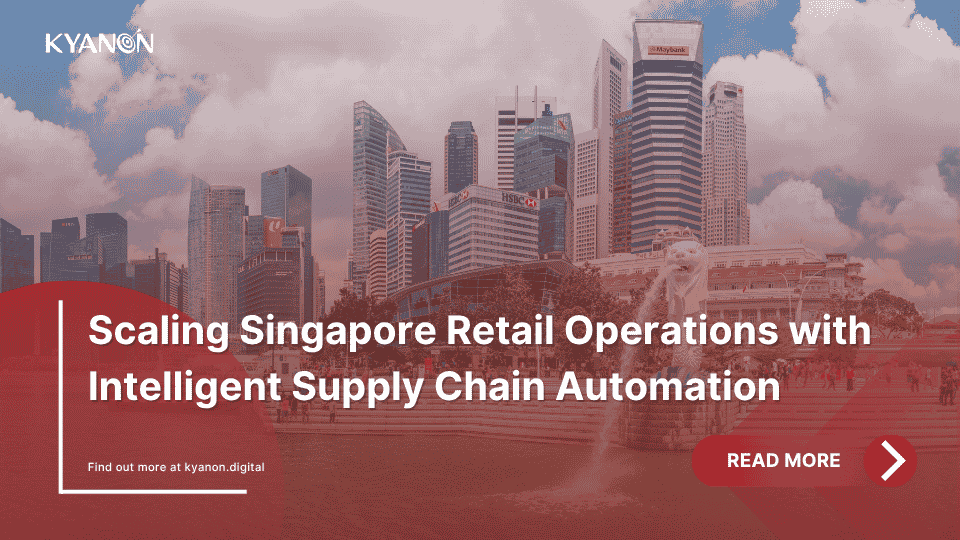 Kyanon Digital automated procurement for a Singapore retailer, cutting data entry time by 90% and inventory discrepancies by over 80%.
Kyanon Digital implemented an AI-powered automation solution that connected supplier document processing, financial reconciliation, and inventory operations with the retailer’s existing SAP, POS, eCommerce, and B2B systems.
Challenges
- Thousands of supplier invoices and delivery documents required manual data extraction and ERP entry.
- Differences between supplier invoices, actual delivery records, and ERP data made financial reconciliation slower and more labor-intensive.
- Disconnected inventory records across retail, eCommerce, and B2B channels complicated replenishment and stock planning.
Solution from Kyanon Digital
- Automated supplier invoice and delivery document extraction and validation using AI.
- Integrated automated reconciliation with SAP to match supplier invoices, goods receipts, and ERP records.
- Connected SAP with the retailer’s POS, eCommerce, and B2B systems so teams could keep stock records consistent across sales channels.
Results and impact
- 90% reduction in manual data entry time across document processing and financial reconciliation.
- Under 30 minutes to process supplier invoices, down from several days.
- Over 80% fewer inventory discrepancy incidents across omnichannel operations.
- Supported the onboarding of additional suppliers and sales channels through standardized integration connectors, without increasing operational headcount.
Explore how Kyanon Digital helps Singapore retailers automate procurement workflows and improve operational efficiency.
Conclusion
Retail procurement digitization is about more than eliminating paperwork. It helps retailers control purchasing costs, reduce manual finance work, and maintain more accurate inventory records. Rather than replacing every existing system, businesses can start by addressing high-volume tasks such as supplier document processing and invoice matching, then expand automation as their operational needs evolve.
Before selecting a solution, retailers should standardize product and supplier records, define purchasing approval responsibilities, and assess how existing systems share order and inventory information. These steps provide a more reliable foundation for scaling automated procurement workflows across multiple outlets.
To identify automation opportunities across purchasing, supplier document processing, and inventory operations, book a consultation with Kyanon Digital to discuss an implementation approach that works with your existing retail systems.
References
Scaling Singapore Retail Operations with Intelligent Supply Chain Automation — Kyanon Digital, 2026.
Retail Industry Digital Plan (IDP) for SMEs — Infocomm Media Development Authority (IMDA), 2026.
Productivity Solutions Grant Overview — GoBusiness Singapore, 2026.








 Create project brief with AI