

Buying AI ecommerce personalization is better when existing platforms meet business needs and faster implementation is a priority. Building is preferable when proprietary recommendation logic creates meaningful competitive value. A hybrid approach may suit enterprises requiring both. The right decision depends on business objectives, technical readiness, and long-term investment considerations.
For Singapore retailers, choosing between building and buying AI ecommerce personalization goes beyond selecting technology. The challenge is balancing personalization capabilities, integration complexity, and long-term costs while ensuring the investment delivers measurable business value.
In this article, Kyanon Digital explores the build-versus-buy trade-offs, when each approach makes business sense, and how enterprises can evaluate cost, ROI, and implementation readiness before committing to an AI personalization strategy.
Key takeaways
- Buy when established AI personalization platforms meet commercial requirements and faster implementation matters more than proprietary customization.
- Build when unique recommendation logic delivers measurable competitive value that existing platforms cannot adequately support.
- Choose hybrid when standard platform capabilities are useful but require differentiated ranking, inventory, or loyalty logic.
- Evaluate total cost of ownership, including integration, governance, model operations, and vendor dependency, not just upfront development costs.
- Kyanon Digital recommends validating data readiness, system integration, and incremental commercial value through one prioritized ecommerce use case before scaling.
Further reading:
- eCommerce Data Governance: What Enterprises Get Wrong
- Data Enrichment for Retail: A Practical Guide
- Challenges of AI in Retail: How to Overcome Them
What is AI ecommerce personalization, and where does it create business value?
AI ecommerce personalization uses machine learning, customer behavior, purchase history, product attributes, and contextual data to tailor online shopping experiences based on individual preferences and purchasing intent.
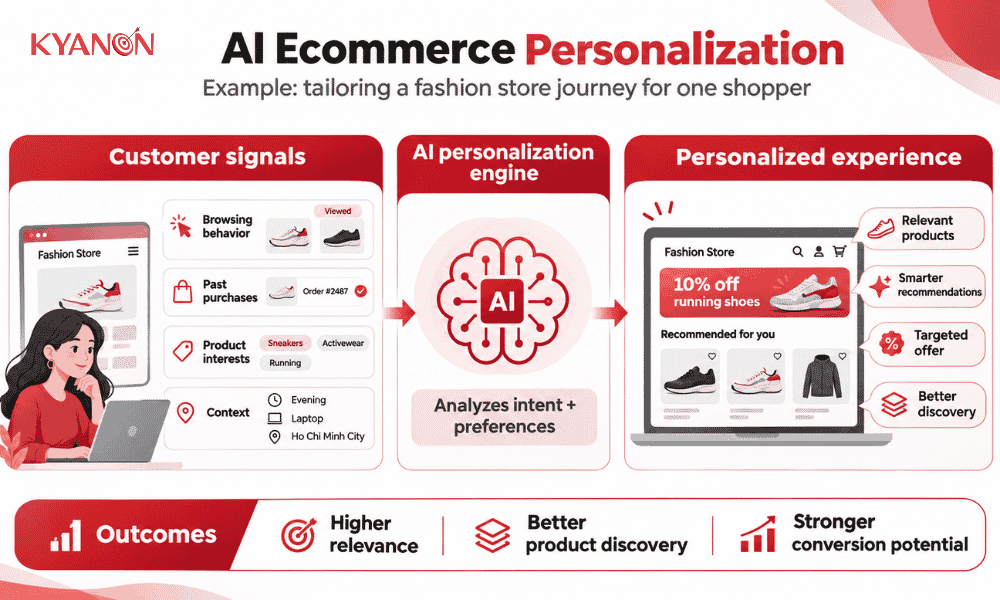
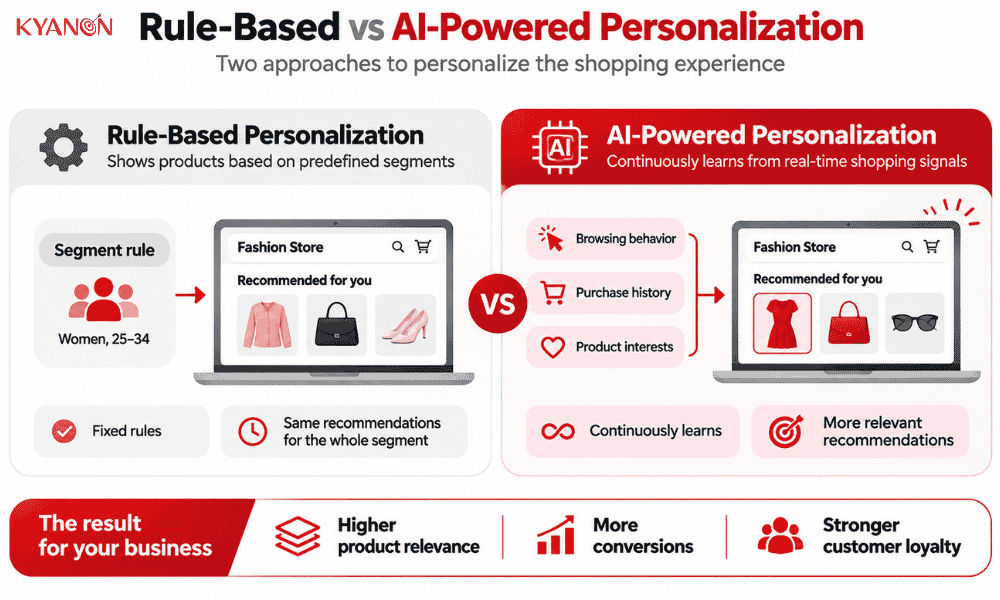
Unlike traditional rule-based personalization, which relies on predefined customer segments, AI-powered personalization can continuously analyze shopping signals to predict relevant products, recommendations, and offers.
For ecommerce businesses, its value comes from improving product discovery, increasing purchase relevance, and optimizing commercial performance across the customer journey.
Where does AI ecommerce personalization create business value?
|
Ecommerce application |
How AI personalization works |
Potential business value |
|
Product discovery |
Personalizes search results, product recommendations, and category rankings based on shopping behavior and product relevance. | Higher conversion rates and revenue per visitor. |
| Onsite experience | Adapts homepages, product detail pages, and product collections to customer preferences. |
Better product engagement and conversion opportunities. |
|
Merchandising & promotions |
Recommends relevant bundles, cross-sells, upsells, and offers while considering inventory and margin objectives. | Higher average order value (AOV) and gross margin. |
| Cart & checkout | Suggests complementary products, relevant incentives, and contextual add-ons during checkout. |
Higher cart value and potentially lower abandonment. |
|
Post-purchase journeys |
Predicts replenishment needs and recommends complementary or next-best products. |
Higher repeat purchase rates and customer lifetime value (CLV). |
The business value of AI ecommerce personalization should be measured through incremental conversion, revenue per visitor, AOV, repeat purchases, CLV, and gross profit, ideally compared against a control group rather than assuming every personalized interaction generates additional sales.
For enterprise retailers, the strategic question is not simply whether AI can personalize shopping experiences, but whether standard platform capabilities are sufficient or proprietary recommendation logic can deliver measurable additional value. This distinction directly informs the decision to build, buy, or adopt a hybrid personalization solution.

What are the differences between building and buying AI ecommerce personalization?
The main differences between building and buying AI ecommerce personalization are time to market, customization, integration requirements, cost, and long-term operational ownership.
Buying provides established capabilities such as product recommendations, personalized search, and merchandising tools. Building offers greater control over recommendation models, proprietary data, and business-specific logic but requires sustained engineering investment.
For enterprise retailers, the decision should consider both implementation priorities and long-term commercial value.
| Decision factor | Buy an existing platform |
Build a custom solution |
|
Time to market |
Typically faster with prebuilt capabilities and ready integrations | Longer development, testing, and model validation |
| Personalization capabilities | Established recommendations, search, and merchandising features |
Custom recommendation models, ranking, and proprietary logic |
|
Integration |
Depends on available APIs and platform compatibility | Designed around existing enterprise systems and architecture |
| Data and model control | Subject to vendor capabilities and contracts |
Greater control over data processing, models, and intellectual property |
|
Cost structure |
Licensing, usage fees, implementation, and integration | Engineering, infrastructure, deployment, and maintenance |
| Flexibility | Limited by configuration and platform extensibility |
Greater customization for specialized customer journeys |
|
Operational ownership |
Shared with the vendor, while internal teams manage data and business requirements |
Enterprise owns infrastructure, monitoring, and continuous improvement |
Kyanon Digital’s perspective: Identify the real constraint before investing in custom AI.
As highlighted in Kyanon Digital’s eCommerce Data Governance analysis, fragmented customer identities and inconsistent product data can undermine personalization regardless of the recommendation technology used. For example, if a platform recommends unavailable products, the problem may lie in inventory synchronization rather than the recommendation model.
Before building a custom engine, enterprises should determine whether the issue requires better data integration, platform configuration, or genuinely new AI capabilities.
When should an enterprise buy an AI ecommerce personalization platform?
Buying an AI ecommerce personalization platform is the better choice when standard capabilities meet commercial requirements, faster implementation is a priority, and custom AI development offers limited additional value.
For enterprise retailers, five signals indicate that buying may be more practical:
- Growing catalog complexity: Large or frequently changing product catalogs make manual recommendations and merchandising difficult to scale.
- Measurable conversion friction: Poor search relevance, low product discovery conversion, or checkout abandonment creates a clear business case for personalization.
- Standard functionality meets requirements: Existing platforms support the required recommendations, personalized search, merchandising rules, and experimentation.
- Limited internal AI resources: The business lacks dedicated ML engineering capacity or prefers vendor-supported model operations.
- Integration readiness: Existing commerce, CRM, CDP, and inventory systems can provide the reliable data needed for personalization.
What should enterprises validate before buying?
Before selecting a vendor, request evidence against three requirements:
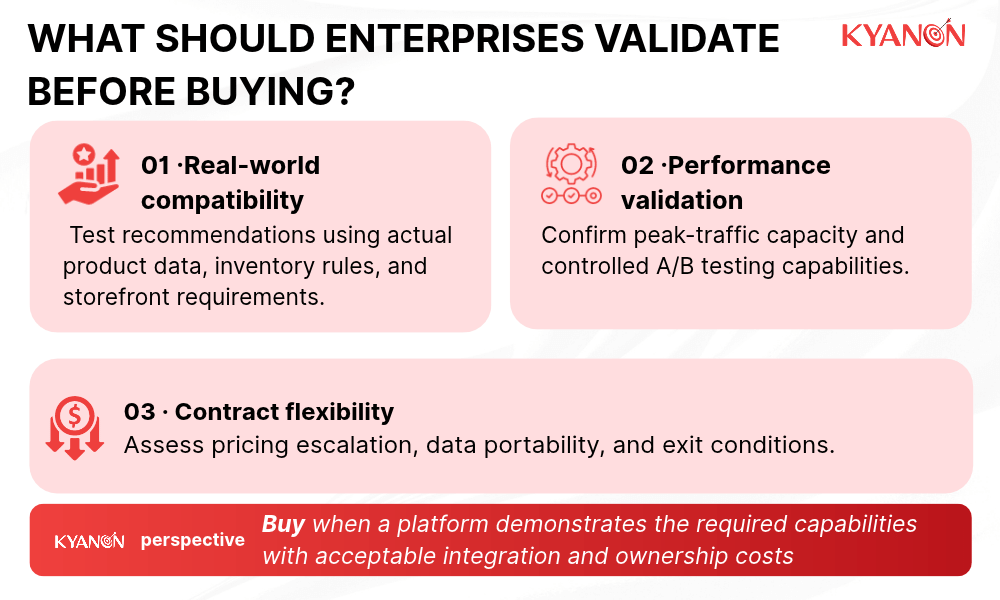
- Real-world compatibility: Test recommendations using actual product data, inventory rules, and storefront requirements.
- Performance validation: Confirm peak-traffic capacity and controlled A/B testing capabilities.
- Contract flexibility: Assess pricing escalation, data portability, and exit conditions.
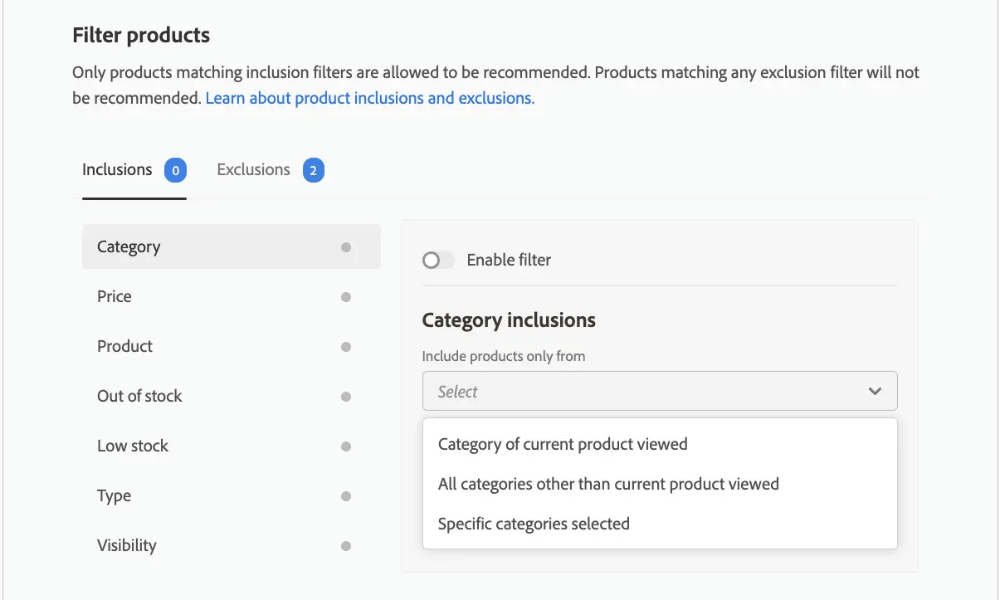
For example, Adobe Commerce Product Recommendations supports configurable product, price, and stock filters. This illustrates why retailers should test existing capabilities before assuming custom development is necessary.
When not to buy: If essential proprietary logic cannot be implemented through vendor configuration or APIs, consider custom or hybrid development.
Business takeaway: Buy when a platform demonstrates the required capabilities with acceptable integration and ownership costs.
When not to buy: If essential proprietary logic cannot be implemented through vendor configuration or APIs, consider custom or hybrid development.
Business takeaway: Buy when a platform demonstrates the required capabilities with acceptable integration and ownership costs.
When should an enterprise build custom AI ecommerce personalization?
Building custom AI ecommerce personalization is justified when existing platforms cannot support proprietary recommendation logic, complex data requirements, or specialized customer journeys that create measurable competitive value.
For enterprise retailers, five signals indicate that custom development may be the better choice:
- Strategic differentiation: Personalization is a core competitive advantage, requiring unique recommendation models rather than standard platform features.
- Proprietary business logic: Recommendations must combine real-time inventory, profit margins, loyalty data, or complex product relationships that vendors cannot adequately support.
- Complex customer journeys: Existing solutions cannot accommodate specialized B2B purchasing workflows, multi-brand operations, or advanced merchandising requirements.
- Greater data and model control: The business requires specific control over model behavior, data processing, architecture, or intellectual property.
- Strong internal AI capabilities: Dedicated engineering, data science, MLOps, and product teams can develop, maintain, and continuously improve the solution.
What should enterprises validate before building?
Custom development requires more than a compelling use case. Enterprises should establish three forms of evidence:
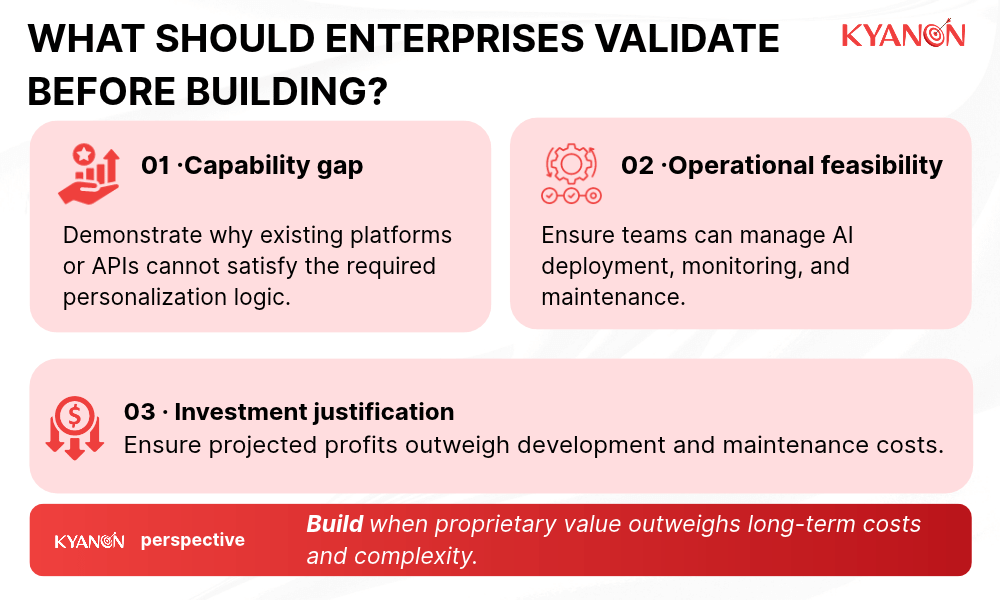
- Capability gap: Demonstrate why existing platforms or APIs cannot satisfy the required personalization logic.
- Operational feasibility: Confirm ownership of data pipelines, model monitoring, retraining, low-latency serving, testing, and fallback behavior.
- Investment justification: Compare projected incremental gross profit against development, maintenance, and opportunity costs.
When not to build: If vendor configuration already meets requirements, custom engineering may add complexity without sufficient commercial benefit.
Business takeaway: Build only when proprietary capabilities justify their full lifecycle investment.
Is a hybrid approach better for enterprise AI ecommerce personalization?
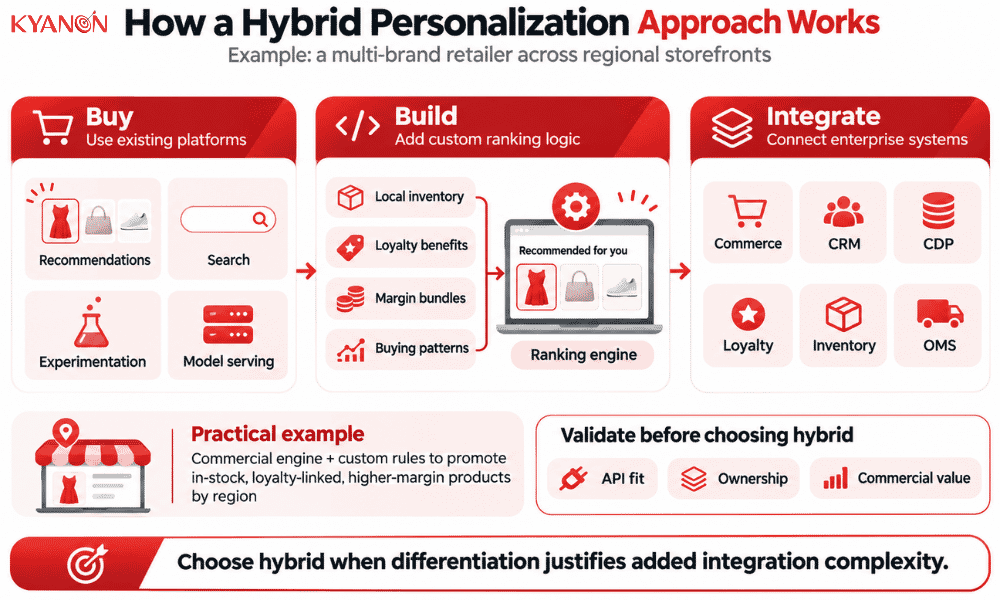
A hybrid approach is suitable when existing AI platforms cover standard requirements but proprietary personalization logic is needed to create additional business value. Rather than developing an entire recommendation engine, enterprises can separate responsibilities across three layers:
- Buy: Established recommendation, search, experimentation, or model-serving capabilities.
- Build: Proprietary ranking logic using inventory, margin, loyalty, or customer-specific signals.
- Integrate: Commerce, CRM, CDP, inventory, and order management systems.
Practical example: A multi-brand retailer uses an existing recommendation engine while developing custom rules to prioritize locally available products and loyalty-specific offers.
For enterprises combining existing platforms with proprietary requirements, Kyanon Digital’s Comprehensive E-Commerce Solution services can support commerce integration and targeted custom development.
What should enterprises validate before choosing hybrid?
- API extensibility: Can proprietary logic work with the existing platform?
- Ownership boundaries: Who manages system performance, custom components, and failures?
- Added complexity: Will integration and maintenance overhead outweigh the expected benefit?
A hybrid architecture is not automatically preferable. If existing software meets business requirements without additional development, building another layer may be unnecessary.
Business takeaway: Choose hybrid when differentiated logic adds enough value to justify additional architectural complexity.
How should Singapore enterprises evaluate the cost and ROI of AI ecommerce personalization?
Singapore enterprises should assess AI ecommerce personalization through total cost of ownership (TCO), incremental gross profit, and time to value, not software pricing alone. A lower-cost platform may require expensive integrations, while custom development introduces ongoing engineering and maintenance responsibilities.
What costs should enterprises evaluate?
- Technology: Platform licensing, usage fees, custom development, and cloud infrastructure.
- Integration & governance: CRM, CDP, POS, inventory connectivity, data preparation, security, and PDPA compliance.
- Ongoing operations: Model monitoring, optimization, staffing, vendor management, and switching costs.
How should enterprises measure ROI?
Evaluate incremental performance against a credible baseline or control group:
| Key KPI |
What to measure |
|
Conversion & revenue per visitor |
Incremental sales from personalization |
| AOV & repeat purchases |
Changes in basket value and purchasing frequency |
|
Incremental gross profit |
Additional profit after product costs, discounts, and returns |
| Payback period |
Time required to recover investment costs |
ROI (%) = [(Incremental Gross Profit + Verified Cost Savings − Total Costs) / Total Costs] × 100
Kyanon Digital’s perspective: In a Thailand pharmacy loyalty transformation, Kyanon Digital integrated customer profiles, loyalty, and campaign operations, achieving:
- 18% higher campaign participation
- 28% faster campaign execution
- 12% higher repeat member engagement
These are loyalty transformation outcomes, not AI recommendation ROI. The practical lesson is to measure customer engagement and operational efficiency separately, then establish their financial contribution before claiming ROI.
For Singapore retailers, investment planning must also account for applicable PDPA obligations, including lawful personal-data use, security, and cross-border transfers. The PDPC’s AI recommendation guidelines provide relevant guidance.
Business takeaway: Start with a controlled personalization pilot. Scale only when incremental profit and verified savings justify lifecycle costs and governance risks.
What to consider before choosing an AI ecommerce personalization solution?
The right AI ecommerce personalization solution should align with business priorities, data readiness, existing architecture, and long-term operating capabilities, not simply offer the most advanced AI features.
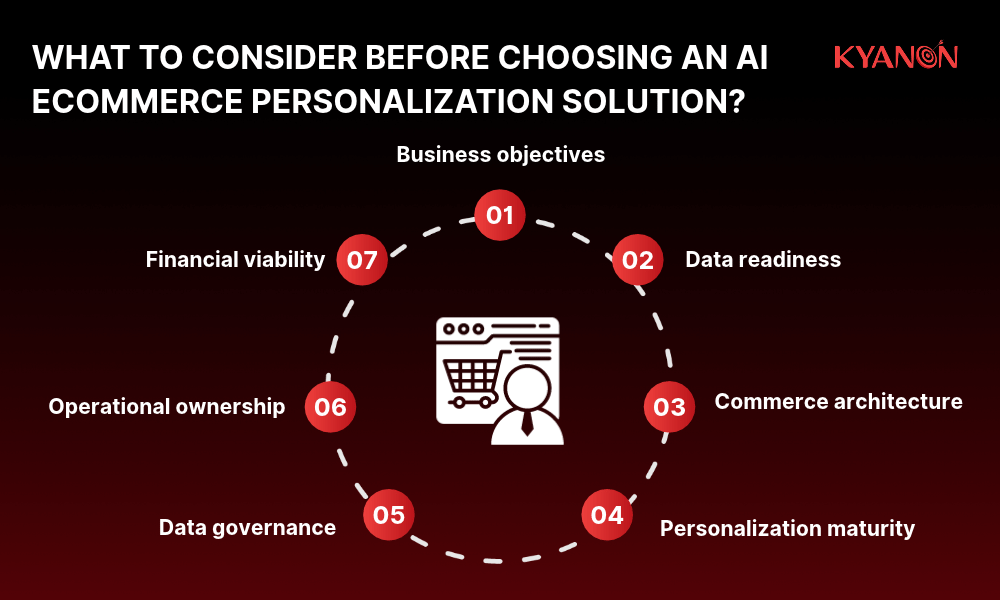
Before approving an investment, enterprise decision-makers should evaluate seven critical factors:
- Business objectives: Identify the specific KPI to improve, such as conversion rate, revenue per visitor, AOV, or retention.
- Data readiness: Verify that customer behavior, transaction history, and product information are accurate, accessible, and connected.
- Commerce architecture: Assess compatibility with existing storefronts, CRM, CDP, ERP, and inventory systems.
- Personalization maturity: Determine whether standard recommendations are sufficient or proprietary decisioning is necessary.
- Data governance: Address customer consent, applicable PDPA obligations, access controls, security, and vendor accountability.
- Operational ownership: Assign responsibility for merchandising rules, model performance, experimentation, and ongoing optimization.
- Financial viability: Compare expected incremental value against implementation, operating, and potential switching costs.
Kyanon Digital’s perspective: Start with a business decision, not an AI model
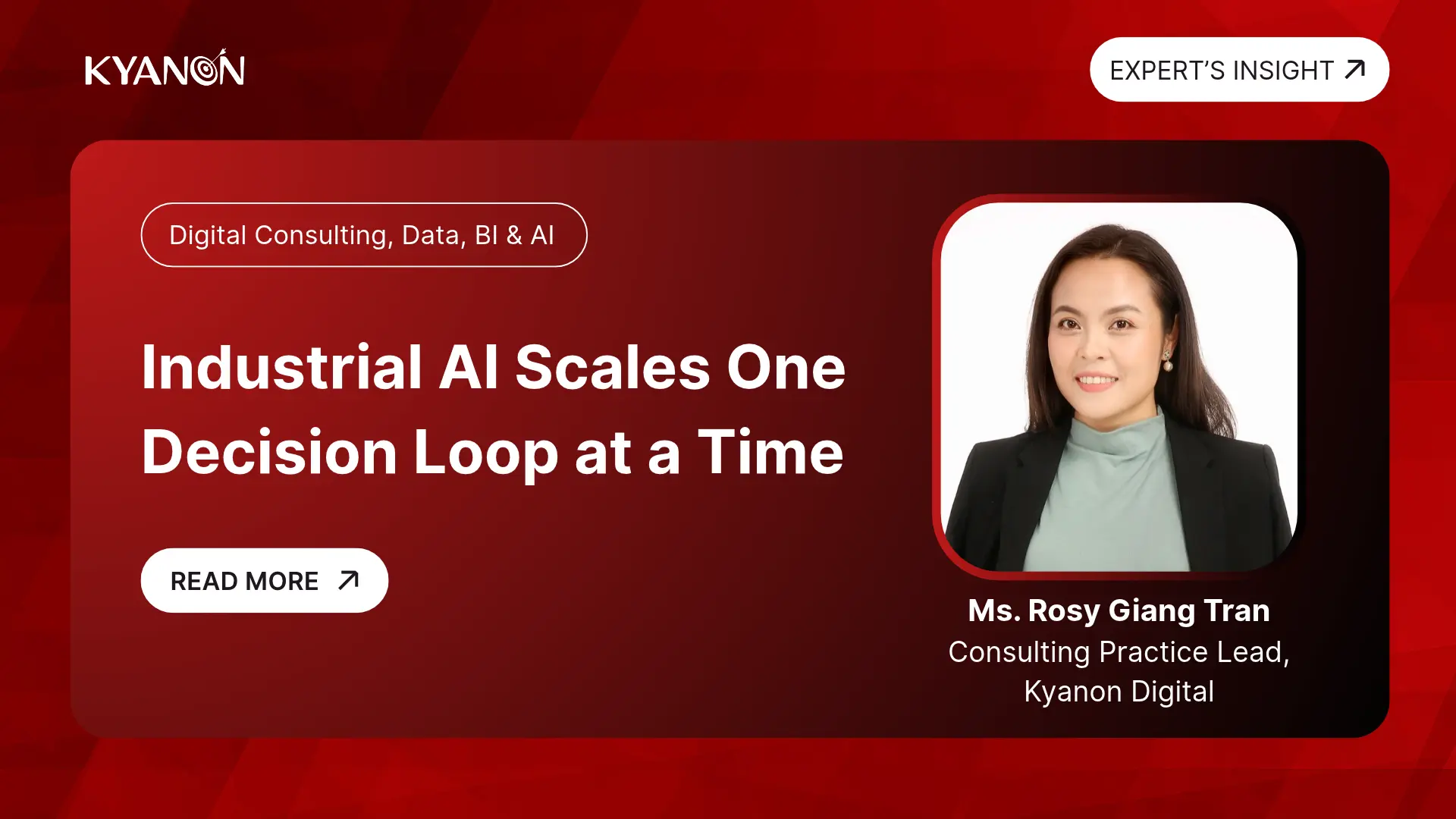
In “Industrial AI Scales One Decision Loop at a Time,” by Rosy Giang Tran, Consulting Practice Lead at Kyanon Digital, emphasizes that AI creates value when four elements work together: a timely signal, a feasible action, an accountable owner, and a measurable result. Although developed for industrial operations, this framework offers a practical way to evaluate ecommerce personalization investments.
For ecommerce personalization, this means evaluating whether AI can improve a specific shopping decision, such as recommending relevant products that are available for purchase, with clear ownership and measurable business outcomes.
For ecommerce personalization, this means evaluating whether AI can improve a specific shopping decision, such as recommending relevant products that are available for purchase, with clear ownership and measurable business outcomes.
How should enterprises make the final decision?
- Buy: Standard features meet business requirements and integrate with existing systems.
- Build: Proprietary recommendation logic creates measurable value beyond available platforms.
- Hybrid: Existing platforms meet core needs but require differentiated business logic.
- Defer: Data quality or integration gaps prevent reliable personalization.
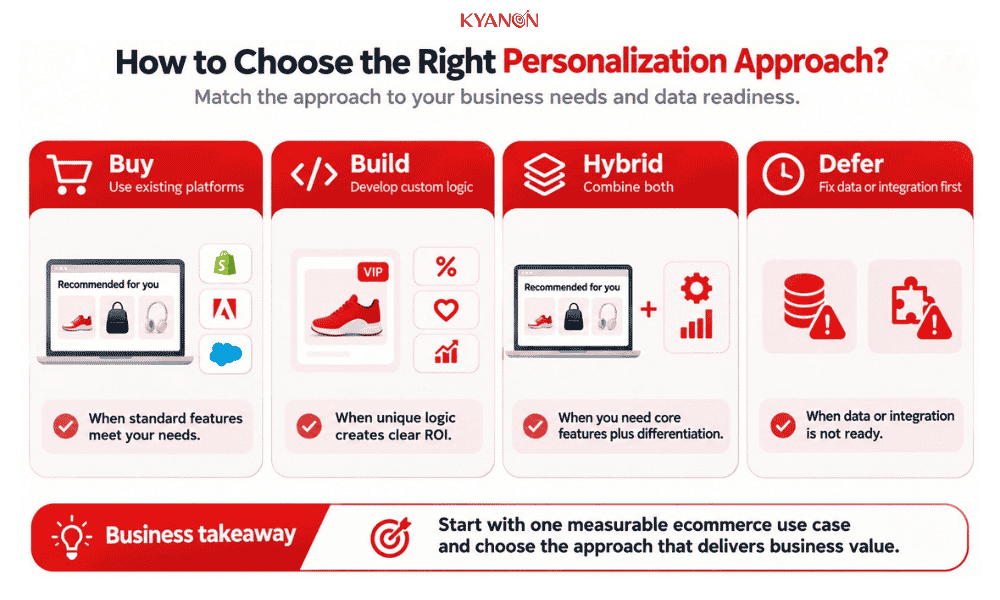
Business takeaway: Start with one measurable ecommerce use case. Choose the approach that improves commercial outcomes with acceptable cost, governance, and operational risk.
How can Kyanon Digital help you implement AI ecommerce personalization?
Kyanon Digital helps enterprises evaluate, build, and integrate AI ecommerce personalization solutions that align with their business objectives, existing architecture, and long-term investment priorities.
Through Comprehensive E-Commerce Solution services, Kyanon Digital supports enterprises across three key areas:
- Build vs. buy assessment: Evaluate existing personalization platforms, custom development requirements, and hybrid architectures based on business fit and total cost of ownership.
- Enterprise integration: Connect ecommerce platforms with CRM, CDP, loyalty, inventory, and order management systems to enable consistent customer experiences.
- AI personalization implementation: Support personalized recommendations, intelligent search, and data-driven merchandising, followed by testing and continuous optimization.
Case study: How Kyanon Digital modernized ecommerce for an established Singapore retailer
In a retail transformation project for an iconic Singaporean retailer, Kyanon Digital demonstrated how platform modernization and enterprise integration can create a stronger foundation for personalized commerce.
Challenges
- An outdated custom ecommerce platform limited flexibility and scalability.
- Disconnected CRM, inventory, and fulfillment systems restricted personalization and omnichannel shopping experiences.
- Legacy architecture increased maintenance and integration complexity.
Solution from Kyanon Digital
- Migrated the retailer from a customized legacy platform to a standard enterprise-grade ecommerce solution.
- Redesigned its ecommerce website and mobile shopping experience.
- Integrated CRM, PIM, OMS, WMS, mobile POS, and fulfillment systems to connect customer and operational data.
Results and Impact
- Connected omnichannel journeys: Enabled online purchases with in-store pickup, cross-channel returns, and store-assisted fulfillment.
- Improved operational visibility: Supported real-time inventory information and more efficient order processing.
- Stronger personalization foundation: Unified customer data supported more relevant marketing and personalized shopping experiences.
Explore the full case study Retail Transformation For An Iconic Singaporean Retailer .
The project demonstrates Kyanon Digital’s experience in combining established commerce platforms with tailored enterprise integrations. It provides relevant architectural evidence for build-versus-buy decisions, although it does not establish measured ROI from an AI recommendation engine.
Conclusion
The right AI ecommerce personalization investment should address a measurable commercial problem without introducing unnecessary technical or operational complexity.
For Singapore enterprises, the next step is to validate one priority shopping journey, establish a credible performance baseline, and test whether incremental gross profit justifies the proposed investment.
Evaluating your next personalization initiative? Discuss your ecommerce architecture and build-versus-buy options with Kyanon Digital to identify an appropriate implementation approach and practical next steps.
References
- eCommerce Data Governance: What Enterprises Get Wrong — Kyanon Digital, 2026.
- What are Product Recommendations? — Adobe Commerce, 2026.
- Filter Products — Adobe Commerce, 2026.
- Comprehensive E-Commerce Solution Services — Kyanon Digital.
- How Can a Pharmacy Loyalty Program Improve Omnichannel Retention? — Kyanon Digital.
- Advisory Guidelines on Use of Personal Data in AI Recommendation and Decision Systems — Personal Data Protection Commission, Singapore, 2024.
- Industrial AI Scales One Decision Loop at a Time — Kyanon Digital, 2026.
- Retail Transformation For An Iconic Singaporean Retailer — Kyanon Digital.







 Create project brief with AI