

For most private healthcare organisations in Singapore, the best approach is to buy existing AI platforms for standard workflows and build custom solutions only where unique operational needs require them. End-to-end development makes sense when available vendors cannot meet those needs and the organisation has the engineering capacity to maintain the solution.
Healthcare leaders face this decision as routine tasks such as clinical note summarisation, claims processing, and staff scheduling consume valuable time. While off-the-shelf software offers a faster starting point, fully custom AI agents can introduce additional development, integration, and maintenance costs.
The choice is also shaped by Singapore’s healthcare landscape. Public healthcare institutions can access sector-wide AI capabilities such as Synapxe’s AgentSea, while private providers must evaluate their own clinical risks, data privacy obligations, integration requirements, and budgets. Understanding when to buy, customise, or build is essential to adopting AI agents sustainably.
Key takeaways
- Use off-the-shelf software for common daily tasks, and save custom development for workflows that make your care uniquely better.
- Long-term software costs come mainly from connecting to electronic health records (EHR), running safety checks, and keeping system data updated over time.
- Never launch an automated agent without clear testing cases, activity logs, and a manual shut-off switch for staff.
- Kyanon Digital recommends working with external integration specialists to link AI models to existing patient databases rather than building a large internal IT team from scratch.
How does Singapore’s public sector use AI agents without a build vs buy decision?
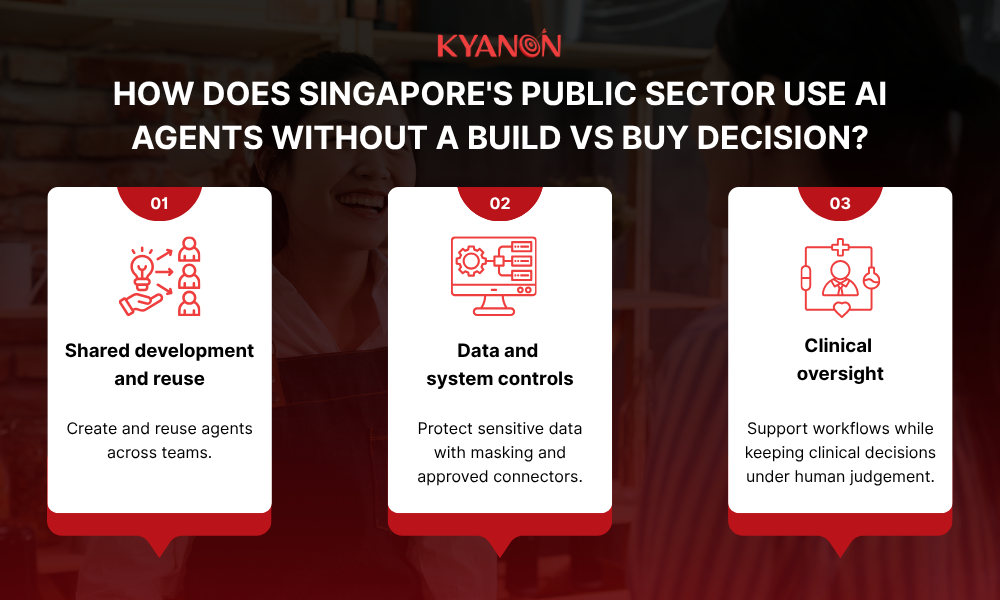
Singapore’s public healthcare sector illustrates how AI agents can be introduced through shared infrastructure rather than developed separately by each team. AgentSea, developed by Synapxe with Amazon Web Services (AWS), enables public healthcare staff to create and reuse AI agents using natural-language instructions and no-code tools.
The platform supports clinical and administrative workflows, including clinical note summarisation, pre-clerking, procurement, and staff rostering. This shared approach helps teams reuse existing capabilities while applying governance controls suited to healthcare environments.
Key considerations include:
- Shared development and reuse: Staff can create and share agents instead of independently building similar solutions.
- Data and system controls: Data masking, security measures, and approved connectors help manage access to sensitive information.
- Clinical oversight: AI can assist with healthcare workflows, while clinical decisions remain subject to appropriate human judgement.
AgentSea is designed for Singapore’s public healthcare sector, rather than offered as a standard commercial platform for private providers. For private healthcare organisations, the relevant lesson is to reuse suitable capabilities where possible while maintaining appropriate governance and control.
However, private providers must assess their own workflows, existing systems, and engineering capacity to determine the right approach. The next step is to compare buying a ready-made solution, customising workflows on an existing platform, and building an AI agent end to end.

Build, buy or AI agent as a service: What are your options?
Private healthcare providers can choose between three clear paths based on their clinical goals, budget, and internal IT capabilities.
Comparison of build, buy, and AI agent as a service options
|
Option |
What you own | Best when | Main risk |
|
Buy a point solution (or AI agent as a service) |
Configuration and adoption | Narrow, commodity workflow |
Data silos, black-box behaviour, limited customisation |
| Buy a platform, build the workflows | Workflow logic, prompts, tools, evaluation | Several related workflows, some differentiating | Deeper platform lock-in |
|
Build end to end |
Everything | Workflow is your moat and you run platform engineering |
Talent concentration, permanent maintenance, liability |
How to create an AI agent in-house: When does building make sense?
Building a custom AI agent in-house or using specialized development services makes sense only under specific conditions.
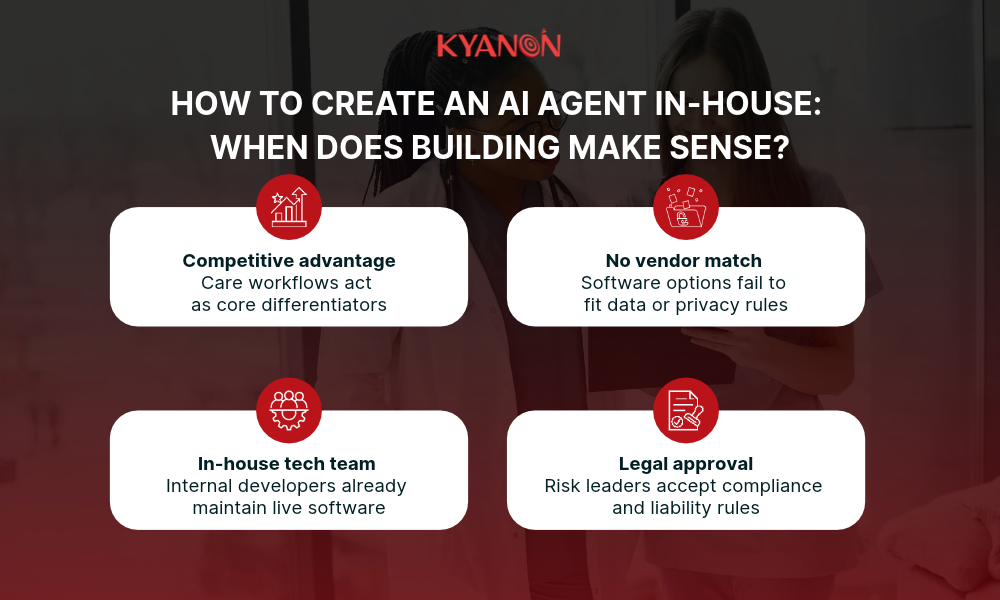
Building makes sense when:
- The workflow gives you a clear advantage: Patients or doctors choose your facility specifically because of a unique operational process or care coordination model.
- No existing software fits your needs: A simple market check proves that no vendor software works with your patient database, regional privacy rules, or clinical steps.
- You already manage software in-house: Your organization already employs software developers who monitor live applications and handle system updates.
- Your legal team approves the plan: Legal and risk leaders formally accept the liability guidelines and data protection rules for automated tools.
Before learning how to create an AI agent, your team must set up four basic safety foundations: a list of real past patient cases for testing, live performance tracking, activity logs for compliance audits, and a tested manual off switch. Without these four elements, building an in-house tool creates high operational and legal risks.
Healthcare organizations that have strong clinical teams but lack dedicated AI software developers often run into project delays when trying to build everything internally. If your organization is facing data connection challenges, talking to a team that offers AI Integration services can help you connect your existing patient records to AI tools without hiring a large permanent software team.
AI agent development services vs building in-house: What does each cost?
Understanding the real cost of an AI project requires looking past initial setup fees to consider long-term software maintenance, security, and staff time.
Breakdown for build vs. buy AI agent solutions
|
Cost line |
Buy | Build | Often underestimated |
| Licence / inference | Recurring fee, scales with use | Model API cost, variable |
Yes. Retry-heavy agents |
|
Integration (EHR, claims, patient data) |
Weeks of engineering either way | Largest single item, especially write-back | Yes. Legacy patient record systems often require more integration work than expected. |
| Compliance and data governance (PDPA, MOH guidance, vendor review) | Vendor review plus your own integration code | You carry all of it |
Yes. Data protection and security checks require significant time. |
|
Evaluation, monitoring, model updates |
Partly vendor | Entirely yours, permanent | Yes. AI models need regular evaluation and updates to remain accurate. |
| Team | Config and adoption | Roughly 3–4 dedicated engineers per production agent (Clunic estimate) |
Yes. Hiring and retaining skilled AI engineers can be challenging. |
How does Kyanon Digital approach AI agent projects in practice?
Kyanon Digital connects approved service knowledge, workflow automation, and human support to help healthcare organisations manage growing customer inquiries. Its work with a private healthcare provider in Singapore illustrates this approach.
The provider faced increasing customer-service demands, with fragmented information and manual processes making support harder to scale. Kyanon Digital implemented a non-clinical AI chatbot to handle routine inquiries and route complex requests to the appropriate teams.
How Kyanon Digital scales customer service with an AI chatbot for healthcare
Challenges
- Routine appointment, location, and administrative inquiries consumed staff capacity.
- Scattered service information made consistent answers difficult.
- Manual routing slowed handoffs to the appropriate teams.
Solution from Kyanon Digital
- Centralized approved service knowledge to support accurate chatbot responses.
- Connected the chatbot to existing service workflows through APIs and automation.
- Preserved human escalation for complex requests and introduced performance monitoring.
Results and impact
- 38% reduction in routine manual inquiries.
- 32% faster response times.
- 28% of eligible enquiries resolved through self-service.
The results show how connected knowledge and workflows can reduce routine service demand while retaining human oversight for complex or sensitive requests.
Explore more: Scaling Customer Service with an AI Chatbot for Healthcare.
Conclusion
Choosing between buying ready-made software, subscribing to an AI service, or building a custom agent comes down to understanding your operational needs and IT capacity. Standard administrative tasks are best handled by existing commercial software, while unique processes that differentiate your clinic justify target-built software integrations.
Before spending money on new software, private healthcare leaders should review their current database setup, patient safety protocols, and long-term IT support plans.
Deciding between buying, building or a hybrid? Talk to the Kyanon Digital team about a scoped review of your workflow and integration needs.
References
Singapore’s public healthcare workers can now build their own AI agents — GovInsider, 2026.
Health AI Projects — Synapxe, 2026.



 Create project brief with AI