

eCommerce replatforming can cost from around $10,000 to more than $600,000 for a full B2B commerce project, depending on business complexity. A 2026 benchmark based on 108 B2B commerce engagements found median build costs of $154,000 for moderate projects and $383,000 for complex projects. Large, multi-phase implementations can exceed $2 million. (Classy Llama Research)
Key takeaways
- Estimate the full implementation scope, not just platform subscription fees. Data migration, integrations, customization, testing, and internal resources all influence the final budget.
- Match architecture to business complexity. SaaS platforms can reduce infrastructure responsibilities, while headless or composable architectures offer flexibility at the cost of additional engineering and maintenance.
- Prioritize data and integration readiness. Poor-quality product data, undocumented workflows, and tightly coupled ERP or CRM systems can create significant migration rework.
- Include post-launch and transition costs. SEO validation, employee training, performance monitoring, and ongoing support should be part of the investment decision.
- Do not replatform solely because a newer platform exists. If targeted improvements can resolve the existing platform’s limitations, a full migration may not provide sufficient financial value.
Further reading:
- The Best E-commerce Platforms: Pros & Cons
- Shopify Development Agency in Singapore: Top Picks 2026
- Singapore 10 Best Ecommerce Website Development Companies
How much does ecommerce replatforming typically cost?
Ecommerce replatforming costs can range from under US$10,000 for a limited store migration to hundreds of thousands of dollars for complex enterprise projects. The final investment depends on business size, platform requirements, data migration complexity, custom development, and third-party integrations.
Ecommerce replatforming cost breakdown by business tier
|
Business tier |
Estimated cost range | Common platforms | Characteristics |
| Starter / Small store | Under US$10,000 is possible for limited-scope migrations | Shopify, WooCommerce |
Basic catalog migration, standard storefront design, limited integrations |
|
Mid-market retailer |
Custom quotation required | Shopify Plus, BigCommerce, Adobe Commerce | Larger product catalogs, ERP/CRM integrations, custom checkout, SEO migration |
| Enterprise / Large retailer | Can reach hundreds of thousands of dollars | Adobe Commerce, commercetools, Salesforce Commerce Cloud, Shopify Plus |
Multi-store operations, complex integrations, extensive customization, high-volume data migration |
Note: These are indicative project categories, not independently verified average price ranges. Actual costs depend on project scope, technical requirements, and the selected implementation partner.
Sources: Shopify – Ecommerce Replatforming Guide (2026); Shopify – White Glove Migration Guide (2026); Shopify – Platform Modernization (2026).

What do real eCommerce replatforming projects cost?
Real eCommerce replatforming costs vary significantly across project scopes. Independent review platform Clutch publishes client-reported project budgets, while its 2026 Shopify development pricing guide indicates that Shopify Plus replatforming with custom applications can cost US75,000–US250,000+. However, this is a platform-specific estimate, not an industry-wide average.
eCommerce replatforming cost benchmarks
|
Project scope |
Reported or estimated cost | Key requirements |
| Small-scale eCommerce migration | Under US$10,000 in a reported project |
Product catalog transfer, platform migration, SEO preservation |
|
Mid-sized eCommerce website rebuild |
US$25,000–US$80,000 estimated | Storefront redesign, development, and standard integrations |
| Shopify Plus replatforming | US$75,000–US$250,000+ estimated |
Platform migration, custom applications, advanced integrations |
|
Complex enterprise replatforming |
Custom quotation required |
Multi-store operations, ERP/PIM integration, extensive customization, phased migration |
Sources: Clutch – Top Shopify Development Companies in Singapore (2026); Shopify – eCommerce Replatforming Guide (2026). Clutch’s pricing guide provides the mid-sized rebuild and Shopify Plus estimates. The under-US$10,000 example comes from a client review of a competing agency hosted on Clutch, rather than Clutch’s own independent pricing research. The enterprise row is scope-based and does not claim a verified cost benchmark.
Kyanon Digital’s perspective: Prioritize business value over migration cost
For enterprises, the most important question is not simply how much replatforming costs, but whether replacing the existing commerce platform will deliver sufficient long-term value.
Before committing to a full migration, businesses should assess their current architecture, integration dependencies, operational constraints, and total cost of ownership. In some cases, incremental modernization can address performance or scalability limitations without requiring a complete platform replacement. Kyanon Digital supports businesses in evaluating these trade-offs and aligning commerce modernization initiatives with long-term business priorities.
Explore our eCommerce replatform services to learn more about platform assessment, migration, and modernization.
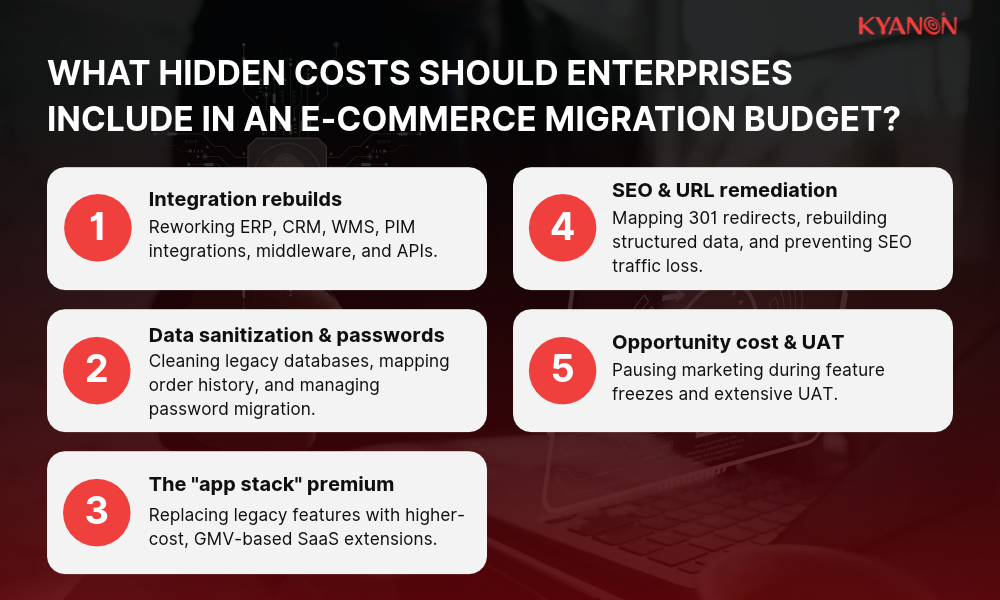
Enterprise eCommerce migrations frequently overrun budgets due to hidden technical and operational expenses. To avoid financial surprises, make sure to add these items to your ecommerce replatforming checklist and always budget 15% to 30% above the platform licensing fee to cover these five core hidden costs:
- Integration rebuilds: Reworking connections to ERP, CRM, WMS, and PIM systems, alongside custom middleware development and API rate-limit upgrades.
- Data sanitization & passwords: Cleaning legacy database schemas, mapping historical orders, and running campaigns to handle unmigrateable customer passwords.
- The “app stack” premium: Replacing native legacy features with third-party SaaS extensions, which often charge higher, GMV-indexed rates for enterprise tiers.
- SEO & URL remediation: Mapping thousands of 301 redirects, rebuilding structured data, and hiring specialists to mitigate post-launch organic traffic drops.
- Opportunity cost & UAT: Pausing your marketing roadmap during feature freezes, combined with extensive end-to-end user acceptance testing (UAT).
How can you calculate the total cost of ownership of Ecommerce replatforming?
To calculate the Total Cost of Ownership (TCO) precisely, leading research firms like Forrester and major commerce authorities recommend evaluating expenses over a 3-to-5-year lifecycle rather than focusing strictly on initial launch numbers.
According to framework criteria defined by Salesforce and BigCommerce, the definitive equation is: TCO=Initial Build Costs+(Annual Ongoing CostsTimeframe)
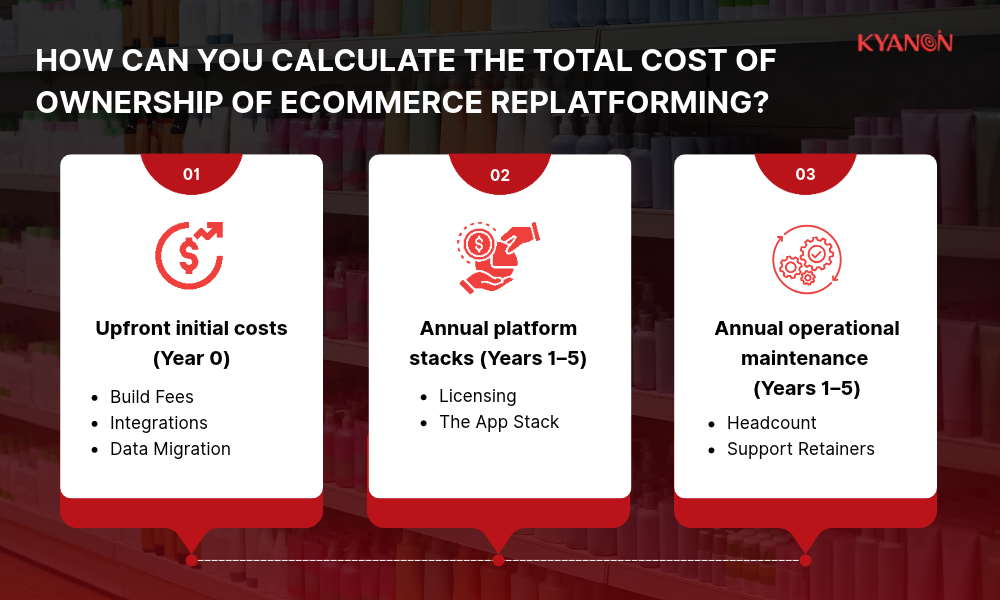
The three financial pillars
Upfront initial costs (Year 0)
- Build Fees: UI/UX design, custom backend programming, and core configuration.
- Integrations: Connecting data lines to ERP, CRM, and PIM infrastructure.
- Data Migration: Cleaning, restructuring, and uploading legacy catalogs and order histories.
Annual platform stacks (Years 1–5)
- Licensing: Subscription tiers, infrastructure usage, or percentage-of-revenue variables.
- The App Stack: Recurring costs for payment gateways, specialized search tools, tax calculation software, and security tools.
Annual operational maintenance (Years 1–5)
- Headcount: Loaded salaries for internal developers, system admins, and merchandisers.
- Support Retainers: Agency contracts for immediate security patching, version upgrades, and ongoing QA.
How can Kyanon Digital help enterprises plan an Ecommerce replatforming investment?
A successful eCommerce replatforming investment starts with understanding what the business needs to change, what existing systems must remain connected, and which capabilities will deliver measurable value.
Kyanon Digital helps enterprises approach B2B ecommerce replatforming as a business transformation initiative, aligning platform decisions, integration requirements, and delivery priorities with long-term operational goals.
Case study: Integrated Commerce Platform For Thailand’s Largest Retail Group
Integrated commerce platform for Thailand’s largest retail group
Business challenges
The retailer faced limitations with its legacy eCommerce platforms as online demand and omnichannel expectations increased. Its main challenges included:
- Inflexible legacy systems that struggled to support high-volume transactions and marketplace integration.
- Fragmented operations across inventory, pricing, promotions, and order management.
- Inconsistent customer experiences across mobile apps, websites, and third-party marketplaces.
- Complex order fulfillment across physical stores, warehouses, and external platforms.
Kyanon Digital’s solution
Kyanon Digital delivered an integrated commerce transformation built around three initiatives:
- Microservices architecture: Designed a scalable, modular architecture and core operational engine to coordinate inventory, pricing, promotions, orders, and customer engagement.
- Mobile ordering application: Delivered a proprietary mobile app within six months, enabling product browsing, personalized promotions, ordering, and delivery tracking.
- Omnichannel integration: Connected the commerce platform with mobile, web, and marketplaces including GrabMart, Tiki, Shopee, and Lazada, enabling centralized product, pricing, inventory, and promotion management.
Results and impact
- Managed 26,000+ SKUs across six digital sales channels.
- Processed 8,000+ orders daily.
- Enabled real-time inventory management across 9 TopsMarket stores.
- Transitioned 99% of offline promotions to online campaigns.
- Delivered a mobile ordering application within 6 months.
- Integrated multiple sales channels to support centralized product, pricing, inventory, and promotion management.
Explore the full case study here: Integrated Commerce Platform For Thailand’s Largest Retail Group
Conclusion
eCommerce replatforming is a strategic investment that requires more than selecting a new platform. Enterprises must evaluate integration complexity, data migration, operational requirements, and long-term total cost of ownership to avoid unexpected expenses and ensure business continuity. Kyanon Digital helps enterprises modernize commerce architecture, integrate business systems, and build scalable eCommerce solutions aligned with business goals.
Planning an eCommerce replatforming project? Contact Kyanon Digital to discuss your existing commerce architecture, migration scope, and implementation priorities.
References
- B2B Commerce Replatforming Benchmarks 2026 – Classy LLAMA
- Integrated Commerce Platform For Thailand’s Largest Retail Group – Kyanon Digital
- Ecommerce TCO: How to Calculate, Optimise, and Reduce Costs – Salesforce
- Commerce Platform Modernization Services – Kyanon Digital
- Ecommerce Replatforming and Migration Guide for 2026 – Shopify
- Top Shopify Development Companies in Singapore – Clutch
- White Glove Migration: A Guide to Fully Managed Replatforming – Shopify
- Platform Modernization for Commerce: A Decision Framework for CTOs – Shopify










 Create project brief with AI