

Manufacturers looking to hire AI developers should define their use cases first, then match the team to the required AI, data, OT/IT, and deployment capabilities. Different use cases require different skills, so relying on one generalist can create capability gaps.
A practical approach is to compare sourcing models and assess developers through real-world manufacturing scenarios, including industrial data, existing systems, and production constraints. Dedicated and offshore AI teams can provide specialized capabilities without requiring manufacturers to build every role in-house.
Based on Kyanon Digital’s enterprise AI experience, this guide covers sourcing models, team structure, evaluation criteria, and practical assessments for hiring AI dedicated developers in manufacturing. Kyanon Digital also provides dedicated AI teams across development, data, integration, and deployment as use cases scale.
Key takeaways
- Manufacturing AI hiring requires more than ML skills. Developers need OT/IT integration, industrial data, edge environments, and production constraints.
- Test real-world capabilities, not just theory. Noisy data and edge-deployment scenarios reveal whether candidates can build reliable production AI.
- Match skills to the use case. Predictive maintenance, computer vision, GenAI, and yield optimization require different capabilities.
- Choose the sourcing model based on scale. In-house offers control, freelancers fit focused tasks, while dedicated teams support multiple AI use cases.
- Start with one clear use case and reliable data. A focused pilot helps validate technical and business outcomes before scaling.
- Manufacturing AI needs cross-functional expertise. Kyanon Digital’s experience shows that combining AI, data, integration, and deployment capabilities is key to addressing real production needs.
Further reading:
- Outcome-Based AI Dedicated Agile Teams in Vietnam
- AI-Native Software Development for Enterprises in Singapore
- Build Your Offshore Dev Team in Vietnam 2026
- What Is an AI-Native Engineering Team? (2026 Guide)
How we evaluate AI-dedicated developers for industrial AI roles
Standard software engineering signals, such as coding challenges, GitHub activity, or machine learning theory questions, do not fully reveal whether a developer can work effectively in a manufacturing environment.
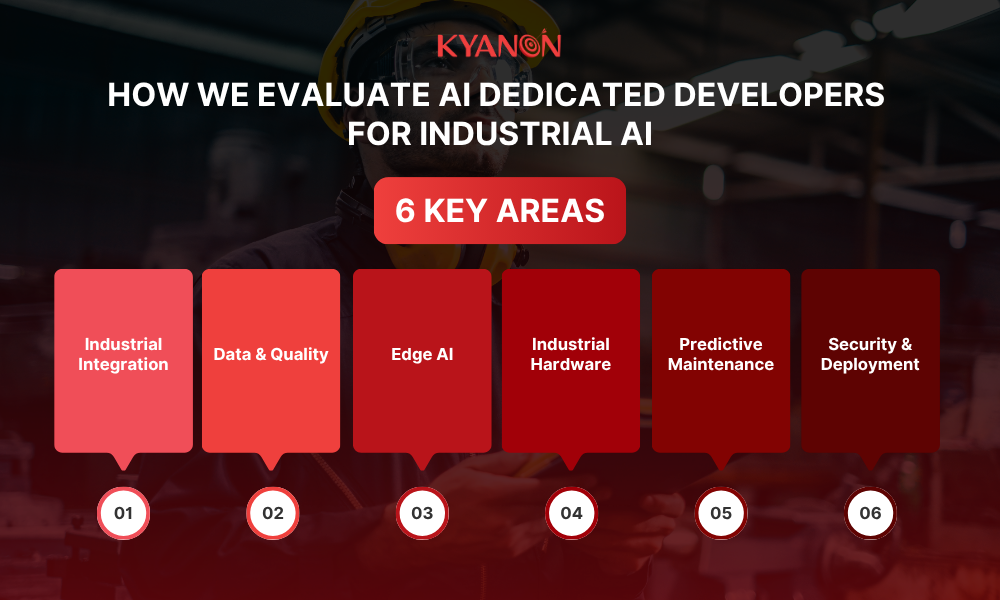
Industrial AI sits at the intersection of AI models, physical equipment, industrial data, and operational constraints. NIST’s smart manufacturing research highlights heterogeneous sensing and control systems, industrial data management, reliability, explainability, and safety as important considerations for deploying AI in production environments.
We therefore evaluate candidates from two perspectives: can they build the technology, and can they make it work within the realities of the plant?
Evaluating industrial AI capabilities
Technical / OT POV | Business / Operations POV |
| Industrial protocols: Can they connect PLCs, SCADA, and CNCs via OPC UA, MQTT, Modbus, or PROFINET safely? | Data scarcity: Can they handle limited defect data through synthetic data, augmentation, and plant-floor validation? |
Edge AI: Can they deploy lightweight models on-prem when cloud latency or connectivity is a constraint? | Real-time decisions: Can they turn AI outputs into decisions operators can act on quickly? |
| Hardware fluency: Can they work across PLCs, IPCs, smart cameras, robotics, and multi-vendor setups? | Predictive maintenance: Can they estimate actionable remaining-useful-life windows, not just healthy/failing states? |
Industrial cybersecurity: Can they deploy AI securely while protecting plant networks and sensitive data? | Operational scalability: Can they integrate AI into existing workflows and scale across plants without adding excessive complexity? |
The technical bar should be tied to measurable production outcomes, not model accuracy alone. McKinsey’s research on semiconductor manufacturing highlights the potential impact: AI-powered equipment diagnostics can reduce machine downtime by 30% on average, while LLM-based maintenance applications can increase labor productivity by up to 35% and free up to 20% of maintenance technicians’ time.
Developer evaluation should therefore focus on whether candidates can connect model performance to plant performance through reliable data ingestion, appropriate edge deployment, safe system integration, and measurable quality or maintenance improvements.
These requirements can be tested through practical hiring simulations such as the Noisy PLC Challenge and Live Edge Deployment Sandbox, which assess how candidates handle real industrial constraints.

Quick comparison: Sourcing your manufacturing AI team
Building an AI team for manufacturing requires more than finding AI talent. The team must understand factory operations, data, AI, and enterprise systems while balancing speed, control, scalability, and long-term capability building.
AI sourcing model comparison
Sourcing model | Best for | Speed & cost profile | Key advantage | Main watch-outs |
| In-house hire | Proprietary AI and long-term capability building. | Slower hiring and higher fixed costs; U.S. manufacturing median: $136,330/year. | Maximum control, knowledge, and IP ownership. | Limited internal AI expertise can constrain scaling. |
Freelance / gig | Focused tasks and short-term support. | Quick to start with flexible hourly or project-based costs. | Targeted expertise without long-term commitment. | Harder continuity as projects expand. |
| Offshore dedicated team | Scaling AI use cases across plants or initiatives. | Flexible capacity; Vietnam providers commonly list $25–$49/hr. | Scale without building every role internally. | Requires strong governance, security, and ownership. |
Source: U.S. Bureau of Labor Statistics, Clutch
The right model depends on how far the AI initiative needs to scale. In-house hiring offers the strongest control for proprietary capabilities but can be constrained by specialized talent availability. Freelancers provide flexibility for focused technical needs, while dedicated teams are better suited to initiatives that require multiple capabilities to work together throughout a longer delivery cycle.
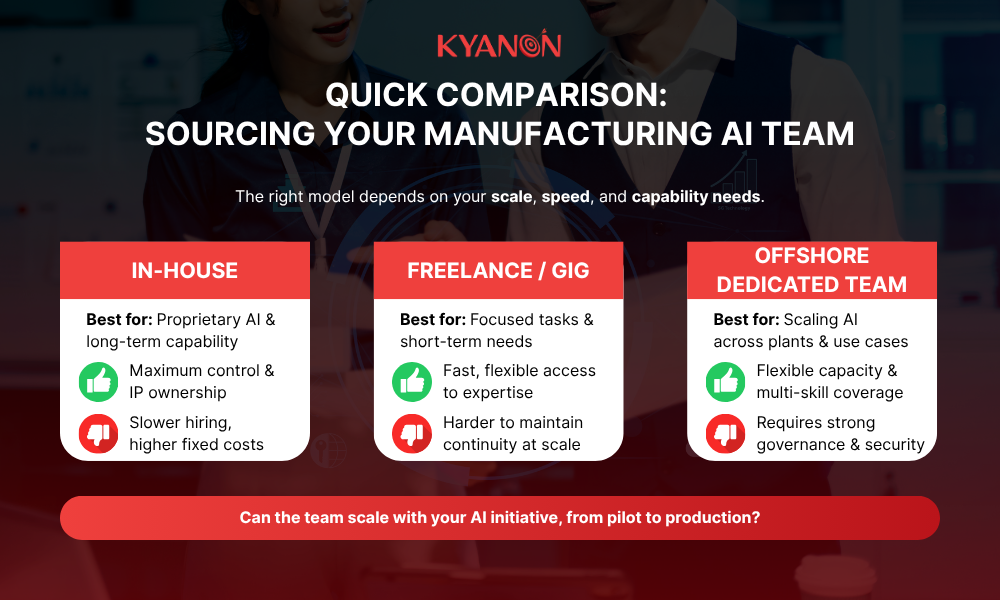
This distinction becomes increasingly important as manufacturers move from pilots toward production. Gartner reports that 56% of supply chain leaders cite legacy-system integration as a major AI challenge, while 50% report limited internal AI expertise or talent. A dedicated team can help address these constraints by adding the capabilities needed for integration, deployment, and ongoing expansion without requiring every role to be built internally.
For enterprises, the sourcing decision should therefore consider not only how quickly a team can start, but also whether it can support the initiative as it moves from a single use case to broader deployment across production environments.
The 4 types of AI dedicated developers manufacturing needs
Manufacturing AI is not a one-size-fits-all capability. Predictive maintenance, visual inspection, operational knowledge, and production optimization solve different business problems and require different data and engineering capabilities. The right developer profile therefore depends on the factory’s operational priorities, data maturity, and AI roadmap.
Key AI developer profiles
Developer type | Primary use case | Business outcome | Best time to hire |
| Predictive maintenance engineer | Equipment monitoring & failure prediction | Reduce downtime & improve asset life | Sensor data is available |
Computer vision quality engineer | Automated visual defect inspection | Increase quality & reduce defects | Inspection is a bottleneck |
| Generative AI & knowledge architect | Maintenance knowledge retrieval | Speed up troubleshooting | Docs are fragmented |
Supply Chain & yield optimization engineer | Production & resource optimization | Improve yield & operational efficiency | Plant workflows are mature |
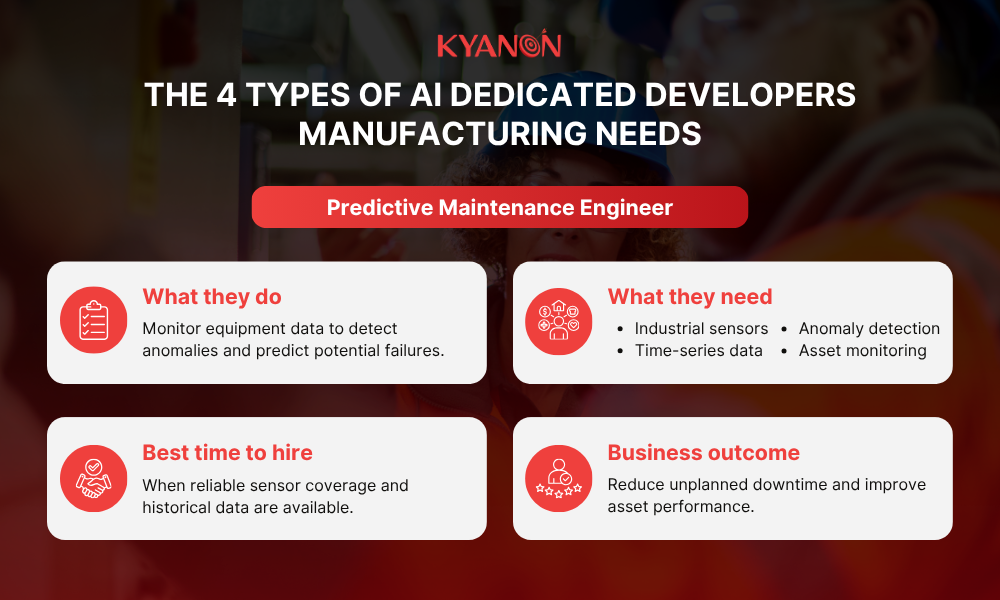
Predictive maintenance engineer
Predictive Maintenance Engineers help manufacturers move from reactive maintenance toward earlier intervention. They use equipment and sensor data to identify abnormal behavior, anticipate potential failures, and support more proactive maintenance decisions.
At CITIC Dicastal, McKinsey reported that AI-enabled transformation increased overall equipment effectiveness by 17% and labor productivity by 27%. Predictive maintenance using knowledge graphs was among the approaches used to improve equipment performance and reduce downtime.
Best fit: Factories with critical assets, consistent sensor coverage, reliable historical data, and a measurable cost associated with unplanned downtime.
Computer vision quality engineer
Computer Vision Quality Engineers apply AI to automate visual inspection and identify defects at production speed. The role is particularly valuable where inspection is repetitive, labor-intensive, or difficult to perform consistently.
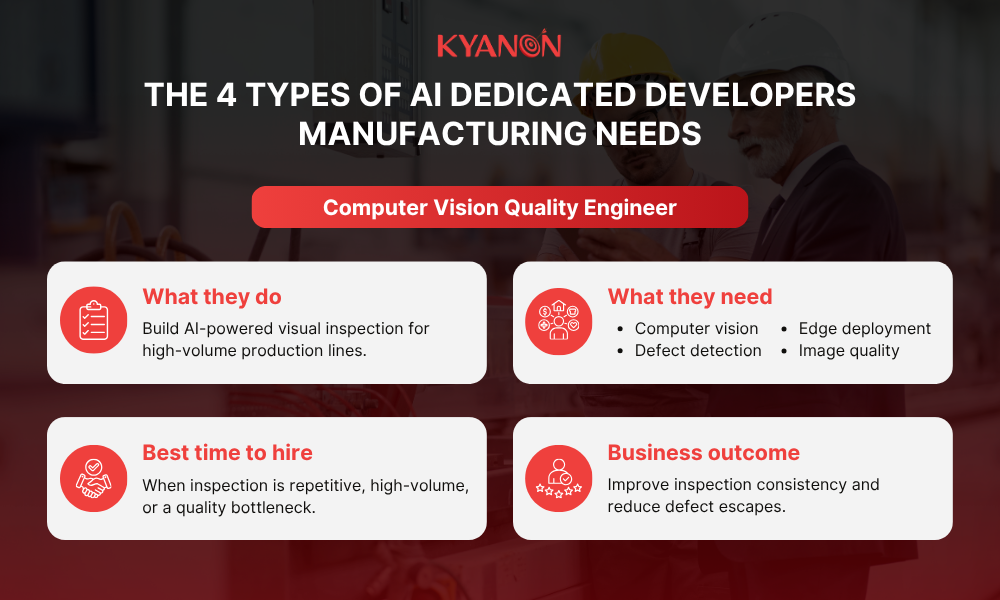
At CITIC Dicastal, AI-enabled vision systems were deployed to inspect complex automotive components at high speed. McKinsey reported that the broader AI-enabled transformation reduced defect rates by more than 30%.
The developer needs to understand both the AI model and factory-floor constraints, including production cameras, edge environments, and real-time processing.
Best fit: High-volume production lines where manual inspection has become a quality, speed, or scalability bottleneck.
Generative AI & knowledge architect
Generative AI & Knowledge Architects make fragmented manufacturing knowledge easier to access and reuse. They connect maintenance records, SOPs, manuals, engineering documents, and other operational sources to support troubleshooting and decision-making.
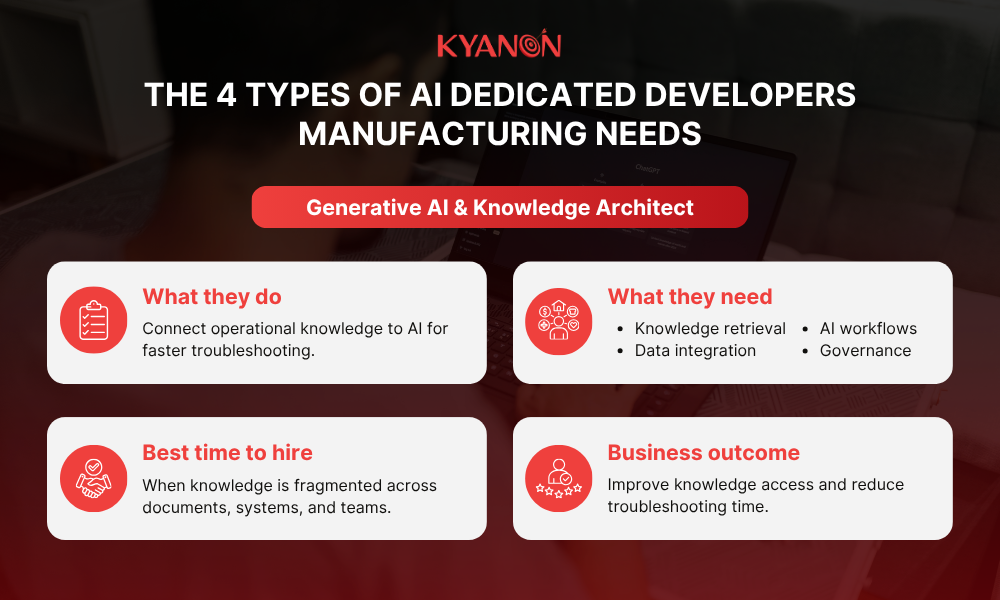
The business case is becoming increasingly measurable. According to McKinsey, LLM-based maintenance tools in semiconductor manufacturing can free up to 20% of maintenance technicians’ time, increase labor productivity by up to 35%, and reduce total cash costs per mask layer by up to 3%.
Best fit: Manufacturers where critical know-how is distributed across documents, systems, and experienced employees rather than available through a centralized knowledge base.
Supply chain & yield optimization engineer
Supply Chain & Yield Optimization Engineers focus on improving interconnected decisions across production, materials, inventory, capacity, and resource usage. Their role goes beyond building an optimization model: they need to connect AI with existing manufacturing and supply chain workflows and demonstrate measurable operational impact.
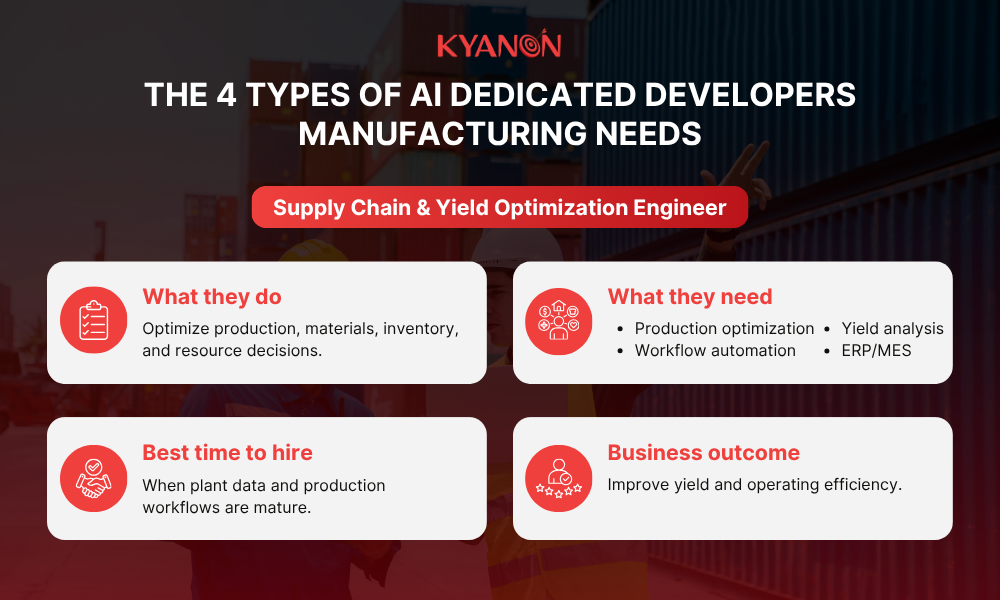
As AI moves deeper into supply chain operations, the technology mix is also changing. Agentic AI and physical AI are among the top supply chain technology trends. Physical AI refers to AI systems that interact with and operate in physical environments, often through robotics, sensors, and connected industrial systems. In manufacturing and supply chain environments, these systems can support real-time sensing, analysis, and physical execution.
Best fit: Manufacturers with mature plant data, established production workflows, and enough system integration to support optimization at scale.
How to choose the right AI dedicated developer for your factory floor
Choosing the right AI developer is not simply about assessing technical skills. The right resource must fit the factory’s data readiness, project scope, and operational goals. Before evaluating individual developers or dedicated teams, manufacturing leaders should first establish whether the environment is ready for AI and what capabilities the project actually requires.
Industrial AI readiness checklist
Key Question | Hiring Implication |
| Which process is AI-ready? | Start with a well-understood production line with reliable sensor data to support a measurable pilot. |
What capabilities are required? | Hire an individual specialist for focused PoCs, or a dedicated cross-functional team for broader roadmaps. |
| What outcome should the pilot prove? | Select partners or developers focused on tying technical delivery to key operational metrics like downtime or defect reduction. |
These questions help prevent a common mistake: hiring AI talent before defining where that talent can create value. Once the initial use case, team structure, and success criteria are clear, the next step is to assess whether candidates can handle the realities of a factory environment.
Traditional coding assessments can show whether a developer can write software, but they may not reveal how well they can work with imperfect industrial data or production constraints. For manufacturing AI projects, practical assessments should therefore reflect the conditions candidates will encounter on the factory floor:
- The noisy data challenge: Provide candidates with an industrial dataset featuring missing readings, timestamp inconsistencies, and anomalies. Have them explain their approach to data cleaning, pattern recognition, and model validation.
- The edge deployment challenge: Present a computer vision scenario with specific hardware, latency, memory, and connectivity limits. Ask candidates how they would prepare the model for deployment and ensure reliable production performance, testing their grasp of capacity, connectivity, and response time.
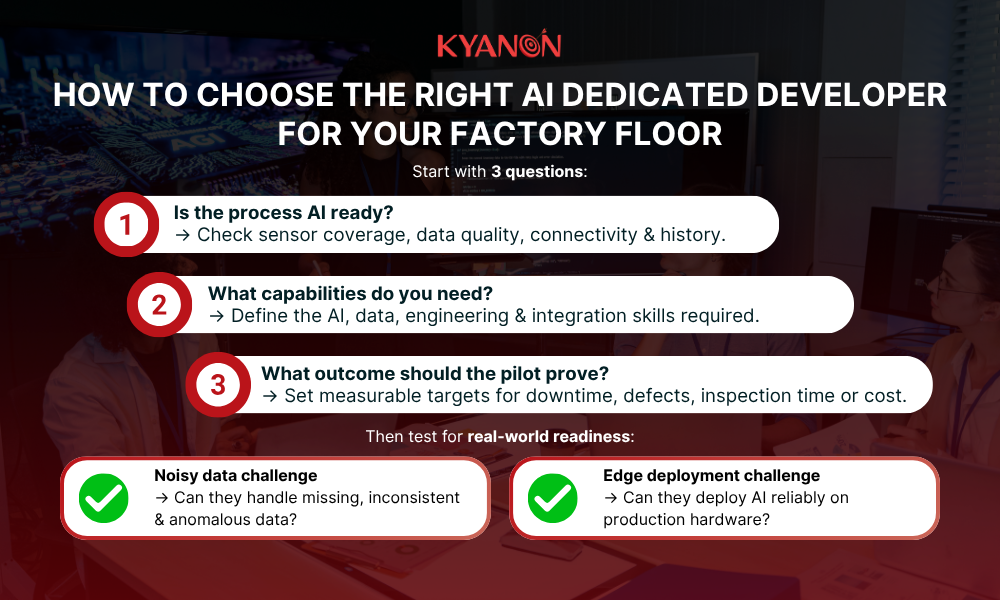
Together, these exercises assess two capabilities that factory AI projects cannot overlook: working with real-world operational data and making AI reliable in production.
“Manufacturing AI creates value when it works with the realities of the plant, not just the possibilities of the model.”
— Kyanon Digital
As AI moves deeper into factories, developers need to combine AI capabilities with an understanding of production data, plant environments, and operational requirements. For manufacturing leaders, the strongest candidates bring both AI expertise and practical manufacturing understanding, helping move solutions from controlled pilots to scalable production use.
Case study: How Kyanon Digital helped a Singapore retailer automate supply chain operations
Although the project was delivered for a retail environment, it demonstrates capabilities that are also relevant to manufacturing operations, including intelligent document processing, ERP integration, reconciliation, inventory visibility, and scalable automation.
Kyanon Digital partnered with a leading Singapore-based retailer operating across retail stores, eCommerce, and B2B channels to automate supplier document processing, financial reconciliation, and inventory management.
The challenge:
Thousands of supplier documents arrived daily in inconsistent formats. Manual reconciliation and fragmented inventory systems created bottlenecks, stock discrepancies, and fulfillment gaps.
The solution:
Kyanon Digital deployed an intelligent supply chain automation platform integrated with SAP, POS, and omnichannel systems:
- AI document processing: Automated invoice and delivery document extraction and validation.
- Automated reconciliation: Matched invoices, goods receipts, and ERP records while routing exceptions for review.
- Real-time inventory sync: Connected inventory across retail, eCommerce, and B2B channels.
- Scalable integration: Standardized connectors simplified supplier and channel onboarding.
The impact:
- 90% reduction in manual data-entry time.
- Invoice processing reduced from days to under 30 minutes.
- 80%+ reduction in inventory discrepancies.
- Automated three-way reconciliation.
- Scaled operations without proportional headcount growth.
Read more: Scaling Singapore Retail Operations with Intelligent Supply Chain Automation
Trends shaping manufacturing AI hiring
Industrial manufacturing is governed by distinct technological shifts that dictate how enterprises recruit, structure, and deploy engineering resources:
Industrial AI hiring trends
Trend | What’s changing | What to look for |
| AI moves from pilots to production | AI is moving into production-scale applications. | Production deployment & scaling experience. |
OT/IT convergence becomes essential | AI increasingly connects IT, OT, IIoT, and robotics. | PLC, SCADA, MES, ERP & OT/IT expertise. |
| Edge AI and physical AI gain momentum | AI is moving closer to machines and real-time operations. | Edge deployment & real-time AI skills. |
Synthetic data supports rare-defect detection | Synthetic data is helping address limited defect samples. | Computer vision & model validation skills. |
| Hybrid and sovereign AI becomes more relevant | Data control, security, and IP are gaining importance. | Private, hybrid & edge deployment skills. |
Specialized AI teams enable faster scaling | Demand for AI + domain expertise is rising. | Specialized manufacturing AI talent. |
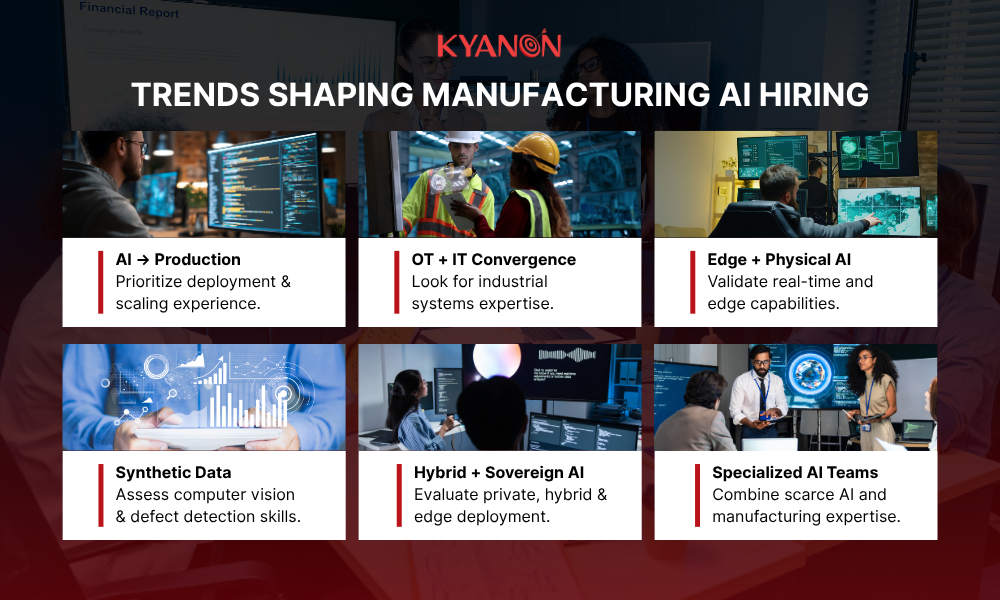
The hiring bar is shifting from AI expertise alone to AI + industrial expertise. Buyers need teams that can integrate AI with existing OT/IT systems, move solutions from PoC to production, and deploy reliably across edge, hybrid, and private environments.
Final thoughts
Manufacturing AI hiring is about more than finding developers who understand machine learning. Successful industrial AI initiatives require engineers who can operate within the physical and digital constraints of the factory floor, including deterministic cycle times, legacy PLCs, noisy sensor data, thermal thresholds, and zero-downtime requirements.
For manufacturers building or scaling AI capabilities, the key question is not simply “Can this developer build an AI model?” The better question is “Can this developer deploy and operate AI reliably within our production environment?” Starting with one production line and the best available data, validating candidates through practical exercises such as the Noisy PLC Challenge and Live Edge Deployment Sandbox, and moving to a dedicated AI development team when multiple use cases emerge can create a more scalable path to operational AI.
Looking to build manufacturing AI capabilities with engineers who understand both AI and industrial environments?
Contact Kyanon Digital to hire AI dedicated developers for manufacturing AI initiatives.



 Create project brief with AI