

An earlier warning creates value only when the business can choose and carry out a better response. For manufacturers and distributors, the unit of AI adoption is a repeatable decision, not a model.
By Rosy Giang Tran, Consulting Practice Lead, Kyanon Digital – Digital Consulting, Data, BI & AI
Key takeaways
- AI earns its keep when four things hold together: a timely signal, a feasible action, an accountable owner and a measurable result.
- Use models for uncertainty, rules for non-negotiable constraints, and people for trade-offs.
- Grow AI’s authority with evidence: observe, then advise, then execute within policy, starting in shadow mode.
It is Tuesday morning. A planner opens the exception list and sees a familiar product at the top: the one-litre floor cleaner is selling faster than expected in Hanoi. The distributor has about three days of cover, and HCMC has fourteen. Released stock sits at the central warehouse, a batch is waiting for quality approval, and orders are due before the next replenishment.
The question is no longer whether Friday’s report will show a shortage. It is whether the business can change the result while there is still time.
This series has built toward this moment. Week 1 exposed the blind spot between factory and market. Week 2 designed a data product that keeps status, ownership and observation time intact. Week 3 turned it into shared measures and an allocation decision with a named owner. AI can now take on a specific job: spot the risk earlier, help compare actions within the business’s constraints, and learn from what the team actually decides.
A warning is worth only as much as the move it enables
AI pays off in a decision like this only when four conditions hold together:
- A meaningful signal. The risk is detected with enough confidence while a choice is still open.
- A feasible action. Released stock, capacity, transport and allocation rights allow an intervention.
- An accountable owner. Someone can approve the trade-off and make the change happen.
- A measurable result. The business can compare the outcome with the old process.
A highly accurate forecast with no usable stock behind it improves visibility, not service. A modest but timely warning that lets a planner redirect a batch before dispatch closes may be worth far more. So the investment case should rest on one question: which decision changed because of the system, and what did the change achieve?
There is one honest limit. A Tuesday warning about Hanoi needs a Tuesday signal, either from an integrated distributor DMS or from a clearly labelled estimate built on orders and sell-in. If the only stock file still arrives on Friday, no model can turn it into a confirmed Tuesday observation.
Exhibit 1 – The Tuesday warning card
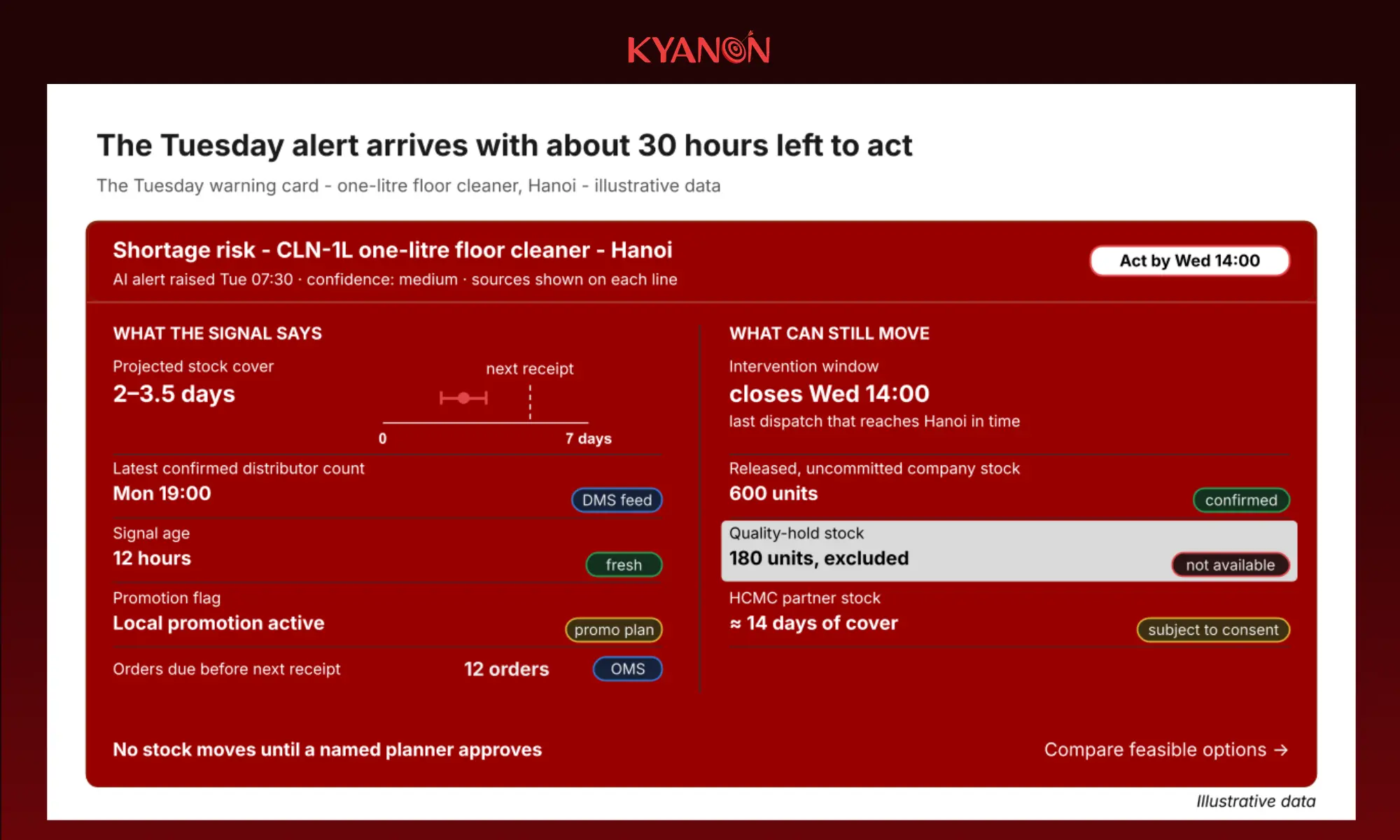
The left side says how serious the risk is and how fresh the evidence is. The right side says what can still move before the window closes, and it keeps held stock out of the available total.

Match the method to each job in the decision
“Use AI for supply chain” is too broad to design or evaluate. The shortage decision contains four distinct jobs, and each needs a different method:
| Job | Suitable method | What it produces | Boundary |
|---|---|---|---|
| Recognise emerging demand | Forecasting or anomaly detection, compared with a simple baseline | Risk by product, location and horizon, with uncertainty |
Zero sales during a stockout may mean zero stock, not zero demand |
|
Establish eligibility |
Versioned business rules on reconciled events | Released, uncommitted, transferable stock and valid production options | Quality hold, partner ownership and commitments are hard constraints |
| Compare feasible actions | Optimisation or scenario analysis on approved objectives | Ranked options with service effect, arrival time, cost and displaced orders |
Never optimise one region by hiding a larger loss elsewhere |
|
Explain and route |
BI workflow plus, where useful, a grounded language assistant | Evidence summary, rationale, named approver, action record |
A generated explanation never authorises a stock movement or a release |
This split gives leaders a practical way to question any AI proposal. Which part predicts? Which enforces policy? Which compares trade-offs? Which simply helps a person understand the answer? Each part can be tested and improved separately. A transparent rule usually beats a model at deciding whether a batch is released. A model earns its place where promotion-driven demand cannot be captured by a fixed threshold.
Exhibit 2 – A recommendation is a stack of methods
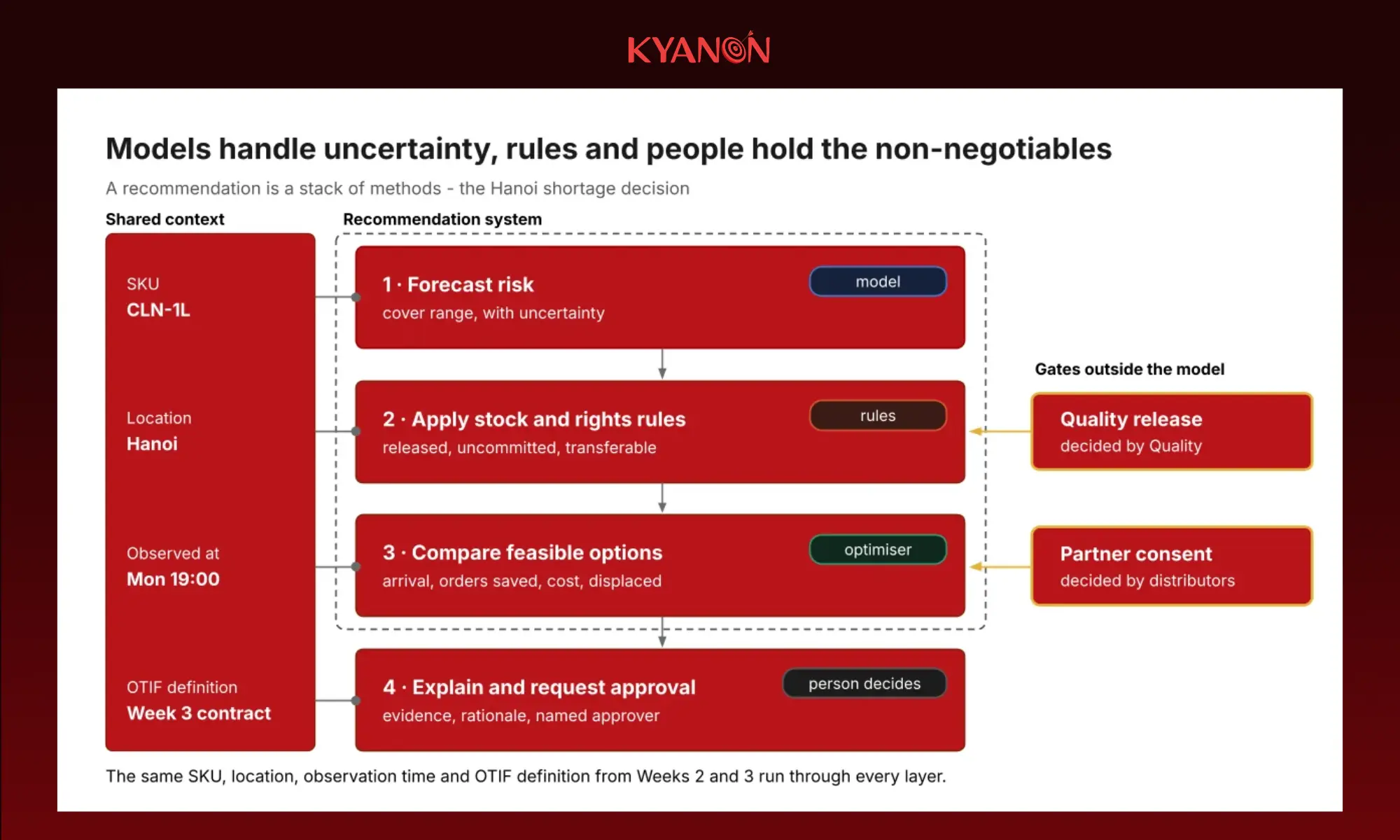
Only the first layer is a statistical model. Eligibility is set by rules, quality release and partner consent come from outside the system, and a named person makes the final call.
What AI adds to the allocation choice
Week 3 set out three options: reallocate company stock, request an HCMC-to-Hanoi partner transfer, or change the next production mix. AI does not replace that decision canvas. It improves it in four ways:
- It filters options that cannot arrive before the shortage or that break a hard constraint, before the meeting starts.
- It estimates each remaining option’s effect: orders protected, orders put at risk elsewhere, earliest arrival and incremental cost, all with visible confidence.
- It explains why each option is feasible or excluded, and which conditions would invalidate the recommendation.
- It records whether the planner accepted, amended or rejected the recommendation, and why.
A planner may reject every option and manage customer commitments instead. That can be the right call if every move would arrive too late or cause a bigger loss elsewhere. A rejection with a recorded reason is evidence for learning, not a model failure. The system should also keep the expected effect at approval separate from the observed effect after execution. Those are different claims, and credible value reporting depends on keeping them apart.
Authority grows with evidence
Industrial decisions differ in consequence and reversibility. Flagging a shortage carries little risk. A transfer proposal affects partners, freight and other customers. Changing production or releasing a held batch carries more still. A practical progression has three modes:
- Observe. AI identifies the risk and shows its evidence. People decide through the existing process.
- Advise. AI presents feasible options and trade-offs. A named planner approves the action.
- Execute within policy. For a narrow, tested, reversible task, AI carries out a pre-authorised action within explicit limits, with monitoring and a stop mechanism.
This is an operating choice, not a property of the model. The NIST AI Risk Management Framework calls for defined context, human oversight, testing, monitoring and risk ownership. In practice, that means documenting what the system may do, how fresh its evidence must be, who can override it, and what happens when a feed or a model misbehaves. In a first pilot, quality release stays with Quality, and partner-owned stock stays subject to the partner’s agreement.
Exhibit 3 – The authority ladder and its evidence gates
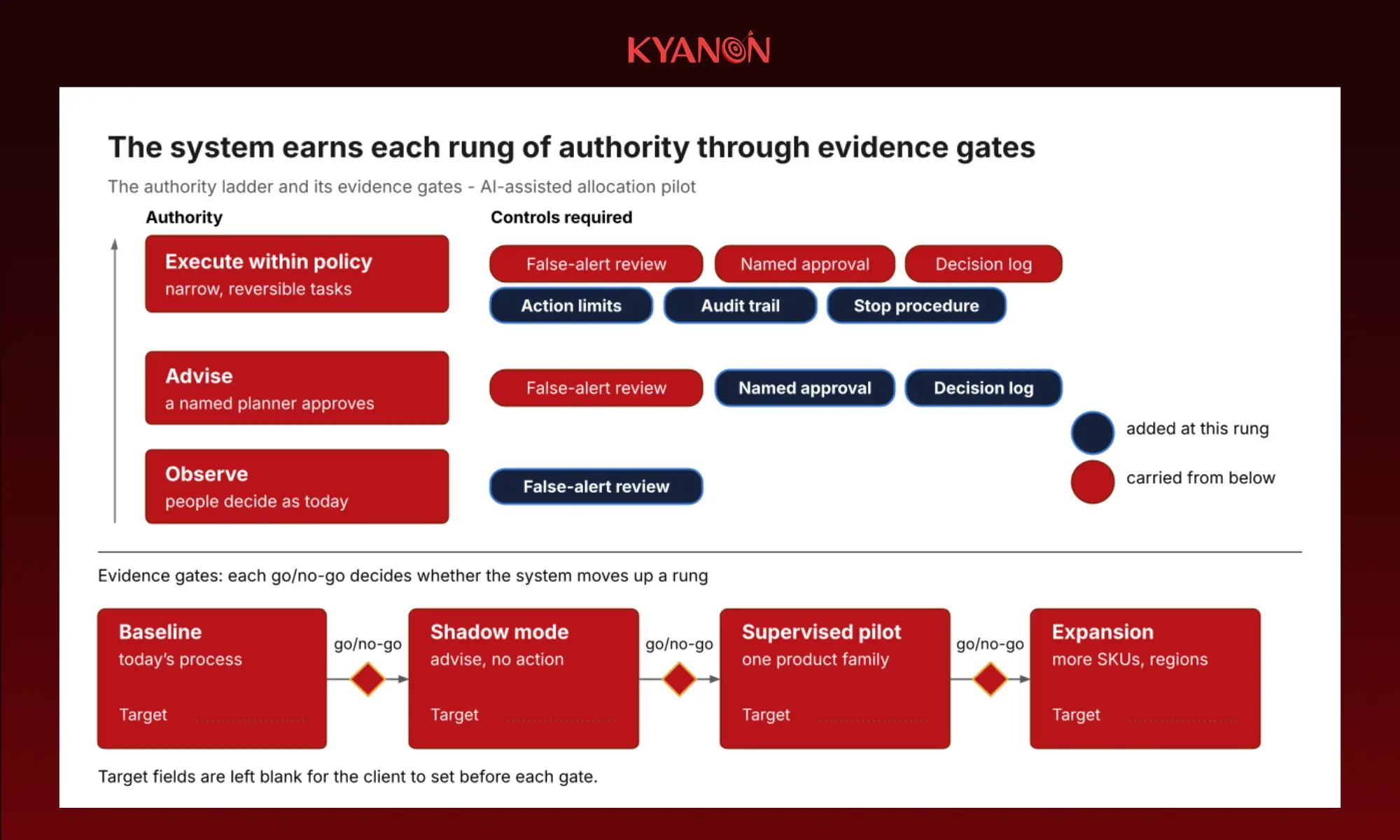
Each rung up the ladder adds controls on top of the ones below it. The system only climbs after it passes a go/no-go gate against targets the client sets in advance.
Judge the pilot by the operation, not the algorithm
Forecast accuracy is necessary but not sufficient. An alert can arrive after the dispatch cutoff. An accepted recommendation can move the shortage to another region. A model can look successful because experienced planners quietly correct it. So measure four levels against a baseline:
| Level | Questions to answer |
|---|---|
|
Data and model |
Was the signal available in time? What were source coverage, observation age, calibration and the false-alert burden? How did the model perform during promotions and stockouts? |
|
Decision |
Was the recommendation seen before the cutoff? Was it accepted, amended or rejected, and why? How long did approval take? |
|
Execution |
Was the approved change carried out as planned? Which hand-offs caused delay? |
| Business outcome |
What changed in stockout days, OTIF, emergency freight, excess stock and planning effort? Did one region’s gain cause a loss elsewhere? |
Run recommendations in shadow mode first, comparing them with what planners actually decide without changing operations. Then move to a supervised pilot on one product family and distributor network. Where possible, compare matched products or regions to separate the pilot’s effect from promotions, seasonality and Tết peaks.
Scale the pattern, configure the context
Scaling does not mean copying thresholds into every plant or region. Product codes, production calendars, release procedures, routes, distributor data terms and customer priorities differ. What travels is the shared core: product and location identities, the governed data product, OTIF and stock-cover definitions, model evaluation, permissions, monitoring and the action log. Each site then configures its local context: calendars, lead times, distributor feeds and approval roles.
The World Economic Forum’s 2026 Global Lighthouse Network report names scaling from pilots to enterprise systems as a central industrial challenge. The practical test is simple: can the second region reuse the core and go live faster than the first, to the same standard of evidence and accountability?
Client story: AI inside a Singapore retail supply chain
For a Singapore retailer scaling its supply-chain operations, we built AI-powered extraction of supplier documents, with low-confidence cases routed to people for review. The solution also included reconciliation connected to SAP and inventory synchronisation across channels. [Add a verified result metric if the client approves.]
This is the authority ladder in practice. AI handles the volume, rules and enterprise integration keep it inside policy, and people handle the exceptions.
The port and logistics Data Hub from Week 2 shows the other half of the pattern: AI models embedded on top of a governed data foundation rather than bolted onto fragmented sources.
The loop, end to end
The full journey is now visible. Find the consequential decision and its blind spot. Build a governed data product around what decision makers need to know. Define the measures and workflow that BI supports. Then use AI where earlier detection or better option comparison can change an action, and measure what changed.
How we help. Our Advanced Analytics & Forecasting and AI, GenAI & ML teams work on top of the data and BI foundation. We prioritise the use case and its baseline, build and integrate forecasting, optimisation and decision-support models, and support adoption, monitoring and scale. Explore our AI and data capabilities.
Your next step: AI pilot scoping. Choose one recurring shortage, allocation or replenishment decision. Bring the teams that own its data, approval and execution. We assess data readiness, design a shadow-mode pilot with a baseline and go/no-go gates, and show what data and BI can improve now versus what AI adds. Talk to our team · Download the full series as a playbook
See the change, trust the evidence, choose within constraints, act in time, learn from the result. Repeat that loop across decisions and sites, and you build a capability rather than a collection of demos.
The manufacturer, the Tuesday warning, the quantities, options and pilot are illustrative. Client stories are separate published engagements.



 Create project brief with AI