


A lean tech stack helps growing businesses scale without unnecessary software costs, technical debt, or operational complexity. The right approach is to simplify redundant tools, modernize performance bottlenecks, and adopt modular, AI-ready architecture where justified. Businesses should prioritize integration, scalability, and long-term maintainability rather than choosing the cheapest tools or rebuilding entire systems prematurely.
As businesses grow, their technology stacks must support increasing workloads, expanding operations, and new AI capabilities without driving up costs, technical debt, or operational complexity. However, fragmented systems, redundant tools, and integration limitations can make scaling increasingly difficult.
The key decision is whether to simplify existing systems, modernize critical components, or adopt a more scalable architecture while maintaining operational efficiency and cost control.
In this guide, Kyanon Digital draws on its experience in enterprise software engineering, IT architecture, and digital transformation to explain how businesses can evaluate their existing tech stacks, address scaling bottlenecks, and make technology decisions that support sustainable growth.
Key takeaways
- Choose minimum justified complexity: build for the next credible growth constraint, not an imagined future architecture.
- Simplify first when the real problem is duplicate SaaS, manual synchronization, fragmented data, or excessive operational overhead.
- Modernize selectively when one database, integration layer, application, or infrastructure component is creating a measurable scaling bottleneck.
- Kyanon Digital recommends separating genuine architecture constraints from process or integration problems before committing to a large re-platforming initiative.
- A lean AI tech stack needs governed data, observable costs, APIs, and replaceable components, not simply another AI tool.
Further reading:
- How Does Platform Modernization for Commerce Work in Singapore?
- Singapore’s Shortcut to Reliable Software Delivery
- AI-Driven Software Development for Enterprises
- Enterprise Digital Commerce Transformation in Singapore
- Fintech IT Consulting: Singapore Scale & Compliance
What does a lean tech stack mean for a growing business?
A lean tech stack maximizes business value while minimizing unnecessary technology costs, system complexity, and maintenance effort. It combines essential software, infrastructure, and integrations to support current operations while remaining flexible enough to accommodate future growth.
However, lean does not necessarily mean using fewer tools. A five-tool stack that relies on manual data transfers may be less efficient than eight well-integrated systems with automated workflows, clear ownership, and reliable data synchronization.
Practical example: Simplifying a growing retail tech stack
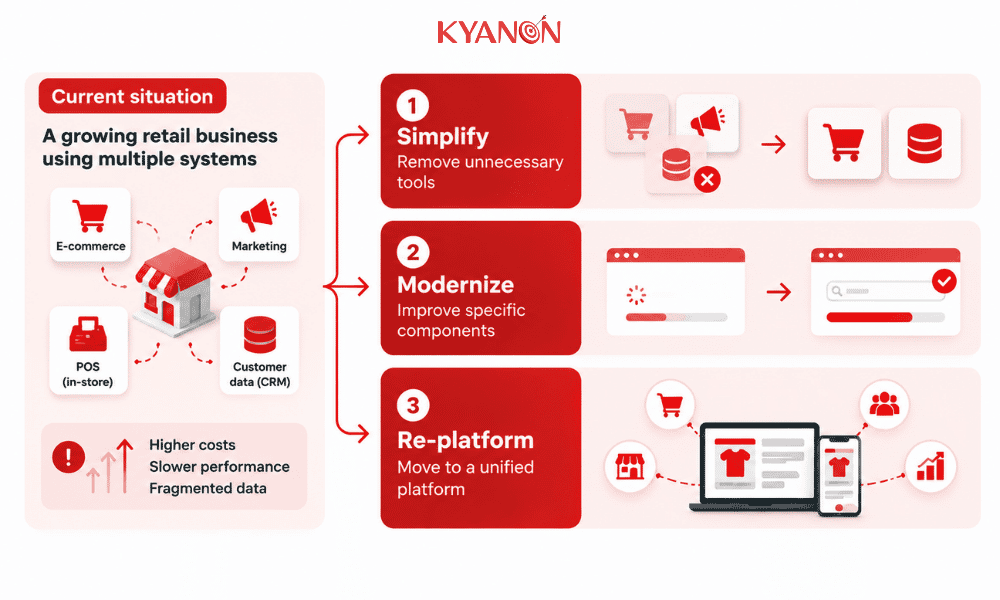
Consider a growing retailer using separate platforms for e-commerce, inventory management, CRM, and marketing. As order volumes increase, employees must manually synchronize customer information, stock levels, and promotional data across systems.
Instead of replacing every platform or building a complex new infrastructure, the retailer could adopt a leaner approach by:
- Retaining existing systems that still meet operational requirements.
- Connecting platforms through APIs to synchronize inventory, orders, and customer data.
- Automating repetitive workflows to reduce manual data entry and reconciliation.
- Introducing new infrastructure only when needed to address verified performance or scalability constraints.
The result is a more connected technology ecosystem with fewer manual dependencies and less unnecessary complexity, without the disruption of a complete system replacement. These are illustrative benefits, not measured outcomes from a specific project.
From Kyanon Digital’s perspective, the goal is to build an architecture that scales with business needs without adding unnecessary complexity. Before adopting, replacing, or upgrading technology, businesses should evaluate three questions:
- Business value: What operational capability or business objective does this technology support?
- Scalability: Can it accommodate increasing users, transactions, data volumes, and integrations without becoming a bottleneck?
- Cost and maintainability: Can the technology be maintained, secured, integrated, and upgraded without disproportionate costs or engineering effort?
These considerations help businesses distinguish between technologies that genuinely support growth and those that introduce avoidable technical debt. A lean architecture should therefore prioritize modularity, interoperability, operational efficiency, and long-term scalability rather than simply reducing the number of tools.

Principles of lean tech stack architecture
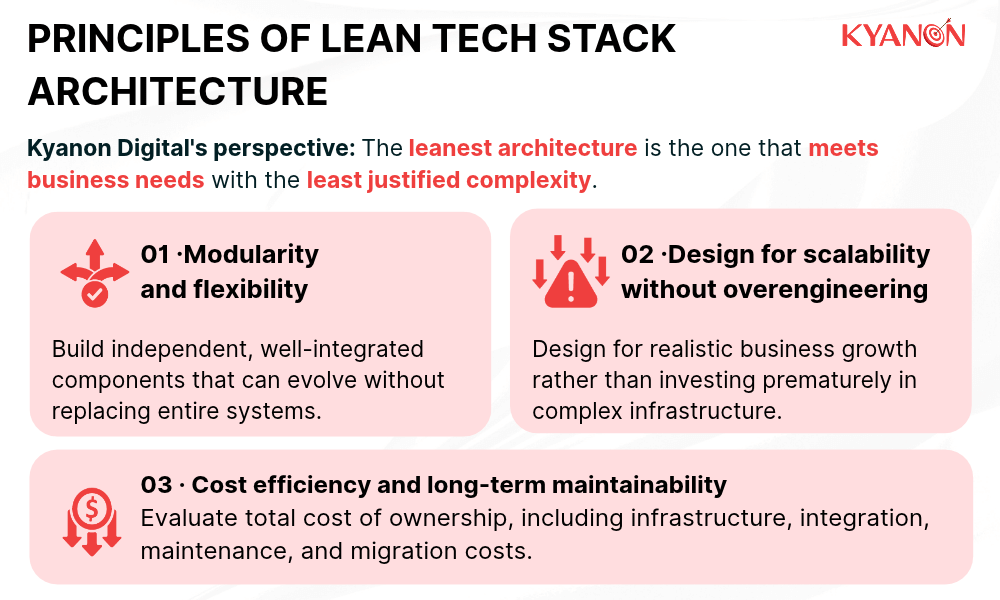
Building a lean tech stack requires balancing scalability, cost efficiency, and long-term maintainability. The goal is not to select the cheapest technologies or eliminate as many tools as possible. It is to create an architecture that meets current business requirements while allowing systems to evolve without unnecessary complexity.
Three principles can guide technology investment and architecture decisions.
Modularity and flexibility
A modular architecture separates business capabilities into clearly defined components, making systems easier to maintain, integrate, and upgrade as requirements change.
However, modularity does not automatically require microservices. A modular monolith can provide clear functional boundaries while keeping deployment and infrastructure management relatively simple. Microservices become more appropriate when different capabilities require independent deployment, scaling, or operational ownership.
For example, a growing e-commerce business may initially manage product catalogs, inventory, and orders within one modular application. As transaction volumes and integrations expand, it can evaluate separating specific services without rebuilding the entire platform.
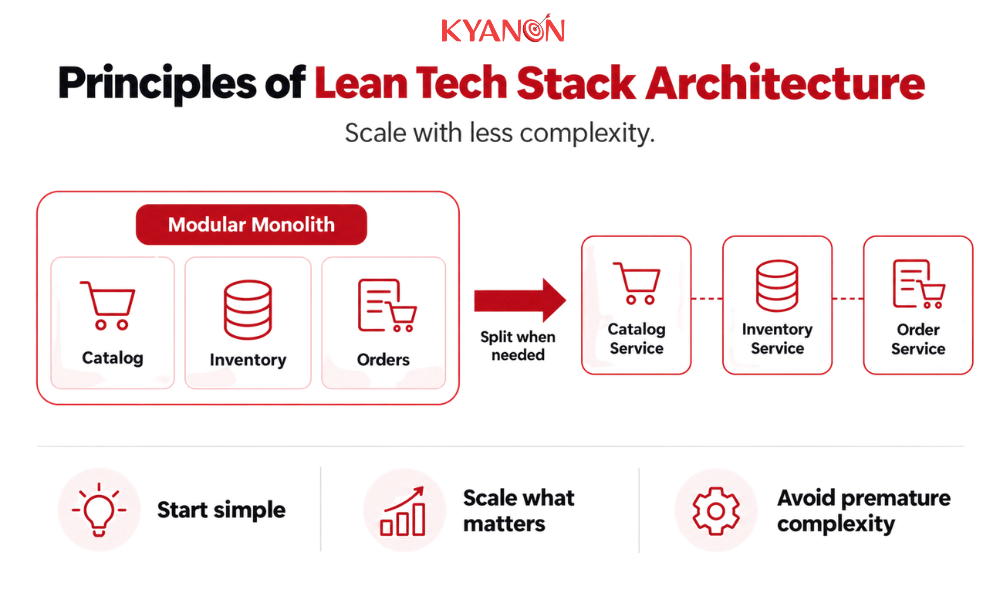
Kyanon Digital’s perspective: Architecture decisions should reflect actual business complexity rather than technology trends. A modular monolith can be more appropriate when applications share closely related workflows and do not require independent deployment. Microservices become more defensible when distinct business capabilities need separate scaling, release cycles, or operational ownership. The objective is to preserve flexibility without introducing unnecessary infrastructure and maintenance overhead.
Design for scalability without overengineering
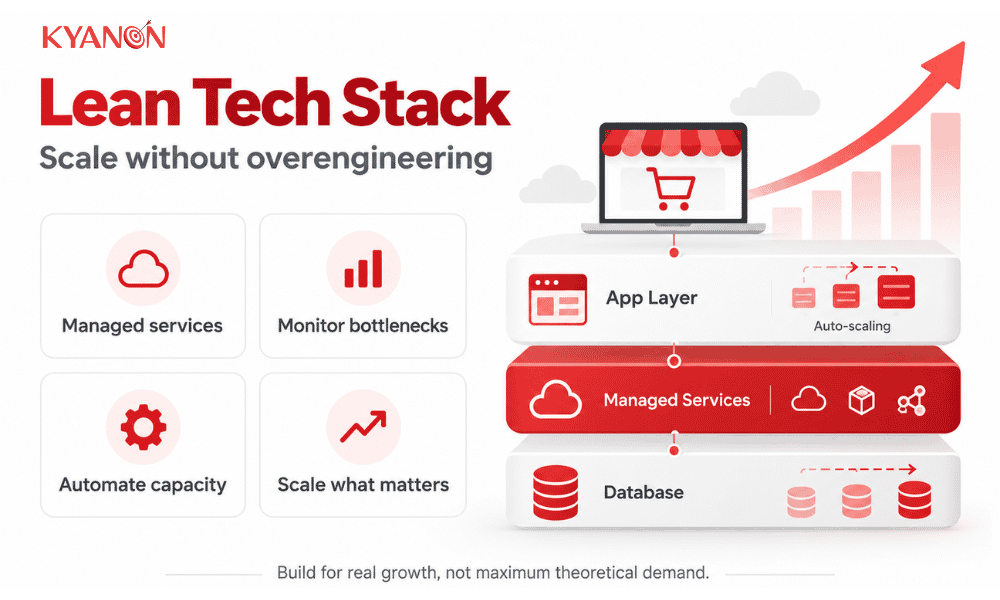
A lean tech stack should accommodate business growth without requiring organizations to invest prematurely in expensive infrastructure or complex distributed systems.
Rather than designing for maximum theoretical capacity, businesses should identify realistic scaling requirements based on expected transaction volumes, workload patterns, customer demand, and system dependencies.
Consider these priorities:
- Use managed services when they reduce infrastructure maintenance without creating unacceptable costs or dependencies.
- Identify scaling bottlenecks through application performance, database utilization, and transaction monitoring.
- Automate capacity management where workloads fluctuate and the operating model supports it.
- Scale individual components when their performance requirements justify independent resources.
For example, a retail platform experiencing seasonal traffic spikes may benefit from autoscaling application infrastructure while retaining its existing database and core architecture. A complete migration to microservices would be difficult to justify unless other constraints require it. The key is to preserve growth options while keeping today’s architecture manageable.
Cost efficiency and long-term maintainability
The cheapest technology is not always the most cost-effective choice. Businesses should evaluate the total cost of ownership (TCO), including implementation, licensing, cloud consumption, integration, security, maintenance, and future migration costs.
A low-cost application may become expensive if it requires custom integrations, manual data reconciliation, or extensive engineering support.
Before adopting or replacing a technology, evaluate:
- Operating costs: Subscriptions, infrastructure consumption, monitoring, and support.
- Integration costs: APIs, middleware, data synchronization, and custom development.
- Maintainability: Documentation, testing, available expertise, and upgrade requirements.
- Vendor lock-in: Data portability, contractual restrictions, switching costs, and platform dependencies.
- Future flexibility: Whether the solution can accommodate new channels, workloads, and business requirements.
For instance, replacing several disconnected SaaS applications with one platform may reduce licensing costs but introduce migration complexity or limit future integrations. Conversely, retaining existing applications and improving their interoperability may provide better value.
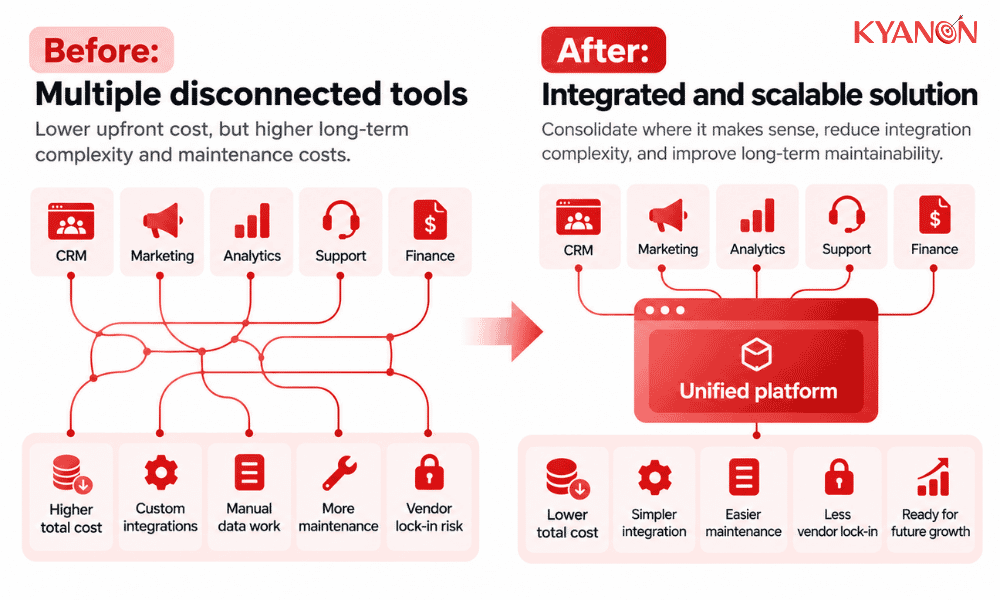
The right decision depends on measurable operational improvements rather than upfront savings alone.
Key components of a lean, scalable tech stack
A lean tech stack should support business growth, reliable performance, and cost efficiency without unnecessary complexity. The right technologies depend on current operational needs, existing systems, and future scaling requirements.
| Component | Primary role | Example technologies |
When to prioritize |
|
Cloud infrastructure |
Hosting and scalability | AWS, Azure, Google Cloud | Rising costs or capacity limitations |
| Database solutions | Data storage and management | PostgreSQL, Amazon Aurora, MongoDB Atlas |
Slow queries or growing data volumes |
|
Backend architecture |
Application logic and APIs | Node.js, Django, .NET | Complex applications or deployment bottlenecks |
| Frontend technologies | Web and mobile experiences | React, Vue.js, Next.js |
Poor UX or expanding digital channels |
|
DevOps and CI/CD |
Automated testing and deployment | GitHub Actions, GitLab CI | Slow releases or frequent deployment failures |
| Integration and data | System connectivity and governance | APIs, webhooks, event platforms |
Disconnected systems or AI data limitations |
Cloud infrastructure
Choose cloud infrastructure based on workload requirements, scalability, and total cost of ownership, rather than provider popularity.
| Decision factor |
What to evaluate |
|
Performance |
Computing, storage, and availability needs |
| Cost |
Usage, data transfer, support, and management |
|
Integration |
Compatibility with existing applications |
| Scalability |
Autoscaling and capacity requirements |
|
Governance |
Security, data residency, and access controls |
Serverless vs. containers: Serverless suits event-driven or variable workloads with minimal server administration. Containers offer greater runtime control but may require more management.
Decision: Retain existing infrastructure when it meets performance and cost targets. Consider migration when operational limitations or scaling constraints justify the transition.
Database solutions
Database selection depends on data structure, transaction requirements, and performance, not technology popularity.
- SQL databases (PostgreSQL, Amazon Aurora): Suitable for structured data, transactions, and complex queries.
- NoSQL databases (MongoDB): Suitable for flexible document structures and evolving data models.
- Managed databases: Reduce infrastructure administration but require evaluation of service limits and ongoing costs.
Before migrating databases, businesses should determine whether performance issues result from inefficient queries, indexing, infrastructure capacity, or architectural constraints. Track query latency, transaction failures, and database operating costs to establish whether targeted optimization is sufficient or a migration is justified.
Backend architecture and frameworks
Backend architecture determines how applications scale, integrate, and evolve. Framework choices should reflect application requirements and available engineering expertise.
|
Criteria |
Modular monolith |
Microservices |
|
Best fit |
Simpler or closely related workloads | Complex, independent services |
| Deployment | Coordinated releases |
Independent releases |
|
Scalability |
Shared application scaling | Individual service scaling |
| Maintenance | Generally lower overhead |
Greater operational complexity |
Decision: Start with a modular architecture when it meets business needs. Adopt microservices when independent scaling, deployment, or team ownership justifies the additional complexity.
Frontend technologies
Frontend selection should balance user experience, performance, and development costs.
- Responsive web applications: Suitable for browser-based experiences across devices.
- Progressive Web Apps (PWAs): Appropriate when installability or selected offline capabilities matter.
- Native mobile applications: Consider when device-specific features or platform requirements justify separate development.
Decision: Optimize existing digital experiences before developing additional applications or adopting new frameworks.
DevOps and CI/CD
A lean DevOps approach uses automation to improve deployment reliability without unnecessary infrastructure complexity.
Prioritize:
- Automated testing: Detect errors before release.
- CI/CD: Standardize builds and deployments.
- Observability: Monitor performance and failures.
- Rollback procedures: Restore service after unsuccessful changes.
Tools such as GitHub Actions and GitLab CI support delivery automation, while Docker supports consistent containerized environments.
Decision: Improve existing pipelines before investing in complex orchestration platforms. Track deployment frequency, failure rates, and recovery time to justify additional tooling.
Integration and data architecture
As businesses expand, disconnected systems can become a greater operational constraint than individual applications.
Separate commerce, CRM, inventory, finance, and analytics platforms may work adequately on their own while creating inconsistent information and manual reconciliation across departments.
A lean integration architecture should prioritize:
- API connectivity: Enable applications to exchange information through documented interfaces.
- Data synchronization: Define when data must update in real time versus scheduled intervals.
- Clear ownership: Establish authoritative sources for customer, product, inventory, and transaction data.
- Security and governance: Control data access, retention, integration permissions, and monitoring.
- AI readiness: Make relevant, authorized, reliable data accessible to approved analytics and AI applications.
For example, a retailer may retain its commerce, CRM, and inventory systems while integrating order and stock information through APIs. This can address fragmented workflows without requiring an immediate platform replacement.
For organizations struggling with disconnected applications or legacy dependencies, Kyanon Digital’s IT Architecture & Strategy services provide a way to evaluate integration constraints, modernization options, and a suitable architecture roadmap before committing to larger changes.
How do you know when your lean tech stack needs modernization?
A technology stack needs modernization when its limitations create measurable business or operational problems that cannot be addressed efficiently through simpler improvements. The first step is determining whether the root cause lies in redundant tools, inadequate integrations, infrastructure configuration, or fundamental architecture limitations.
|
Business problem |
Suitable first action |
When broader modernization may be needed |
|
Growing software costs |
Audit utilization and consolidate redundant tools | Core platforms have persistently high maintenance or licensing costs |
| Slow application performance | Investigate queries, infrastructure, and application bottlenecks |
Architecture prevents required performance improvements |
|
Fragmented business data |
Improve APIs, ownership, and synchronization | Existing systems cannot support necessary integrations |
| Frequent deployment failures | Strengthen automated testing and CI/CD |
Tight coupling makes changes consistently risky |
|
Legacy systems limit growth |
Refactor or modernize the constrained components | Unsupported technology or architecture blocks critical capabilities |
| AI adoption limited by poor data access | Improve data integration, access controls, and governance |
Existing data architecture cannot support required workloads |
For a business experiencing only isolated performance issues, optimizing infrastructure or refactoring a specific component may be sufficient. Larger modernization becomes more defensible when limitations span multiple systems and prevent essential capabilities from evolving.
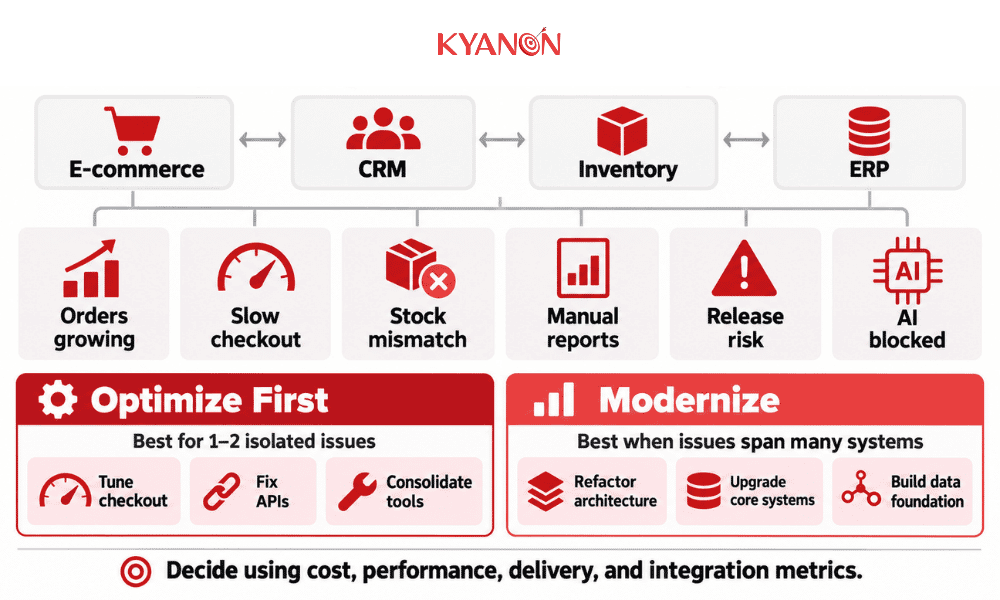
Before approving an investment, establish a baseline for application performance, operating costs, release reliability, and integration effort. Use those measurements to define a bounded improvement, assign technical and business ownership, and assess results before expanding the scope.
Should you simplify, modernize, or re-platform?
The right approach depends on what is preventing your existing technology from supporting business growth. Rising software costs, slow applications, fragmented data, or limited scalability do not automatically justify a complete system replacement.
Before investing in new infrastructure, businesses should identify the root cause, evaluate existing capabilities, and determine whether targeted improvements can resolve the problem.
| Business symptom | Recommended action |
When to consider a larger investment |
|
Rising software costs and redundant tools |
Audit subscriptions, consolidate overlapping applications, and optimize cloud utilization. | Existing platforms create persistent maintenance costs or cannot support essential business processes. |
| Slow application performance | Identify bottlenecks in databases, APIs, infrastructure, or application code before upgrading. |
Current architecture cannot meet performance requirements despite targeted optimization. |
|
Fragmented business data and disconnected systems |
Improve API integrations, data synchronization, and ownership across existing platforms. | Legacy systems lack integration capabilities or prevent consistent data access across operations. |
| Frequent deployment failures and technical debt | Introduce automated testing, CI/CD, and incremental code refactoring. |
Tightly coupled applications make routine changes increasingly risky or expensive. |
|
Legacy technology limits business growth |
Modernize critical components while retaining systems that still deliver business value. | Unsupported technologies, architectural limitations, or integration dependencies prevent essential capabilities from evolving. |
| AI adoption is constrained by poor data accessibility | Strengthen data integration, governance, access controls, and AI-ready data pipelines. |
Existing data architecture cannot securely support required AI workloads or enterprise-wide integration. |
How to decide which approach fits your business
- Simplify when existing systems remain functional but overlapping tools, unnecessary subscriptions, or inefficient workflows increase operating costs.
- Modernize selectively when specific components create measurable performance, integration, security, or maintenance constraints.
- Re-platform when the existing architecture fundamentally prevents business-critical improvements and incremental modernization is no longer technically or economically viable.
How Kyanon Digital built a scalable commerce stack for a large Thailand retail group
Kyanon Digital’s scalable commerce platform connects six digital sales channels, streamlining operations and supporting high-volume retail growth.
Challenges
- Legacy platforms could not easily support growing online transaction volumes.
- Inventory, pricing, promotions, and orders were fragmented across channels.
- Owned channels and external marketplaces required coordinated real-time information.
- Fulfillment across stores, warehouses, and marketplaces increased operational complexity.
Solution from Kyanon Digital
- Designed a microservices architecture because independent commerce capabilities required greater modularity and scalability.
- Created a core operational engine coordinating inventory, pricing, orders, promotions, and customer processes.
- Connected web, mobile, legacy systems, and marketplaces through APIs and synchronization mechanisms.
- Centralized operational control while allowing individual services to evolve independently.
Results and impact
- 26,000+ SKUs managed across six digital sales channels.
- Real-time inventory management supported across nine stores.
- 8,000+ orders per day processed without system interruption.
- 99% of offline promotions were transitioned to online campaigns.
Read the full case study to discover how Kyanon Digital built a scalable, integrated commerce platform for a major Thai retailer.
The important lesson is not that every growing company needs microservices. This architecture was justified by the retailer’s transaction volume, channel complexity, fulfillment requirements, and need for independent service evolution. A smaller organization without those conditions may remain leaner with a well-structured modular application.
How should a lean tech team scale?
A lean tech team should scale by removing recurring engineering friction before simply adding developers.
Prioritize:
- Standardized CI/CD and automated testing;
- Reusable components and documented APIs;
- Observability for performance and failure diagnosis;
- Clear ownership of applications and data;
- Automation of repetitive infrastructure work;
- External specialist capacity when a temporary capability gap is slowing a defined initiative.
Do not build an internal platform merely because it is a trend. For a small team shipping one or two applications, managed services and straightforward automation may remain more efficient.
How should businesses optimize their current tech stack?
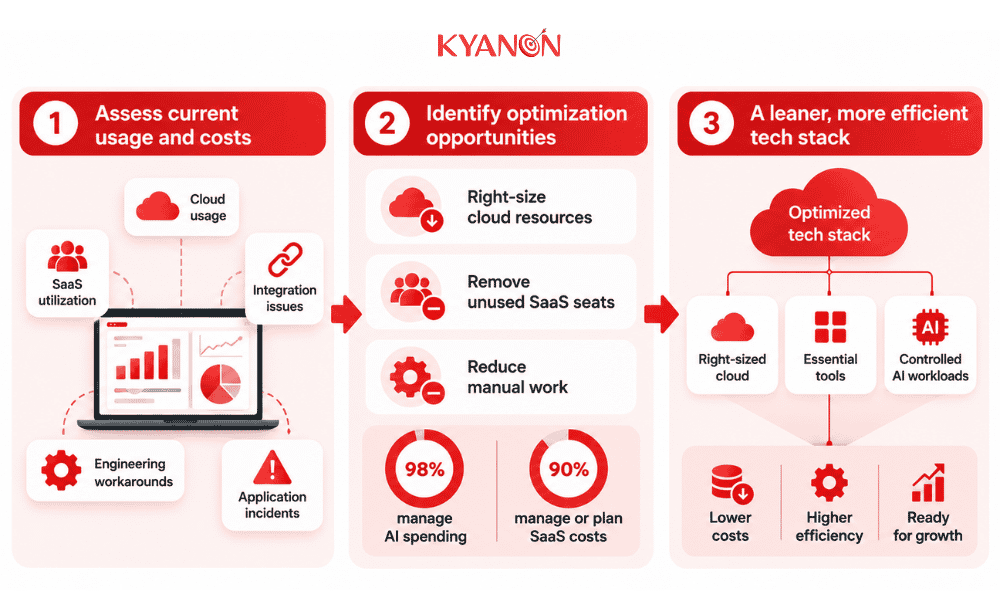
Start with usage, dependency, and unit economics, not a list of technologies. Review SaaS utilization, cloud consumption, integration failures, engineering hours spent maintaining workarounds, deployment frequency, application incidents, and infrastructure cost per meaningful business unit such as transaction or active customer.
As AI becomes a larger part of enterprise technology spending, cost optimization must extend beyond cloud infrastructure to include SaaS subscriptions, AI workloads, and software licensing. According to the FinOps Foundation’s State of FinOps 2026 report, based on 1,192 practitioners globally, 98% reported managing AI spending, while 90% managed or planned to manage SaaS costs. These findings highlight the importance of evaluating total technology costs, resource utilization, and measurable business value when building a lean, scalable tech stack.
A cheaper component is not automatically better if it increases integration effort, manual operations, vendor dependency, or engineering support requirements.
How do you future-proof a lean AI tech stack?
Future-proofing a lean AI tech stack means prioritizing flexibility, scalability, and governance without unnecessary technology investments. Businesses should focus on modular architecture, API integration, data accessibility, and security to support evolving AI requirements.
According to IBM’s 2026 Tech Leader Study, technology executives expect an average of 1,661 AI agents per organization by 2027, a projected 38% increase. This highlights the importance of adaptable infrastructure as AI adoption grows.
A practical framework for future-proofing your tech stack
Before investing in additional AI capabilities, businesses should evaluate five areas:
| Priority | What to evaluate |
Recommended action |
|
Architecture flexibility |
Can individual components evolve without disrupting the entire system? | Use modular design and documented APIs. |
| Data readiness | Can AI applications securely access reliable business data? |
Improve data integration, quality, and governance. |
|
AI interoperability |
Can AI models or providers be changed without rebuilding workflows? | Separate model integrations from core business logic. |
| Scalability and cost | Can infrastructure support growing workloads at sustainable costs? |
Monitor usage, performance, and cost per AI task. |
|
Security and governance |
Are AI access, outputs, and operations appropriately controlled? |
Implement access controls, evaluation, logging, and human oversight. |
Start with the weakest critical dependency, rather than upgrading every component simultaneously. For example, if an AI customer-service application cannot retrieve accurate information from existing systems, improving data integration should take priority over adopting a more advanced AI model.
Businesses should validate each improvement against measurable outcomes, such as response reliability, processing costs, and operational efficiency, before expanding AI investments.
Conclusion
A lean tech stack balances scalability, cost efficiency, and maintainability without unnecessary complexity. Businesses should simplify redundant tools, modernize performance bottlenecks, and consider re-platforming only when existing architecture limits growth.
Before investing, evaluate technology costs, system performance, and integration requirements to identify the most valuable improvements.
Looking to optimize your tech stack for sustainable growth? Discuss your architecture and modernization roadmap with Kyanon Digital to determine the right next steps for your business.
References
- Gartner Top 10 Strategic Technology Trends for 2026 — Gartner, 2026
- Technology Adoption Roadmap for Midsize Enterprises: 2026 — Gartner, 2026
- 2026 Tech Leader Study: Building the IT Foundation for Agentic AI at Scale — IBM Institute for Business Value, 2026
- AWS Well-Architected Framework — Amazon Web Services.
- Azure Well-Architected Framework — Microsoft.
- Google Cloud Well-Architected Framework — Google Cloud.
- State of FinOps 2026 — FinOps Foundation, 2026
- IT Architecture and Strategy — Kyanon Digital
- Integrated Commerce Platform for Thailand’s Largest Retail Group — Kyanon Digital






 Create project brief with AI