

If you are comparing LLM development firms in Singapore, this guide highlights 12 providers worth considering based on their technical capabilities, delivery models, industry fit, and readiness for enterprise deployment. Kyanon Digital is particularly relevant for businesses that need LLM development combined with RAG, AI agents, enterprise integration, and broader software engineering.
The right choice, however, depends less on who appears highest in a ranking and more on how well a provider fits your use case, existing technology environment, governance requirements, and delivery model. As enterprise AI moves beyond standalone chat interfaces, buyers increasingly need providers that can support RAG-based knowledge systems, copilots, AI agents, multimodal applications, and workflows connected to existing business systems.
For business and technology leaders, the key question is therefore whether a provider can turn an LLM into a reliable production system, not simply provide access to a foundation model.
Key takeaways
- Choose based on project fit, not ranking. The right LLM development firm depends on your use case, existing systems, data requirements, governance needs, and delivery scope.
- For enterprise projects, the harder part is often not accessing an LLM but connecting it reliably with trusted data, APIs, business applications, and operational workflows.
- Kyanon Digital is one option to consider when the project requires LLM capabilities to be combined with broader software engineering, system integration, and production application development.
- Look at proven delivery examples, not capability lists alone. For example, Kyanon Digital applied RAG in a LegalTech platform to connect LLMs with curated legal and regulatory knowledge, supporting document search, drafting, classification, and monitoring.
- Specialist firms may still be a better fit for narrower requirements such as conversational AI, industry-specific applications, or a clearly defined standalone use case.
- Before shortlisting a provider, clarify the business workflow, baseline KPI, data sources, integration dependencies, governance constraints, and long-term ownership of the solution.
Further reading:
- Kyanon Digital Named Among Top AI Development Companies in Vietnam by GoodFirms
- How Can Startups Harness AI Agents As A Service?
- AI in Business: What It Is, Why It Matters, and How to Use It
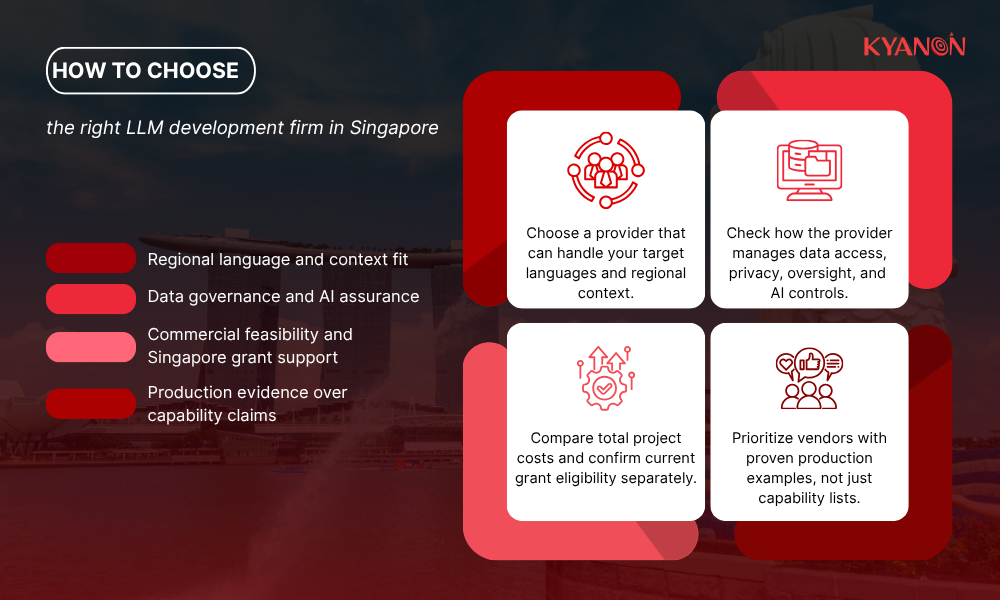
How to choose the right LLM development firm in Singapore
Choosing the right LLM development firm in Singapore requires more than comparing model expertise or general software development capability. The stronger fit is usually the provider that can handle your target languages and business context, connect models securely with enterprise data, work within Singapore’s AI governance environment, and show evidence of moving AI systems into production.
Regional language and context fit
Regional language capability matters when an LLM will serve users across Singapore and Southeast Asia. A system may need to handle English alongside Malay, Vietnamese, Thai, Indonesian, Tamil, or mixed-language communication, while also interpreting local terminology and cultural context correctly.
AI Singapore’s SEA-LION initiative illustrates why this deserves explicit evaluation. SEA-LION is a family of open LLMs developed to better represent Southeast Asian languages, cultures, and contexts, supported by regional data and localized benchmarks.
What to ask: Instead of requiring every vendor to use SEA-LION, ask how they evaluate model performance for the actual languages, terminology, and user groups your application must support. Depending on the use case, the appropriate architecture could use SEA-LION, another foundation model, or multiple models.
A provider should also be able to explain how it will test regional performance rather than assume that good English-language benchmarks automatically translate into good Southeast Asian performance.
Data governance and AI assurance
For enterprise LLM projects, governance should be evaluated at the data, model, application, and workflow levels.
Where personal data is involved, Singapore’s PDPC provides guidance on how the PDPA applies to the development, testing, monitoring, deployment, and procurement of AI systems. It also addresses the responsibilities of third-party developers supporting organizations that deploy bespoke AI solutions.
Singapore’s AI Verify framework adds another useful evaluation layer. IMDA describes AI Verify as a governance testing framework and toolkit covering areas including transparency, explainability, robustness, security, data governance, accountability, and human agency, with support extended to GenAI use cases.
For agentic AI, the bar is higher. Buyers also need to understand what an agent can access, what actions it can perform, when human approval is required, and how those actions are logged.
This is why enterprise LLM governance should not be treated separately from architecture. As explained in Kyanon Digital’s guide to LLM integration services for enterprise systems, production architecture needs to account for model routing, orchestration, enterprise data and context, and governance together rather than treating the LLM as an isolated API.
What to ask: How will the provider control data access, permissions, retrieval, logging, model evaluation, human escalation, and actions taken by AI agents? If RAG or private enterprise data is involved, ask where data is processed and how information exposure is controlled.
If your LLM initiative spans several data sources or enterprise systems, assess the architecture, integration dependencies, and governance controls before committing to a model. Kyanon Digital’s Generative AI Consulting services in Singapore cover RAG architecture, enterprise data integration, private deployment, and production GenAI applications for this type of requirement.
Commercial feasibility and Singapore grant support
Government funding can affect project economics, but it should be evaluated at the project level rather than used as a shortcut for choosing a vendor.
This is particularly important because Singapore’s grant landscape changed in 2026. The Enterprise Development Grant (EDG), Market Readiness Assistance (MRA), and Productivity Solutions Grant (PSG) ceased on 29 September 2026. From 30 September, businesses seeking new grant support are directed to the EDGE Grant.
Current EDGE Grant activities include areas such as automation and digitalization. EnterpriseSG’s large-scale digital transformation activity specifically includes technologies such as AI/ML, data analytics, workflow automation, and integration of legacy systems with new digital architecture, subject to the relevant business and project eligibility conditions.
What to ask: Before committing to a provider, check whether your company, project scope, proposed technology, and intended outcomes meet the current EnterpriseSG requirements. Do not assume that selecting a particular AI vendor automatically makes a project grant-eligible.
This also makes the comparison more commercially useful: evaluate implementation scope, integration effort, infrastructure, ongoing model usage, monitoring, and support, not just the initial development quote.
Production evidence over capability claims
A long list of technologies does not show whether a provider can turn an LLM proof of concept into a dependable business system.
Look at actual delivery examples. Ask vendors to show how previous projects handled enterprise data, RAG, integrations, evaluation, model failures, monitoring, security controls, human intervention, and ongoing application ownership.
For AI agents, production evidence should go further. Ask what the agent is permitted to do, where approval is required, how actions are logged, how failed tasks are handled, and how the system can be stopped or rolled back.
The practical test is simple: a suitable LLM development firm should be able to explain not only what the AI can do, but also how it connects to your environment, how its performance will be evaluated, where its authority ends, and who operates it after launch.

How we evaluated these LLM development firms
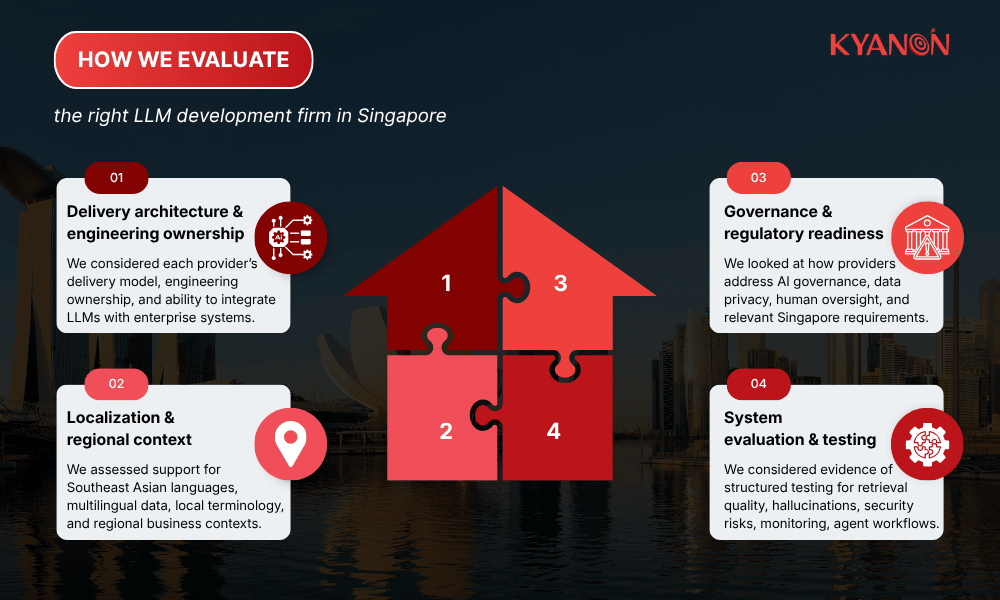
We evaluated these LLM development firms in Singapore based on publicly available evidence of how well their capabilities align with four areas that matter when moving an LLM from experimentation into production: delivery architecture, regional context, governance, and system evaluation.
Delivery architecture & engineering ownership
We assessed how each firm structures delivery and supports LLM applications beyond the model layer.
- Delivery Model: Whether engineering is delivered through Singapore-based teams, distributed development teams, or a hybrid model, with clear ownership of architecture, IP, communication, and ongoing support.
- System Integration: Ability to build RAG applications, AI agents, and integration layers that connect LLMs with enterprise data, APIs, CRM, ERP, identity systems, and existing applications.
Localization & regional context
For Singapore and Southeast Asia use cases, we considered how well providers can support regional languages and business contexts.
- Southeast Asian Context: Experience working with multilingual data and regionally relevant models or datasets, including frameworks such as AI Singapore’s SEA-LION where appropriate.
- Linguistic Versatility: Ability to handle local terminology, code-switching, multilingual content, and domain-specific language across markets.
Governance & regulatory readiness
We evaluated whether providers can translate Singapore’s AI governance expectations into practical system controls.
- AI Governance: Alignment with relevant IMDA guidance, AI Verify principles, and controls around transparency, accountability, and human oversight.
- Data Privacy: Ability to address PDPA-related requirements through appropriate data access, permissions, logging, retention, and deployment controls.
- Industry Requirements: For regulated sectors such as financial services, consideration of additional governance and risk-management requirements.
System evaluation & testing
Because LLM outputs are probabilistic, we also looked for evidence of structured testing and monitoring.
- Pre-Deployment Evaluation: Use of domain-specific datasets to test retrieval quality, answer relevance, hallucinations, and regression risks.
- Adversarial Testing: Ability to test prompts, data exposure, security risks, and unexpected model behavior.
- Agentic Workflow Testing: For AI agents, evaluation of individual workflow steps, tool usage, failure points, and human escalation rather than relying only on final-output accuracy.
These criteria help distinguish different types of providers. A specialist may be better suited to a narrow LLM application, while firms such as Kyanon Digital may be more relevant when AI needs to connect with enterprise data, applications, and broader software engineering.
12 LLM development firms in Singapore to consider
Top 12 LLM Development Firms in Singapore.
Quick comparison table
Company | Core focus | Consider when your business needs |
Kyanon Digital | RAG, AI agents, enterprise GenAI applications, integration, software engineering | LLMs connected to enterprise data, systems, applications, and workflows |
| Sobot | Conversational AI, AI agents, customer service | AI-powered customer support and service operations |
TechTIQ Solutions | Custom AI/ML and software development | AI implementation combined with broader custom software delivery |
| Fcode Labs | Generative AI, RAG, AI-enabled products | RAG and AI functionality inside digital products |
Chemin AI | AI enablement and model operations | Modular AI architecture and model lifecycle requirements |
| Dextra Labs | AI consulting and custom AI applications | Structured AI initiatives requiring consulting plus implementation |
viAct | AI for heavy industries | Construction, manufacturing, mining, safety, and field operations |
| ST Engineering | Large-scale AI and engineering | Complex, regulated, public-sector, or infrastructure environments |
Vinova SG | Software and AI development | SMEs and product teams combining GenAI with application development |
| DXC Technology | Enterprise technology and AI transformation | Large-scale enterprise transformation across complex IT estates |
Tata Consultancy Services (TCS) | Enterprise AI and global transformation | Multi-market organizations requiring large global delivery capacity |
| Singsys | Custom software and AI integration | Businesses introducing AI within web, mobile, or custom applications |
Kyanon Digital
Kyanon Digital is a Vietnam-based LLM development company helping enterprises leverage Large Language Models to drive automation and personalization. With strong expertise in AI/ML, the firm specializes in fine-tuning domain-specific LLMs to enhance user experiences across industries.
- Website: kyanon.digital
- Founded: 2012
- Team size: 500+ (across Vietnam, Singapore, Thailand, Australia, Malaysia)
- Pricing tier: $25 – $49/hr
- Key clients: Confidential Fortune 500 companies, regional enterprises, and fast-growing businesses across APAC.
Strengths:
- Enterprise integration depth: Suitable when LLMs must connect with proprietary data, APIs, CRM, ERP, document repositories, or existing business applications.
- From prototype to production: Combines LLM engineering with software development, QA, DevOps, monitoring, and ongoing optimization to support production deployment.
- RAG and agentic AI capability: Supports enterprise knowledge systems, AI copilots, intelligent workflows, and agent-based applications where grounding and controlled actions are important.
- Flexible APAC delivery model: Combines regional business engagement with scalable engineering capacity for projects that require both local coordination and broader delivery resources.
- Governance and security readiness: Structured engineering and information-security practices help businesses address access control, data protection, quality assurance, and operational risk.
- Lifecycle ownership: Relevant for businesses that want one partner to support architecture, development, integration, deployment, and post-launch improvement rather than handing off between multiple vendors.
Case study: Building an AI-powered legaltech platform with LLM development
Kyanon Digital LLM Development Case Study.
Client’s Challenge
A leading law firm sought to automate document review and legal research processes while maintaining data security and accuracy. Traditional keyword-based search systems were slow, inconsistent, and unable to understand legal context, leading to wasted time and missed insights.
Kyanon Digital’s Solution
As the client’s LLM development company, Kyanon Digital built an AI-powered LegalTech platform that leveraged fine-tuned Large Language Models (LLMs) to enhance legal document understanding and automation. The solution included:
- Developing a domain-specific LLM optimized for legal terminology and Vietnamese-English bilingual data.
- Implementing secure, on-premise deployment ensuring client confidentiality.
- Integrating intelligent document search, summarization, and case law analysis features.
Results & Impact
- Reduced legal research time by over 60%, improving operational efficiency.
- Delivered accurate, context-aware responses with enhanced data protection.
- Demonstrated how LLM development can drive real-world transformation in the legal sector.
Sobot
Sobot positions itself as an AI-first LLM development firm specializing in conversational AI. By combining LLMs with proprietary small language models (SLMs), it delivers faster, more accurate AI agents tailored for enterprise use.
- Founded: 2014
- Team size: 450
- Pricing tier: Not publicly disclosed
- Key clients: Enterprises, SMEs, and startups in retail, e-commerce, finance, gaming, entertainment across the US, Southeast Asia, China and global markets
- Strengths:
- Practical approach: addresses common LLM issues (latency, accuracy, vague answers).
- All-in-one platform that includes AI chatbots, live chat, voice support, ticketing, messaging, and WhatsApp Business API integration
- NLP-powered chatbots, LLMs, scenario-based AI, AI Copilot
- Trusted by global brands, 4.9+ user ratings
- Enterprise-grade compliance, local data centers, scalable deployment
TechTIQ Solutions
TechTIQ Solutions is a Singapore-headquartered digital consultancy and LLM development company combining project management and QA in Singapore with engineering teams in Vietnam to deliver cost-efficient, AI-driven digital solutions worldwide.
- Founded: 2017
- Team size: 350+
- Pricing tier: $25 – 49/hr
- Key clients: Startups, SMEs and corporates in finance, e-commerce, logistics, healthcare, media, retail, telecom, energy
- Strengths:
- Offers a full spectrum of AI and machine learning services, including supervised, unsupervised, and reinforcement learning
- TechTIQ Solutions applies AI technologies across various industries, including finance, e-commerce, logistics, healthcare, and media
- Specializes in generative AI development
- Balances custom LLM development with affordability.
Fcode Labs

Fcode Labs is a tech consultancy and LLM development company delivering next-gen AI solutions for startups and enterprises. The firm blends Generative AI with modern deployment techniques like Retrieval-Augmented Generation (RAG) to enhance knowledge retrieval and personalization.
- Founded: 2018
- Team size: 80+
- Pricing tier: $25 – $49 / hr
- Key clients: Startups, SMEs, and enterprises in healthcare, fintech, retail, and education across Asia, Europe, and North America
- Strengths:
- End-to-end expertise: from research prototypes to enterprise deployment.
- Strong background in AI personalization engines across fintech and e-commerce.
- Specializes in RAG-based LLM systems, ensuring accuracy and relevance.
Chemin AI
Chemin AI is a Singapore-based strategic AI-enablement partner, focuses on scalable LLM development with a modular “Model Stack” approach, enabling enterprises to adopt AI with agility.
- Founded: 2025
- Team size: 1,000+ collaborators
- Pricing tier: Not publicly disclosed
- Key clients: Startups, SMEs and research leaders across education, healthcare, retail and automotive
- Strengths:
- Comprehensive LLM Suite: Chemin Logic spans discovery, training, deployment, and feedback across data, model, design, and skill stacks
- Expertise in enterprise-ready AI deployment
- Focus on operational scalability for large organizations
Dextra Labs
Dextra Labs is a Singapore-based AI and digital transformation consultancy, delivering custom tech leadership, AI-driven products, and strategic services to help startups, investors, and enterprises scale smarter. Their LLM development service focuses on prompt engineering, consulting, and enterprise deployment.
- Founded: 2022
- Team size: 10 – 49
- Pricing tier: $25 – 49/hr
- Key clients: Startups, SMEs and investors in fintech, healthcare, SaaS, logistics and e-commerce (Singapore, US, UAE)
- Strengths:
- Comprehensive Enterprise LLM Deployment
- Developing LLM-powered applications across various domains
- Expertise in deploying LLM solutions across various industries: healthcare, finance, legal, supply chain
- Known for bridging the gap between LLM research and production rollout
viAct
viAct is a Hong Kong – based AI company specializing in LLM development for heavy industries. Its platform enables businesses to build and deploy customized AI agents that streamline workflows, enhance productivity, and improve safety across complex job sites.
- Founded: 2016
- Team size: 51 – 200
- Pricing tier: Not publicly disclosed
- Key clients: MNCs, SMEs and startups in construction, logistics, manufacturing, mining and refinery sectors
- Strengths:
- Industry-specific LLM expertise in construction tech.
- Offers actionable insights from massive datasets, enabling faster, smarter decisions for project management.
- Rare focus on LLM for physical industries, beyond digital-only sectors.
- Combines LLMs with generative AI to create predictive models and automated insights, improving efficiency and ESG compliance.
ST Engineering

ST Engineering is a Singapore-headquartered global technology, defense, and engineering group, delivering solutions in digital systems, smart city technologies, aerospace, and defense. With a focus on innovation and reliability, the company leverages AI, LLM development and advanced digital platforms to solve real-world challenges across industries worldwide.
- Founded: 1967
- Team size: ~27,000
- Pricing tier: Not publicly disclosed
- Key clients: MNCs, government agencies, and enterprises in defense, aerospace, smart city, public safety, transport and critical infrastructure
- Strengths:
- Proprietary LLMs – Custom models tailored for Singaporean linguistic and enterprise needs.
- Security-Focused LLMs – AI solutions for SOC analysts to automate repetitive tasks and improve efficiency.
- Generative AI + Computer Vision – Advanced image and scene understanding for multiple applications.
- Comprehensive AI Strategy – Holistic AI systems for operations, platforms, autonomous systems, and internal productivity.
- Skilled AI Workforce – 10,000-strong AI-ready team with ongoing training programs.
Vinova SG

Vinova SG is a Singapore-based IT solutions provider with 15+ years of experience, offering LLM development services to SMEs and enterprises, with a focus on fintech and mobile solutions.
- Founded: 2010
- Team size: 300+
- Pricing tier: $20 – 70/hr
- Key clients: MNCs, SMEs, startups across banking, fintech, government, healthcare, manufacturing, real estate
- Strengths:
- Provide entire AI development lifecycle, from needs analysis and roadmap creation to custom model development and user-friendly application deployment.
- Serves a diverse range of industries, including education, finance, healthcare, government, and real estate
- Practical LLM adoption for SMEs with limited budgets.
- Vinova offers consultation services to guide clients on ethical considerations and responsible use of Generative AI
DXC Technology

DXC Technology is a global IT services and consulting leader, offering LLM development and Generative AI consulting for large enterprises across industries worldwide.
- Founded: 2017 (merger of HPE Enterprise Services & CSC)
- Team size: 120,000+
- Pricing tier: Not publicly disclosed
- Key clients: MNCs, governments, public sector and enterprises in insurance, healthcare, banking, manufacturing, aerospace and critical infrastructure
- Strengths:
- Large-scale enterprise partnerships.
- Expertise in AI governance & compliance.
- Trusted by Fortune 500 for secure LLM deployment.
Tata Consultancy Services (TCS)
Tata Consultancy Services (TCS) is a global leader in IT services, consulting, and digital transformation, with over five decades of innovation and a massive global presence harnessing AI and LLM development to modernize business operations.
- Founded: 1968
- Team size: 614,000+
- Pricing tier: Not publicly disclosed
- Key clients: MNCs, governments and enterprises across banking, insurance, manufacturing, retail, telecom, public services,…
- Strengths:
- Decades of enterprise AI experience.
- Case-proven LLM use cases in telecom network ops.
- Combines domain expertise + LLM engineering at global scale.
Singsys

Singsys is a Singapore-based software firm and emerging LLM development company, delivering custom mobile, web, and enterprise solutions alongside strategic digital services for global clients.
- Founded: 2009
- Team size: 250+
- Pricing tier: $30 – 70/hr
- Key clients: Enterprises, SMEs and startups across e-commerce, education, real estate, SaaS, fashion, logistics and social media verticals
- Strengths:
- Strong foundation in web & mobile development.
- Expanding LLM practice for customer experience solutions.
- Delivers end-to-end digital + LLM integration at competitive rates.
Why choose Kyanon Digital for LLM development firm in Singapore
Expertise Trusted by Fortune 500 Clients
With a presence in Singapore and extensive experience supporting regional and global businesses, Kyanon Digital helps Singapore enterprises build, modernize, and scale software solutions across their digital ecosystems. Our experience spans complex software engineering and digital transformation projects for enterprises, Fortune 500 companies, and organizations across APAC.
A World-Class IT Team
Our 500+ consultants and engineers bring expertise across software engineering, technical architecture, project management, QA, DevOps, cloud, data, and AI/ML. With delivery capabilities across Vietnam, Singapore, Thailand, Australia, and MalaysiaAPAC region, we combine local business understanding with scalable engineering resources to support Singapore-based clients.
Enterprise-grade quality & delivery
Our ISO 9001-certified quality management system supports consistent delivery, structured engineering processes, and continuous improvement. We apply Agile methodologies and quality assurance practices throughout the software development lifecycle, from planning and architecture to development, testing, deployment, and ongoing optimization.
Uncompromising Security
With ISO 27001-certified information security management, Kyanon Digital integrates security considerations throughout the software development lifecycle. This helps Singapore businesses manage data protection, access control, application security, and operational risks while developing and modernizing enterprise software.
Conclusion
There is no universal “best” LLM development company in Singapore.
Choose a specialist when the problem is narrow and domain-specific. Choose an AI product vendor when an existing product closely matches the workflow. Choose a software engineering and AI partner when LLMs need to operate across enterprise data, applications, APIs, and business processes.
Before issuing an RFP, define one business workflow, its current baseline KPI, the systems and data involved, the decisions the AI may make, and the conditions requiring human intervention. Expand only when the first deployment demonstrates an acceptable change in that operational outcome.
If you are evaluating RAG, enterprise copilots, AI agents, or LLM integration across existing systems, discuss your GenAI implementation requirements with Kyanon Digital. The discussion should establish the use-case boundary, data and integration dependencies, deployment approach, governance requirements, and evidence needed before scaling.



 Create project brief with AI