

Singapore healthcare enterprises should hire dedicated AI developers when a pilot must become a production system: it needs integration with clinical data such as NEHR, ongoing MLOps, and compliance with HSA and PDPA rules. Before that point, governance, a defined use case, and data access matter more than headcount.
Singapore’s Ministry of Health announced approximately S$200 million over five years for the Health Innovation Fund to support innovation and test-bedding in public healthcare institutions, including AI. It also identified routine documentation and medical imaging as areas for wider AI deployment.
Key takeaways
- Clarifies that Singapore healthcare enterprises should only transition from pilots to hiring dedicated AI talent once clinical data pipelines and strict HSA/PDPA compliance structures are actively required for production.
- Warnings against building an in-house engineering team prematurely when leveraging external technical expertise offers a far faster, lower-risk route to compliance and deployment for standard operational tools.
- Shows, in Kyanon Digital’s experience delivering system integrations, that a hybrid delivery model allows providers to keep core clinical governance internal while accelerating custom engineering through external partners.
- Highlights that localizing Large Language Models for Singapore’s multi-ethnic clinical environment requires testing against localized NLP nuances and strict data sovereignty before committing to full-scale deployment.
Further reading:
- How to Hire AI Offshore Developers for Singapore Healthcare?
- How Much Does AI Development Cost in Singapore Healthcare?
- How Can Custom AI Chatbots Support Singapore Healthcare?
Healthcare AI vendor vs. in-house developers: Which options are better?
Choosing between a healthcare AI vendor and in-house developers depends heavily on whether your AI application is a standard operational tool or your core, proprietary product. Synapxe reported that public healthcare professionals had created more than 12,000 AI agents on AgentSea in just over two months. More than 300 agents had been made shareable, supporting tasks such as clinical record summarisation, procurement reviews and roster generation.
Vendors are best suited when specialized skills are lacking or faster implementation is required. In-house hiring is more appropriate when AI is a long-term strategic capability that requires product control and a continuous development workload. A hybrid model offers a middle ground, but it is not automatically the best choice for every organization.
| Feature | Healthcare AI Vendor |
In-House Developers |
|
Speed to Deployment |
Immediate to a few weeks (Pre-built pipelines and models). | 6 to 12+ months (Sourcing talent, building infrastructure). |
| Regulatory & Compliance | Low risk. Experienced vendors already have ISO 13485, HSA, or HIPAA compliance structures built-in. |
High risk. Team must build compliant logging, data masking, and audit trails from scratch. |
|
Upfront Costs |
Predictable. Typically structured as software-as-a-service (SaaS) or fixed implementation fees. | High & variable. Requires substantial recruitment, salaries, and compute infrastructure setup. |
| Customization | Limited. Restricted to the vendor’s configuration options and product roadmap. |
Complete. Total flexibility to adapt pipelines to proprietary data workflows or EHRs. |
|
Long-Term Maintenance |
Handled by Vendor. Updates, security patches, and model drift mitigation are covered in the license. |
Internal Overhead. Requires permanent staff to monitor, maintain, and retrain models. |
MOM‘s inaugural report found that 28.5% of Singapore private-sector establishments with at least 10 employees had started adopting AI. However, just 3.8% were integrating AI into core business processes. Among AI-adopting firms, 42.4% cited a lack of in-house expertise as a constraint, and 44.9% cited implementation costs.
Kyanon Digital supports healthcare enterprises with AI application development, data engineering, system integration, and dedicated engineering teams. Rather than treating vendor engagement and internal hiring as mutually exclusive, enterprises can adopt a hybrid model: retain clinical governance, product ownership, and compliance oversight internally while leveraging external engineering expertise to build, integrate, and scale AI solutions.

What is the total cost of ownership (TCO) of hiring an in-house AI team in Singapore?
Hiring and maintaining an in-house AI team in Singapore involves direct salaries, statutory contributions, technical infrastructure, and operational overhead. A realistic Total Cost of Ownership (TCO) breaks down across key categories.
Direct labor & staff costs (Annual per hire)
|
Cost component |
Estimated annual cost (USD) |
Details |
|
Mid-Level AI / Automation Engineer / Software Engineer |
70,000 – 126,000 | Base annual salary in Singapore, depending on experience and specialization. |
| Employer CPF & Benefits | +17%–20%+ of base salary |
Includes employer CPF contributions, 13th-month Annual Wage Supplement (AWS), medical insurance, and ongoing training. |
|
Core In-House AI Team |
190,000 – 352,000+ |
Estimated annual payroll and statutory costs for 1 AI/ML engineer, 1 data/integration engineer, and partial leadership/product support. |
Note: Actual costs vary by role, seniority, compensation structure, and applicable CPF contribution rules.
- Time-to-value lag: In-house AI/automation hires typically require 3 to 6 months of onboarding and architecture setup before shipping production-grade systems.
- Key-person risk: Relying on a single or small in-house AI specialist exposes the company to single-point-of-failure risks (if they leave, institutional knowledge and custom pipelines go dark).
Infrastructure, tooling & compute expenses
|
Cost component |
Estimated cost (USD) |
Details |
|
Cloud & GPU Compute |
300-16,000+ per month | Costs depend on workload volume and whether you use managed APIs (e.g., OpenAI, Anthropic) or self-hosted open-weight models on GPU instances such as NVIDIA A100/H100 clusters. |
| Software Subscriptions & Tooling | 235-1,560+ per month |
Includes integrated development environments, vector databases, monitoring tools, orchestration and automation platforms (e.g., Make, n8n, Zapier Enterprise), and CI/CD pipelines. |
|
Total Estimated Infrastructure & Tooling Costs |
535-17,560+ per month |
Combined estimated monthly spend, excluding other operational expenses and any additional usage-based fees. |
Disclaimer: Actual costs may vary depending on project scope, technical complexity, team structure, infrastructure requirements, and vendor pricing. Contact Kyanon Digital for a tailored assessment based on your healthcare AI requirements.
What should you look for in a healthcare AI tech partner in Singapore?
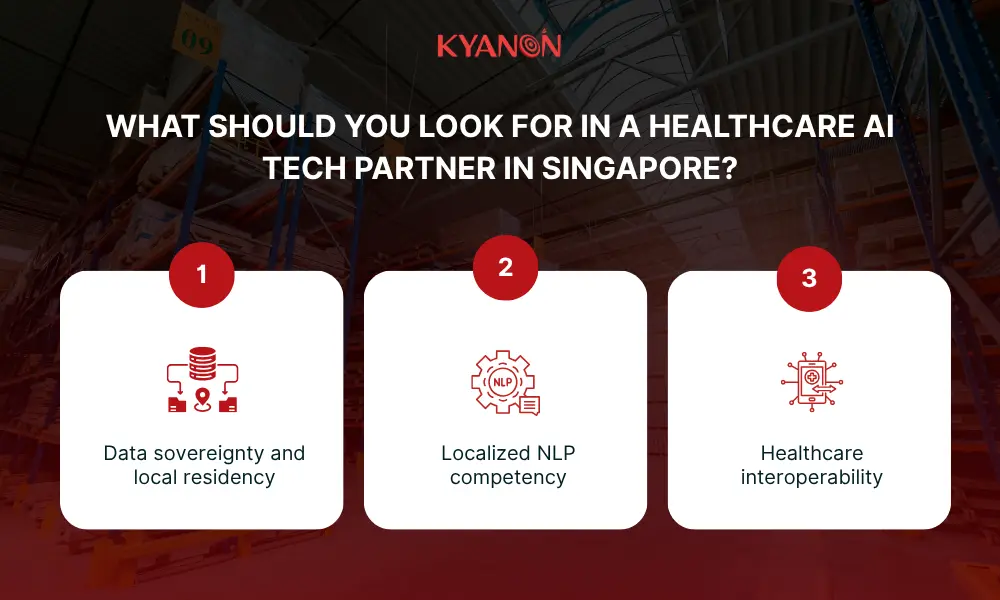
Choosing a healthcare AI tech partner requires more than AI development expertise. Singapore healthcare enterprises should assess three core capabilities to ensure secure deployment and seamless integration into clinical workflows.
- Data sovereignty and local residency: Look for expertise in secure data pipelines, encryption, access controls, and Singapore’s PDPA requirements. Your partner should clearly explain where patient data is stored, processed, and transferred, including when third-party AI services are involved.
- Localized NLP competency: Ensure the partner can adapt and evaluate large language models (LLMs) for Singapore’s healthcare context, including medical terminology, Singlish, Malay, and Mandarin. Test model accuracy and safety against representative clinical and patient communication scenarios.
- Healthcare interoperability: Prioritize hands-on experience with HL7 and FHIR standards and integration with existing hospital management systems (HMS), electronic medical records, and the National Electronic Health Record (NEHR), where authorized and applicable.
Healthcare enterprises should prioritize partners that combine AI engineering, data security, and system integration expertise. Kyanon Digital supports AI application development and enterprise integration, helping organizations build solutions around existing systems and workflows. Before committing, request a clear technical architecture, data-flow assessment, and measurable validation criteria to confirm the solution meets your security and operational requirements.
How can Kyanon Digital safely accelerate your healthcare AI roadmap?
Singapore healthcare enterprises do not have to choose between overcoming the AI talent shortage and maintaining strict security standards. Kyanon Digital helps organizations accelerate AI development through AI engineering, data and analytics, system integration, and dedicated engineering teams, aligning implementation with existing systems, data governance requirements, and operational priorities.
Whether you are validating an AI proof of concept, integrating AI into clinical workflows, or scaling an existing solution, the first step is to assess your data readiness, integration requirements, and security controls before committing to a delivery model.
Ready to move forward? Contact Kyanon Digital to assess your healthcare AI use case, identify the right engineering capabilities, and define a practical roadmap from proof of concept to production.
References
- Transforming Healthcare Through Technology – Singapore Ministry of Health (MOH)
- Inaugural Release of Report on Adoption of Artificial Intelligence Among Firms – Ministry of Manpower
- Singapore Empowers Public Healthcare Professionals with Sector-Wide Agentic AI Platform – Synapxe

 Create project brief with AI