

Singapore healthcare automation uses AI, software automation, and robotics to reduce repetitive work across clinical support, administration, and healthcare operations. AI can assist with documentation and scheduling, software can streamline workflows, and robotics can support physical tasks. Results depend on system integration, data quality, human oversight, and measurable operational improvements.
Singapore’s ageing population is increasing pressure on healthcare capacity and care coordination. According to the Ministry of Health (MOH), one in four Singaporeans will be aged 65 or older by 2030. In March 2026, MOH also reported that its Productivity and Digitalisation Grant had supported more than 240 healthcare projects, including automated showering and vital-sign monitoring systems.
For healthcare leaders, the priority is identifying where automation can deliver measurable operational value, whether by reducing administrative turnaround times, improving care coordination, or supporting patient monitoring. Success depends on selecting the right technology for each workflow and evaluating outcomes against an established baseline.
This article examines where AI, software automation, and robotics fit across Singapore healthcare workflows, their practical benefits and limitations, and what organizations should assess before scaling.
Key takeaways
- Start with the workflow bottleneck: Automation creates the most value when it targets measurable issues such as rostering time, documentation workload, medication handling, patient monitoring or administrative turnaround.
- Match the technology to the problem: AI, software automation and robotics solve different operational constraints and should not be treated as one interchangeable automation initiative.
- Integration determines scalability: Legacy HIS, EMR, billing and administrative systems can limit automation unless data quality, API access and workflow ownership are addressed first.
- Measure operational outcomes, not AI adoption: Track metrics such as processing time, manual workload, error rates, roster efficiency or service response before expanding a pilot.
- Kyanon Digital recommends workflow-first automation: When fragmented systems and manual handoffs are the main constraint, prioritize integration and process automation before adding more complex AI capabilities.
Further reading:
- How Can Custom AI Chatbots Support Singapore Healthcare?
- How To Implement AI in Singapore Healthcare?
- AI Agents for Singapore Healthcare: Build or Buy?
How is automation transforming healthcare operations in Singapore?
Clinical and administrative workflow automation
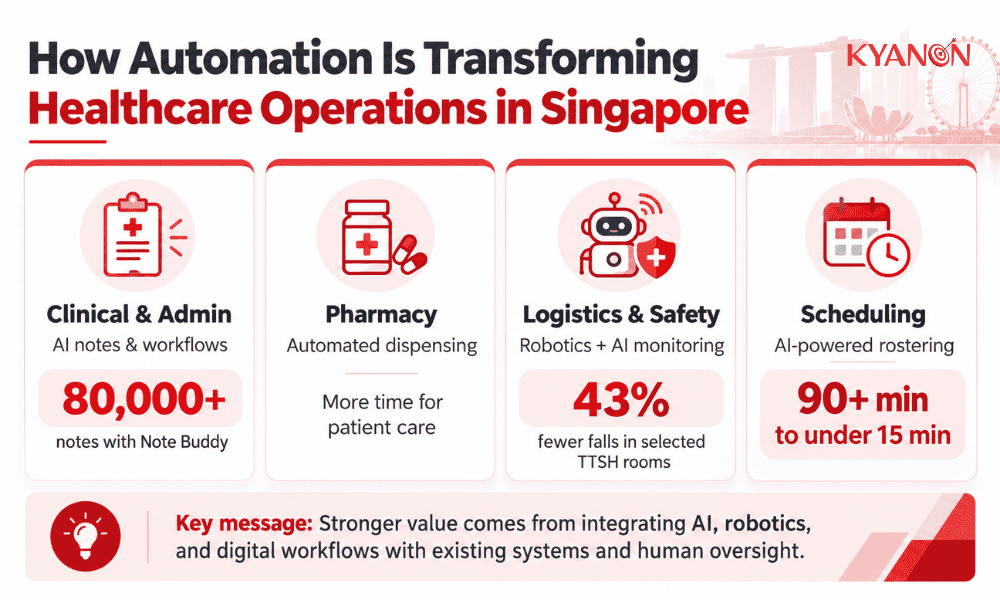
AI is already changing documentation and administrative work. In April 2026, MOH reported that SingHealth’s Note Buddy had supported healthcare workers across public healthcare institutions and clusters in generating more than 80,000 medical and administrative notes.
Healthcare automation is also evolving beyond individual tasks toward connected workflows. According to Singapore’s MOH, AI is increasingly supporting information sharing, workflow coordination, and multi-step processes across healthcare systems, while human oversight remains essential.
Kyanon Digital’s perspective is to look beyond document generation. Providers should assess how information is validated, stored, routed and used in the next workflow step.
Pharmacy and medication management automation
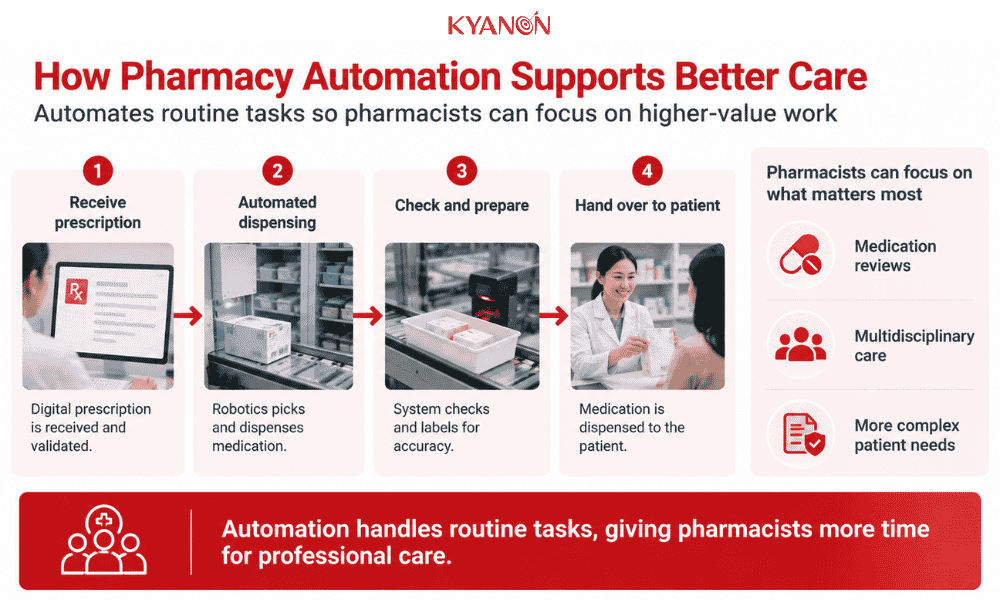
Automation can support medication handling and information processing while pharmacists retain responsibility for professional judgement and patient-facing care.
MOH noted in August 2026 that automation and digitalization are changing pharmacy work, enabling pharmacists to spend more time on medication reviews, multidisciplinary care and more complex patient needs.
The technology should therefore match the bottleneck. Physical dispensing, information flow, queue management and AI-assisted decision support solve different problems and should not automatically be treated as one automation project.
Hospital logistics, deliveries, and patient safety
Robotics and intelligent monitoring can reduce routine physical and observation tasks. In July 2026, MOH stated that appropriate use of robotics and automation can ease staff workload and improve operational efficiency, while noting that their longer-term sector-wide productivity impact still requires further study.
Tan Tock Seng Hospital uses PreSAGE, an AI-powered fall-prevention system that combines thermal sensors and predictive analytics to alert nurses before patients leave their beds. The hospital reported a 43% reduction in falls in single and isolation rooms, demonstrating how intelligent monitoring can improve patient safety while reducing nursing workload.
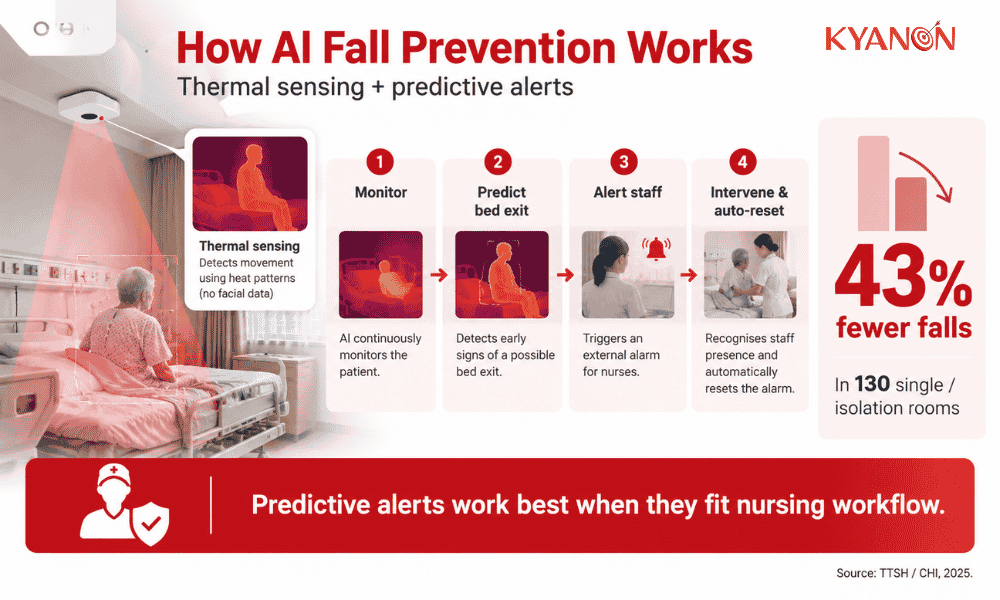
The practical implication is that a robot or monitoring system should not be evaluated in isolation. Alerts, task assignment, staff response and exception handling must fit the surrounding hospital workflow.
Workforce management and scheduling
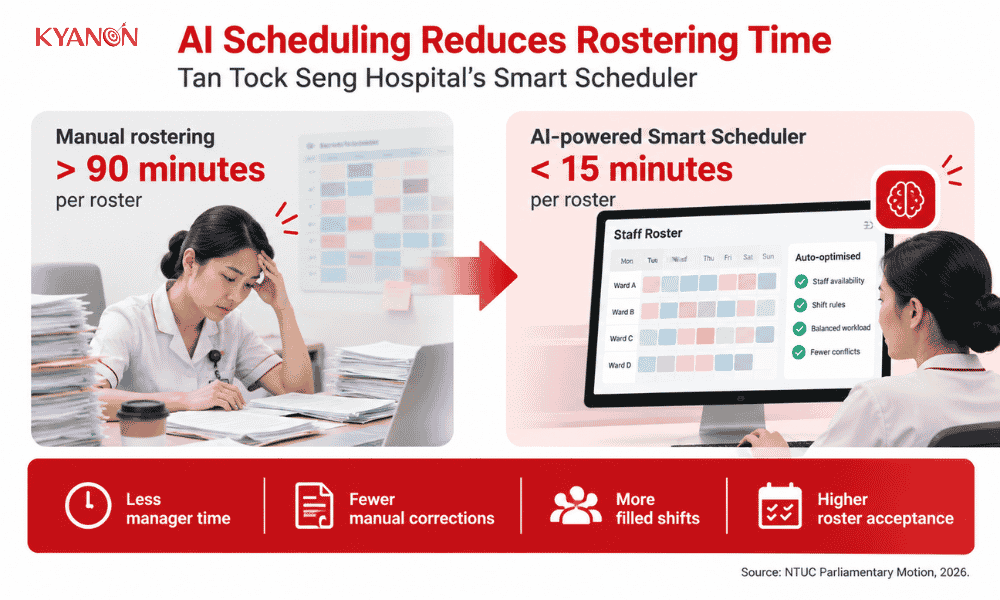
Automation is also improving workforce coordination. A 2026 NTUC parliamentary motion cited a Tan Tock Seng Hospital Smart Scheduler that reduced rostering time from more than 90 minutes to under 15 minutes. This illustrates the right way to assess impact: track manager time, manual corrections, unfilled shifts or roster acceptance rather than AI adoption alone.

What challenges must Singapore healthcare providers address before automating?
Before investing in healthcare automation, Singapore providers must assess system readiness, regulatory compliance, workforce adoption, and scalability. These factors determine whether automation improves operations or introduces new costs, risks, and manual work.
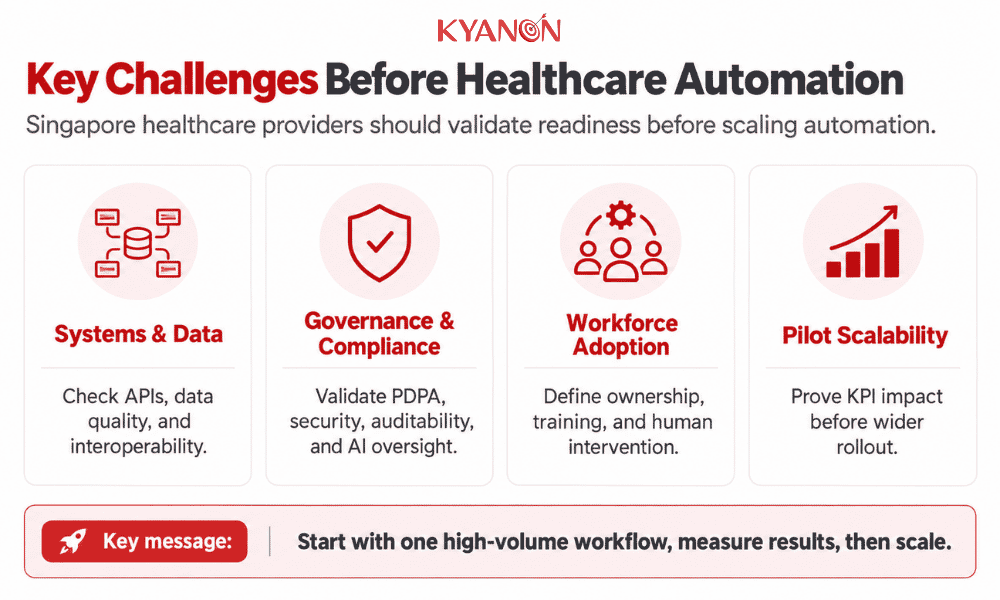
- Legacy systems and data interoperability: Fragmented HIS, EMR, billing, and administrative systems can limit automation effectiveness. Providers should assess API availability, data quality, and integration requirements before choosing between targeted integration and broader modernization. MOH’s 2026 digital transformation initiatives reinforce the importance of connected healthcare systems.
- Patient data protection and AI governance: Automation involving patient information must address applicable PDPA and Healthcare Services Act requirements, while AIHGle 2.0 provides guidance on responsible AI deployment. Providers should validate data access, security, auditability, human oversight, and applicable regulatory obligations before implementation.
- Workforce adoption and accountability: Automation must fit existing clinical and administrative workflows. Staff training, clear ownership, and human intervention procedures are essential to prevent automation bias, workflow disruption, and inconsistent adoption.
- Pilot scalability and measurable value: A successful demonstration does not guarantee operational improvement. Start with a high-volume workflow, establish baseline KPIs such as processing time, manual workload, or error rates, and validate integration reliability before expanding across departments.
Kyanon Digital recommends prioritizing workflow integration before adding complex AI capabilities. When fragmented systems and manual handoffs limit automation readiness, Kyanon Digital’s Integrate & Automate services help healthcare organizations connect legacy platforms, streamline data flows, and automate operational workflows without unnecessary system replacement.
How should healthcare providers choose an automation company in Singapore?
Healthcare providers should choose an automation company in Singapore based on healthcare workflow expertise, integration capabilities, regulatory readiness, and long-term operational support, rather than technology features or implementation costs alone.
Before selecting a partner, compare capabilities against the specific workflow being automated.
Selection criteria | What healthcare providers should verify |
Healthcare workflow expertise | Experience with clinical or administrative workflows, exception handling, and human oversight. |
| System integration | Ability to connect with existing HIS, EMR, CRM, scheduling, and legacy systems through secure APIs. |
Regulatory and AI governance | Understanding of applicable PDPA, Healthcare Services Act, AIHGle 2.0, and HSA requirements, supported by documented controls and testing. |
| AI reliability and safety | Evidence of response validation, access controls, human escalation, and clinical safety testing where applicable. |
Post-launch support | Defined responsibilities for monitoring, maintenance, knowledge updates, incident resolution, and AI performance evaluation. |
| Measurable business outcomes | Relevant project evidence and KPIs such as processing time, manual workload, error rates, and service response times. |
Choose packaged automation when workflows are standardized and existing software meets integration and governance requirements. Consider custom AI automation services when fragmented systems, complex handoffs, or organization-specific processes require tailored engineering.
Before committing to a broader rollout, request a defined pilot scope, integration architecture, acceptance criteria, and post-launch support plan. The right partner should demonstrate how automation will improve a measurable operational outcome without compromising patient safety or service continuity.
How did Kyanon Digital automate customer service for a Singapore healthcare provider?
Challenges
- Routine service inquiries consumed staff capacity.
- Knowledge was fragmented across documents, systems and teams.
- Manual routing made consistent service harder to scale.
Solution from Kyanon Digital
- Consolidated approved service knowledge and defined automation boundaries.
- Built a RAG-based non-clinical chatbot connected to existing workflows through APIs.
- Preserved human escalation for complex, sensitive or unsupported requests.
Results and impact
- 38% reduction in routine manual inquiries.
- 32% faster response times.
- 28% of eligible inquiries resolved through self-service.
- 24% reduction in repetitive agent workload.
The case demonstrates a bounded approach: automate a high-volume non-clinical workflow, integrate it with existing operations, preserve escalation and measure change against service baselines.
Conclusion
Healthcare automation in Singapore creates the most value when it improves how work moves across people, systems and physical operations. Start with a measurable bottleneck, confirm data and integration readiness, retain human accountability and expand only when operating evidence supports the next phase.
Planning an automation initiative? Book a 30-minute AI feasibility scoping session with Kyanon Digital to identify suitable workflows, integration dependencies and a practical implementation roadmap
References
- Current Healthcare Workforce Strength Compared Against Projected Service Demand — Ministry of Health Singapore, 2026.
- Speech at the 26th SGH Annual Scientific Meeting — Ministry of Health Singapore, 2026.
- Speech at the AIA Healthcare Summit 2026 — Ministry of Health Singapore, 2026.
- Data on Public Hospital Robotics Deployment, Clinical Outcomes and Long-Term Impact on Healthcare Manpower — Ministry of Health Singapore, 2026.
- Data Security Requirements Apply to AI Tools That Process Patient Data — Ministry of Health Singapore, 2026.
- Emerging Regulatory Policy Issues: Artificial Intelligence — Ministry of Health Singapore, 2026.
- Scaling Customer Service with an AI Chatbot for Healthcare — Kyanon Digital.


 Create project brief with AI