

What is digital commerce in healthcare? It is the integration of modern retail transaction systems, such as online appointment booking, secure payment gateways, and automated prescription subscriptions, into the patient journey. By adopting digital commerce platforms, Singapore medical providers can eliminate front-desk queues, offer price transparency, and ensure seamless post-discharge care while remaining fully compliant with MOH and PDPA regulations.
Today’s healthcare consumers benchmark your clinic’s service against the frictionless transactions they experience on leading e-commerce and banking apps. Long waiting room queues, opaque pricing, and manual prescription collection loops are the leading causes of a poor healthcare Customer Experience (CX). Addressing this requires embedding retail convenience directly into the clinical journey.
Key takeaways
- Frictionless payments remove front-desk queues and prevent billing shock by enabling upfront digital checkout and transparent package pricing.
- Automated continuity leverages subscription models and curated e-shops to deliver chronic care medications and connected medical devices directly to patients.
- Strategic integration of modern digital commerce platforms into existing Electronic Medical Records (EMR) is generally more viable for healthcare providers than building proprietary e-commerce engines from scratch.
- Regulatory compliance under Singapore’s PDPA and HCSA requires strict architectural compartmentalization to separate retail data from sensitive clinical records.
Further reading:
- How To Implement AI in Singapore Healthcare?
- How Can AI Ecommerce Automation Help Singapore Healthcare?
- AI Agents for Singapore Healthcare: Build or Buy?
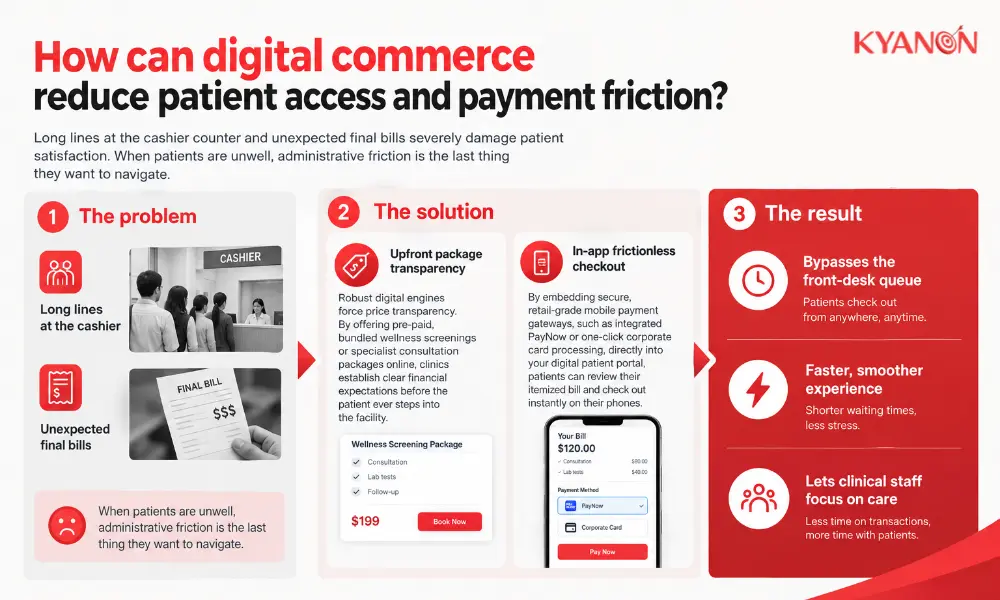
How can digital commerce reduce patient access and payment friction?
Long lines at the cashier counter and unexpected final bills severely damage patient satisfaction. When patients are unwell, administrative friction is the last thing they want to navigate.
- Upfront package transparency: Robust digital engines force price transparency. By offering pre-paid, bundled wellness screenings or specialist consultation packages online, clinics establish clear financial expectations before the patient ever steps into the facility.
- In-app frictionless checkout: By embedding secure, retail-grade mobile payment gateways, such as integrated PayNow or one-click corporate card processing, directly into your digital patient portal, patients can review their itemized bill and check out instantly on their phones.
This approach completely bypasses the front-desk queue. The result is a highly professional, fast checkout experience that slashes patient waiting times and allows front-line clinical staff to focus on patient care rather than processing transactions.

Should healthcare providers build or integrate digital commerce platforms?
When upgrading healthcare IT infrastructure to support digital e-commerce capabilities, technical leaders face a critical decision: build a custom transactional engine from scratch or integrate existing enterprise commerce platforms with their core systems.
Here is how the two approaches compare for medical enterprises:
Decision factor | Build a custom commerce engine | Integrate an existing commerce platform |
Implementation timeline | Depends on the scope of custom development, integrations and validation. | May reduce the need to develop core commerce capabilities from scratch; timing depends on integration complexity and readiness. |
| Upfront investment | Can require substantial engineering effort to build and maintain core functionality. | Includes platform licensing where applicable, implementation, integration and ongoing operating costs. |
Security and PCI DSS | The organisation must manage applicable security controls for its custom environment. | A suitable payment provider may reduce PCI DSS scope, but the organisation retains applicable responsibilities for third-party oversight and its own environment. |
Workflow flexibility | Greater control over bespoke business logic and specialised workflows. | Flexible customer experiences are possible, but customisation depends on platform capabilities and integration design. |
| Scalability and maintenance | The organisation or its delivery partner is responsible for the architecture and ongoing maintenance arrangements. | Responsibilities depend on the hosting model, platform service and implementation partner. |
Best suited for | Organisations with highly specialised requirements that justify greater control over the technology. | Organisations seeking to reuse established commerce capabilities and integrate them with existing systems. |
For most Singapore healthcare providers, integrating a headless commerce platform provides the best balance of speed, security, and specialized healthcare customization.
Looking to modernize your clinic’s digital infrastructure? Explore Kyanon Digital’s Digital Commerce Services to see how we build secure, high-conversion patient portals tailored for the healthcare sector.
How should healthcare leaders measure digital commerce ROI?
Transitioning to a digital retail model requires clear metrics to justify the initial technical investment. Industry research highlights the opportunity: J.P. Morgan’s 2025 Trends in Healthcare Payments Report found that 71% of providers reported taking more than 30 days to collect payments after a patient encounter. Meanwhile, Epic Research found that patients with active portal accounts had a 6.2% appointment no-show rate, compared with 7.9% among those without one. These findings illustrate potential areas for improvement, but actual returns depend on each organisation’s workflows, technology and patient population.
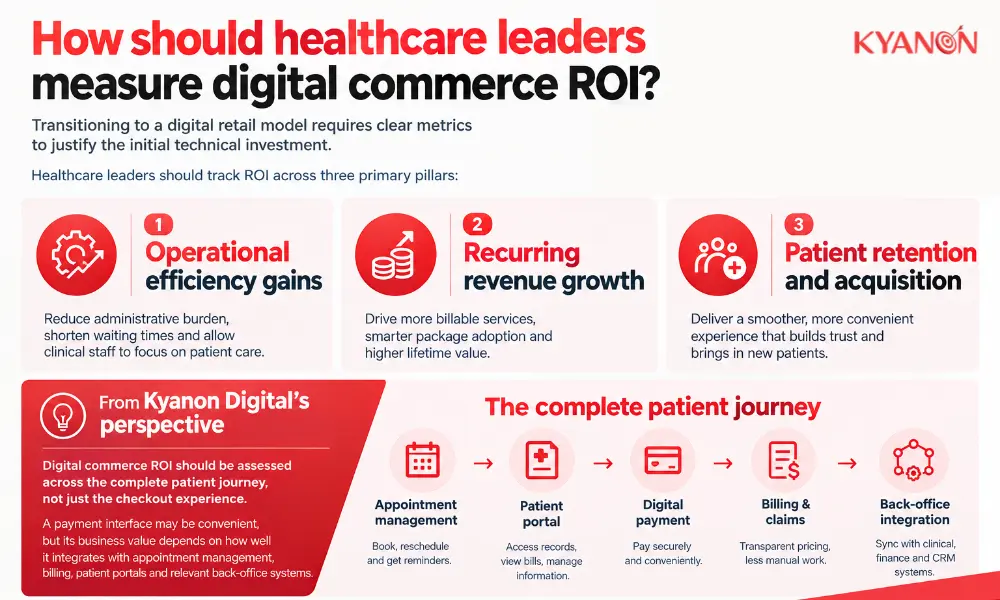
Healthcare leaders should track ROI across three primary pillars:
- Operational efficiency gains: Measure the reduction in average patient wait times and the decrease in front-desk administrative hours spent on billing and appointment scheduling.
- Recurring revenue growth: Track the adoption rate of automated prescription subscriptions and the Customer Lifetime Value (CLV) of patients enrolled in chronic care delivery programs.
- Patient retention and acquisition: Monitor patient portal engagement rates, the drop-off rate in post-discharge follow-ups, and Net Promoter Scores (NPS) before and after the implementation of frictionless mobile checkout.
From Kyanon Digital’s perspective, digital commerce ROI should be assessed across the complete patient journey, not just the checkout experience. A payment interface may be convenient, but its business value depends on how well it integrates with appointment management, billing, patient portals and relevant back-office systems.
How can healthcare providers address security and regulatory risks?
Business leaders are often paralyzed by the fear of regulatory backlash, such as a potential S$1M PDPA penalty for medical data leaks, or violating the Healthcare Services Act (HCSA) which strictly restricts aggressive retail marketing of clinical services.
Compliance is achieved through strict architectural compartmentalization. Providers must architect the customer-facing commerce frontend (handling credit cards, delivery addresses, and basic accounts) to operate completely independently of sensitive Electronic Medical Records (EMR). Furthermore, implementing “Access-First Care” workflows, where buying an advanced diagnostic package triggers a clinical triage review rather than a standard open retail cart, ensures providers adhere to MOH regulations against commoditizing medical treatments.
How Kyanon Digital can support healthcare digital transformation
Transforming legacy healthcare IT requires specialized architectural oversight to balance modern retail experiences with strict clinical compliance. Kyanon Digital partners with enterprise healthcare providers to architect, integrate, and deploy headless commerce solutions that safely modernize the patient journey.
We design compliant “Access-First Care Portals” with total data compartmentalization, ensuring that your patient-facing e-commerce operations (payments and fulfillment) are completely air-gapped from your core clinical EMR data. This protects your enterprise against data breaches while unlocking high-margin digital revenue streams.
Case study: Scaling customer service for a Singapore healthcare provider
The Problem
A private healthcare provider in Singapore faced a growing volume of digital inquiries. Routine questions about appointments, operating hours, administrative procedures, and facility locations were consuming significant staff capacity, increasing the cost-to-serve and risking proportional headcount increases.
The Solution
Kyanon Digital architected a governed AI customer-service layer using Azure OpenAI and Retrieval-Augmented Generation (RAG). We built a conversational chatbot designed strictly for non-clinical inquiries, automating routine administrative support. Crucially, we implemented strict routing rules so that any complex, medical, or sensitive requests were immediately escalated to the appropriate human teams.
The Outcome
The digital transformation delivered immediate operational ROI while maintaining total clinical safety:
- 38% reduction in routine manual inquiries.
- 32% faster response times for patients.
- 28% of eligible inquiries resolved completely through self-service.
- 24% reduction in repetitive agent workload, allowing staff to focus on complex patient care.
Explore the full case study here: Scaling Customer Service with an AI Chatbot for Healthcare
Conclusion
Transforming your patient experience shouldn’t mean taking on unnecessary regulatory or operational risks. Upgrading to modern digital commerce infrastructure allows you to eliminate administrative friction, improve patient outcomes, and secure new revenue streams safely. Contact Kyanon Digital to map out your digital expansion.





 Create project brief with AI