

Digital transformation in manufacturing is increasingly driven by agentic AI, smart robotics, industrial IoT, digital twins, predictive maintenance, and connected operations. These technologies help manufacturers address production inefficiencies, equipment downtime, labor constraints, and supply chain disruptions. However, business value depends on choosing the right applications, integrating existing systems, and measuring operational improvements.
For manufacturers, the challenge is no longer simply adopting new technologies. It is determining which digital investments can improve production efficiency, reduce operational costs, and scale across facilities without disrupting critical operations.
At Kyanon Digital, we see manufacturing transformation as a shift from isolated technology adoption toward connected, data-driven operations. Through enterprise integration, data analytics, AI applications, and intelligent automation, we help organizations connect technology investments with measurable business objectives. This article explores the ten manufacturing digital transformation trends shaping the industry, their practical business applications, and how manufacturing leaders can prioritize investments based on operational needs.
Key takeaways
- AI and intelligent automation are expanding from isolated tasks into connected production planning, maintenance, and operational decision-making.
- Connected manufacturing systems are becoming essential for improving visibility across equipment, production lines, ERP, MES, and supply chain operations.
- Prioritize business outcomes: Manufacturers should select technologies based on operational bottlenecks, data readiness, implementation feasibility, and measurable KPIs.
- Kyanon Digital supports manufacturing transformation through enterprise system integration, data analytics, AI applications, and workflow automation, helping businesses build more connected and scalable digital operations
Further reading:
- How Can AI-Enabled Workflows Help Singapore Manufacturers?
- Modern Data Platform for Manufacturing: Design It Around Decisions, Not Tables
- What Is the True Cost of AI in Manufacturing in Singapore?
- Top 10 Digital Transformation Challenges In Manufacturing
- Digital Transformation Roadmap: From Zero to Hero Business
What are the top 10 digital transformation trends in manufacturing?
The most important manufacturing digital transformation trends address recurring operational challenges, from costly equipment downtime and inconsistent product quality to disconnected production data and increasingly complex supply chains.
For business leaders, understanding each technology is only the first step. The more important question is where it creates measurable value, when it should be prioritized, and what needs to be in place before investment.
Agentic AI and autonomous manufacturing systems
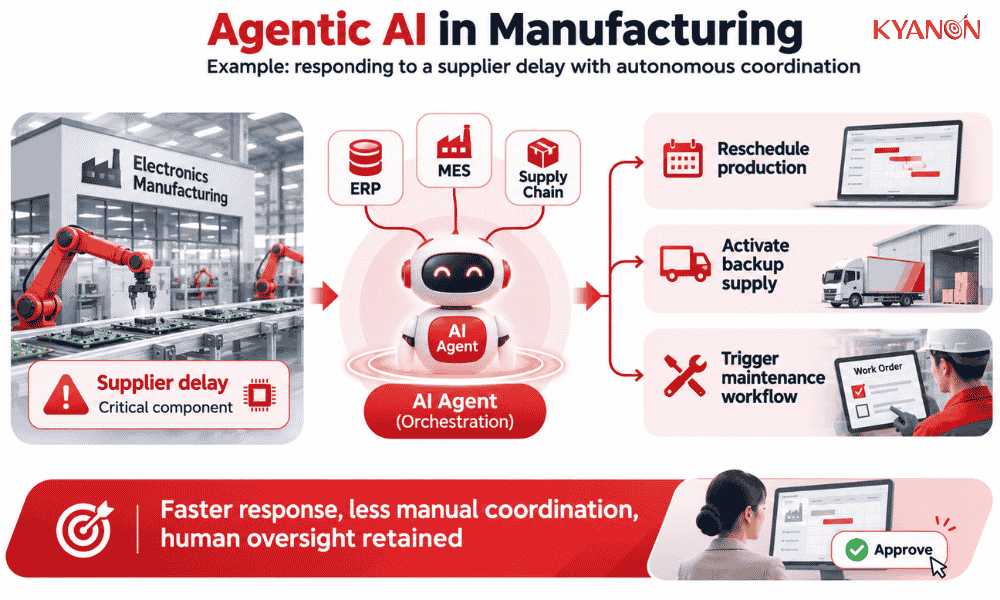
Agentic AI is moving manufacturing beyond passive monitoring toward autonomous, goal-driven operations. AI agents can coordinate production scheduling, respond to supply disruptions, and trigger maintenance workflows across connected ERP, MES, and supply chain systems.
For manufacturers struggling with manual coordination and delayed decisions, this creates opportunities to improve operational responsiveness while maintaining human oversight.
Physical AI and smart robotics
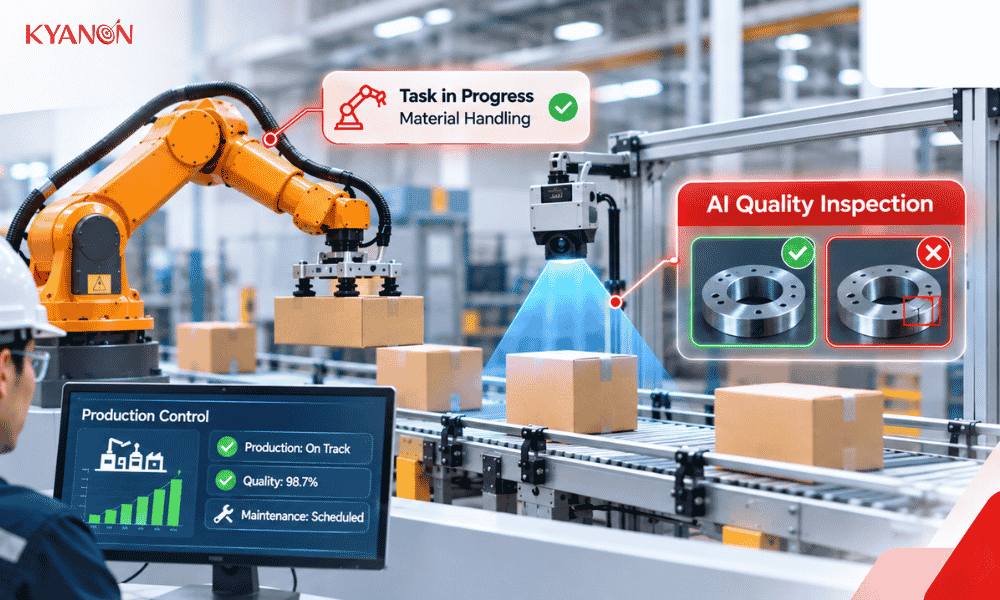
Physical AI combines robotics, computer vision, and machine learning to enable more adaptive and intelligent production processes. Smart robots can inspect product defects, adjust assembly operations, and automate repetitive material handling tasks.
These capabilities are particularly valuable for manufacturers facing labor shortages, inconsistent product quality, and increasing production demands, provided equipment compatibility and safety are validated.
Enterprise digital twins
Digital twins allow manufacturers to simulate production scenarios before making costly physical changes. By combining real-time equipment data with virtual models, manufacturers can identify bottlenecks, evaluate production capacity, and test operational adjustments.
Kyanon Digital’s relevant data engineering expertise is demonstrated by its Data Hub & BI Analytics project for a major Vietnamese port and logistics operator. The solution delivered faster, more stable data integration, reduced manual reporting and errors, and real-time operational visibility. While not a digital twin implementation, it demonstrates KD’s ability to build the connected data infrastructure such solutions require.
Industrial IoT and edge computing
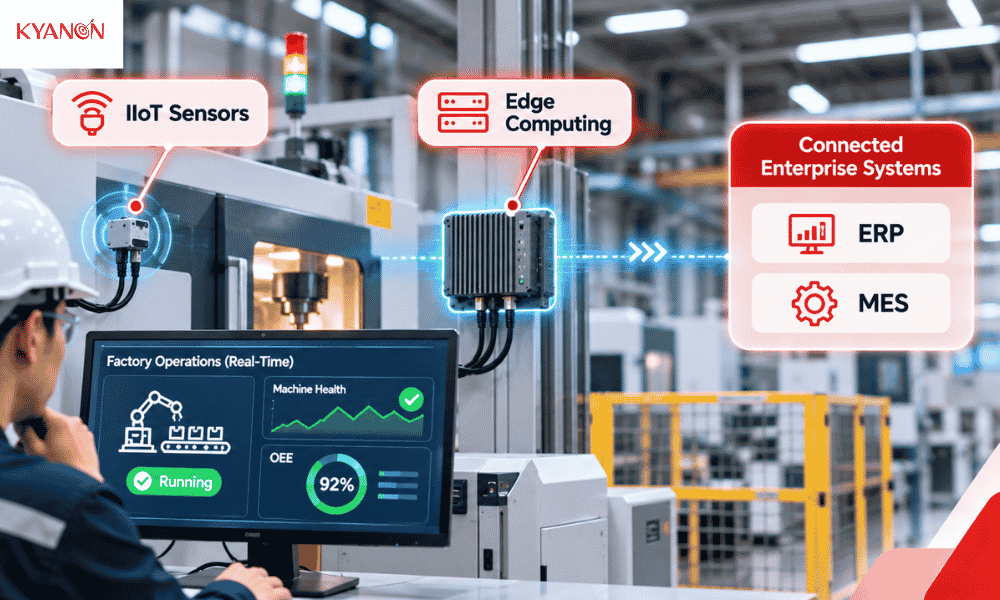
Industrial IoT (IIoT) and edge computing enable real-time visibility and faster responses across connected factory operations. Sensors collect equipment and production data, while edge devices process time-sensitive information locally. Manufacturers can use these insights to detect abnormalities, track machine performance, and reduce reporting delays.
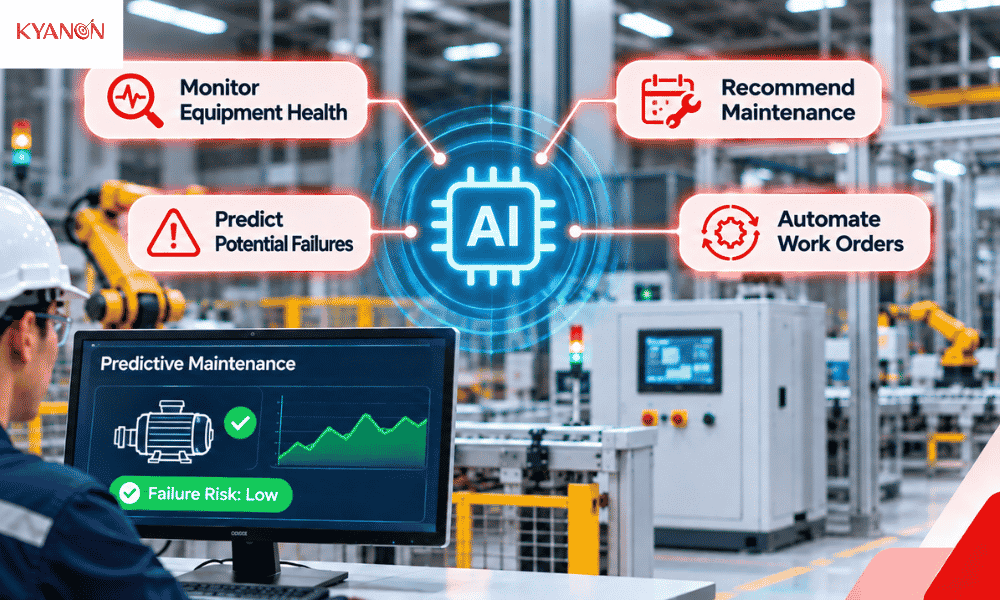
Predictive and prescriptive maintenance
Predictive and prescriptive maintenance are shifting manufacturers from reactive repairs toward data-driven equipment reliability management. AI models analyze machine conditions to detect potential failures, while prescriptive analytics recommends maintenance actions.
This is particularly relevant for equipment-intensive manufacturers where unexpected breakdowns disrupt production. Kyanon Digital’s AI, data analytics, and integration capabilities can support predictive insights connected to maintenance workflows.
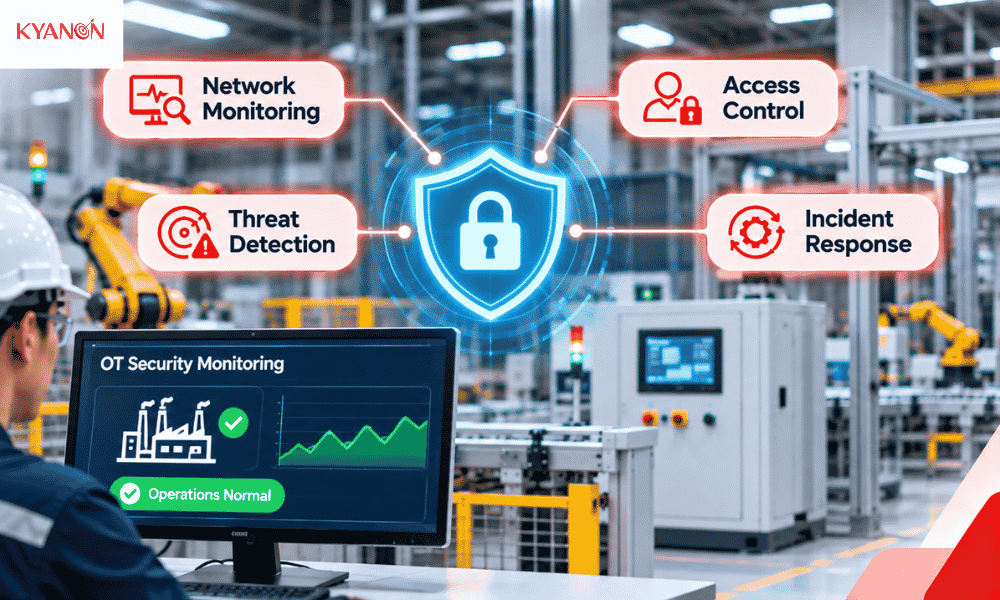
OT cybersecurity and preemptive defense
As factories connect industrial equipment with enterprise IT and cloud systems, operational technology (OT) cybersecurity becomes essential for production continuity. Manufacturers are strengthening industrial network monitoring, access controls, threat detection, and incident response to reduce cyber exposure.
These measures are especially important for organizations modernizing legacy equipment or expanding remote connectivity, where security must be balanced with equipment reliability and safety.
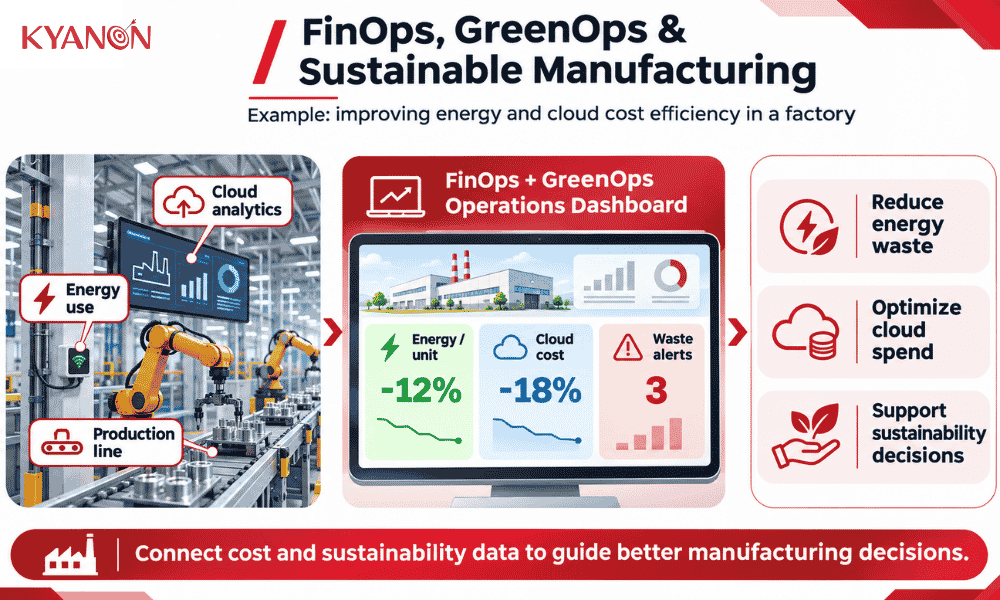
FinOps, GreenOps, and sustainable manufacturing
Rising energy and infrastructure costs are pushing manufacturers toward data-driven resource efficiency and sustainable operations. Connected analytics can help businesses monitor energy consumption per production unit, identify resource waste, and manage cloud expenditure. Kyanon Digital’s data engineering and BI capabilities can support integrated operational reporting, helping manufacturers make more informed decisions about cost efficiency and sustainability investments.
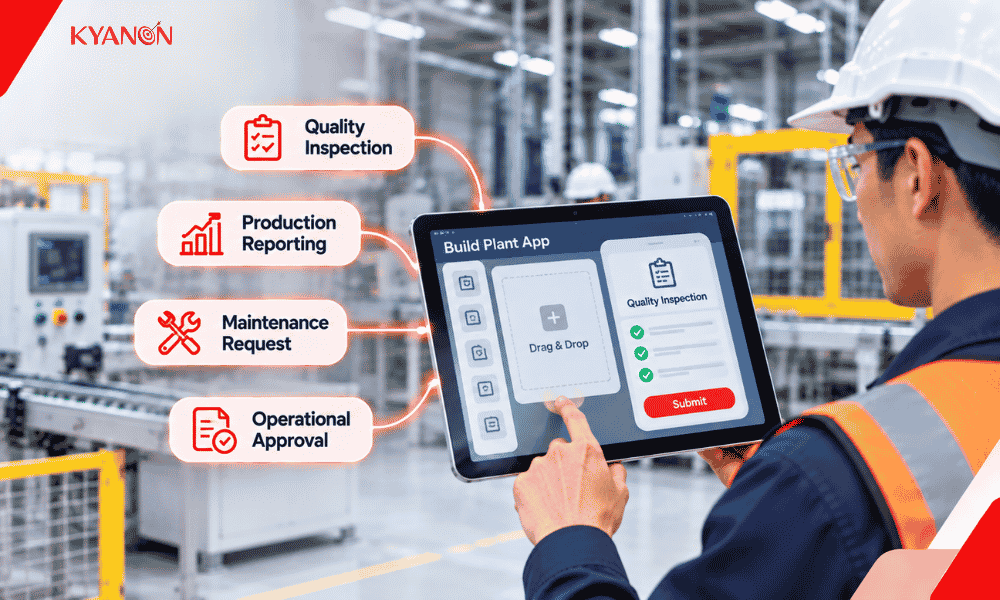
Low-code and no-code plant applications
Low-code and no-code platforms are accelerating the digitization of everyday manufacturing workflows without requiring extensive custom development. Plant teams can build applications for quality inspections, production reporting, maintenance requests, and operational approvals.
These tools are particularly useful for manufacturers relying on spreadsheets or paper-based processes, although enterprise integration, security, and application governance remain essential for long-term scalability.
Immersive AR/VR training and maintenance
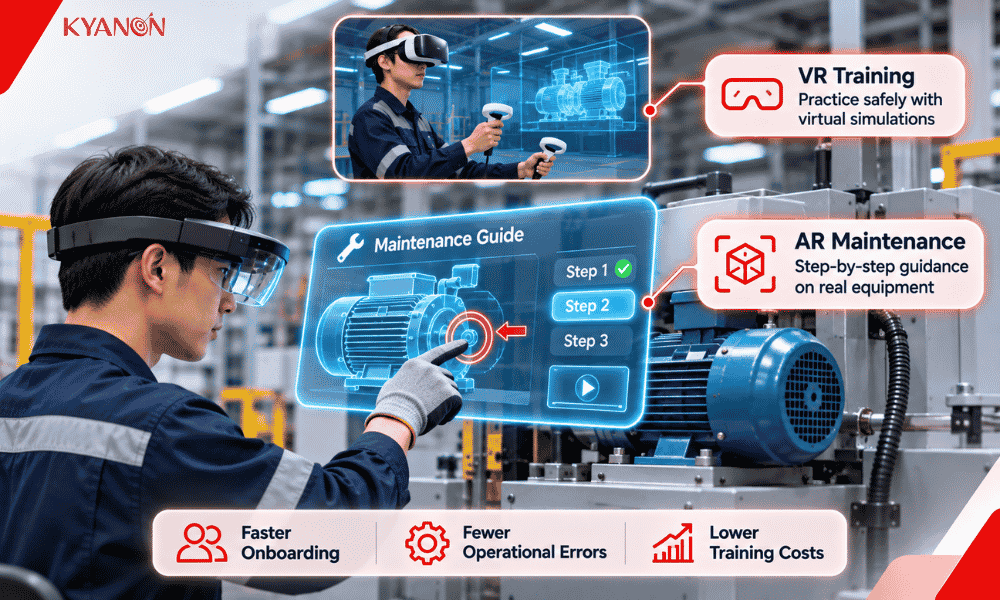
Augmented reality (AR) and virtual reality (VR) are changing how manufacturers train employees, maintain equipment, and transfer technical knowledge. Virtual simulations allow operators to practice complex procedures, while AR-assisted instructions support technicians during maintenance.
These technologies can be valuable for manufacturers managing specialized machinery, workforce turnover, or costly training processes, where improved onboarding and fewer operational errors are priorities.
Digital provenance and supply chain traceability
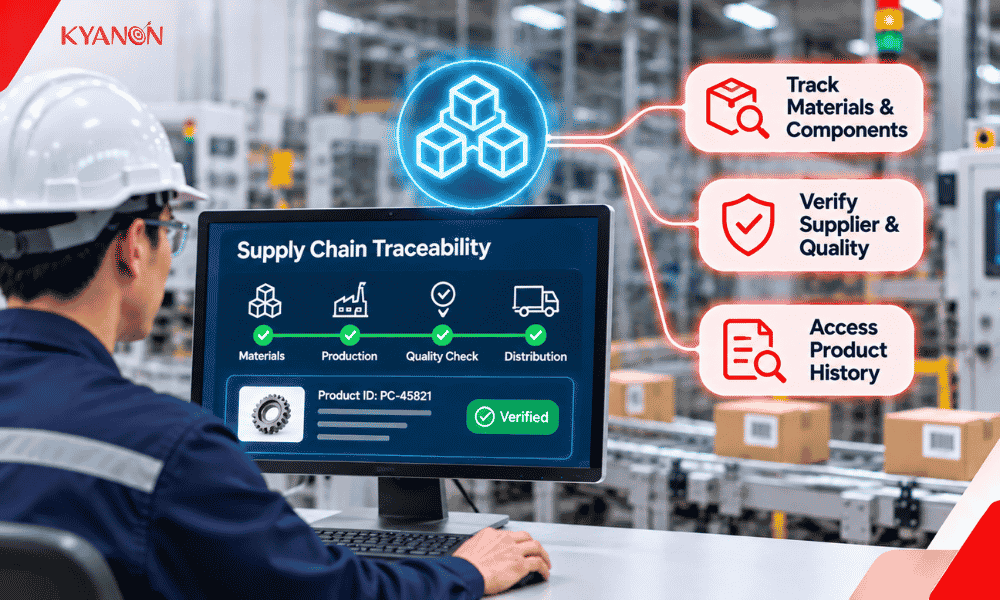
Digital provenance helps manufacturers track and verify materials, components, and production records across complex supply chains. Traceability systems can support faster quality investigations, supplier verification, and more reliable product histories, with blockchain useful only where shared, tamper-evident records are necessary.
Kyanon Digital’s enterprise integration capabilities can help connect ERP, inventory, and supply chain applications to improve traceability data flows.

Which manufacturing digital transformation trends should businesses prioritize?
Manufacturers should prioritize digital transformation initiatives based on their most pressing operational constraints rather than technology popularity. The table below connects common manufacturing challenges with suitable technologies and measurable performance indicators.
|
Business challenge |
Technology to prioritize |
KPI to evaluate |
|
Frequent equipment failures |
Predictive maintenance, IIoT | Unplanned downtime, MTBF |
| High defect rates and rework | Computer vision, smart robotics |
First-pass yield, defect rate |
|
Disconnected ERP, MES, and production data |
Enterprise integration, industrial data platforms | Data latency, manual reconciliation |
| Production scheduling inefficiencies | Agentic AI, advanced analytics |
Schedule adherence, lead time |
|
Limited production visibility |
Digital twins, connected analytics | OEE, throughput |
| High energy consumption | Energy monitoring, sustainable operations |
Energy consumed per unit |
|
Slow operator training |
AR/VR, digital work instructions | Time to competency, error rate |
| Poor material traceability | Digital provenance, traceability systems |
Traceability completeness, recall response time |
Kyanon Digital’s implementation perspective: Before introducing advanced AI or automation, manufacturers should validate whether their underlying operational data and systems can reliably support the intended workflow.
For example, if production planners spend hours reconciling data across ERP, MES, and spreadsheets, introducing an autonomous AI agent may add complexity without resolving the underlying integration problem.
In this situation, improving system interoperability is often a more defensible first investment. Kyanon Digital’s Integrate & Automate services support the development of connected enterprise workflows, providing a foundation for more advanced analytics and intelligent automation.
How can manufacturers move from digital transformation pilots to scalable operations?
Scaling manufacturing digital transformation requires more than proving that a technology works on one production line. Organizations must establish the data, integration, security, and operating structures needed to replicate successful initiatives across facilities.
The World Economic Forum’s Global Lighthouse Network highlights practical examples of manufacturers applying advanced technologies to operational transformation.
To move beyond isolated pilots, manufacturers should evaluate four requirements:
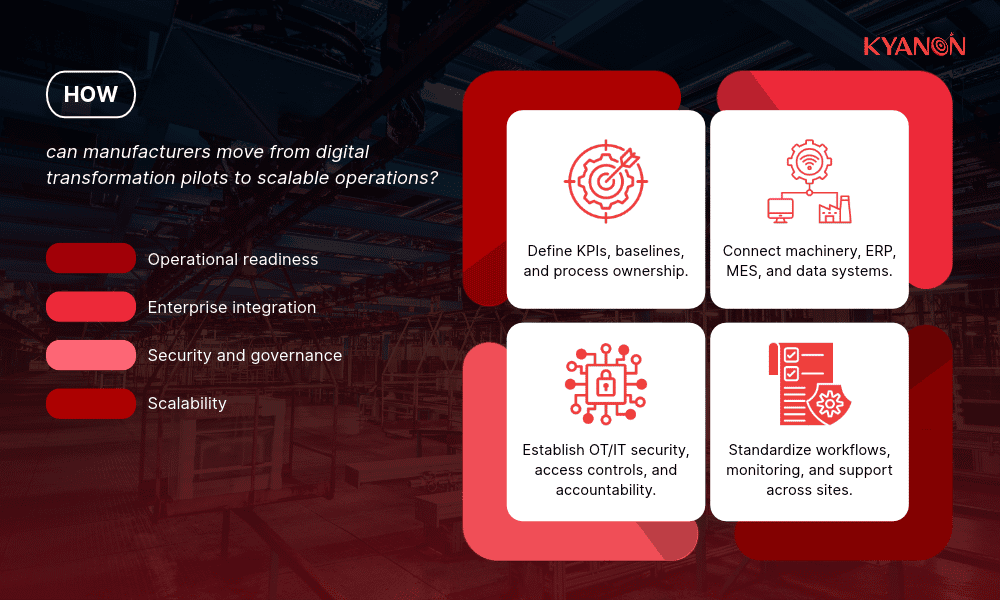
- Operational readiness: Establish production baselines, process ownership, and measurable improvement targets.
- Enterprise integration: Validate connections between machinery, ERP, MES, maintenance systems, and data platforms.
- Security and governance: Define OT/IT boundaries, access controls, approval requirements, and ongoing operational responsibilities.
- Scalability: Build reusable integration patterns, monitoring, documentation, and support processes before expanding across sites.
A practical approach is to validate one end-to-end workflow before extending automation across the enterprise.
For example, predictive maintenance should not be evaluated solely by model accuracy. Its operational value depends on whether maintenance teams can act on alerts, schedule appropriate interventions, and reduce equipment downtime.
Why choose Kyanon Digital for manufacturing digital transformation?
Kyanon Digital is an enterprise digital transformation and AI partner supporting businesses with software engineering, enterprise integration, data analytics, intelligent automation, and application modernization.
With experience supporting enterprise-scale digital initiatives across APAC, Kyanon Digital focuses on connecting existing technology environments with operational requirements rather than introducing disconnected digital solutions.
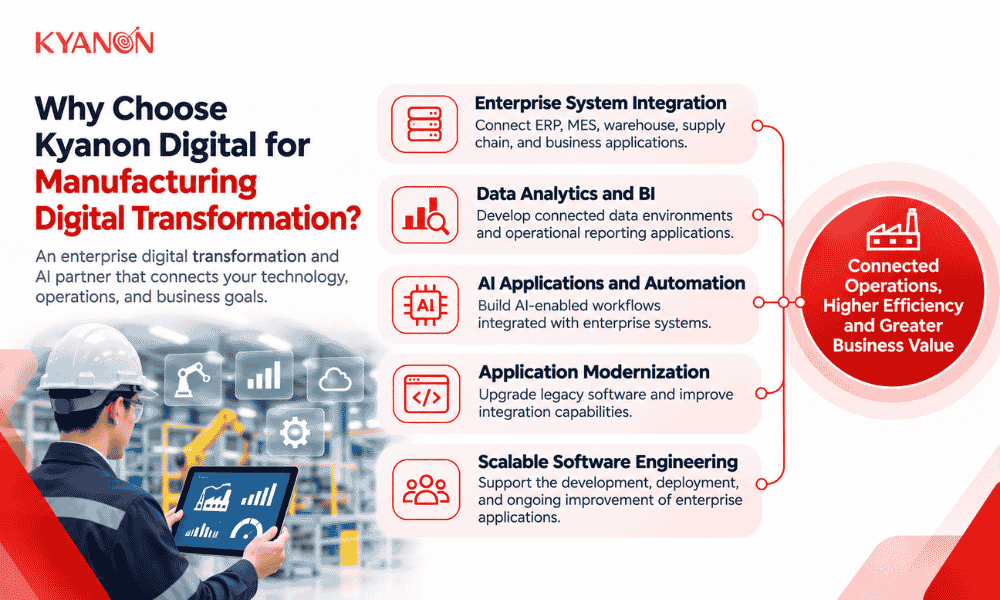
Its relevant capabilities include:
- Enterprise system integration: Connecting ERP, MES, warehouse, supply chain, and business applications where supported by available interfaces.
- Data analytics and BI: Developing connected data environments and operational reporting applications.
- AI applications and automation: Building AI-enabled workflows integrated with enterprise systems.
- Application modernization: Upgrading legacy software and improving integration capabilities while managing operational dependencies.
- Scalable software engineering: Supporting the development, deployment, and ongoing improvement of enterprise applications.
Through its End-to-End Digital Transformation services, Kyanon Digital can help manufacturers assess technical dependencies, prioritize transformation opportunities, and develop implementation approaches aligned with operational goals.
Manufacturers should validate relevant industry references, technical scope, and OT-specific requirements before selecting an implementation partner.
How Kyanon Digital improved data visibility for a major logistics enterprise
A major Vietnamese port and logistics operator partnered with Kyanon Digital to modernize fragmented data systems and improve operational visibility across its nationwide network.
Kyanon Digital designed and delivered a comprehensive enterprise solution built around three pillars: a scalable Data Hub, a centralized data catalog, and an AI-powered BI reporting system, all working together to power smarter, faster operations.
Challenges
- Disconnected operational systems and inconsistent data.
- Manual reporting that delayed business decisions.
- Limited centralized visibility into operations, finance, and workforce performance.
Solution from Kyanon Digital
- Enterprise Data Hub: Integrated operational data for real-time sharing across systems.
- Centralized Data Catalog: Standardized data and strengthened governance.
- AI-Powered BI Analytics: Implemented Power BI dashboards and AI-driven insights for operational reporting.
Results and impact
- Faster, more reliable data integration across departments.
- Reduced manual reporting workload and reporting errors.
- Improved real-time visibility and management decision-making.
Relevance to manufacturing: Although this project focused on logistics, it demonstrates how connecting fragmented enterprise data can establish the foundation for scalable analytics and AI-enabled operations, an important prerequisite for manufacturers modernizing ERP, MES, and supply chain workflows.
Explore Kyanon Digital’s Data Hub & BI Analytics full case study.
Conclusion
The most valuable manufacturing digital transformation trends are those that solve persistent operational problems, rather than introduce technology for its own sake.
Whether the priority is reducing equipment downtime, improving production visibility, strengthening supply chain resilience, or deploying AI-enabled workflows, sustainable progress depends on reliable data, connected systems, and measurable outcomes.
Manufacturers should begin with one high-impact operational challenge, evaluate their existing technology environment, and establish the business metrics needed to justify further investment.
For businesses planning connected operations, enterprise integration, or AI-enabled manufacturing initiatives, discuss your digital transformation roadmap with Kyanon Digital to explore integration requirements, technology priorities, and a practical delivery approach.
References
- Top Strategic Technology Trends for 2026 — Gartner, 2026.
- Global Lighthouse Network — World Economic Forum.
- New Global Lighthouse Sites Demonstrate How AI Is Rewiring Manufacturing and Supply Chains — World Economic Forum, 2026.
- Integrate & Automate — Kyanon Digital.
- End-to-End Digital Transformation — Kyanon Digital.







 Create project brief with AI